- 37 pages
- English
- ePUB (mobile friendly)
- Available on iOS & Android
eBook - ePub
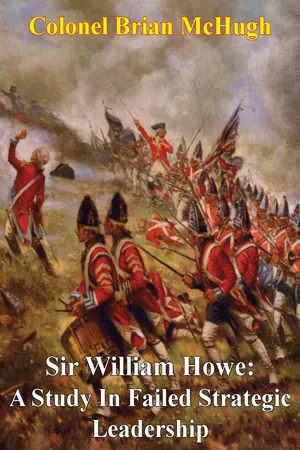
Sir William Howe: A Study In Failed Strategic Leadership
About this book
This paper examines the strategic leadership competencies of British General William Howe during the American Revolution (1775-1778). During the American War of Independence, General Howe displayed periodic tactical brilliance and operational competence but consistent strategic ineptitude. After arriving in America, Howe was quickly thrust into the position of Commander-in-Chief of British Forces and General of North America. Howe's lack of self-awareness, ineptness in managing the personalities of his subordinate commanders, personal biases, and lack of political savvy resulted in the strategic failure of the British war effort. Howe's difficulty in transitioning from tactical, through operational to the strategic level provides a useful example as to the dramatically different challenges faced by current leaders as they prepare for and address similar challenges in our contemporary operational and strategic environment.
Information
Subtopic
19th Century HistoryIndex
HistorySTRATEGIC LEADERSHIP COMPETENCIES
An explanation on the strategic leadership competencies must first include a definition of the concept of strategic leadership. Although there are numerous definitions available, most reflect certain common competencies including: an ability to assess and understand the external environment and alignment of the organization’s vision to the environment, a need for building consensus across a myriad of stakeholders to secure resources and political support as well as facilitate decisions, and a requirement to manage change and formulate strategy that aligns ends, ways, and means in achieving a vision.{2}
Strategic leaders are constantly operating in an environment marked by volatility, uncertainty, complexity, and ambiguity (VUCA). To function in this environment they must be “an expert, not only in their own domain of war fighting and leading large military organizations, but also in the bureaucratic and political environment of the nation’s decision making process.”{3} A strategic leader also has the responsibility of acting as the steward for his/her organization ensuring that professional ethics are at the forefront of all activities and setting the tone for acceptable actions within the organization. Successful strategic leaders must recognize that any perceived chink in their proverbial moral armor or tear in their cloth of selfless rather than selfish service can negatively impact the entire organization from within as well as from the outside. Finally, strategic leaders should possess a keen sense of self. This self-awareness allows them to identify and take action to mitigate personal propensities, flaws, and biases in order to make objective decisions.
In order to meet the challenges of leading at the strategic level, senior leaders must embody certain competencies to achieve results. A principle frequently articulated at the senior leader level is “That which got you here is not going to get you there.” In short, being a good tactical leader does not translate into success at the strategic level. In studying strategic leadership it is clear that there are competencies that a leader must gain and refine to achieve success at the strategic level that are different than those required at the tactical or even operational levels. Current strategic leadership doctrine explains that although many of the competencies required in a strategic leader are the same as those required from a leader at any level, some are vastly different. For example, like tactical leaders, strategic leaders must care for their subordinates but they must also be capable of envisioning long range requirements and possess integrative thinking skills.{4} Related strategic leadership competencies can be categorized into three groups: conceptual (thinking skills needed to operate in a complex and ambiguous environment), technical (knowledge of external and internal political, economic and cultural systems that influence the organization), and interpersonal (consensus building and effective communication within and external to the organization).{5}
Conceptual Competencies:
Comprehensive conceptual competencies are particularly important at the strategic level in an environment of extreme complexity where clear solutions rarely exist and almost all alternatives have associated negative consequences. Operating in this type of complexity, strategic leaders must possess the mental acumen to determine underlying threads that connect issues and ascertain second and third order effects of their actions. In addition, strategic leaders must ensure long term gains are not sacrificed to short term success{6} or that if they (long term gains) are sacrificed it is indeed a conscious decision.
Conceptual competencies include frame of reference development, problem management, and envisioning the future. Frame of reference development is a lens through which the leader views the world based on education, experiences, and self-development. For a leader to develop an effective frame of reference the leader must continuously adapt that frame and be open new ideas and feedback from others, learn from past experiences, and be comfortable with abstract concepts.{7} Problem management involves: applying past experiences, identifying patterns, discarding irrelevant data, considering second and third order effects, maintaining flexibility and working interactively rather than individually to achieve an outcome that is most beneficial for the system as a whole.{8} Finally, envisioning the future is the leader’s ability to formulate and convey strategic aims and the development of strategic plans for mid-term and long-term programs facilitating the achievement of the aims. In this context the leader must understand the interaction of ends, ways, and means in formulating the strategy. An effective strategic leader envisions the future, sets goals that account for contingencies, and adapts the organization to changing environments.{9}
Technical Competencies
At the strategic level, technical competencies require a comprehensive “understanding of organizational systems, an appreciation of functional relationships outside the organization, and knowledge of the broader political and social system within which the organization operates.”{10} Included in the technical competencies are: systems understanding, Joint, Interagency, Intergovernmental, Multinational (JIIM) relationships, and political and social competence. Systems understanding is a comprehension of how the organization fits within the nation and in relation to the nation’s dealings with the international community. At the strategic level, a leader assumes various roles affecting numerous supporting and coordinating relationships. It is imperative that the leader not only understands these roles but also the associated duties and boundaries within each role. JIIM implies that strategic leaders must understand the different cultures, language and operating procedures of the various agencies, nations, and services with whom they operate in order to maximize potential. Political and social competence are those skills that allow a strategic leader to effectively interact with the political powers in the development of policy, preparing strategy, and the securing of resources for support of the strategy.{11}
Interpersonal Competencies
This third group of competencies consists of the leader’s ability to interact both internal to the organization and externally across the diverse spectrum of people, organizations, and agencies that either are a part of or influence the organization. Key to interpersonal relations at the strategic level is the requirement that strategic leaders must influence and rely on the support of stakeholders outside their organization where there is no clear hierarchy of superior to subordinate role established.{12} The interpersonal competencies include: consensus building, negotiation, and communication. Consensus building is about developing a strategy that subsumes the key interests of the stakeholders. Building consensus, ensures all key organizations and personalities agree with the major aspects of the decision thus establishing credibility and common identity with the stakeholders. Consensus fosters improved relationships which help strategic leaders accomplish their objectives in a collaborative process. Negotiation is the ability to “communicate a clear position while still conveying willingness to compromise.”{13} The last of the interpersonal competencies is communication. Communication entails the ability to convey a clear, persuasive message internal to the organization and externally to others. Effective communication sets the conditions for successful consensus building and negotiations.{14} Further, communications also entails the effective dialogue between leaders and the led and is conveyed in both a direct and indirect manner (through deeds as well as words).
This brief synopsis of strategic leadership presents a foundation for the examination of the performance of William Howe during the American Revolution. A strategic leader is created from a lifetime of experience, education, and training. Therefore, an overview of Howe’s maturation through his formative years offers insight into his personality and propensities that underlie his development of key strategic competencies.
WILLIAM HOWE’S DEVELOPMENTAL YEARS
William Howe was born on August 10, 1729 in Cumberland, England the third son of Sir Emanuel Howe, the 2nd Viscount of Howe. Howe’s family was well connected as Sir Emanuel was a member of Parliament and the Governor of Barbados and his mother was a cousin of King George. While this background cannot have hindered Howe in life, there is no indication that he relied on it to pad the road to his success. Instead, a young Howe showed a tendency for self-reliance and practicality. These tendencies, while a boon in his early years, caused interpersonal turmoil later in his career.
Like many of the famous 18th century British military leaders, Howe attended the Eton Academy. Unlike many of his contemporaries, Howe was not an astute student and did not move on to further his education at one of England’s universities. Instead, Howe was an indifferent pupil who preferred adventure and carousing to books and contemplation.{15} This penchant for “action” over serious study and reflection served Howe well as a tactical level leader. However, this same tendency hindered his performance at the strategic level where complexity abounds and long term effects of short term actions must always be considered.
Not recognizing the value of schooling, Howe left Eton at the age of 17 and procured a commission in the Army. His first assignment was as a Cornet in the Duke of Cumberland’s Light Dragoons and by 1746 he was a Lieutenant fighting in the War of Austrian Succession. Upon return from the War in 1749, Howe, because of his reputation as a reliable leader, was recruited and subsequently transferred to the 20th Regiment of Foot and promoted to Captain.
It was during his time with the 20th Foot that he began to emerge as a military officer of some renown. In 1758 Howe was given command of a battalion and subsequently deployed to America in support of the Seven Years’ War. During the war, Howe distinguished himself several times. Probably his highest praise was that given by Major General James Wolfe for his actions during the battle of Louisburg. In describing Howe, Wolfe told King George that Howe commanded the best trained and most capable battalion in all of America.{16} Although Wolfe was killed during the capture of Quebec, Howe continued to impress his superiors. Over the next two years, he commanded a regiment and then a brigade in the war. During this time, Howe solidified his reputation as he received accolades from Wolfe’s successors General Townshend and General Murray. Returning to Europe, Howe played a role in the final chapters of the Seven Years’ War. First as a Brigade Commander at the siege of Belle Isle and then as the Adjutant General of the forces which captured Havana. Throughout this period, Howe had compiled a “splendid record and his star was clearly in the ascendant.”{17} In the years between the wars Howe continued to build upon his reputation as a military man. Then in 1772, he was promoted to Major General and turned his attention to politics.
General Howe held two political positions at varying points during these years. First, he served as a member of the House of Commons and secondly, he held the position of Governor of the Isle of Wight from 1768-1772. A staunch Whig, Howe was opposed to an aggressive policy towards the colonies. During the growing tensions of 1774, Howe voted against the Coercive Acts and, later that year, informed his constituents that if “a war with America should come and he should be offered a command in the British Army, he would decline.”{18} However, within five months, he accepted a posting and was en route to Boston. In response to a letter written by one of his constituents condemning his acceptance of this posting, Howe provides a hint of his utter misconception of his operational environment and his personal bias towards the American Army. In summation, Howe explains that the insurgents are merely an undisciplined mob of rabble rousers who are very few in comparison to the whole people and who lack the stomach for conflict.{19} General Howe then goes on to further expand that “the few, who I am told desire to separate themselves from Britain, I trust, when they find they are not supported in their frantic ideas by the more moderate, which I have described, they will, from fear of punishment, subside to the laws.”{20} In terms of a strategic assessment, General Howe is departing for the colonies with the belief that the opposition is a small minority of radicals whose will can easily be defeated by leveraging what he believed to be a supportive majority and a show of arms. His assessment did not reflect the growing Revolutionary fervor in America. Howe was to confront this fact first hand at the battle of Bunker Hill and at numerous succeeding encounters, yet he continuously failed to reconcile this misassessment with his strategy.{21}
In considering General Howe’s development up to assuming command in America, it is apparent why he was chosen to replace Major General Gage. Howe was an experienced officer who had earned the confidence of the leadership in England through exploits both on and off the battlefield. He also possessed knowledge of politics and the workings of government. Finally, he was believed to be an officer who could act on initiative with the limited guidance that the tyranny of distance the war with America imposed. Therefore, in selecting General Howe to replace General Gage, Lord Germain expected that he “had a general not only experienced in tactics but capable of acting on his own initiative.”{22}
A closer look at Howe’s development shows some flaws in this logic. First, Howe was not a student nor did he see the utility in spending time studying the ways of war and history of previous campaigns. Second, Howe was not known for his innovation but as a steady, common sense soldier able to act upon direction. Third, he was known for his self-reliance in that he did not keep counsel with others. Finally, he had never been in a position to operate independently (his highest command up to this point having been at the brigade level). His first trial at the strategic level would be in an environment three thousand miles from his political masters against an adaptive enemy who would fight in an unconventional manner. All said, these shortcomings were not necessarily a recipe for disaster. However, they do give an appreciation of Howe’s initial preparedness in terms of his ability to meet the strategic challenges he would soon face. Thrust into duties as Commander-in-Chief of the British Army in America, Howe’s lack of experience and inability to develop the competencies required to operate at the strategic level would prove his demise.
GENERAL HOWE, BRITISH CINC DURING THE REVOLUTION (1775-1778)
As Commander-in-Chief of the British Army of America Howe found himself confronted by a unique strategic environment. Up to his arrival in May of 1775 and even into that autumn, the British government was at odds on how to deal with the rebellion. While most agreed that the rebellion could be crushed by the military, many questioned the appropriateness of doing so.{23} These competing perspectives resulted in a policy that “wavered between coercion and conciliation, vacillating between a punitive war to impose peace and an attempt to negotiate a settlement through appeasement.”{24} However, after the outcomes of 1775 and early 1776, a change in attitude occurred in England with the pendulum of opinion swinging towards coercion. By the winter of 1775, Britain viewed the situation as a military problem believing that “only the sword would bring the hard core revolutionaries to their knees.”{25} At the upper levels of leadership a changing of the guard occurred when the more moderate Lord Dartmouth was replaced by Lord Germain as the Secretary of State of the Colonies. Germain was an “enthusiastic advocate of force...
Table of contents
- Title page
- TABLE OF CONTENTS
- ABSTRACT
- STRATEGIC LEADERSHIP COMPETENCIES
- WILLIAM HOWE’S DEVELOPMENTAL YEARS
Trusted by 375,005 students
Access to over 1.5 million titles for a fair monthly price.
Study more efficiently using our study tools.
Frequently asked questions
Yes, you can cancel anytime from the Subscription tab in your account settings on the Perlego website. Your subscription will stay active until the end of your current billing period. Learn how to cancel your subscription
No, books cannot be downloaded as external files, such as PDFs, for use outside of Perlego. However, you can download books within the Perlego app for offline reading on mobile or tablet. Learn how to download books offline
Perlego offers two plans: Essential and Complete
- Essential is ideal for learners and professionals who enjoy exploring a wide range of subjects. Access the Essential Library with 800,000+ trusted titles and best-sellers across business, personal growth, and the humanities. Includes unlimited reading time and Standard Read Aloud voice.
- Complete: Perfect for advanced learners and researchers needing full, unrestricted access. Unlock 1.5M+ books across hundreds of subjects, including academic and specialized titles. The Complete Plan also includes advanced features like Premium Read Aloud and Research Assistant.
We are an online textbook subscription service, where you can get access to an entire online library for less than the price of a single book per month. With over 1.5 million books across 990+ topics, we’ve got you covered! Learn about our mission
Look out for the read-aloud symbol on your next book to see if you can listen to it. The read-aloud tool reads text aloud for you, highlighting the text as it is being read. You can pause it, speed it up and slow it down. Learn more about Read Aloud
Yes! You can use the Perlego app on both iOS and Android devices to read anytime, anywhere — even offline. Perfect for commutes or when you’re on the go.
Please note we cannot support devices running on iOS 13 and Android 7 or earlier. Learn more about using the app
Please note we cannot support devices running on iOS 13 and Android 7 or earlier. Learn more about using the app
Yes, you can access Sir William Howe: A Study In Failed Strategic Leadership by Colonel Brian Joseph McHugh in PDF and/or ePUB format, as well as other popular books in History & 19th Century History. We have over 1.5 million books available in our catalogue for you to explore.