eBook - ePub
Official Secret: The Remarkable Story Of Escape Aids, Their Invention, Production, And The Sequel
- 199 pages
- English
- ePUB (mobile friendly)
- Available on iOS & Android
eBook - ePub
Official Secret: The Remarkable Story Of Escape Aids, Their Invention, Production, And The Sequel
About this book
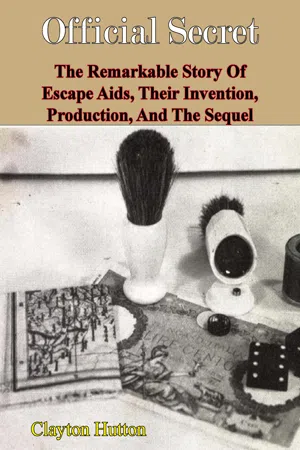
Few readers fail to thrill to escape stories, but do they pause to wonder who or what organization was behind the ingenious escape aids that became familiar to the allied forces. Here is the story of that man, Major Hutton. whose wartime job was to devise aids to facilitate production, to engineer distribution and to be ready to substitute at one when the enemy solved the secret. There were silk maps to all areas and frontiers; there were all sorts of ways of concealing tiny compasses; there were flying books that could be quickly converted, heels that held money, plastic containers that held necessities for survival - food, medicine first aid items, even a cream in toothpaste tubes. Frequently his methods were on the edge of the illegal.—Print Ed.
Trusted by 375,005 students
Access to over 1.5 million titles for a fair monthly price.
Study more efficiently using our study tools.
Information
Subtopic
European HistoryIndex
History1—ROOM 424
Three tired dahlias, drooping despondently in a jam pot on the window ledge, provided the only splash of colour in the dark and gloomy entrance hall. A trio of ancient commissionaires were moving, leisurely amongst the score or so of dark-suited civilians who, like myself, were waiting to be interviewed. I wondered idly how many of them had also ascended the imposing flight of steps at the front of the building, only to be told to ‘go round to the back’ by a formidable fellow whose top hat and faded campaign ribbons instantly discouraged would-be gate-crashers.
I sat down at a table covered in green baize, and silently cursing the spluttering pen provided, wrote down a résumé of my business on a buff form with a surface almost as porous as blotting-paper. This was whisked away and I was left to meditate on the circumstances that had brought me to the War Office in the last week of September, 1939...
During World War I, after serving in the Yeomanry and the Yorkshire Regiment, I had been a pilot in the Royal Flying Corps, so as soon as I realized that another war with Germany was inevitable, I applied to join the Royal Air Force. When I eventually discovered that my services were not wanted by the RAF, I decided to try the Army. I wrote several times to the War Office, drawing attention to my 1914-18 record and stressing the fact that I was willing to serve in no matter what capacity, but all my appeals were ignored. I then took recourse to telegrams. Working on the fairly safe assumption that they would galvanize the recipients into action, I despatched seventeen impressively lengthy wires in one week, addressing them to various departments and so wording them that they could not possibly be pushed into a ‘Pending’ tray and discreetly forgotten.
My unorthodox approach proved immediately successful. After six negative replies, I received an invitation to present myself at the War Office for an appointment with a Major J. H. Russell. There had been no indication as to the probable nature of the duties I might be called upon to perform, but I knew I was bound for the Intelligence branch, so I had been more than satisfied. My claim for consideration as a potential Intelligence Officer had been based on a varied and colourful life, during which I had acquired a grounding in and intimate knowledge of journalism in all its multifarious aspects, of advertising and publicity, and of the motion picture industry both in Great Britain and in America. Oddly enough, it was to be a random recollection of a boyhood experience that was ultimately to convince those in authority that I possessed the peculiar qualities they were seeking.
At this stage in my reflections I was invited to follow one of the superannuated commissionaires down one of the long corridors that radiated from the hall. We passed old men and young girls, all carrying steaming cups of tea on cheap japanned trays, and finally I was ushered into a small dimly-lit room in which no fewer than nine officers were miraculously accommodated. In an atmosphere heavy with cigarette smoke they sat, almost shoulder to shoulder, behind rough wooden tables piled high with dusty files and papers of every description. Some were bellowing vociferously into telephones; others were scribbling industriously; one—a major, distinguished-looking, grey-haired, with penetrating eyes and an indefinable charm of manner—was watching me amusedly. As I moved, rather hesitantly, towards the table, he rose and gave me an encouraging hand-shake.
‘Clayton Hutton,’ he stated rather than asked. ‘I read your telegram. As a matter of fact, I read half a dozen others, too, sent on to me from various departments.’ He gestured towards a chair pushed under the table opposite him. ‘But sit down and have a cigarette. My name is Russell, by the way. Came here straight from the Temple and am still feeling my way around. My job, apparently, is to fit square pegs into square holes. Anyway, tell me all about yourself.’
Delighted by this informal approach, I closed my ears to the surrounding hubbub and talked to him through a blue haze of tobacco smoke.
‘I started off by wanting to go on the stage,’ I began, ‘but my mother’s opposition turned me towards journalism. I learned the whole business under Lord Northcliffe, and when he died in 1922, I had a long spell with the Daily Chronicle. Then I quit journalism to become a publicity director in the film industry. I suppose my real speciality is thinking up new ideas and then putting them across.’
Major Russell eyed me speculatively. ‘Have you always been interested in show business, Mr Hutton?’
‘All my life,’ I admitted. ‘Magicians, illusionists, escapologists in particular—they all fascinate me. I expect it goes back to the night I tried to outwit Houdini at the Birmingham “Empire”. I’ve got a copy of the original challenge in my wallet. I remember how—’
‘Let me see it,’ Major Russell broke in surprisingly.
Rather taken aback by this unexpected request, I fished a folded sheet of paper from my wallet, smoothed it out and laid it on the desk. Major Russell leaned forward to study its unequivocal message, nodding to himself at intervals, as though what he was reading there served to confirm opinions previously formed. From where I was sitting the words were upside-down, but I knew them by heart.
CHALLENGE
To Mr Harry Houdini
The Birmingham Empire
BIRMINGHAM
April 29th, 1913.
Dear Sir,
“When you were previously in Birmingham, you escaped from a packing-case.
“As the case was delivered two days ahead, you had ample time to tamper with it.
“In order to eliminate such a possibility, will you accept the challenge permitting us to bring to the ‘Empire’ timber, battens, 2½” nails, and in full view of the audience construct a strong heavy box, you to enter immediately, we to nail down the lid, securely rope up the box, and defy you to escape without demolishing same.”
Yours truly,
Sgd.
EDWARD WITHERS, 26 Coventry Road
BENJAMIN WITHERS, 52 Hunton Road, Gravelly Hill
FRED LEES, 23 Craddock Road, Saltley
CLAYTON HUTTON, Washwood Heath, Birmingham
(Employees of W. J. CLAYTON LTD, Timber Merchants, Park Saw Mills, Birmingham)
“The above CHALLENGE has been accepted by
HOUDINI
for the Second House, Friday night, May 2nd, at the
BIRMINGHAM EMPIRE
under the condition that the box is not air-tight.”
When he had finished reading, Major Russell stabbed at the paper with an insistent forefinger. ‘You initiated this?’
‘It was my idea,’ I replied. ‘In those days I was working in my uncle’s timber mill in Saltley for five shillings a week. I went to the “Empire” one night and was so impressed by Houdini’s performance that I went backstage to see him after the show. He had announced that he would give a hundred pounds to anyone who could produce a wooden box from which he couldn’t escape.’
‘You accepted the challenge?’
‘I certainly did. You see, Major, I assumed that the boxes he had used on the stage were not genuine. We had a first-class carpenter at the mill and I. felt confident that he could knock something together that would baffle Houdini. To cut out any trickery, I stipulated that we should construct the box on the stage, in full view of the audience. Houdini agreed without any hesitation. The only snag was that he insisted on visiting the mill to meet our carpenter. As I dared not let my uncle know what I was up to, I had to fix the appointment during the lunch hour. I didn’t realise at the time that by introducing Houdini to the carpenter, I was as good as throwing away any chance I had of winning that hundred pounds.’
‘You mean he bribed him?’
I nodded ruefully. ‘And I didn’t find out until many years later at the Holborn “Empire”, when Houdini was making his last appearance. He told me the whole story, but I’ll come to that in a minute. All I remember seeing at the time was the arrival of a hansom cab, which drew up outside the office on a blazing hot summer’s day, and out stepped Houdini, smoking a fat cigar and wearing a magnificent fur-lined coat and a pair of gaudy carpet slippers. He had a long chat with Ted Withers, our master carpenter, and then mystified me by pacing the full length of the sixty-foot wall at the front of the mill. I caught on next day, of course, and so did my uncle. Houdini’s publicity agent had come back during the night and pasted an enormous bright yellow poster on the wall, calling attention to the challenge and generally advertising the Friday night show. Oh, he was a great showman was Harry Houdini!’
‘And what happened at the performance?’
‘First of all, Houdini told the audience that he had accepted the challenge of Messrs W. J. Clayton Limited. We next brought in the pieces of the box and Ted Withers assembled it on the stage to an orchestral accompaniment that was positively deafening. About twenty people came up, examined the finished job and pronounced it satisfactory. Some of them handcuffed Houdini, put him in a sack, sealed it, laid him inside the box, and Ted nailed down the lid. The whole thing was strongly roped, placed on a low trolley and wheeled into a small tent upstage. For the next ten to fifteen minutes the orchestra thumped out martial music fortissimo. Then, with dramatic suddenness, the curtains in front of the tent were swept aside, and Houdini, bathed in perspiration, stood there dangling the handcuffs from one hand and bowing to the wildly enthusiastic audience. The box was still intact and roped up as before.’
‘It was the same box?’ inquired Major Russell.
‘Without any doubt. Not even the rope had been tampered with. The fellow who had actually tied the knot swore it had never been undone. It looked as though Houdini had achieved the impossible. Naturally, we didn’t know that he had given Ted Withers three pounds to nail the box together in a certain way. In fact, there were only two full-length nails, top and bottom of the end from which he eventually emerged. Although the rest seemed all right, they penetrated only a single thickness of planking. All Houdini had to do, therefore, was to exert pressure with his feet and the end-piece pivoted on the two genuine nails. He cut himself free from the sack by means of a razor blade he had palmed when shaking hands with the last man to come up on the stage—a confederate. As an expert escapologist, he had no trouble in slipping out of the handcuffs. A moment or two later, he had fastened down the end, this time with proper nails, hammered in under cover of a Sousa march. Hammer and nails, by the way, were concealed in one of the bamboo poles that supported the tent. To all intents and purposes, nothing had been disturbed.’
‘What about the slashed sack?’ put in Major Russell astutely.
‘Easily accounted for. To prove that there was nobody in the box, Houdini simply chopped it to pieces with an axe. When he finally produced the sack, the audience was not surprised by its torn condition. He thought of everything.’
‘So you didn’t get the hundred pounds, after all.’
‘No, but Houdini did present me with what he referred to as “a fine silver watch” as a souvenir. It was only when I examined it later that I discovered that he had fooled me again. It was made of white metal and had no value whatsoever.’
At this point Major Russell abruptly thrust aside the mass of papers with which he had been dealing prior to my arrival, stood up and bade me follow him. ‘You may be the very man we want,’ he hinted mysteriously, as he conducted me along the murky corridor. ‘Judging by what you’ve told me, I think you may very well fit into one of the square holes I mentioned. At any rate, we’re looking for a showman with an interest in escapology. You appear to fill the bill.’
Wondering what it was all about, I accompanied my guide out into the street and round to the old Metropole Hotel, which had been taken over by the Office of Works. There, in Room 424, a vast barn-like office on the fourth floor, I was introduced to Major Crockatt—suave, well-groomed, shrewd—who lost no time in informing me that the only Scottish regiment worthy of the name was the one to which he belonged—the Royal Scots—and that all the best soldiers came from north of the border. At that stage of our relationship I did not consider it expedient to point out that most of the British Army’s biggest battles had been won by Irish generals. I merely eyed his many decorations and murmured a polite agreement.
At the instigation of Major Russell, I repeated the gist of my Houdini story and expressed a few forthright views on the psychology of escape. As I finished, the two officers exchanged significant glances.
‘Good,’ enthused Major Crockatt. ‘I believe you’ll do, Hutton. But before we go any further, let me attempt to put you in the picture. Our main concern in this department is to give assistance to prisoners-of-war. In the last show, with a few notable exceptions, the men who were captured by the enemy were content to stay put until the cessation of hostilities. This present war is to be conducted along vastly different lines. Not only will prisoners be expected to seize all opportunities of escaping; the intention is also that they are to be supplied with gadgets that will enable them to break out of the POW camps, and once out, help them find their way to freedom.’
‘But w...
Table of contents
- Title page
- TABLE OF CONTENTS
- ILLUSTRATIONS
- 1-ROOM 424
- 2-SILK SQUARES AND MULBERRY LEAVES
- 3-‘SWINGING’ IN THE OLD KENT ROAD
- 4-FOOD FOR FLIERS
- 5-TALKING OF BOOTS...
- 6-ON ILKLEY MOOR
- 7-OPERATION POST-BOX
- 8-‘F’ FOR FREDDIE
- 9-ALL IN THE DAY’S WORK
- 10-MEDITATIONS AMONG THE TOMBS
- 11-THE OTHER SIDE
- 12-BABY-FACE AND THE CONTORTIONIST
- 13-BOTTOM SECRET: ACT ONE
- 14-BOTTOM SECRET: ACT TWO
- 15-BOTTOM SECRET: ACT THREE
- POSTSCRIPT
Frequently asked questions
Yes, you can cancel anytime from the Subscription tab in your account settings on the Perlego website. Your subscription will stay active until the end of your current billing period. Learn how to cancel your subscription
No, books cannot be downloaded as external files, such as PDFs, for use outside of Perlego. However, you can download books within the Perlego app for offline reading on mobile or tablet. Learn how to download books offline
Perlego offers two plans: Essential and Complete
- Essential is ideal for learners and professionals who enjoy exploring a wide range of subjects. Access the Essential Library with 800,000+ trusted titles and best-sellers across business, personal growth, and the humanities. Includes unlimited reading time and Standard Read Aloud voice.
- Complete: Perfect for advanced learners and researchers needing full, unrestricted access. Unlock 1.5M+ books across hundreds of subjects, including academic and specialized titles. The Complete Plan also includes advanced features like Premium Read Aloud and Research Assistant.
We are an online textbook subscription service, where you can get access to an entire online library for less than the price of a single book per month. With over 1.5 million books across 990+ topics, we’ve got you covered! Learn about our mission
Look out for the read-aloud symbol on your next book to see if you can listen to it. The read-aloud tool reads text aloud for you, highlighting the text as it is being read. You can pause it, speed it up and slow it down. Learn more about Read Aloud
Yes! You can use the Perlego app on both iOS and Android devices to read anytime, anywhere — even offline. Perfect for commutes or when you’re on the go.
Please note we cannot support devices running on iOS 13 and Android 7 or earlier. Learn more about using the app
Please note we cannot support devices running on iOS 13 and Android 7 or earlier. Learn more about using the app
Yes, you can access Official Secret: The Remarkable Story Of Escape Aids, Their Invention, Production, And The Sequel by Clayton Hutton in PDF and/or ePUB format, as well as other popular books in History & European History. We have over 1.5 million books available in our catalogue for you to explore.