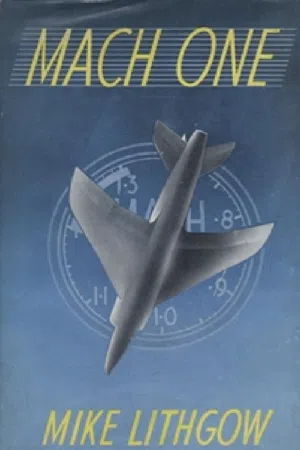
Mike Lithgow joined the Fleet Air Arm in 1939. A year later he was flying from the deck of the ill-fated carrier Ark Royal.
Lithgow flew in the attack which sank the Bismarck, and later was in the search for the Tirpitz. While on patrol in the South Atlantic his plane flew into the sea and he and his crew were left floating in their Mae Wests eight hundred miles from the nearest land...their rescue can only be described as miraculous.
In 1945 Lithgow became a test pilot with Vickers Supermarine organisation; since 1948 he has been Chief Test Pilot.
In his brilliant career with Vickers, Lithgow has flown the world demonstrating the prowess of that wonderful aircraft, the Swift, and its succeeding prototype, F525. His story is entertaining, intensely readable, and revealing of a very brave man.
eBook - ePub
Mach One
About this book
Information
Topic
HistoireSubtopic
Histoire de l'Europe1
There were about thirty of us when we gathered on the platform at Waterloo Station, all signed up as midshipmen with the Fleet Air Arm and on our way for a short period of naval training aboard H.M.S. Frobisher before our air training as pilots and observers. Something always happens to me in March, and this was March 13th, 1939.
H.M.S. Frobisher was at that time moored in Fareham Creek, though later we moved alongside in Portsmouth Dockyard. I had no idea then that I should ever look back on those days as happy ones, with a feeling almost of nostalgia. The routine was not one which appealed to me very strongly at the time. It began with semaphore drill on the forecastle at 5.30 a.m., and by breakfast time we usually felt we had already put in a good day’s work. Lectures in all branches of nautical lore followed, with practical seamanship and sailing as welcome interludes. There were at least two breaks during the day for P.T. and other forms of violent physical exercise, to “shift” for which we were permitted the princely allowance of three minutes.
Proceedings on board were enlivened by the presence, apart from our own Number 5 Air Course, of sixty or so regular cadets who were entering the Navy in a more orthodox manner. Our exalted rank of midshipmen, or even sub-lieutenants in some cases, was gall and wormwood to them, still condemned to many a day as cadets, and the passing of many more exams. Things usually came to a head on guest nights, and I well remember one of our number, cornered by the enemy, diving head first, in full mess kit, through a scuttle into Portsmouth Harbour to avoid capture. Furthermore, he managed to swim to an accommodation ladder and get on board again without being seen, which was possibly an even more meritorious achievement.
An ordeal on which I do not look back with any regret was Sunday Divisions at Whale Island, better known, perhaps, as H.M.S. Excellent. This famous haunt of the Gunnery branch of the Navy was the scene of a parade, followed by a church service, of many hundreds of officers and men, culminating in a march-past before the Commander. For some obscure reason we were always placed at the head of the formation. I’m afraid our arms drill was not exactly of Royal Marines’ standard, and we must have been responsible for reducing a number of senior Gunnery Officers to a state of almost apoplectic fury, which resulted, more or less as a matter of course, in a dressing-down from the Commandant himself, Commander R. M. T. Taylor. Of him we stood in great awe, but later, when he was Executive Commander in the Ark Royal, I could not imagine why, as he then appeared the most charming of men.
Apart from Whale Island they were happy days, but we were anxious to fly and looked forward with impatience to beginning our training. When the great day came we were split into two groups, the larger going to No. 20 Elementary and Reserve Flying Training School at Gravesend, and the smaller to Rochester. These schools were run most efficiently by civilian instructors under contract to the Admiralty. I went to Gravesend, and the only noteworthy detail I can remember of my experiences there was being extremely air-sick after my first experience of a spin, a fact which I hope may be of some comfort to any embryo test pilot. From Gravesend we were entrusted to the care of the Royal Air Force for Advanced Flying Training at Netheravon. The types currently in use there were North American Harvards and Fairey Battles.
War clouds were already on the horizon and a speeding-up process had been introduced into training programmes, so that the course was reduced to about five months. I was actually sitting in the officers’ mess at Netheravon when the Prime Minister’s fateful words came over the radio.
With the completion of Advanced F.T.S. and the award of our “wings”, we were now to begin the specialized training necessary before we could consider ourselves fully-fledged naval pilots. In those days it was the practice to train pilots both in T.B.R. (Torpedo, Bombing and Reconnaissance) work and in Fighters. Later, this somewhat uneconomic arrangement was changed, and pilots became definitely specialized in either “T.B.R.” or Fighters.
The longest training, as might be expected, was in torpedo dropping, which, then as now, look place at the Torpedo Training Unit at Gosport. For several weeks we flew at 50 feet over the sea—a change from Netheravon days, where a breach of low-flying regulations of this order was more likely to lead to a court-martial—in Swordfish and Sharks, endeavouring to master the intricacies of dropping torpedoes at fast targets continuously altering course.
The Swordfish, or “Stringbag” as it has affectionately come to be called, was the standard torpedo bomber of the day—and for that matter of many a day thereafter. It carried a prodigious load of bombs, mines, torpedoes, depth charges or anything else that could be thought up for it—and a great deal was—without, to any marked degree, prejudice to its handling qualities other than to knock a few more knots off its speed, if such a term can be applied. The pilot was accommodated in an open, though reasonably comfortable cockpit, with an observer (navigator) and telegraphist air-gunner occupying a bath-like space behind him. The method of communication was ostensibly through the medium of “Gosport” speaking tubes, but generations of naval aviators have found a dig in the ribs and a stentorian shout far more effective.
In early war years a Swordfish could be induced to proceed at 110 knots, if pressed, but later, when every conceivable device for the successful conduct of the war at sea was hung in or on it, it became necessary to fine off the propeller pitch to enable it to take off from small ships, after which 85 knots became a more usual speed.
The essence of a torpedo attack was to approach the target from the cover of what cloud there happened to be, or sun if there was no cloud, at the near-maximum height of a much-laden Swordfish (say 10-12,000 feet), in sections of three aircraft. A great deal depended on the leader at this stage, as obviously a bow or beam attack gave the best chance of success; and he had to dispose his sections of three so that, if the target combed the tracks of his torpedoes, the remainder of the force would still be in a position to make a successful attack. Much depended, too, on the leaders of sections.
The next stage was the dive. This was an exhilarating experience in a Swordfish. Usually the first intimation of impending attack was a belly-view of one’s next ahead as he entered an incredibly steep dive. The only way not to be left behind at this juncture was to achieve an even more incredible steep angle, so No. 3 of the formation usually had a pretty thin time of it. In this dive it was by no means unusual to register speeds of 200 knots, though the old hands will tell you that a far more reliable guide was a certain musical note, corresponding approximately to middle C, caused by the many wires and struts humming in the breeze. This noise was not always sufficient to drown the remarks of the observer who, at the moment of entering the dive, was carefully putting the finishing touch to the D.R. plot on his chart-board.
At some 200 feet all three aircraft would wheel sharply in through 90 deg. towards the target, the formation thus becoming line abreast, ideally some 200 yards apart. Sights were set to the correct target speed (by experience this can be estimated within 2 knots) and the range closed to 800 yards, speed 120 knots, 50 to 80 feet altitude, at which point the torpedo was dropped. The getaway was usually made down-wind, since if this was of any consequence the escaping speed of a Swordfish was liable to be increased by some 50 per cent.
Day after day, several times a day, we assiduously practised torpedo attacks on various ships provided for the purpose. Having achieved the required accuracy, we were at last allowed to use “runner” torpedoes—that is, the real thing with the warheads removed. This was an expensive pastime, as a torpedo is not improved if dropped too fast or too high, and is only recoverable if it has been correctly used. The Malahne and Philante were the targets at this time, and the scene of operations was in the triangle formed by Portsmouth, the Nab, and Ryde, Isle of Wight.
There were many other exercises in addition to torpedo attacks, such as spotting, bombing, reconnaissance, navigational, depth-charging and, finally, introduction to the catapult. The catapult at Gosport had been removed from a battleship and, being of the single cordite-charge type, had earned the reputation of packing a considerable punch.
Catapults are extensively used in carriers, since they save the ship turning away from the fleet into wind to fly-off, and are also invaluable when at anchor. The amount of urge behind the catapult is adjusted to suit the prevailing conditions of wind and aircraft weight. Successive generations of Flight Deck Engineer Officers have shown sadistic delight in taking good care that the acceleration has erred considerably on the positive side, and while most pilots would agree that it is the right side on which to err, we always had a grave suspicion that the margin was a trifle harsh.
To a naval pilot the first deck-landing conjures up memories akin to his first solo.
In 1939 H.M.S. Argus was the training carrier, and the Admiralty, with commendable forethought, had sent her to Hyeres, some 20 miles from Toulon in the South of France, so that weather should not unduly hinder the training programme. At least I think that was the reason, but we found other advantages. I was particularly fortunate in that replacement aircraft were required out there—not, I hasten to add, as a result of a high breakage rate, but to build up the establishment.
We collected the aeroplanes from Scotland and flew them out via Lee-on-Solent, Nantes, Bordeaux, Toulouse and Marseilles. It was a most amusing trip, our bright yellow Swordfish providing a never-failing source of incredulity and astonishment everywhere we landed. In Bordeaux the taxi-driver who drove us from the hotel to the airport asked if they were capable of cruising at “trois cent kilometres”. I hadn’t the heart to tell him that “trois cent kilometres” would definitely be pushing a Swordfish, and I think we eventually compromised on “deux cent”, though not without a show of disappointment on his part.
It was then the practice for embryo deck-landing pilots to be taken up in a Gypsy Moth “for a look at the deck” before being allowed to have a go in a more expensive piece of machinery. There was no dual deck-landing trainer; nor in fact is there now; I think it must be against the Instructors’ Union. Three landings in the Gypsy Moth were an unnerving experience. The aircraft was so light that it behaved rather like a pea on a drum and seemed to be at the mercy of the lightest eddy-over the “round-down” I was heartily thankful to climb into a sturdy Swordfish, and managed to complete, without incident, the requisite number of landings to have “passed D.L. course” stamped in my log-book.
The Argus was an ideal training carrier, though unusual in having no superstructure on the starboard side of the flight-deck. She was also unusual in that there was a ramp across the flight-deck a short distance before the bows. The idea of this was literally to throw the aircraft into the air, whether the pilot decided the moment was ripe or not. It later proved a source of extreme embarrassment when rather higher performance aeroplanes were operated from her, which definitely required that little bit of extra deck for take-off.
Returning to England by rail not many days before the fall of France, a number of us were appointed to take the Fighter School course at Eastleigh. The types used for instruction were Gladiators, Skuas and Rocs. The Roc was a development of the Skua, with a power-operated four-gun rear turret rather after the style of the Defiant. The Skua was a fighter dive-bomber powered by a Bristol Perseus engine. It performed valuable work at the beginning of the war and had the distinction of shooting down the first enemy aircraft to be destroyed. This honour belongs to Lieutenant (now Captain) B. S. McEwan, R.N.
The Gladiator was one of the most popular aeroplanes among pilots but, looking back now, I cannot think it was a very wise thing to let not-very-experienced pilots do alternate training flights on such widely-differing types as the docile “Glads” and the Skuas, with their relatively high wing loadings. However, we had to use what we had got.
At the end of this course we were all asked to make a choice between Fighters or T.B.R.’s. Needless to say. those of us who elected to remain on Fighters were appointed within forty-eight hours to T.B.R. Squadrons, and vice versa. Checking up afterwards, I found only four of us who had been lucky enough to have their wishes fulfilled. It was a question of supply and demand, of course, and although I was sorry at the time not to stay on Fighters, I wouldn’t have changed for anything later on. I was, in fact, appointed to a Swordfish Squadron temporarily stationed at Thorney Island. The time was May, 1940 when the invasion scare was at its peak. The Squadron was standing by with torpedoes loaded, and everyone was in an advanced state of readiness, so much so that no flying was permitted in case the call came through. After some days of this we eventually received permission to sail around the Island and as far as Bosham, having first arranged an elaborate recall procedure.
On June 13th we were rather shattered when instructed to carry out a reconnaissance of the Havre-Cherbourg area with our bomb-racks removed in the hope that the enemy would be deceived into thinking we were Gladiators. It wasn’t much consolation to be found masquerading as Gladiators when the opposing aircraft were likely to be ME. 109s, even though we were allowed six Blenheims as escort. My log-book records this flight of six Swordfish in close formation over Cherbourg as having occupied 4 hours 20 minutes, and as far as I was concerned every minute was pregnant with possibilities.
Two days later we were ordered to Jersey. I was the sixth aircraft to taxi out behind the C.O., and was surprised to see a motor-cycle despatch rider hare across the aerodrome at prodigious speed, fling his machine to one side and hand a signal to him. The C.O. promptly taxied back to dispersal and switched off, followed by the rest of us, in a very curious mood. It transpired that the Germans had just walked in and although we were all equipped with W/T, I have often wondered since exactly how close we were to dropping in on an unexpected reception.
The next day a more popular signal arrived from the Admiralty instructing us to work up on intensive night flying at Carew Cheriton, near Tenby in South Wales. The expected duration of this welcome break was one week, so we packed little more than a toothbrush and a pair of swimming shorts, and set off in high spirits.
The week that followed was idyllic. The days were entirely our own and we spent them in lazing on the beach and swimming in the delightful bay of Tenby. The most that was expected of us was a night-flying sortie each evening. We began to hope that the week would lengthen into two, or even that our existence had been forgotten altogether.
On the sixth day we received a rude shock. This came in the form of an Admiralty signal putting us at four hours’ notice to join H.M.S. Ark Royal. Later the same day we were airborne for Aldergrove, Northern Ireland, where we quickly refuelled and took off again for a rendezvous with the Ark Royal some 100 miles north-west of Ireland, still with little more than our toothbrushes and swimming shorts. We were not to see either our ground-crews or kit for some weeks, as we sailed immediately at maximum speed for Gibraltar.
2
Despite the unusual manner of our arrival, we were extremely proud to become one of the Ark’s Squadrons. She was already in the news, having seen a great deal of action in the early days of the war.
It seems difficult to believe now, but both the Ark and the Courageous were independently engaged on hunting submarines in those early days. It was not until the Courageous was sunk that it was realized that carriers were far too valuable, and vulnerable, for such hazardous duty. The Ark herself was extremely fortunate not to be sunk by a Heinkel bomber whilst returning to Scapa on September 27th, 1939. The Germans themselves were convinced that she had been; their pilot, Lieutenant Francke, was awarded the Iron Cross personally by Goering and was feted as a national hero. Fortunately, the 2,000 lb. bomb he had dropped fell into the sea about 30 yards off the Ark’s bows, causing no damage whatsoever.
Undoubtedly the Germans were all the more convinced they had sunk the Ark when their reconnaissance aircraft could find no trace of her in any Home Fleet ports. This was not surprising, as she had already sailed for Capetown, where she arr...
Table of contents
- Title page
- TABLE OF CONTENTS
- AUTHOR’S NOTE
- FOREWORD
- 1
- 2
- 3
- 4
- 5
- 6
- 7
- 8
- 9
- 10
- 11
- 12
- 13
Trusted by 375,005 students
Access to over 1.5 million titles for a fair monthly price.
Study more efficiently using our study tools.
Frequently asked questions
Yes, you can cancel anytime from the Subscription tab in your account settings on the Perlego website. Your subscription will stay active until the end of your current billing period. Learn how to cancel your subscription
No, books cannot be downloaded as external files, such as PDFs, for use outside of Perlego. However, you can download books within the Perlego app for offline reading on mobile or tablet. Learn how to download books offline
Perlego offers two plans: Essential and Complete
- Essential is ideal for learners and professionals who enjoy exploring a wide range of subjects. Access the Essential Library with 800,000+ trusted titles and best-sellers across business, personal growth, and the humanities. Includes unlimited reading time and Standard Read Aloud voice.
- Complete: Perfect for advanced learners and researchers needing full, unrestricted access. Unlock 1.5M+ books across hundreds of subjects, including academic and specialized titles. The Complete Plan also includes advanced features like Premium Read Aloud and Research Assistant.
We are an online textbook subscription service, where you can get access to an entire online library for less than the price of a single book per month. With over 1.5 million books across 990+ topics, we’ve got you covered! Learn about our mission
Look out for the read-aloud symbol on your next book to see if you can listen to it. The read-aloud tool reads text aloud for you, highlighting the text as it is being read. You can pause it, speed it up and slow it down. Learn more about Read Aloud
Yes! You can use the Perlego app on both iOS and Android devices to read anytime, anywhere — even offline. Perfect for commutes or when you’re on the go.
Please note we cannot support devices running on iOS 13 and Android 7 or earlier. Learn more about using the app
Please note we cannot support devices running on iOS 13 and Android 7 or earlier. Learn more about using the app
Yes, you can access Mach One by Mike Lithgow in PDF and/or ePUB format, as well as other popular books in Histoire & Histoire de l'Europe. We have over 1.5 million books available in our catalogue for you to explore.