Sometimes, the ideology that formed the basis for founding an empire can become the cause of its fall. The decline of the Spanish Empire is a clear example of how ideology may both adversely influence national grand strategies and trigger processes of decline of an empire. The strong religious conviction of the Habsburgs was a fundamental factor in defining an imperial strategy that did not conform to the genuine interests of Spain as the core of the Empire. This strategy did not take into account limited Spanish capabilities that were not enough to achieve its religious goals.
The purpose of this research is not to analyze in depth how religion influenced the decline of the Spanish Empire, but to use this process to establish a paradigm to explain how ideologies can become a negative influence on national policies. Once the paradigm is established, it will be compared to a similar process to develop some valid conclusions regarding the importance of defining national strategic objectives according to the interests and capabilities of each state.
Over the last two decades, the desire to expand and promote democracy around the world became the dominant ideology in the United States. Therefore, its influence in the evolution of recent American national strategies serves as a valid comparison. This study presents some conclusions that not only might be applicable for the analysis and study of national strategies, but also may help to understand how and when ideologies that may be necessary to maintain the cohesion of nations and empires, can became a source of national decline.
eBook - ePub
Ideology And The Fall Of Empires: The Decline Of The Spanish Empire And Its Comparison To Current American Strategy
- 78 pages
- English
- ePUB (mobile friendly)
- Available on iOS & Android
eBook - ePub
Ideology And The Fall Of Empires: The Decline Of The Spanish Empire And Its Comparison To Current American Strategy
About this book
Information
Subtopic
Military & Maritime HistoryIndex
HistoryCHAPTER 1 — INTRODUCTION
“Strategy is not merely the art of preparing for the armed conflicts in which a nation may become involved and planning the use of its resources and the deployment of its forces in such way as to bring a successful issue. It is the rational determination of a nation’s vital interests, the things that are essential to its security, its fundamental purposes in its relations with other nations, and its priorities with respect to goals.”― Gordon A. Craig and Felix Gilbert, Reflections on Strategy in the Present and Future
Many factors influence the fall of empires; even the same ideology that formed the basis for founding an empire can become the cause of its fall. The case of the Spanish Empire is a clear example of how the ideology that served to establish its roots was, some years later, one of the most important causes for its decline.
The strong Catholic conviction of the Habsburgs was the fundamental factor, if not the only one, in defining an imperial strategy that did not conform to the genuine interests of Spain as the core of the Empire. This strategy did not take into account that the capabilities of Spain were not enough to achieve its goals. Moreover, it pushed Spanish economic and industrial development into the background, and focused all the national resources on expanding and imposing the Catholic religion all over its Empire.
However, the purpose of this research is not to analyze in depth how religion influenced the decline of the Spanish Empire, but to establish a paradigm of how individual ideologies whether they be religious or secular, can become a negative influences to national policies and/or promote the decline of nations.
Nevertheless, once established, it is necessary to compare the paradigm with other similar processes to develop some conclusions regarding how ideologies influence national strategies, and the importance of defining national strategic objectives according to the capabilities of each state. The other example which will be examined is that of the United States (U.S.). In this case, the desire to expand and promote democracy around the world emerged as the dominant ideology within the U.S. during the last two decades. The influence of democracy as ideology in the evolution of recent American national strategies will serve as comparative element.
The Spanish Empire
In 1469, the marriage between Ferdinand II of Aragon and Isabella I of Castile established the foundations of what will be called the Hispanic Monarchy. Some years later, on January 2, 1492, the last Muslim bastion on the Iberian Peninsula, Granada, fell into Christian hands. With this event, the Hispanic kingdoms put an end to seven centuries of religiously-based struggle, expelling the Muslims, who, after the invasion of 711, had occupied almost the entire Iberian Peninsula.
Moreover, only three months after the conquest of Granada, in March, the Catholic Monarchs signed an edict ordering the expulsion of all professed Jews. Furthermore, that same year, on October 12, Christopher Columbus discovered the Americas and took possession of the new lands in the name of the Catholic Monarchs. Truly, 1492 was a crucial year for the Hispanic Monarchy.
As a result of these new facts, Spain faced two clearly different scenarios to implement its policies: the Mediterranean, where the Turkish and Berber presence was a threat to navigation and to the coasts of the Spanish kingdoms, and the Atlantic, where the discovery of a new continent opened the possibility of creating a vast empire.
After Ferdinand's death (1516), his grandson Charles I{1} inherited Spain’s Crown. At this time, Spain had already consolidated its presence in both scenarios, the Mediterranean Sea and the Americas{2}, and had laid the groundwork for its expansion through them. Despite the magnitude of the project, Spanish resources and military capabilities were enough to attain the immediate successive objectives. Moreover, the Catholic Monarchs had the support of the clergy, the ruling classes and the common people.
It is important to highlight that four dynastic inheritances converged in the person of Charles I. He received, among other possessions, the Crown of Castile, a number of places on the coast of North Africa, an American Empire still undefined, the Crowns of Aragon, Naples and Sicily, the Duchy of Burgundy, and the Archduchy of Austria. Therefore, Charles I of Spain was the most powerful monarch in Europe. However, as a consequence, he had to face complex challenges and different conflicts: rivalry and confrontation with France, the onset and progress of the Protestant Reformation within the Empire and in the Netherlands, secessionist movements in the Netherlands, a Turkish threat on Austria, etc.
Similarly, the Spanish monarchy also assumed the leadership of the defense of the Catholic Church against Muslims and Lutherans. Therefore, the Spanish monarchy had to combat, sometimes simultaneously, against Turks, Berbers, French, Dutch, Venetians, Lutheran princes and so on.
On the other hand, Spain had to support the tremendous effort of consolidating the American empire, and its extension through Asia and the Philippines. All this combined with the maintenance of freedom of the following navigation axes:
1. Barcelona/Valencia–Balearic Islands -Sicily.
2. Seville–Canary Islands -Antilles.
3. Coruña–English Channel -The Netherlands.
Due to all these commitments, Spain did not have a day of peace in 200 years.
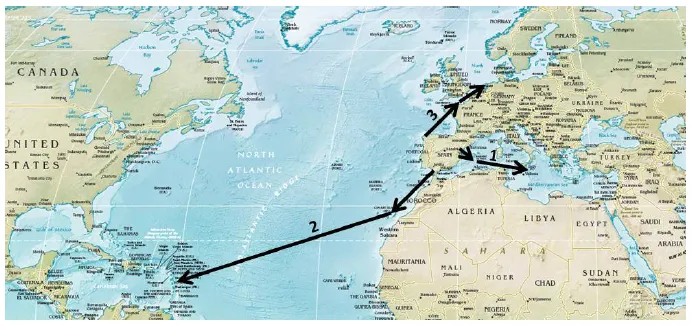
Figure 1. Spanish navigation axes in sixteenth century
Source: Created by author using a map from Central Intelligence Agency, World Factbook, https://www.cia.gov/library/publications/the-world-factbook/docsrefmaps.html (accessed April 16, 2013).
In 1556, Charles I abdicated and appointed his son, Philip II (1527-1598), heir of all his Spanish, American, and West European dominions, but bequeathed the Crown of the Empire to his brother Ferdinand. Later, in 1580, Philip II inherited Portugal and the Spanish monarchy reached its peak of power. This monarch possessed a vast empire that spanned four continents. Spain was the most powerful nation in the world. But, when the sixteenth century ended, Spain had been fighting for a hundred years without a day of respite. Spanish armies were still unbeatable, but there were clear indications that something else was happening. The economy, despite the silver and gold of the known as the New World, was in crisis, agriculture and industry were suffering from a lack of labor, and the state was not be able to support their armies and naval forces any more.{3}
All these circumstances pointed to the need for a change in strategy. However, in matters of national policy, the seventeenth century was a continuation of the sixteenth century. Nothing changed and Spain had to face an additional 100 years of uninterrupted war. In other words, Spain was not able to adapt its strategic objectives to the real capabilities and possibilities of the nation along with its empire.
In this process, religion profoundly influenced the development of the foreign policy of the Spanish monarchy. As mentioned before, in the early sixteenth century, the Spanish kingdoms ended seven centuries of war against Muslims. This war had become a crusade against the infidel. Furthermore,
“The idea of the crusade, with its popular religious and emotional overtones, was therefore ready at hand for Ferdinand and Isabella. A vigorous renewal of the war against Granada would do more than anything else to rally the country behind its new rulers, and associate Crown and people in a heroic enterprise which would make the name of Spain ring through Christendom. (Elliott 2002, 46)”
Therefore, it was logical that, after the conquest of the last Muslim stronghold on the peninsula, this crusading spirit was transformed into a fight against Turkish Empire that threatened Christianity in the Mediterranean Sea and in Eastern Europe.
Spain fought, alone, or with the support of Venice and the Papacy, both by sea and by land, to stop the advance of the Turkish Empire. Similarly, the nation subordinated its commercial interests to the religious interests not only of the Church of Rome, but also to the self-imposed moral duty of the Spanish monarchy. Something similar happened with the appearance of the Lutheran Reformation. In this case, the Spanish monarchy became the key element to implement the Counter-Reformation with the support of the Church of Rome, its theologians, and their military and economic resources. As a result, all the Spanish efforts were focused on facing a series of religious conflicts.
Spain proudly assumed the role of champion of the Catholic Church against Muslims and Lutherans. Moreover, this championing that had begun with the Catholic Monarchs, continued with Charles I and, then with Phillip II. However, this role hindered the economic development of Spain due to the lack of resources to attend to all the national interests. This issue was a major factor that prompted the decline of the Spanish Empire.
The Strategy of the United States
After the collapse of the Soviet Union in 1991, as a consequence of “years of economic decline and political infighting among members of the Communist Party” (Ryan 2009, 1), the world started a new era led by the U.S. as the only superpower within the context of a new democratic wave (Waltz 2000, 6). As Charles Krauthammer states in his article The Unipolar Moment, “The immediate post-Cold War world is not multipolar. It is unipolar. The center of world power is an unchallenged superpower, the United States, attended by its Western allies” (Krauthammer 1990-1991, 23).
Only four years before, in 1987, the U.S. President submitted, according to the Goldwater-Nichols Department of Defense (DOD) Reorganization Act of 1986,{4} the first National Security Strategy Report (NSSR). This document establishes not only the basis of national grand strategy, but also includes the following considerations in its section 104 (b) (1, 4), among others:
1. The worldwide interests, goals, and objectives of the United States that are vital to the national security of the United States.
2. The adequacy of the capabilities of the United States to carry out the national security strategy of the United States, including an evaluation of the balance among the capabilities of all elements of the national power of the United States to support the implementation of the national security strategy.
National security concerns, the international environment, the state of the global and national economies, domestic politics, pressure lobbies, and other factors and actors influence the development of a national grand strategy. Although the current U.S. strategy has been evolving since 1987, it has maintained an array of features that...
Table of contents
- Title page
- TABLE OF CONTENTS
- ABSTRACT
- ACKNOWLEDGMENTS
- ACRONYMS
- CHAPTER 1 - INTRODUCTION
- CHAPTER 2 - LITERATURE REVIEW
- CHAPTER 3 - RESEARCH METHODOLOGY
- CHAPTER 4 - ANALYSIS
- CHAPTER 5 - CONCLUSIONS AND RECOMMENDATIONS
- REFERENCE LIST
Trusted by 375,005 students
Access to over 1.5 million titles for a fair monthly price.
Study more efficiently using our study tools.
Frequently asked questions
Yes, you can cancel anytime from the Subscription tab in your account settings on the Perlego website. Your subscription will stay active until the end of your current billing period. Learn how to cancel your subscription
No, books cannot be downloaded as external files, such as PDFs, for use outside of Perlego. However, you can download books within the Perlego app for offline reading on mobile or tablet. Learn how to download books offline
Perlego offers two plans: Essential and Complete
- Essential is ideal for learners and professionals who enjoy exploring a wide range of subjects. Access the Essential Library with 800,000+ trusted titles and best-sellers across business, personal growth, and the humanities. Includes unlimited reading time and Standard Read Aloud voice.
- Complete: Perfect for advanced learners and researchers needing full, unrestricted access. Unlock 1.5M+ books across hundreds of subjects, including academic and specialized titles. The Complete Plan also includes advanced features like Premium Read Aloud and Research Assistant.
We are an online textbook subscription service, where you can get access to an entire online library for less than the price of a single book per month. With over 1.5 million books across 990+ topics, we’ve got you covered! Learn about our mission
Look out for the read-aloud symbol on your next book to see if you can listen to it. The read-aloud tool reads text aloud for you, highlighting the text as it is being read. You can pause it, speed it up and slow it down. Learn more about Read Aloud
Yes! You can use the Perlego app on both iOS and Android devices to read anytime, anywhere — even offline. Perfect for commutes or when you’re on the go.
Please note we cannot support devices running on iOS 13 and Android 7 or earlier. Learn more about using the app
Please note we cannot support devices running on iOS 13 and Android 7 or earlier. Learn more about using the app
Yes, you can access Ideology And The Fall Of Empires: The Decline Of The Spanish Empire And Its Comparison To Current American Strategy by Major Enrique Gomariz Devesa in PDF and/or ePUB format, as well as other popular books in History & Military & Maritime History. We have over 1.5 million books available in our catalogue for you to explore.