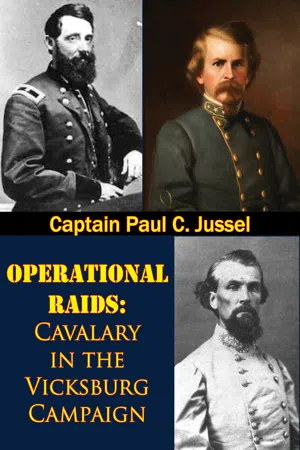
This study is a historical analysis of the cavalry raids led by Confederate Major Generals Earl Van Dorn and Nathan Bedford Forrest in December 1862 and Union Colonel Benjamin Grierson in April 1863. Each raid is examined in detail based on the historical data available and focuses on the operational concerns and considerations of Union and Confederate commanders.
Some of the conclusions that can be drawn from this investigation are: the use of cavalry had evolved to large, independent units for separate operations; the operational benefit of cavalry was demonstrated first by the Confederacy, then refined and used by the Federals during the Vicksburg Campaign; the synchronization and orchestration of units from different commands against a common target produced significant benefits; and sufficiently strong units, capable of self-sustainment, can be detached from the main body of an army to operate behind enemy lines to destroy the enemy Infrastructure.
The study concludes that operational raids can be a significant economical operation to attack an enemy center of gravity without using the bulk of the army. The historical examples from the Vicksburg Campaign can be compared to today's force structure to show that capability is limited for the modem commander.
- 68 pages
- English
- ePUB (mobile friendly)
- Available on iOS & Android
eBook - ePub
Operational Raids: Cavalry In The Vicksburg Campaign, 1862-1863
About this book
Trusted by 375,005 students
Access to over 1.5 million titles for a fair monthly price.
Study more efficiently using our study tools.
Information
Subtopic
19th Century HistoryIndex
HistoryCHAPTER 1
AirLand Battle doctrine stresses the need for initiative, agility, depth, and synchronization. Initiative implies not only taking action within the commander’s intent, but also forcing “the enemy to conform to our operational purpose and tempo.” Agility concerns the physical ability to react faster than the enemy can, as well as the mental capability to understand changing situations and create a new plan or scheme based on the new circumstances: Depth, “the extension of operations in space, time, and resources,” and synchronization, “the arrangement of battlefield activities in time, space, and purpose to produce maximum relative combat power at the decisive point,” complement the other tenets to produce the conditions that lead to our intended end state—battlefield victory.{1}
Yet victory is not possible without the clear and purposeful application of a nation’s resources against the enemy’s source of strength and will: his center of gravity. The application of power in a particular area, a theater of war or theater of operations, must be coordinated at a high level, a level the US Army currently terms “operational”. The operational level of war concerns the orchestration of all available forces in a coordinated effort, a campaign, against the enemy’s center of gravity. Within the overall framework of a campaign, many ways and means exist to attack the enemy’s center of gravity; one of them is a raid on a vulnerable supply base or line of communication. The raid, as an operational mission, is a very efficient and effective method of attacking the weak link of a numerically superior enemy. In an economy of force role, with the appropriate priority, a small number of highly trained soldiers or a relatively small unit can successfully perform the mission.
By definition, a raid is designed to “confuse the enemy” or “to destroy his installations.”{2} Though currently limited in scope to a small scale operation, large units can perform this mission successfully. History is replete with examples of large armies being stymied in their efforts by a far smaller force raiding into its rear and destroying its support system. From the American Civil War, Major General Philip Sheridan’s Trevilian Station Raid, launched In June, 1864 with 8000 men in two divisions, is an example. Its purpose was twofold. Sheridan was first tasked to destroy the supply lines from the Shenandoah Valley to the Confederate Army of Northern Virginia stationed around Richmond. His secondary mission was to draw the majority of the Confederate cavalry away from the main army to allow the Union Army of the Potomac to cross the James River unmolested. Though failing in the first task, Sheridan succeeded in the second task.{3} This operational raid focused not only on the logistical lifelines, but also on the Confederate instrument of operational influence, the cavalry. The real Federal success lay in the control of the Confederate cavalry; they had to ride to the beat set by Sheridan’s troopers.
Another example was when Major General James Wilson, with over 13,000 troopers organized into three divisions, rode into the untouched Confederate farmland of Alabama and Georgia in March and April, 1865.{4} This raid destroyed significant amounts of materiel and industry. Its success heralded the use of a powerful, mobile, well-equipped force whose sole aim was to disrupt or destroy an enemy’s infrastructure before the main, slow-moving forces joined battle.
In the 1904-1905 Russo-Japanese War, the Russian commander in the Far East, General Kuropatkin, took advantage of Japanese dispositions to launch a powerful raid in January, 1905. The Japanese supply line was dangerously exposed for over 100 miles from the port of Newchwang to the front lines around Mukden. The Russians assembled a cavalry force of 7000 troopers under Major General Mishchenko to penetrate the Japanese lines and smash the depot and railway at Newchwang. The cavalry quickly pierced the front lines and struck the infrastructure that supported the enemy’s ability to wage war The benefits of the raid included not only the destruction of the supply base and its rail network, but also the delay of reinforcements to the area.{5} The Russian generals appreciated the situation and used the best arm available to accomplish the task. To forward looking observers of this war, and to other military writers of the period, the traditional role of cavalry was fundamentally different. Its role as the shock and exploitation force had changed and new techniques and equipment were required to keep pace with new missions, such as operational raids.{6}
The leaders of the new Red Army demonstrated their understanding of the operational raid during the 1919-1920 Russo-Polish War with their First Cavalry Army. When Polish troops penetrated Soviet defenses In the Ukraine, the Cavalry Army was brought Into the area. Led by Semyon Budyonny, the cavalrymen participated in the counter-offensive during May and June, 1920 and successfully turned the Poles back. The Cavalry Army, consisting of four divisions and 16,000 troopers, became the most successful unit as it rode to the front, dismounted to fight, and remounted to attack exposed flanks or to pursue the fleeing enemy. Its ability to penetrate the Polish defenses and attack garrisons in the depth of the battlefield produced tremendous advantages for the burgeoning Red Army. The success of Soviet arms in the Polish War can, in some measure, be attributed to the First Cavalry Army.{7}
The American Army rediscovered the operational raid when it flexed its military might in the Second World War. Though mechanization had displaced the horse and troopers were now mounted in tanks and armored cars, the idea of operational raids to disrupt an enemy was never far from ex-cavalrymen’s thoughts. In particular, Lieutenant General George S. Patton’s Third Army showed the benefits to be derived from coordinated operational and tactical actions. The actions of the XII Corps of the Third Army around Nancy and Arracourt in September, 1944 illustrated these benefits.
With the Third Army approaching the Lorraine region of France In September, 1944, the 4th Armored Division was used as a raiding force against the German defenders of Nancy. When the 35th and 80th (US) Infantry Divisions failed to make sufficient progress against the 3d and 15th Panzergrenadier and 553d Volksgrenadier Divisions defending along the Moselle river, the 4th AD was committed through the shallow bridgeheads to create a larger lodgement. The Division, however, penetrated enemy lines and, with “a front equal to the width of the lead tank,” continued for 45 miles to the vicinity of Arracourt, 15 miles beyond Nancy. The 4th AD Initially destroyed supplies and command and control facilities and networks, then engaged German reinforcements as they moved forward. More importantly, the enemy was forced to evacuate Nancy without a fight because of the 4th AD’s action in its rear.{8} The operational raid proved very useful In disrupting enemy rear areas; its continued use by the Third Army resulted in significant gain.
What, then, are the characteristics of an operational raid? What conditions are necessary for the success of this sort of mission? What type of force can best accomplish the mission? The first American use of this force and mission can be traced to the cavalry raids of the Vicksburg Campaign of 1862-1863. This study assesses the December 1862 raids of Confederate Major Generals Earl Van Dorn and Nathan Bedford Forrest on Union Major General Ulysses Grant’s supply lines and base at Holly Springs, Mississippi and the April 1863 raid led by Union Colonel Benjamin Grierson against Confederate Lieutenant General John Pemberton’s lines of communication. It first focuses on doctrine and tactics of the cavalry as the war started, then proceeds through a historical analysis of the raids. The focus of the analysis is threefold. It will highlight the operational concerns of the opposing commanders by examining the organization and disposition of their forces during the December-April period. Second, it will show the conditions each commander believed existed just prior to launching the raids. Then, the desired results and the actual results are compared and assessed. Finally, after evaluating the results of the raids in light of modem military doctrine and force structure, an assessment of the American Army’s ability to conduct similar operations is made.
CHAPTER 2
All of the maneuvering by Northern and Southern generals was influenced by the military doctrine of the time. Napoleon was the model most of the leaders had studied. The vast majority of the West Point trained officers had been influenced by the teachings of Dennis Hart Mahan and one of his most popular pre-war students, Henry Halleck. They both espoused many of the Napoleonic concepts on war, particularly those on bases of operations and combined arms, as interpreted by Antoine Henri Jomini. A successful strategy was offensive. In order to effectively prosecute an offensive strategy against the enemy, strong bases needed to be established, first In friendly territory and then progressively deeper in enemy territory. Grant himself observed:
“It is generally regarded as an axiom of war that all great armies moving in an enemy’s country should start from a base of supplies, which should be fortified and guarded, and to which the army 1s to fall back in case of disaster.{9}”
“This thinking served as the basis for how both sides initially prosecuted the war.”
The major limitation was that it did not seem to allow an army to operate without a base. This restrictive thinking, as well as the practical fear of risking defeat, prevented much deviation from this norm until absolute necessity dictated it be done. Grant and Pemberton each had this sort of “base of supplies” and each kept them protected. Each advanced their bases as the situation allowed and each believed their troop dispositions protected the bases.
Though Jomini was impressed with the mobility of the cavalry, he did not envision its operational use as a means unto itself to attack an enemy; he advocated its use during battle in combination with other arms to strike the enemy. Thus, cavalry was principally designed, equipped, and organized to be the exploitation force on the battlefield. It was kept in reserve until needed at the critical moment during the battle, when it was committed to break through and pursue a wavering infantry line. This outlook pervaded the thinking of most commanders on both sides as the war started. Generals were unprepared to think of cavalry in terms of a fast-moving, hard hitting force. Nothing they had experienced at West Point, in Mexico, or on the plains against the Indians taught them to think of a raids such as Van Dorn’s, Forrest’s, or Grierson’s. The raids also served to challenge the traditional concepts of supply bases and secure lines of communications.
Equally influential in the development of cavalry was the small number of available regiments and their lack of training. Early Federal mobilization efforts concentrated on Infantry units; it was believed the war would be over before any sizable cavalry force could be raised, equipped, trained, and employed to influence the war. The few regiments that were raised spent more time learning to tide and care for its horses than in learning the tactical concepts of Jomini. The Confederate cavalrymen, though better individual horsemen, fared little better with the tactical concepts. As a result, no commander wanted to risk his small mounted force, a force he might need during a critical portion of an upcoming battle, on missions that required long-distance detached service. This sort of thinking relegated the cavalry, especially in the Western theater, to duty as couriers and glorified headquarters escorts and guards. On occasion, the troopers would be used as scouts, but this mission was often assigned to only a small number. There was little opportunity for a regimental commander to exercise his entire unit on a mission. These doctrinal dilemmas were being challenged and rethought by leaders on both sides as the struggle In the West centered on the Mississippi River and Vicksburg.
The Mississippi River valley became something of an obsession with the Union high command early in the war. President Abraham Lincoln’s personal feeling and upbringing gave him an understanding of the importance of the river. Gubernatorial influence helped affect the decision-making process also; Governor Richard Yates of Illinois had early guided the Union hand in the taking of St. Louis, Missouri.{10} Lieutenant General Winfield Scott’s plan for subduing the rebellious states called for a seizure of the Mississippi to divide the South. He assessed that they could not survive without use of that artery.{11}
Though not fully appreciative of Scott’s plan, Lincoln, as the Commander-in-Chief, generally guided Union forces to the purpose of seizing the Mississippi. Control of the river would guarantee a separatio...
Table of contents
- Title page
- TABLE OF CONTENTS
- ABSTRACT
- ACKNOWLEDGEMENT
- CHAPTER 1
- CHAPTER 2
- CHAPTER 3
- CHAPTER 4
- CHAPTER 5
- APPENDIX 1-CONFEDERATE AND UNION CAVALRY, ORDER OF BATTLE, DECEMBER, 1862
- APPENDIX 2-CONFEDERATE AND UNION CAVALRY, ORDER OF BATTLE, APRIL, 1863
- BIBLIOGRAPHY
Frequently asked questions
Yes, you can cancel anytime from the Subscription tab in your account settings on the Perlego website. Your subscription will stay active until the end of your current billing period. Learn how to cancel your subscription
No, books cannot be downloaded as external files, such as PDFs, for use outside of Perlego. However, you can download books within the Perlego app for offline reading on mobile or tablet. Learn how to download books offline
Perlego offers two plans: Essential and Complete
- Essential is ideal for learners and professionals who enjoy exploring a wide range of subjects. Access the Essential Library with 800,000+ trusted titles and best-sellers across business, personal growth, and the humanities. Includes unlimited reading time and Standard Read Aloud voice.
- Complete: Perfect for advanced learners and researchers needing full, unrestricted access. Unlock 1.5M+ books across hundreds of subjects, including academic and specialized titles. The Complete Plan also includes advanced features like Premium Read Aloud and Research Assistant.
We are an online textbook subscription service, where you can get access to an entire online library for less than the price of a single book per month. With over 1.5 million books across 990+ topics, we’ve got you covered! Learn about our mission
Look out for the read-aloud symbol on your next book to see if you can listen to it. The read-aloud tool reads text aloud for you, highlighting the text as it is being read. You can pause it, speed it up and slow it down. Learn more about Read Aloud
Yes! You can use the Perlego app on both iOS and Android devices to read anytime, anywhere — even offline. Perfect for commutes or when you’re on the go.
Please note we cannot support devices running on iOS 13 and Android 7 or earlier. Learn more about using the app
Please note we cannot support devices running on iOS 13 and Android 7 or earlier. Learn more about using the app
Yes, you can access Operational Raids: Cavalry In The Vicksburg Campaign, 1862-1863 by Captain Paul C. Jussel in PDF and/or ePUB format, as well as other popular books in History & 19th Century History. We have over 1.5 million books available in our catalogue for you to explore.