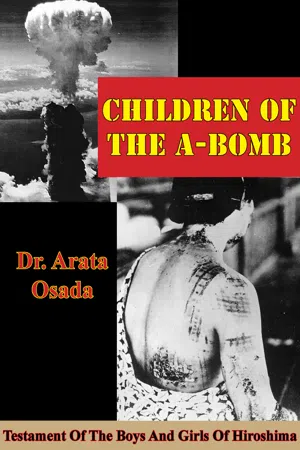
"Children of the A-Bomb" is a collection of 67 testimonies of Hiroshima survivors culled from a total of more than 2,000, detailing the experiences of these innocent victims on 6th August 1945, as painfully remembered six years later, on what, in the Japanese way of counting, was the seventh anniversary of the event.
The book is divided into four sections, according to the grade of the writers in 1951: from grammar to junior, senior and high school, including three undergraduate college students. The length of the testimonies varies from one to ten pages, the longer ones of course being concentrated in the latter half of the book. And though much of the material focuses on the immediate aftermath of the bombing, some of the writers also cover the days and sometimes weeks that followed, insofar as they were affected by the bomb, or perpetuated the victims' misery with their litany of typhoons, starvation, and radiation sickness and death.—Jean-Francois Virey
- 258 pages
- English
- ePUB (mobile friendly)
- Available on iOS & Android
eBook - ePub
Children Of The A-Bomb: Testament Of The Boys And Girls Of Hiroshima
About this book
Information
Subtopic
European HistoryIndex
HistoryIV—HIGH SCHOOL (SENIORS) AND COLLEGE
86—Naoko MASUOKA
Girl, Junior College student.
Hiroshima, which was reduced to ashes in one instant...On that August 6th of 1945, which I shall not be able to forget as long as I live—on that day I lost a lot of friends whom I loved, I lost my teacher, and the school where we were so happy was burned to the ground.
The sixth of August—from early morning on that day we had hot, glorious weather without a single cloud in the wide sky. I was in the eighth grade of the Girls’ School at the time, and I was supposed to go to Zakoba-cho to help clean up after the demolition squads working on the Clearance Project.
“Good morning!”
“Good morning.”
Among the students and teachers gathering in the schoolyard, who could have imagined that we were greeting this morning as our last?
Cheerfully singing “Blossoms and Buds of the Young Cherry Tree,” we left the school at seven-thirty, headed for Zakoba-cho, and it must have been a little after eight when we arrived there. I put the first-aid kit which I always carried down on the ground and stood up to go to work. That was the time.
Just as somebody’s voice was calling “There’s a B-29,” I lost consciousness in a flash of blinding light.
I wonder how much time passed after that. All at once I came to and found that everything was dark and something was pressing me to the ground as I lay there. I feel as though it is impossible to breathe in the rising clouds of dust. Oh, what shall I do? What in the world has been happening to me? My heart feels heavy with worry and loneliness. When I try to stand up it feels as if I am touching someone’s body with my feet.
A crying voice is calling, “Mother! Mother!”
I am crying too. Perhaps I am going to die just like this. I wonder if my body will be burned up, here among the ashes. Unconsciously I feel pressed for time: ‘I don’t want to die! ‘ I can’t tell in which direction I ought to try to escape. In the meantime it is becoming a little brighter before my eyes. I am shocked when I see the figures of my friends. Some of them are covered with blood; the skin of others is red with burns. They are such sights as I would turn my eyes away from at an ordinary time. My hands are burned black, and a yellow liquid is dropping like sweat from the broken skin. There is a queer smell. Suddenly my tears come. Why must I suffer this crime to such an extent? I wonder what can be happening to my father and mother and brothers now? How shocked they would be if they could see my miserable figure at this moment! I trudge along after all the others as they flee. Voices are screaming for help on all sides. A person with the lower half of his body pinned under a concrete wall cries and screams. Everyone is indifferent to such things and goes hurrying past on his own way.
I wonder how long I wandered around after that? The streets were so completely changed that I could not tell the direction or anything. I came out to some bridge or other. (Later I found out this was Hijiyama Bridge.) A horse tied to a telephone pole is plunging about wildly, all covered with blood. Bathed in hot sunlight I crossed the bridge, walking barefoot, and sat down by the river’s edge. There is a student from a different girls’ high school there, who is also a pathetic sight with her whole body covered with burns, and she is saying “I want a drink of water. I want a drink of water,” and drinking the dirty river water.
“Hey! You’ll die if you drink water,” the shout comes from somebody up on the bridge.
Another student walks into the river—I suppose it is because she is in such pain—screaming “I want to die quickly.”
I was loaded into the car of a rescue squad that happened to come along just then, and taken to Ujina, where I was given careful first aid treatment and then sent by boat to Ninoshima. In the boat there was one woman who was completely naked and burned all over, and she was writhing her body around in agony as if she were out of her mind. We arrived at Ninoshima and there began five days of my life that I shall never be able to forget as long as I live.
We lie on a blanket spread over a straw mat on the board floor. On this side and on that, the people who are dying every day can hardly be distinguished from the living. A person who was talking cheerfully yesterday is a cold dead body this morning. Can the dying of a person be such an ephemeral thing? Am I going to die right here just as I am? This kind of thought brings to me an indescribably forlorn feeling. Before I die I want to see my father and mother and my big brother and my little brother at least once. My heart is full of that single desire.
This is what happened the second day I was there. A girl who was lying in a corner was about to die at any minute, and then she said just the one word, “Mother,” and she died.
Just at that moment a lady came in. It was that girl’s mother.
“Mother has been searching for you all this time. You wanted me to come to you sooner, didn’t you? I was a little too late, wasn’t I? “She was weeping as she held the corpse close to her. Everybody was crying in sympathy. I wanted to see my mother’s face soon, too. I wanted to go home at the first possible second, but there was not a thing I could do about it. Shortly after noon on the fifth day suddenly I opened my eyes at the sound of a voice calling my name. Oh, it’s my father! I wonder how many days it is since I saw him last. The tears poured out of my eyes. My strong father was crying too, and all that time not a word could pass his lips. He just kept crying and saying,
“I’m so glad, I’m so glad.”
I wonder what in the world would have happened if I hadn’t been lucky enough to meet my father at this time? Just to think of it now makes me shudder.
After that I went home. My home was in the suburbs of Hiroshima and it escaped damage. It seems that Father and Mother and my brothers and even our relatives and neighbors had been searching for me every day. Mother, too, clutched me and cried. For two or three months after that Mother cared for me with desperation and finally just managed to save my life. There is no doubt that I owe my survival to the efforts of a great many people.
I really feel it is rather a wonder that I survived. A great many of my friends died—there were only about five survivors in each class. All our teachers died. But when I see those who lost their fathers and mothers, whose homes were burned, and who are struggling to make a living, I feel that this suffering of mine is really a small thing.
* * * * *
87—Setsuko SAKAMOTO
Girl, Junior College student.
Even Hijiyama, though they call it ‘Bald Hill,’ cannot resist the tremendous force with which Nature paints it green in scattered, spreading patches. So I, who have been ill most of the time since the A-bomb, idly turn my eyes toward the cream-painted Quonset-type buildings on its summit, and as the sole survivor of my whole class, I think back over the wretched scenes of that time which are still so vivid that they make me shudder.
I remember how, on the 6th of August of 1945, we were ordered to report to Zakoba-cho to help clear up after the demolition squads working on the Clearance Project, and we set out. The ground almost blistered our feet from day after day of burning hot weather, but we cheerfully began the work of carrying away the roof tiles, chanting bravely in unison as we passed them along from one to another. At just a little after eight o’clock the rolling drone of a B-29 engine came echoing from a distant part of the sky.
Shortly after the voice of our teacher, saying “Oh, there’s a B! There’s a B!” made us look up at the sky, we felt a tremendous flash of lightning. In an instant we were blinded and everything was just a frenzy of delirium. The vicinity was in pitch darkness; from the depths of the gloom, bright red flames rise crackling, and spread moment by moment. The faces of my friends who just before were working energetically are now burned and blistered, their clothes torn to rags; to what shall I liken their trembling appearance as they stagger about? Our teacher was holding her students close to her like a mother hen protecting her chicks, and like baby chicks paralyzed with terror, the students were thrusting their heads under her arms. My teacher’s hair had turned white in the meantime and she looked much bigger than she usually did.
I just kept saying over and over, “Teacher, I am Sakamoto,” and finally at the third time she recognized me.
Even though I had lived in Hiroshima for a long time, I hardly knew my way about the streets, so I meant to stay with my teacher, but before ten minutes had passed I found myself quite alone. All about me were people whom I had never seen before, but then my name was called by my friends and I came to myself with a start. Some of my friends were bewailing the change that had come over their own faces; others were crying and calling for their parents. Tightly clutching each other’s burned hands, we searched for somebody resembling our teacher.
Suddenly we noticed that in our flight we were stepping from one gravestone to another. A pine tree nearby was blazing with crackling noises and we were in danger of being caught up at any moment in the whirling flames. We hadn’t the faintest sense of direction and just fled along with the flocks of people, avoiding the flames. Screaming children who have lost sight of their mothers; voices of mothers searching for their little ones; people who can no longer bear the heat, cooling their bodies in cisterns; every one among the fleeing people is dyed red with blood. My friend and I, who had been entrusting ourselves to the stream of people, suddenly for some unknown reason were running along an embankment in the opposite direction from the crowd. After a short while we came to a small stone bridge. We found out that this was Fujimi Bridge. The shops and green trees that had lined both sides of the street until this morning were burned and vanished without leaving a trace, the telephone poles had fallen over, the electric wires were on the ground, and beside them a baby was lying with its cute little hands tightly clenched and its eyes closed. There is nothing more to be said than that it was a hell on earth. From Hijiyama Bridge I carried my friend, who was going crazy with her burns and her thirst, on my back and searched for a relief station, and when we finally arrived at the foot of Hijiyama it was just about midday. The shady places under the trees were crowded with patients and I could not help turning my eyes away from them. The two of us were already at our wits’ end and when we heard the order “Enemy planes approaching; take shelter!” we once again frantically scrambled up the steep hillside and hid ourselves among the scrub bamboo. Suddenly I began to feel nauseated and I vomited a lot of yellow mucus.
As we were lying there, drowsing, we were aroused by someone’s voice saying, “Are there any patients here?” and we were taken to a shelter dug into the hillside, and carefully nursed.
As I looked down from the side of the hill on the demolished houses of the town I suddenly began to worry about my own home which had been left with nobody in it. At the shelter we happened to meet a person who lived near my friend’s house, and that person arranged to have my friend taken home on a stretcher, so I parted from her and just about sunset I returned to my home. My house had been turned into such a pathetic wreck that no one could possibly live in it.
Under such circumstances as these our two teachers, although they were severely wounded themselves, worked themselves to the bone for the sake of us, their students, and in the end sacrificed their precious lives. Forty of my friends, too, all fell victims one after another. No one except a prophet would ever have dreamed that that morning was to be our final parting. On the 29th of August I went to visit the home of that friend with whom I had fled. For more than two hours I talked and wept with her bereaved family. My own condition at that time was a pitiful sight to be seen. I finally got well enough to put on my hat and go to school but everything kept reminding me of the teachers and classmates I had lost and I felt as though my heart would burst.
Every year on the 6th of August I visit that place at Zakoba-cho, and at O-Bon{22} I always call on the families of four or five of my late friends, but that is the saddest thing for me. Changes in the weather, and especially extreme cold and heat, affect me very much, I am forever getting sick, and at times I find myself thinking it would have been better if I had died that time together with all the rest of them, and I even make my mother cry at times. I keep my body going with injections that probably don’t do any good but at least ease my mind, and at other times I give myself strength to go on by thinking that more than forty divine spirits are watching over my person. Whenever my health improves even a little I feel as though I should apologize to my dead teachers and friends for the fact that I have been able to live until now. I believe that my first duty is to keep my own spirit sternly calm so that I will be able to live worthily on behalf of my forty friends.
* * * * *
88—Toshiko IKEDA
Girl, Junior College student.
During the six years since the atom bomb exploded in the sky over Hiroshima, those of us who at the time were overwhelmed with terror and plunged into the depths of sorrow seem gradually, as the days and months go by, to have drawn away from those ghastly memories in proportion to the progress toward recovery of the city of Hiroshima. ‘Once it passes your throat you forget how it burned in your mouth,’ as they say. But no; it is not so. We stand in awe of touching this part of our minds. If I once let my thoughts revert to that time, those brutal scenes would revolve more than ever before my eyes as vividly as if they were things of yesterday. This was too cruel a sacrifice to be called ‘a stepping stone to peace. Even I have the feeling that I would like to avoid staring too intently at that 6th of August.
I was a second year student then at the First Prefectural Girls’ High, and about a week before, we had started going to work under the Student Labor Plan at the Hiroshima Printing Bureau in Minami Kannon-machi. On that morning, too, I had eaten my early breakfast alone and, leaving behind me the voice of my aunt asking “Was there enough salt in the soup?”, I set out in a hurry for the printing plant, wearing my big padded hood with a kerchief tied around my head, my first-aid kit hung from my shoulder and my feet stuck into wooden sandals. On the way an alert sounded and as I walked along staying as close as possible under the eaves of each house I passed, suddenly my chest tightened at the thought ‘Maybe this is the day?’
Before starting to work we assembled in the school yard of the Second High (the present Kannon Junior High) and after finishing a furious drill in which we carried wooden guns, we were lined up at the west end of the long east-to-west school building, looking at the words, which were posted abou...
Table of contents
- Title page
- TABLE OF CONTENTS
- I-GRAMMAR SCHOOL
- II-JUNIOR HIGH SCHOOL
- III-SENIOR HIGH SCHOOL
- IV-HIGH SCHOOL (SENIORS) AND COLLEGE
- APPENDIX I-COMPILER’S FOOTNOTES
- APPENDIX II-COMPLIER’S LETTER TO THE WRITERS
Trusted by 375,005 students
Access to over 1.5 million titles for a fair monthly price.
Study more efficiently using our study tools.
Frequently asked questions
Yes, you can cancel anytime from the Subscription tab in your account settings on the Perlego website. Your subscription will stay active until the end of your current billing period. Learn how to cancel your subscription
No, books cannot be downloaded as external files, such as PDFs, for use outside of Perlego. However, you can download books within the Perlego app for offline reading on mobile or tablet. Learn how to download books offline
Perlego offers two plans: Essential and Complete
- Essential is ideal for learners and professionals who enjoy exploring a wide range of subjects. Access the Essential Library with 800,000+ trusted titles and best-sellers across business, personal growth, and the humanities. Includes unlimited reading time and Standard Read Aloud voice.
- Complete: Perfect for advanced learners and researchers needing full, unrestricted access. Unlock 1.5M+ books across hundreds of subjects, including academic and specialized titles. The Complete Plan also includes advanced features like Premium Read Aloud and Research Assistant.
We are an online textbook subscription service, where you can get access to an entire online library for less than the price of a single book per month. With over 1.5 million books across 990+ topics, we’ve got you covered! Learn about our mission
Look out for the read-aloud symbol on your next book to see if you can listen to it. The read-aloud tool reads text aloud for you, highlighting the text as it is being read. You can pause it, speed it up and slow it down. Learn more about Read Aloud
Yes! You can use the Perlego app on both iOS and Android devices to read anytime, anywhere — even offline. Perfect for commutes or when you’re on the go.
Please note we cannot support devices running on iOS 13 and Android 7 or earlier. Learn more about using the app
Please note we cannot support devices running on iOS 13 and Android 7 or earlier. Learn more about using the app
Yes, you can access Children Of The A-Bomb: Testament Of The Boys And Girls Of Hiroshima by Arata Osada in PDF and/or ePUB format, as well as other popular books in History & European History. We have over 1.5 million books available in our catalogue for you to explore.