With never-before published contemporary photographs, facsimile documents and other illustrations...
The true story of the conspiracy that came close to destroying the Union from within, getting Illinois, Indiana and Ohio to join the Confederacy while New York City was in flames. Chicago was ready for rebellion, 100,000 Northern Confederates stood ready to strike. Based on official papers hitherto suppressed by the U.S. War Dept.—the secret and unpublished diaries of Capt. Thomas H. Hines, C.S.A., official agent of the Confederate government and mastermind of its underground.— Print Ed.
- 363 pages
- English
- ePUB (mobile friendly)
- Available on iOS & Android
eBook - ePub
Confederate Agent: A Discovery In History
About this book
Information
Subtopic
19th Century HistoryIndex
HistoryPART I—RAIDER AND GUERRILLA: The Apprenticeship
I. THE MOST DANGEROUS MAN IN THE CONFEDERACY
THIS is the story of a grand conspiracy, a lost cause and the men and women who believed in it. At times it seems so incredible that one wonders if it ever happened. The existing records, some of them sealed by government orders for almost ninety years, tell us it did.
The full range of human emotions—love, hate, cowardice, courage and frivolity—runs through it, and, like a bright pattern in a crazy-quilt, is the love story of its young leader.
Let us first examine this Northwest Conspiracy in all its far-flung ramifications. Relatively little about it has appeared in print. The reason is simple: it was a secret plan and the men who took part in it kept their lips sealed, many until their deaths. In 1864 the New York Times hinted that it had been a vast Confederate plan to spread “a siege of terror from Maine to Minnesota.” This was only partially true; the objective was not just to make raids on northern cities. The overthrow of the United States government by revolution was the principal goal of the Conspiracy.
Next, the cause. Of course it was the Confederacy—in the agonizing months when her gray columns began their slow but inevitable retreat. Most of her leaders knew she was doomed. Exchange Commissioner Colonel Robert Ould said to Mrs. Mary Boykin Chesnut, famous for her Diary from Dixie, in a memorable whisper, “We are rattling downhill.”
And now, the men. They were young and handsome, mostly hard-bitten veterans of General John Hunt Morgan’s command. The Rebel raider, as the North knew him. They were scholarly and men of good breeding. Those whom the court-martial boards convicted died in high Roman fashion. One of them, John Yates Beall, told the hangman, “As someone has said, we may be as near God on the scaffold as elsewhere.”
This is their story. It begins on a fall morning in 1861, with fifteen young men trotting south on the Newtown Turnpike. The riders were all neatly dressed in broadcloth, linen shirts, cocked hats and shining jackboots. They were armed with a strange assortment of weapons; long squirrel guns, old muzzle loaders that had seen service in the Indian raids along the Kentucky frontier, horse pistols that had been fired at Buena Vista, double-barreled shotguns and a few old swords.
They all rode with the easy grace of men accustomed to the saddle since childhood. As they passed McCracken’s farm on the pike they could see the orderly rows of shrubbery, the carefully trimmed, fresh green lawns, the winding driveway which led from the pike to the big white house.
They passed under the giant oaks and elms, shafts of sunlight flashing on the silver of their bridles. Overhead the crows and the blue jays shattered the morning quiet with their raucous calls.
The fifteen riders had formed themselves into a troop of cavalry after the triumphant Confederate bravos occupied Bowling Green. Since then they all had been whistling for action against the damn Yankees. It had been difficult to decide on a name for the troop. “Kentucky Raiders” and “Lexington Rifles” had been advanced and rejected. They liked the latter, but John Hunt Morgan’s troop already had selected that name. “Buckner’s Guides,” honoring that great Kentucky military leader, General Simon Bolivar Buckner, finally had been accepted.
The officers, elected by the members, had been chosen for their personality and leadership. The Guides had wanted Hines as captain, but he refused, so Alonzo Ridley was named with Hines as 1st Lieutenant. Hines, who had resigned from the Masonic University, at La Grange, in Oldham County, the day after the troop had been formed, was well known to all of them for his coolness and leadership. Men always seemed ready to follow Hines in the classroom or elsewhere.
There was no snobbery in the Guides. The riders were sons of plantation owners, farmers, tobacco growers, storekeepers and members of the senior class and faculty of the university. One was a Latin instructor, another a fencing master. They had met twice a week in a pasture outside Lexington, performing there what an old Mexican war veteran said were cavalry maneuvers. Now at last, they voted they were ready for war. They had met early in the morning to avoid the Federal patrols on the roads leading out of the town, then had set out for Maj. General W. J. Hardee’s camp.
At the head of the column, Hines rode with the ease of a man who had spent eighteen of his twenty years in the saddle. He was a slender man, his weight no more than a hundred and thirty pounds, but he rode with such quiet grace that his slenderness, almost frailty, attracted no attention. From his grandfather, a surgeon in the English Army who had come to America before the French and Indian wars, had come the blue eyes that could be as cold as frozen seas, and the square-cut jaw; from the Dinwiddies of Virginia, on his grandmothers side, he had the slender, graceful body, hard as whipcord, the thick, black curly hair, slanting eyebrows and an instinctive appreciation for beautiful women, good music and fine horses.
He had a familiar look. A man might have looked twice at Hines, wondering where he had seen that face before. Suddenly it would have come to him: Hines bore a striking physical resemblance to another handsome young man of his day, John Wilkes Booth.
On that fall morning Hines led his men through the Blue Grass. At one toll gate they said they were Union cavalry and crossed the small stream without paying a toll.
It was about noon when they left the pike to turn into a side road. They splashed across a creek and rode up a small hill. Even before they were in sight of the camp they could smell the savory odor of frying bacon and pork roasting over a spit. They reached the top of the hill and the camp spread out before them.
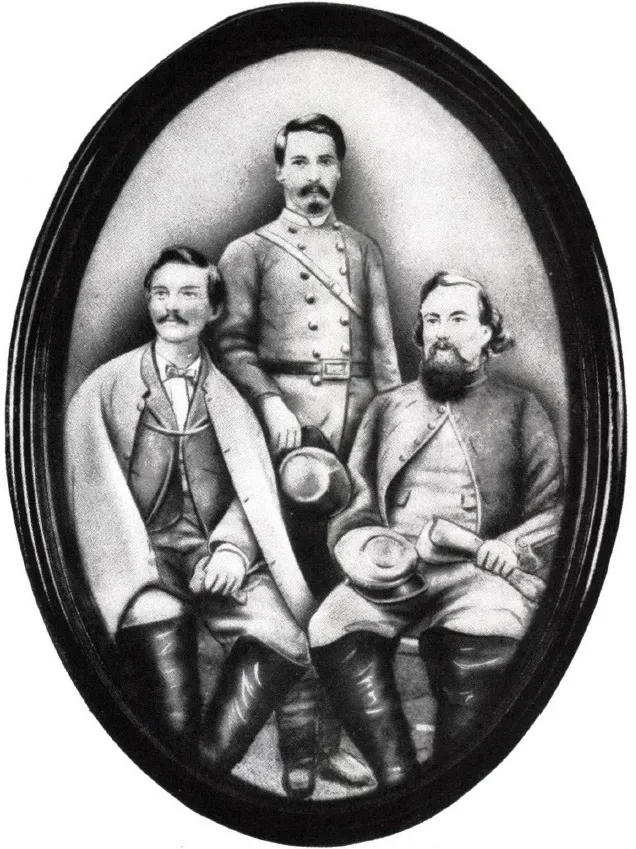
Courtesy, Mrs. John J. Winn
A rare photograph of Captain Hines, Colonel Eastin and General Morgan, taken about 1863 before the Ohio raid.
II. MORGAN’S RAIDERS
JOHN HUNT MORGAN—the name had a magic ring to it. The man himself had a strange, magnetic force that drew men to him. His men and officers would never forget him; years after his death they would unashamedly weep for him in their memoirs, forgetting his faults. Tall, handsome, picturesque, he was a man of curious contradictions.
As a cavalryman he was superb. A technical military handbook asserts that he permanently altered cavalry tactics and operations by using his command as riflemen. Another says he was the greatest partisan fighter since Francis Marion, the Swamp Fox of the Revolution. But he excelled not in cavalry tactics alone. The love of conspiracy was strong in his make-up, and might have attracted young Hines. The two made a fine conspiratorial team. Both were close-mouthed, shrewd and wily. Years after the Civil War, when he wrote his memoirs, Basil Duke, second in command of Morgan’s cavalry, wondered what lay between Hines and Morgan. Even in 1866, when he wrote Morgan’s Cavalry—The Official Records of the Union and Confederate Armies (1880-1901) had not yet been published-Duke, who had married Morgan’s sister Henrietta in 1861, was unaware that his general and the young captain had secrets between them about which only the high command in Richmond knew.
But neither Hines nor Morgan had any thoughts of conspiracy the day they joined forces in Nashville, Tennessee, to keep order in that terrified city. Rumors had spread with prairie-fire rapidity...the Federals were at the gates...the Union steamboats could be seen...the cannonading would soon start....
On January 15, the city was evacuated. The gray columns marched to Murfreesboro. There, according to Doctor James Blanton’s unpublished account of Hines’ career, now found among the Hines Papers, the Guides were disbanded for the reason that “they were in a strange region.” Was war always to be fought in one’s back yard?
Two weeks later Hines reorganized his small command, offering its services to General John Cabell Breckinridge at Burnsville, Tennessee, but was refused by that commander “because Congress had not given him authorization.” Hines then traveled to Richmond, missing the battle of Shiloh and the great might-have-been victory for the Confederacy.
In Richmond he heard that his first general, Albert Sidney Johnston, had died, leading his men, at two o’clock that afternoon.
Hines stayed out of the war, in Richmond, for a month. This war-time capital, with the decay which attaches itself to all lost causes already too apparent, was to be no stranger to him in the months to come.
It was the magic of Morgan’s name that brought Hines back into the Army. The name was already one to conjure with. In April they were telling stories in Richmond of how Morgan and his men had ridden into Murfreesboro and passed themselves off as Federal cavalrymen, to be cheered by the Union sympathizers who lined the sidewalks; of how in the college town of Lebanon they had suffered their first defeat, with the wounded Basil Duke watching Morgan in tears as the wounded streamed past him. They told of Morgan’s gallant effort to capture the train which was taking his men as prisoners to Cave City in southern Kentucky, capturing instead a Federal payroll of eight thousand dollars, which helped ease the hurt of defeat.
In May, 1862, Hines enlisted as a private in Morgan’s Ninth Kentucky, Company A, Captain John Breckinridge Castleman commanding. In the months ahead, Castleman and Hines would share incredible hardships. From their first meeting they struck up a friendship which was to last a lifetime.
Hines’ qualities as an officer were not lost on Morgan. On June 10, 1862, he commissioned Hines a captain, assigning him to Company E Ninth Kentucky.
Hines was now among the corps of officers who would later serve under him as his Northwest Conspiracy raiders. The story of his life and adventures cannot, of course, be separated from theirs. There was his close friend, Captain “Breck” Castleman, “born in the season of wild rose and elder blossom on June 30, 1841, at Castleton, Fayette County...” as he wrote of those early days; the handsome Colonel George B. Eastin, who was to fight a famous duel with a Yankee officer over a lady’s hand; Lieutenant John W. Headley, who would think nothing of kidnapping a Vice President of the United States and holding him as a hostage; Captain Robert Cobb Kennedy and Colonel Robert Martin, who would put New York City to the torch; Lieutenant Bennett H. Young, the cavalier bank robber whom St. Albans, Vermont, would never forget, and others.
In late June, a man who was neither a Kentuckian nor an American joined Morgan: Colonel George St. Leger Grenfel, one of the most fascinating but little known figures of the Civil War. It is hard to believe that he was flesh and blood and not from the pages of a G. A. Henty book. Soldier Of Fortune, white chieftain of a Moroccan desert tribe, veteran of four wars and revolutions, he was commissioned Inspector General under Braxton Bragg at the age of sixty-two.
When John Hunt Morgan formed his cavalry, Grenfel joined him, bringing with him the iron discipline and the tactics of the desert riders of Africa against whom he had fought and under whom he had served.
It was about this time, in the spring of 1862, that the first fires of the Copperheads in the North began to flicker. Isolated arrests were made by the Federal detectives who were ignorant of the vast scope of this American “fifth column.”
Hines, Morgan and the high command in Richmond were all to be closely linked with the Copperhead movement. There is ample evidence that Hines served as a liaison between Morgan, the Richmond headquarters and the Copperhead leaders.
In the spring of 1862, Hines perfected his guerrilla tactics. He led several raids into Kentucky, destroying Federal rolling stock, burning bridges, tearing up railroad tracks and stealing horses. Union head-quarters in Louisville or Lexington became familiar with the frantic messages from commanders of outposts in the Blue Grass, which usually read, in effect: “At ten o’clock this morning a Rebel force under the notorious Captain Hines crossed into this state, halting a train near Christiansburg, burning two cars and stealing one hundred horses. Lieutenant Jones and a patrol gave immediate pursuit, but the enemy had vanished....”
The scene was always the same: Hines and his troopers sweeping out of the winter twilight or the gray dawn, the chilling Rebel cry quivering in the air; the ragged volleys, the surprised guards scattering for cover or dying at their posts; the arch of flame as the torches were flung into the warehouses or blockhouses; the grinding noise as crowbars ripped up the rails; the squeal of frightened horses herded through the forest; then gradually the shouts; the pounding hoofbeats dying out, leaving behind the crackling flames, the smoke and the dead men in the trampled snow.
That winter Hines tried his hand at conspiracy. He slipped in and out of Kentucky, organizing his underground and contacting that state’s Copperhead leaders. From them Hines learned of the growing dissatisfaction in the North against the Lincoln administration a...
Table of contents
- Title page
- TABLE OF CONTENTS
- DEDICATION
- ILLUSTRATIONS
- REPORT OF AN AUTHOR’S SEARCH FOR SECRET HISTORY
- DRAMATIS PERSONAE OF THE NORTHWEST CONSPIRACY
- TIMETABLE
- PART I-RAIDER AND GUERRILLA: The Apprenticeship
- PART II-SECRET AGENT: Underground Ambassador
- PART III-THE NORTHWEST CONSPIRACY: The Preparation
- PART IV-THE NORTHWEST CONSPIRACY: The Attacks
- PART V-THE AFTERMATH: Dispersion and Reunion
- A FINANCIAL ACCOUNTING OF THE NORTHWEST CONSPIRACY
- SOURCES
- BIBLIOGRAPHY
- MAPS
Trusted by 375,005 students
Access to over 1.5 million titles for a fair monthly price.
Study more efficiently using our study tools.
Frequently asked questions
Yes, you can cancel anytime from the Subscription tab in your account settings on the Perlego website. Your subscription will stay active until the end of your current billing period. Learn how to cancel your subscription
No, books cannot be downloaded as external files, such as PDFs, for use outside of Perlego. However, you can download books within the Perlego app for offline reading on mobile or tablet. Learn how to download books offline
Perlego offers two plans: Essential and Complete
- Essential is ideal for learners and professionals who enjoy exploring a wide range of subjects. Access the Essential Library with 800,000+ trusted titles and best-sellers across business, personal growth, and the humanities. Includes unlimited reading time and Standard Read Aloud voice.
- Complete: Perfect for advanced learners and researchers needing full, unrestricted access. Unlock 1.5M+ books across hundreds of subjects, including academic and specialized titles. The Complete Plan also includes advanced features like Premium Read Aloud and Research Assistant.
We are an online textbook subscription service, where you can get access to an entire online library for less than the price of a single book per month. With over 1.5 million books across 990+ topics, we’ve got you covered! Learn about our mission
Look out for the read-aloud symbol on your next book to see if you can listen to it. The read-aloud tool reads text aloud for you, highlighting the text as it is being read. You can pause it, speed it up and slow it down. Learn more about Read Aloud
Yes! You can use the Perlego app on both iOS and Android devices to read anytime, anywhere — even offline. Perfect for commutes or when you’re on the go.
Please note we cannot support devices running on iOS 13 and Android 7 or earlier. Learn more about using the app
Please note we cannot support devices running on iOS 13 and Android 7 or earlier. Learn more about using the app
Yes, you can access Confederate Agent: A Discovery In History by James D. Horan in PDF and/or ePUB format, as well as other popular books in History & 19th Century History. We have over 1.5 million books available in our catalogue for you to explore.