This study is an analysis of Union joint operations in the James River Basin from 1862 to 1865. Specifically the contributions made by the Union Navy during the battles of this period.
It begins with an analysis of the Peninsula Campaign conducted by Major General George B. McClellan and Rear Admiral Louis M. Goldsborough in 1862 and concludes with the Union forces entry into Richmond in April 1865.
The Union Navy played a significant role in shaping the outcome of the battles for control of the James River Basin and the eventual capture of Richmond. The Navy's control of the river allowed Lieutenant General Grant to maintain his main supply base well forward in the theater. This enabled Grant to rapidly maneuver and resupply his forces.
The study provides lessons on the difficulties of joint operations and the requirements to ensure success in the joint arena. Furthermore, it provides today's United States military with a view of riverine and mine warfare operations and the implication of allowing these warfare areas to decay.
- 75 pages
- English
- ePUB (mobile friendly)
- Available on iOS & Android
eBook - ePub
Joint Operations In The James River Basin, 1862–1865
About this book
Information
Subtopic
19th Century HistoryIndex
HistoryCHAPTER ONE—INTRODUCTION
This study is an analysis of the Union Navy’s participation in the battles that took place in the James River Basin from 1862 to the fall of Richmond in April 1865. This examination provides important lessons for understanding the concerns and problems which may arise in today’s joint and combined arena. Furthermore, it shows the intrinsic difficulties encountered in conducting cooperative operations without unity of command or joint doctrine. The analysis will show the inter-service requirements for conducting riverine operations. It will also illustrate the inherent difficulties associated with conducting operations in a mine environment. In order to highlight these areas and the contributions made by the Navy during this period in the James River Basin, the analysis focuses on several basic questions:
1. How involved was the Navy in the planning and execution of the battles? What was the commitment of the Navy toward the James River battles? Was this involvement substantial or superficial to the total operation?
2. How important to the outcome of the battles was the contribution of the Navy? If the Union had altered its import of the Naval portion of their order of battle, would the initiative have shifted?
3. How well did the Navy integrate into the general scheme of battle? What was the assistance that the Navy rendered in protection of the Union Army both on and off the waterways? What were the problems that each service encountered interfacing with a separate organization to achieve the common goal?
The Navy did in fact play an important role in the outcome of the American Civil War: from the blockading of ports to the battles upon the inland rivers, the Navy supported the Army’s efforts throughout the war. In a letter written 26 August 1863, to Union men from his hometown, Springfield, Illinois, President Lincoln praised the achievements of the Navy:
“Nor must Uncle Sam’s web-feet be forgotten. At all the watery margins they have been present. Not only on the deep sea, the broad bay, and the rapid river, but also up the narrow, muddy bayou, and wherever the ground was a little damp, they have been and made their tracks. Thanks to all.”{1}
Unlike today’s Defense Department which controls the United States military organization, the military during the Civil War was split into two separate organizations: the Department of War, and the Department of the Navy. In the James River Basin the Civil War Naval forces fell under the command of the North Atlantic Blockading Squadron. The North Atlantic Blockading Squadron had jurisdiction over the waters bounding North Carolina, Virginia, Maryland, and all associated tributaries. The James River Squadron (or James River Flotilla), established in 1862, was a subordinate command of the North Atlantic Blockading Squadron and had domain over the James River and its tributaries.
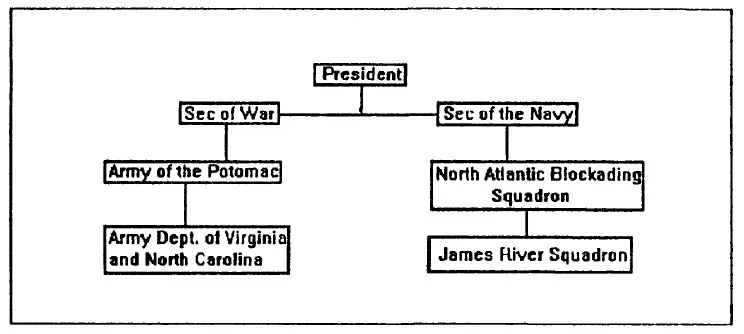
Figure 1. Union Command and Control Organization
The Department of the Potomac (or Army of the Potomac) was constituted in August 1861 and consisted of the Departments of Washington, Northeastern Virginia, and the Shenandoah. Included within its limits were the states of Delaware, Maryland, the District of Columbia, and that part of Virginia east of the Allegheny Mountains and north of the James River, except for Fort Monroe and sixty miles of the country around it which fell under the command of the Department of Virginia.{2} In April 1862 when Major General George B. McClellan commenced his Peninsula Campaign, the Departments of the Shenandoah and the Rappahannock were removed from the Department of the Potomac command. In July 1863 the Department of Virginia expanded to include portions of North Carolina, and its name changed to the Department of Virginia and North Carolina.
The Civil War era military system did not allow for simplicity of command and control by a single commander-in-chief as is common today. Sister services cooperation in the theater of operations had to be approved by both departments instead of being dictated by the commander-in-chief. Requests for assistance often required long lead times as the communications went up one chain-of-command and then down the other chain-of-command. Cross chain communications normally did not normally occur below the level of the area commander and occasionally were made at the Secretary level. This lack of command and control by a single entity allowed for departmental rivalry to interfere with operations. During the Civil War, the political rivalries occasionally became a significant hindrance to operations.
Gideon Welles, a soft-spoken career politician from Connecticut, was Abraham Lincoln’s Secretary of the Navy. Charles A. Dana, Assistant Secretary of War during the Civil War, recalled:
“Welles was a curious-looking man: he wore a wig which was parted in the middle, the hair falling down on each side; and it was from his peculiar appearance...that the idea that he was an old fogy originated....In spite of his peculiarities...Mr. Welles was a very wise, strong man. There was nothing decorative about him; there was no noise in the street when he went along; but he understood his duty, and did it efficiently, continually, and unwaveringly. There was a good deal of opposition to him, for we had no navy when the war began, and he had to create one without much deliberation; but he was patient, laborious, and intelligent at task.”{3}
Lincoln recognized that “Welles generally gave good counsel, whatever the issue, that above all, he was trustworthy and completely loyal.”{4}
Lincoln’s first Secretary of War, Simon Cameron, who had lost the President’s confidence, was replaced in January 1862 by Edwin M. Stanton.
“The appointment of Mr. Stanton was not made on party or personal considerations....He was appointed because, in addition to his great ability, his restless energy, and his absolute honesty, he was an unconditional Unionist of the Democratic faith, and his appointment would be a proof to the country that Mr. Lincoln regarded the war as a people’s war, and not that of a party.”{5}
Also known as a forceful, prodigious worker and a master of detail, Stanton was supremely confident of his own ability to cope with any problem.{6} Welles was not fond of Stanton, because of the latter’s well known condescending remarks about Lincoln’s administration. However, Stanton was backed by Welles’ adversaries in the administration: Secretary of State William H. Seward and Secretary of the Treasury Salmon P. Chase. Having received counsel from Welles’ enemies within the administration and Congress, Stanton entered the Cabinet prejudiced against Welles. Unfortunately, each man exacerbated these feelings by seizing every opportunity to rebut the other in the eyes of Lincoln.
Major General Winfield Scott, Commanding General of the United States Army at the beginning of the Civil War, proposed a strategic plan to force the Southern states to acquiesce and rejoin the Union. Craig Symond’s, in his book A Battlefield Atlas of the Civil War, gives the following summary of Scott’s plan:
“The plan he offered to the President consisted of three elements, all designed to achieve not so much a military victory as reconciliation:”
(1) A major army should be created to operate in northern Virginia, both to protect the Federal capital and to tie down the principal rebel army. Scott did not advocate an early offensive, however, largely because he knew that a spilling of blood was the surest guarantee of rendering a reconciliation impossible.”
(2) A naval blockade should be established to cut the Confederacy off from European military aid and diplomatic support. The subsequent isolation would demonstrate to the rebels their dependence on the Northern states and perhaps force them to reconsider their rashness.
(3) A combined Army-Navy operation to control the Mississippi River should be mounted to split the Confederacy in half both physically and economically.”{7}
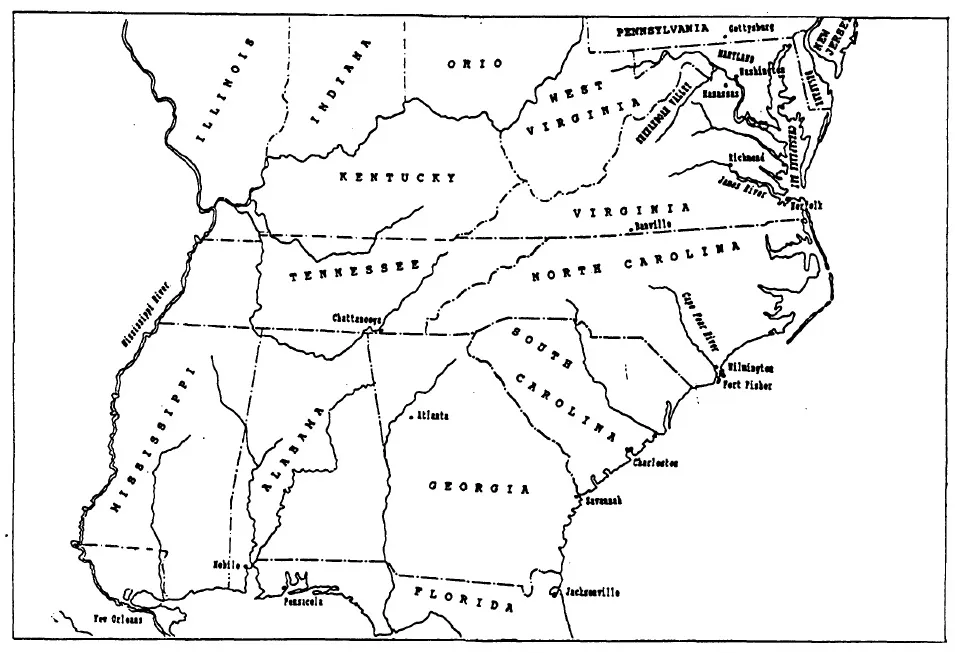
Figure 2. Southeastern United States
Scott was severely criticized by the press, who dubbed his plan “The Anaconda Plan,”{8} because of his desire to enact such a passive stance toward the rebellious Southerners. Many of his subordinates, who also criticized him, believed that the proper approach should be a decisive assault on Richmond. Scott also believed that the Union Army was not prepared and it needed time to build-up a strong enough force to achieve such a victory. Lincoln accepted Scott’s proposal as the basis for the overall Union strategy, but yielded to the masses and agreed to an early assault on Richmond which failed as Scott had predicted.
The James River Basin in southeastern Virginia was a strategic inland waterway during the Civil War. Flowing from the mountains in western Virginia, through the Confederate capital in Richmond, and into the Chesapeake Bay, this river was vitally important to the interests of both the Union and Confederacy. Richmond was not only the capital city, but it was the premier industrial center, as well as one of the two main munitions centers in the Confederacy.
Where the river joined the Chesapeake it was flanked to the north by Fort Monroe and to the south by the shipyard in Norfolk. At the outbreak of the war, Union forces had been overrun in Norfolk and had lost one of the major shipyards in the country. Fort Monroe and the southern tip of the Virginia Peninsula were held, affording the Union an entrance to the eastern approaches of Richmond, and a base for operations against the Confederacy.
With Union naval superiority maintaining control of the Chesapeake Bay, it was critical for the Confederacy to retain control of Norfolk and the James River. Norfolk was the key to the control of the lower James River and the southeastern approaches to Richmond. Residents of Richmond feared Union control of the James River because there was no assurance that the Union Navy could not silence or pass defenses along the James. Furthermore, the James afforded the Federals the ability to conduct joint land-water operations all the way into Richmond. The loss of Norfolk would also make the Confederate controlled sounds of North Carolina vulnerable from its northern flank.
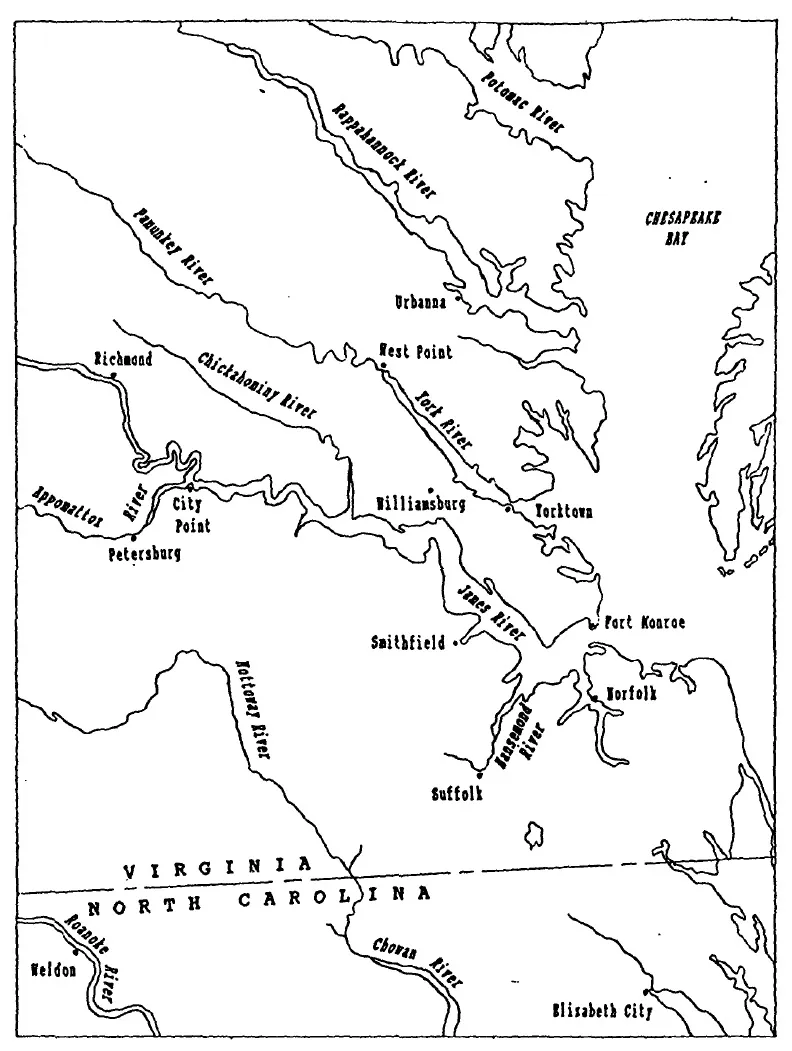
Figure 3. Southeastern Virginia
Chapter two is an examination of the Peninsula Campaign, conducted from April to June 1862. This campaign, conducted by the Union forces on the Peninsula of Southeastern Virginia and surrounding waters, will provide insight into the problems encountered by the...
Table of contents
- Title page
- TABLE OF CONTENTS
- ABSTRACT
- LIST OF ILLUSTRATIONS
- CHAPTER ONE-INTRODUCTION
- CHAPTER TWO-PENINSULA CAMPAIGN
- CHAPTER THREE-ADMIRAL LEE AND THE GENERALS
- CHAPTER FOUR-BUTLER’S ADVANCE MAY-JUNE 1864
- CHAPTER FIVE-SIEGE WARFARE
- CHAPTER SIX-TAKING OF RICHMOND
- CHAPTER SEVEN-CONCLUSION
- APPENDIX A-VESSELS
- APPENDIX B-BIOGRAPHY
- BIBLIOGRAPHY
Trusted by 375,005 students
Access to over 1.5 million titles for a fair monthly price.
Study more efficiently using our study tools.
Frequently asked questions
Yes, you can cancel anytime from the Subscription tab in your account settings on the Perlego website. Your subscription will stay active until the end of your current billing period. Learn how to cancel your subscription
No, books cannot be downloaded as external files, such as PDFs, for use outside of Perlego. However, you can download books within the Perlego app for offline reading on mobile or tablet. Learn how to download books offline
Perlego offers two plans: Essential and Complete
- Essential is ideal for learners and professionals who enjoy exploring a wide range of subjects. Access the Essential Library with 800,000+ trusted titles and best-sellers across business, personal growth, and the humanities. Includes unlimited reading time and Standard Read Aloud voice.
- Complete: Perfect for advanced learners and researchers needing full, unrestricted access. Unlock 1.5M+ books across hundreds of subjects, including academic and specialized titles. The Complete Plan also includes advanced features like Premium Read Aloud and Research Assistant.
We are an online textbook subscription service, where you can get access to an entire online library for less than the price of a single book per month. With over 1.5 million books across 990+ topics, we’ve got you covered! Learn about our mission
Look out for the read-aloud symbol on your next book to see if you can listen to it. The read-aloud tool reads text aloud for you, highlighting the text as it is being read. You can pause it, speed it up and slow it down. Learn more about Read Aloud
Yes! You can use the Perlego app on both iOS and Android devices to read anytime, anywhere — even offline. Perfect for commutes or when you’re on the go.
Please note we cannot support devices running on iOS 13 and Android 7 or earlier. Learn more about using the app
Please note we cannot support devices running on iOS 13 and Android 7 or earlier. Learn more about using the app
Yes, you can access Joint Operations In The James River Basin, 1862–1865 by LCDR David K. Zatt in PDF and/or ePUB format, as well as other popular books in History & 19th Century History. We have over 1.5 million books available in our catalogue for you to explore.