- 47 pages
- English
- ePUB (mobile friendly)
- Available on iOS & Android
eBook - ePub
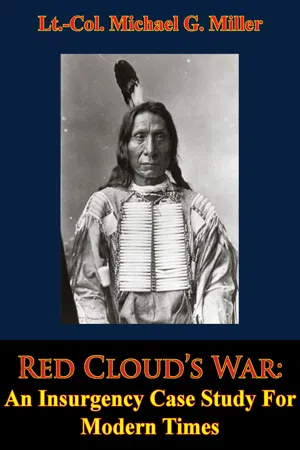
Red Cloud's War: An Insurgency Case Study For Modern Times
About this book
This will be a case study of the little known Fetterman Massacre of 1866. It will look the situation at the time, possible causes, key players, the massacre itself and the aftermath. Similarities to the counterinsurgency in Afghanistan will be noted where applicable throughout this paper. A case will be proposed that the Army was ill prepared for the Indian Wars of the latter 19th Century, just as they were initially ill prepared for an extended Afghanistan Insurgency Campaign. Connections are drawn showing that there were lessons learned in 1866 that are still appropriate today. Familiarity with them, along with other more recent examples, will better prepare the Army to fight counterinsurgencies in the future.
Information
Subtopic
Social Science BiographiesIndex
Social SciencesRED CLOUD’S WAR: AN INSURGENCY CASE STUDY FOR MODERN TIMES
As the Army learned after the invasions of Iraq and Afghanistan, they’ve done this before. The United States has a history of fighting insurgencies dating back to the mid-19th Century. It is in vogue once again to read historical case studies, particularly those from the 20th Century, to gain insight in how to better prosecute today’s insurgent war in Afghanistan. In fact, most of the principles espoused in FM 3-24, the U.S. Army manual on Counterinsurgency, are based on case studies from the 20th Century.{1} But there’s at least one very long and similar campaign against a similar insurgent foe: the American Indian Wars. Counterinsurgency today, or “COIN” as it is referred to, is a relatively new American term for counterinsurgency, but the fight with insurgents it refers to is much older-even ancient-when referring to irregular enemies.{2} The U.S. Army Indian Wars of the 19th Century, while being similar, remain little studied in today’s COIN academic circles. This paper will specifically be a case study of Red Cloud’s War of 1866, which consisted of the various depredations committed by the Sioux, Cheyenne, and Arapahoe upon frontier settlements and emigrants between the years 1863 and 1868.{3} Red Cloud’s War remains the only one to have been won by the Indians.{4} While it’s true that Custer’s defeat at the battle of Little Big Horn was a bigger single battle loss, the Indians ultimately lost the overall war. This study will look at the opening of the Bozeman Trail and how it fundamentally changed the history of Wyoming and Montana. And finally, it will take a detailed look at the Fetterman Massacre at Ft. Phil Kearny, Dakota Territory on December 21st, 1866 and its effects on the Army, government, society and the Indians. Throughout this study, similarities to modern counterinsurgency in Afghanistan will be noted. It shall become clear to the reader that COIN, although a relatively new term in the American lexicon, is not new in the history of America. This case study will show a lack of proper strategic guidance, failure to properly organize, train and equip the troops, failure to understand a tribally based enemy with a true warrior ethos, reluctance & ignorance in the use of available intelligence, failure to adequately evaluate and use available terrain, and a lack of leadership from the commanding officer.
Many similarities exist between the Indian Wars of the 19th Century and the ongoing COIN efforts in Afghanistan against the Taliban. They include: extremely long lines of supply; rugged terrain, remote forts & outposts, severe winters, tribal based enemy with a warrior culture, and a cunning/mobile/adaptable and elusive enemy whose tactics differ greatly from the U.S. Army.
When finished reading this case study, it will be clear that a little known, but important battle from the Indian Wars had a large effect on the service, the government and U.S. society in general. The relevance of this case study and similar historical military examples may be considered just one more tool in a commander’s toolkit when applied to today’s ongoing war in Afghanistan. Note that Native American, First Peoples, American Indian are all typically referred to in this paper as “Indian” to: 1) Use the term that was used in 1866, and 2) Be concise.
This document is divided into seven sections: the background and context of the time in America, the U.S. Army and American Indians in 1866; Key Players; the movement of the Army into the Powder River Country; the situation which set the stage for the fight; the Fetterman Massacre; after effects of the battle; and a brief comparison to the Afghanistan Campaign with some lessons learned.
Background
Ten years before the infamous massacre of George Armstrong Custer and his forces at the Little Big Horn, another very similar yet little known battle occurred in the Powder River Country of Wyoming. The Fetterman Massacre as it came to be known was the key and defining battle of Red Cloud’s War, and one of the most important of the Indian Wars Campaign. This battle resulted in the largest defeat of U.S. Army troops by American Indians, until eclipsed 10 years later at Custer’s Last Stand. In fact, had the Custer debacle not taken place, Fetterman’s would probably be a household name. This is a chapter of American History full of high drama, controversy and one that remains shrouded in some mystery. What led to that battle then, is a story of a U.S. War with American Indians over possession and ownership of disputed territory. It was an effort by the U.S. Army to pacify an aroused and dangerous enemy. America, in its Manifest Destiny was expanding west. There was treasure to be had, and to get to it the immigrants had to pass through Indian Country. This is essentially about the strong, newly victorious (in the Civil War) U.S. Government wanting to take something they desired from the American Indians whom they misguidedly perceived as weak. That statement of human nature speaks volumes and is probably true for most of the wars throughout history. Clausewitz said, “War is an act of force to compel our enemy to do our will.”{5} In this case, the U.S. Government had a desire to occupy and traverse an area containing the Indian’s most sacred hunting grounds. Three traditionally powerful Indian Nations: the Lakota Sioux, Cheyenne, Arapahoe and other allies were determined to resist the momentum of the white man’s westward migration. Previous attempts had been made by the government at negotiation, but to no avail. Thus for the Indians, as Clausewitz put it, “War was merely the continuation of policy by other means.”{6} This was in essence their most valuable and sacred land, and a very basic survival interest. They were not going to give it up without a fight.{7} This fascinating story is not just about the Fetterman fight; it is also about the Bozeman Trail, Fort Phil Kearny, the defensive minded commanding officer named Carrington, a saber wielding Lieutenant named Grummond and a determined, powerful Sioux leader named Red Cloud.{8} It is important to understand the context of the era, as it is in any historical case study, to see the key role it plays in setting the stage.
The mid 1860’s Army was trying to find itself after a long and bloody Civil War. Fiscal constraints and new non-traditional requirements meant that downsizing and reorganization was needed to meet new tasks and challenges. Western posts clearly illustrated the main problem facing the Army in the 1860’s: a woefully ineffective logistics system causing a basic lack of resources.{9} On the 21st of December 1866, the U.S. Army and it’s perception of the Indian Wars was forever changed by events on the Bozeman Trail. At Ft. Phil Kearny in the Powder River, the Army assigned a very difficult task to a leader and officers who each seemed to be set on their own agenda. Some were vain, overconfident and in search of glory; others were timid, lacking confidence and the leadership skills necessary to do the job.
That day Capt. William J. Fetterman took a force of 81 troops made up of infantry, cavalry and civilians from Ft. Phil Kearny, in an attempt to rescue a wood train which was under attack by the Indians. What followed was the culmination of tensions which had been building for nearly a year, which resulted in utter failure and complete destruction of Fetterman’s command. As such, it was the first large scale victory of an Indian force over a single large U.S. Army command. The events leading up to that day, the massacre and that which followed would help change the Army forever.
The Indian Wars of the 19th C...
Table of contents
- Title page
- TABLE OF CONTENTS
- ABSTRACT
- RED CLOUD’S WAR: AN INSURGENCY CASE STUDY FOR MODERN TIMES
Trusted by 375,005 students
Access to over 1.5 million titles for a fair monthly price.
Study more efficiently using our study tools.
Frequently asked questions
Yes, you can cancel anytime from the Subscription tab in your account settings on the Perlego website. Your subscription will stay active until the end of your current billing period. Learn how to cancel your subscription
No, books cannot be downloaded as external files, such as PDFs, for use outside of Perlego. However, you can download books within the Perlego app for offline reading on mobile or tablet. Learn how to download books offline
Perlego offers two plans: Essential and Complete
- Essential is ideal for learners and professionals who enjoy exploring a wide range of subjects. Access the Essential Library with 800,000+ trusted titles and best-sellers across business, personal growth, and the humanities. Includes unlimited reading time and Standard Read Aloud voice.
- Complete: Perfect for advanced learners and researchers needing full, unrestricted access. Unlock 1.5M+ books across hundreds of subjects, including academic and specialized titles. The Complete Plan also includes advanced features like Premium Read Aloud and Research Assistant.
We are an online textbook subscription service, where you can get access to an entire online library for less than the price of a single book per month. With over 1.5 million books across 990+ topics, we’ve got you covered! Learn about our mission
Look out for the read-aloud symbol on your next book to see if you can listen to it. The read-aloud tool reads text aloud for you, highlighting the text as it is being read. You can pause it, speed it up and slow it down. Learn more about Read Aloud
Yes! You can use the Perlego app on both iOS and Android devices to read anytime, anywhere — even offline. Perfect for commutes or when you’re on the go.
Please note we cannot support devices running on iOS 13 and Android 7 or earlier. Learn more about using the app
Please note we cannot support devices running on iOS 13 and Android 7 or earlier. Learn more about using the app
Yes, you can access Red Cloud's War: An Insurgency Case Study For Modern Times by Lt.-Col. Michael G. Miller in PDF and/or ePUB format, as well as other popular books in Social Sciences & Social Science Biographies. We have over 1.5 million books available in our catalogue for you to explore.