- 30 pages
- English
- ePUB (mobile friendly)
- Available on iOS & Android
eBook - ePub
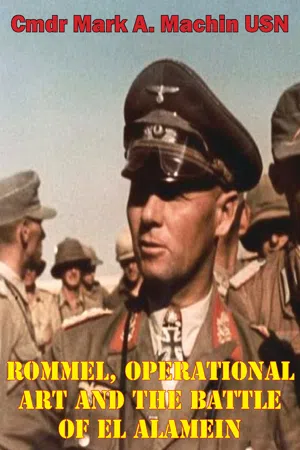
Rommel, Operational Art And The Battle Of El Alamein
About this book
Field Marshal Rommel's North African Campaign demonstrates many of the limitations and restricting factors of modern warfare. Examining the Axis Alliance preparation, implementation and sustainment of its operations provides insight applicable to the warfare commander of today. Relevancy is obtained through analysis of the Axis coalition command and control structure, tactical battle operations, strategic strategy, weapon technology, use of intelligence and logistical support network. Rommel's successful offensive through Libya and Egypt was ended at the Battle of El Alamein due to the critical influence of these factors. His exploits demonstrate excellence of battlefield tactics at the expense of strategic strategy and logistical sustainment.
Trusted by 375,005 students
Access to over 1.5 million titles for a fair monthly price.
Study more efficiently using our study tools.
Information
Subtopic
European HistoryIndex
HistoryROMMEL, OPERATIONAL ART AND THE BATTLE OF EL ALAMEIN
CHAPTER I — INTRODUCTION
The North African Campaign between the Allied and Axis forces during 1941 to 1943 faced many of the obstacles present in modern warfare. It was based on support of coalition forces and was exposed to all the limitations of that structure. Italy set the stage in Libya with its unrealistic military goals that could not be supported by-its poorly trained troops, outmoded equipment and weak leadership. The British were present in Egypt separated by only a wire fence along the border to Libya. They were there to protect assets viewed critical to Allied war strategy and once Italy joined the war, attacked the Italian positions. This was the beginning of the North African Campaign that would last for 28 months, involve desert warfare from Egypt to Tunisia and mark the end of Axis presence in Africa.
Hitler feared that Mussolini would take Italy out of the Axis Alliance if critically defeated in Africa and elected to send a supporting defensive force. This was commanded by General Rommel, later to become Field Marshal, who surpassed all expectations in battlefield success. He also presented the Axis leadership with unexpected demands and problems that directly affected Hitler's global war strategy. How the Axis powers dealt with North Africa is a good demonstration of the requirements faced by current leaders in their warfare strategy. Examination of Rommel's operational art exposes the basic effects of the principles of war and exhibits many of the limitations and critical areas prevalent in warfare.
This paper will concentrate on the period from Germany's intervention in February 1941 until the defeat at the Battle of El Alamein in November 1942. Rommel's most successful offensives and final retreat took place during this time. It will look at the introduction of Rommel's tactics, strategy and personality into the battlefield. The effects of concentration on the tactical level of war at the expense of both operational planning and strategic guidance will be examined. Poor coordination of strategy, diverging goals and ineffective command and Control are viewed in the context of coalition warfare. The debilitating effect from lack of adherence to logistical preparation and limitations is investigated. Emphasis will be given to the difficulty Rommel faced in meeting his logistical requirements and the critical effects on his plans. Allied response to Rommel's strategy, competing force comparisons and Allied strengths and weaknesses will also be examined.
CHAPTER II — AXIS OFFENSIVE TO EL ALAMEIN
Prelude to Rommel. During the early stages of World War II, the western desert of North Africa served as the border of the British defense of critical Middle East oil and access to the Suez Canal. The British viewed the Italian held positions in Libya as a threat to their assets. {1}Following Italy's entering of the war in June 1940, the heavily outnumbered British forces began incursions across the double wire fence into Libya and met with success against the Italian troops. An Italian counter-offensive force of 215, 000 men advanced against the British forces of 36, 000 men in September 1940. The British were initially pushed back but after receiving reinforcements of troops and heavy armor, succeeded in outflanking the Italian Libyan defenses. The British drive under General O'Connor into Cyrenaica effectively destroyed the Italian resistance and resulted in the capture of over 130, 000 prisoners. {2}
Hitler saw the loss of North Africa as more important to the maintenance of the Axis Alliance than as loss of a critical military position. In comparison to other commitments in the Balkans, North Africa was a secondary theater in importance. The British were also preoccupied with the Axis movement in the Balkans and reduced their troop strength and logistics away from North Africa. This was the general situation presented to Rommel when he arrived in Libya in February 1941 as commander of the Deutsche Afrika Korps (DAK){3}
The German campaign in North Africa was to last until the British and United States captured the Tunisian cities of Tunis and Bizerta in Hay 1943. This opened the entire North African coast to Allied control, allowed the exposure of Italy to invasion and ended t...
Table of contents
- Title page
- TABLE OF CONTENTS
- Abstract
- CHAPTER I - INTRODUCTION
- CHAPTER II - AXIS OFFENSIVE TO EL ALAMEIN
- CHAPTER III - BATTLE OF EL ALAMEIN
- CHAPTER IV - APPLICATION
- CHAPTER V - CONCLUSION
- BIBLIOGRAPHY
Frequently asked questions
Yes, you can cancel anytime from the Subscription tab in your account settings on the Perlego website. Your subscription will stay active until the end of your current billing period. Learn how to cancel your subscription
No, books cannot be downloaded as external files, such as PDFs, for use outside of Perlego. However, you can download books within the Perlego app for offline reading on mobile or tablet. Learn how to download books offline
Perlego offers two plans: Essential and Complete
- Essential is ideal for learners and professionals who enjoy exploring a wide range of subjects. Access the Essential Library with 800,000+ trusted titles and best-sellers across business, personal growth, and the humanities. Includes unlimited reading time and Standard Read Aloud voice.
- Complete: Perfect for advanced learners and researchers needing full, unrestricted access. Unlock 1.5M+ books across hundreds of subjects, including academic and specialized titles. The Complete Plan also includes advanced features like Premium Read Aloud and Research Assistant.
We are an online textbook subscription service, where you can get access to an entire online library for less than the price of a single book per month. With over 1.5 million books across 990+ topics, we’ve got you covered! Learn about our mission
Look out for the read-aloud symbol on your next book to see if you can listen to it. The read-aloud tool reads text aloud for you, highlighting the text as it is being read. You can pause it, speed it up and slow it down. Learn more about Read Aloud
Yes! You can use the Perlego app on both iOS and Android devices to read anytime, anywhere — even offline. Perfect for commutes or when you’re on the go.
Please note we cannot support devices running on iOS 13 and Android 7 or earlier. Learn more about using the app
Please note we cannot support devices running on iOS 13 and Android 7 or earlier. Learn more about using the app
Yes, you can access Rommel, Operational Art And The Battle Of El Alamein by Cmdr Mark A. Machin USN in PDF and/or ePUB format, as well as other popular books in History & European History. We have over 1.5 million books available in our catalogue for you to explore.