- 62 pages
- English
- ePUB (mobile friendly)
- Available on iOS & Android
eBook - ePub
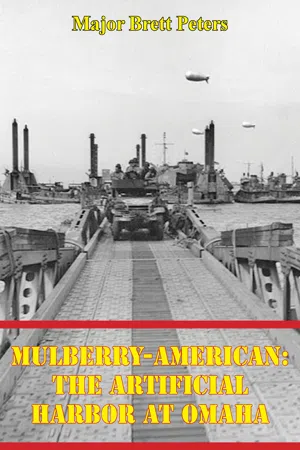
Mulberry-American: The Artificial Harbor At Omaha
About this book
The Overlord operation is a widely studied episode in military history. Often overlooked is a little known U.S. operation designed to overcome logistical problems in the Overlord plan. For the first 90 days of combat the Overlord operation would not benefit from major ports to sustain the build-up and counter the German attempt to push the Allies back into the sea. The Allies planned, designed, and constructed two artificial harbours to overcome the lack of ports. The harbours were known by the code name, Mulberry. The components were towed across the English channel with the invasion fleet and constructed under enemy fire. Mulberry A, the A stood for American, was completed three days ahead of schedule and doubled the throughput of U.S. supplies over the Normandy beachhead. Mulberry A was destroyed by a summer gale after only three days of operation and subsequently abandoned. Effective beaching LSTs during the operation led many critics to conclude that Mulberry A supply operations had little effect on the Overlord operation. To the contrary, using modern assessment methods, it can be concluded that the Mulberry operation was effective and influenced the outcome of the cross channel attack.
CHAPTER 1 — CODE NAME MULBERRY
After the tragedy at Gallipoli in World War I Allied military leaders gave little credence to the concept of opposed beach assaults. The British Army prior to World War II had discounted the concept of an opposed assault as not viable and instead focused on landings on unopposed terrain. The U.S. Army acknowledged that opposed assaults may be necessary but failed to develop doctrine on beach assaults and instead chose to rely on the U.S. Marine Corps doctrine. The surprising capitulation of the French army in 1940 made an opposed amphibious assault a very real possibility as the Allies had no foothold on the mainland from which to launch any offensive against Germany. If there was to be victory over the Germans an opposed beach assault in German occupied France would be unavoidable. In preparation for just such a reality the Allies proceeded with operation Bolero in 1942. Operation Bolero was the codename for the U.S. forces build up in Great Britain. While Bolero began the massive build-up of U.S. forces, operation Sledgehammer was planned. Sledgehammer was to be an opportunistic assault into German controlled France should the German army fall into disarray due to failures in Russia. In 1943 it became apparent to the Allies that a Sledgehammer opportunity was not forthcoming and the plan was shelved. Planning for operation Sledgehammer gave way to what was called operation Roundup, which later became operation Overlord.{1}
The Allied invasion of Normandy remains one of the most fascinating operations in military history. No student of history can ignore the grandeur, individual stories of heroism, and terror that the beach assault at Normandy embodies. It is easy to focus on the heroic aspects of the Normandy invasion and the sacrifices made, but what cannot be overlooked is that the invasion could not have taken place had one major limitation not been solved. Overlord planners had difficulty working through the problem of how to sufficiently supply the invading forces.
The answer was to build an artificial sheltered harbour in England, tow it across the English Channel and install it under fire as the D Day invasion took place.
The decision to embark on such a massive and expensive operation both in material and manpower was not taken lightly. Construction of the artificial harbours, codenamed Mulberry, was the only apparent answer to problems experienced in earlier amphibious operations. It was imperative that the errors made in assaults prior to Overlord not be repeated at Normandy. Errors and miscalculations at Dieppe, North Africa, Sicily, and Anzio were taken into account in brutally honest after action reports. These after action reports were not are ignored by Overlord planners. If the same errors made in smaller operations were made at Normandy the results could not be so readily overcome in an operation of such magnitude.
The most significant lesson was the calamity at Dieppe 19 August 1942. In the commando raid at Dieppe Allied forces failed in an attempt to take a French port in a direct assault. The operation at Dieppe ended with appalling casualties to British and Canadian commandos, and Army Rangers. The Dieppe raid demonstrated to planners the very real likelihood that a direct assault from the sea would not be possible without unspeakable casualties, if the assault were possible at all.
Lessons learned at Anzio gave Overlord planners pause until the logistics question could be sufficiently addressed. Critical review of the Anzio operations demonstrated to Allied planners that their ability to logistically support forces over the beaches was limited at best. Allied forces learned that a successful beachhead assault, even unopposed, cannot overcome inadequate logistics methods and slow resupply of ammunition, equipment, and replacements.
Original Overlord plans for the invasion of France called for an initial assault of only three divisions. It was calculated by planners that the initial beachhead assault might be supplied solely over beach, but logisticians would need to supply a total of twelve divisions by the end of the first week. By the end of the first month logisticians would need to supply twenty four divisions solely over beaches; if a port could not be captured intact quickly enough Overlord would end in catastrophe. Adding to the problem for planners, operation Overlord’s initial assault plan was later changed to five divisions, compounding the logistical issues.
The operations logistics gap was an issue throughout planning for Overlord. Even if planners reduced the operation’s size in order to account for beach resupply, the objectives were deemed difficult to reach and incurred too much risk. Early planning assumptions were based on limited objectives. The Normandy invasion was intended only to create an administrative base from which further operations could be launched and supplied. In every estimate even with limited objectives Allied forces reached logistical culmination before major resistance was even encountered. With the resources available in England in 1942 and early 1943 planners determined beach resupply by itself was out of the question, supply had to be augmented.
Particularly glaring to Overlord planners was the imperative to overcome in the Atlantic Wall. The wall itself was not just a propaganda tool concocted by Doctor Goebbels; the wall was a very real concern to planners. The term Atlantic Wall had a deeper meaning. On the surface, the Atlantic Wall represented the fortifications and guns placed on the French coast to repel invasion, but to Overlord logistics planners the Atlantic Wall was not just the beach fortifications, but the inevitable mobile counterattack. The panzers of the German 7th Army represented the most dangerous obstacle to the success of the operation, more dangerous than any beach fortification. The only hedge against keeping Allied forces from being pushed back into the sea was to land sufficient supplies and heavy equipment to defeat a German counterattack. Such quantities of supplies could only be brought in fast enough without fully functional ports. The Atlantic Wall had to be broken by logistics. Gen. Omar Bradley said on the eve of the invasion, “Just as soon as we land, this business becomes primarily a business of build-up. For you can almost always force invasion, but you can't always make it stick.”{2}
German planners estimated that the Allies needed to land one million personnel to overcome the fifty plus German divisions available in Western Europe. Some among the German staff were largely unconcerned about Allied forces gaining a beachhead; they knew that without the benefit of a port for the invasion the Allies could not land the necessary infantryman, armour, and artillery to overcome a German counter offensive. The key component of the German plan to defeat the Allied invasion was to deny, at all costs, the use of a port.
In order to defeat Germany, an opposed beach assault by Allied forces must successfully gain a beachhead in France and move inland to establish the necessary administrative bases to sustain further offensive operations. Such forces could only be sustained by a working port. Without a functional sheltered port or the ability to capture a large port intact, the answer was artificial ports code named Mulberry; build a harbour in England and bring the structure with the invasion force. Overlord was given the green light by national leadership and the operations would move forward with Mulberry as a most secret but key component. The harbours, constructed in England and towed across the English Channel, were designed to give the needed additional logistical support only a sheltered port could provide. The two harbours installed on the far shore were the result of fantastic vision, detailed planning, and almost superhuman exertion all with a single goal in mind; support the combat soldier during the breakout at Normandy. To this end, how effective were the harbours completed at Normandy? Mulberry A (American), constructed at Omaha Beach and Mulberry B (British) constructed at Arromanches near Juno beach, were an enormous and expensive endeavour both in manpower and material. Critics have stated that in the end Mulberry A was wasteful, unnecessary, and played little role in the overall success of Overlord. Many believe the value of Mulberry A was other than its logistical output or gross tonnage. This paper will touch on such statements.
In chapter 2 the logistics means and methods the Allied forces had available to them will be analyzed. Logistics capabilities, available shipping, and other factors vital to Overlord logistics planners require scrutiny. Chapter 3 will further focus on the planning for the Mulberry harbours. Chapter 4 will focus primarily on Mulberry A operations. Precisely what took place, when, and what were the effects Mulberry A operations had on the Allied breakout at Normandy? The study of operations in chapter 4 will focus primarily on the United States operations at Mulberry A; however, British operations at Arromanches cannot be ignored due primarily to U.S. forces use of Mulberry B after the destruction of Mulberry A at D+13. Finally, chapter 5 will establish that the initial 6 decision regarding Mulberry A by U.S. senior leaders was wrong, and their assessments, flawed.
CHAPTER 2 — LOGISTICAL MEANS AND METHODS
Deep within the rationale behind the overall Overlord plan was a logistical problem. Overlord in its inception was to provide logistics bases from which to launch further operations. There was little thought given to decisive operations. The preponderance of the planning was based on logistics and how to out build the Germans logistically. How the British and Americans were to accomplish this was a difficult question. Planners had to ask, how were they to supply such an operation without the use of ports?
The problem of landing supplies over the beach was a new and unanswered question for logistics planners. Planners were working under the resource restrictions of 1942 43 while working out the details for a cross channel attack. There were severe limitations on English shipbuilding in 1942 43. After a suitable invasion location was found, Normandy, commanders calculated that Allied forces could not be maintained entirely through captured ports until D+90. A portion of the lines of communication would have to be maintained over the beaches and, on a very limited basis, through the air, for the first three months.{3}
With these issues in mind the enabling factors of the invasion would centre on shipping, beach organization, and port reconstruction. Each factor was extremely important to the Overlord maintenance plan. Most important to Mulberry, however were the shipping aspects of the plan.
Planners identified early that there was a severe lack of available landing craft. Nearly all of England’s shipbuilding capacity was dedicated to the manufacture of merchant vessels and combat ships for use in the U Boat campaign. Logistics planning for a cross channel attack was based on the capabilities and limitations of known craft, and for logistics the craft of most concern were primarily the Landing Craft Tank (LCT) and Landing Ship Tank (LST). The LST was a 1,500 ton cargo vessel the British had yet to see and the LCT was a smaller 284 ton landing craft.
Planning cantered on the LST and LCT as the primary means of pushing tonnage over the beaches. The most important vessel for discharge of supplies was the LST. The LST was a 327 foot, 1,500 ton vessel of British design, capable of carrying 2,000 tons of tanks and other supplies.{4} What made the LST unique was the LSTs size coupled with the ability to discharge supplies directly onto the beach. Due to British limitations in shipbuilding early in the war, the LST design was given to the Americans for construction and delivery under the Lend Lease Act. Other smaller craft had the same capability of landing and discharging on the beach, but the LST was much larger and could carry those same craft to th...
Table of contents
- Title page
- TABLE OF CONTENTS
- ABSTRACT
- ACRONYMS
- CHAPTER 1 - CODE NAME MULBERRY
- CHAPTER 2 - LOGISTICAL MEANS AND METHODS
- CHAPTER 3 - PLANNING FOR MULBERRY
- CHAPTER 4 - MULBERRY A OPERATIONS
- CHAPTER 5 - CONCLUSIONS
- ILLUSTRATIONS
- GLOSSARY
- APPENDIX A - MULBERRY TIMELINE
- APPENDIX B - CODE NAMES
- BIBLIOGRAPHY
Trusted by 375,005 students
Access to over 1.5 million titles for a fair monthly price.
Study more efficiently using our study tools.
Information
Publisher
Lucknow BooksYear
2015Topic
HistorySubtopic
European HistoryeBook ISBN
9781786250742
Index
HistoryFrequently asked questions
Yes, you can cancel anytime from the Subscription tab in your account settings on the Perlego website. Your subscription will stay active until the end of your current billing period. Learn how to cancel your subscription
No, books cannot be downloaded as external files, such as PDFs, for use outside of Perlego. However, you can download books within the Perlego app for offline reading on mobile or tablet. Learn how to download books offline
Perlego offers two plans: Essential and Complete
- Essential is ideal for learners and professionals who enjoy exploring a wide range of subjects. Access the Essential Library with 800,000+ trusted titles and best-sellers across business, personal growth, and the humanities. Includes unlimited reading time and Standard Read Aloud voice.
- Complete: Perfect for advanced learners and researchers needing full, unrestricted access. Unlock 1.5M+ books across hundreds of subjects, including academic and specialized titles. The Complete Plan also includes advanced features like Premium Read Aloud and Research Assistant.
We are an online textbook subscription service, where you can get access to an entire online library for less than the price of a single book per month. With over 1.5 million books across 990+ topics, we’ve got you covered! Learn about our mission
Look out for the read-aloud symbol on your next book to see if you can listen to it. The read-aloud tool reads text aloud for you, highlighting the text as it is being read. You can pause it, speed it up and slow it down. Learn more about Read Aloud
Yes! You can use the Perlego app on both iOS and Android devices to read anytime, anywhere — even offline. Perfect for commutes or when you’re on the go.
Please note we cannot support devices running on iOS 13 and Android 7 or earlier. Learn more about using the app
Please note we cannot support devices running on iOS 13 and Android 7 or earlier. Learn more about using the app
Yes, you can access Mulberry-American: The Artificial Harbor At Omaha by Major Brett Peters in PDF and/or ePUB format, as well as other popular books in History & European History. We have over 1.5 million books available in our catalogue for you to explore.