Includes over 100 maps, plans and illustrations
The United States Air Force reached its nadir during the opening two years of the Rolling Thunder air campaign in North Vietnam. Never had the Air Force operated with so many restraints and to so little effect. These pages are painful but necessary reading for all who care about the nation's military power.
Jacob Van Staaveren wrote this book in the 1970s near the end of his distinguished government service, which began during the occupation of Japan; the University of Washington Press published his book on that experience in 1995. He was an Air Force historian in Korea during the Korean War, and he began to write about the Vietnam War while it was still being fought. His volume on the air war in Laos was declassified and published in 1993. Now this volume on the air war in North Vietnam has also been declassified and is being published for the first time. Although he retired to McMinnville, Oregon, a number of years ago, we asked him to review the manuscript and make any changes that seemed warranted. For the most part, this is the book he wrote soon after the war.
Readers of this volume will also want to read the sequel, Wayne Thompson's To Hanoi and Back: The U.S. Air Force and North Vietnam, 1966-1973, which tells the more encouraging story of how the Air Force employed airpower to far greater effect using a combination of better doctrine, tactics, technology, and training.
![Gradual Failure: The Air War Over North Vietnam 1965-1966 [Illustrated Edition]](https://img.perlego.com/book-covers/3018372/9781786253989_300_450.webp)
eBook - ePub
Gradual Failure: The Air War Over North Vietnam 1965-1966 [Illustrated Edition]
- 370 pages
- English
- ePUB (mobile friendly)
- Available on iOS & Android
eBook - ePub
Gradual Failure: The Air War Over North Vietnam 1965-1966 [Illustrated Edition]
About this book
Information
Subtopic
Military & Maritime HistoryIndex
HistoryCHAPTER 1—Flaming Dart
At approximately two in the morning of February 7, 1965, a small band of Viet Cong (VC) insurgents, numbering between six and ten men, breached the last strands of barbed wire protecting the small U.S. Advisory Detachment of II Corps, popularly known as the MACV compound, about 4.5 kilometers north of Pleiku in the central highlands of South Vietnam. Entering the compound, they placed several small demolition charges with delay fuses of four to five seconds along the north wall of the main building and against the entrance gate. A U.S. sentry, Jesse Pyle, who was on duty in a sandbagged area near a billet, moved to investigate. Suddenly a charge four feet away exploded prematurely, mortally wounding Pyle. Proceeding with their stealthy attack, the Viet Cong quickly detonated three more charges, which blasted off the entrance gate, hit a mess office, and tore a hole through the roof of the main building. They threw sixteen more charges through the damaged wall and windows of the building, then sprayed it with fire from 7.62-mm automatic weapons. In the attack, which lasted from ten to fifteen minutes, the Viet Cong killed Pyle and wounded twenty-four other Americans and destroyed five rooms and damaged twelve more. There were no Vietnamese casualties.
Almost simultaneously, about 6.5 kilometers distant but still close to Pleiku, two small assault teams consisting of five to six Viet Cong and each armed with demolition charges and 81-mm mortars, entered the runway and aircraft parking area at Camp Holloway, the headquarters of the U.S. Army’s 52d Aviation Battalion. One team placed demolition charges on the landing gear and under the fuselages of several aircraft while the other broke through a barbed wire fence near the helicopter ramp and placed charges on helicopter skis. As the charges exploded, the Viet Cong fired their mortars at nearby billets, engulfing them in flame and mortar fragments. This assault, which also lasted between ten and fifteen minutes, caused much greater carnage than the one at the MACV compound: 7 American soldiers were killed and 104 were wounded. Again, there were no Vietnamese casualties. On or near the airfield, five Army UH-1B helicopters had been reduced to smoldering ruins. The toll of major or minor damage further included eleven UH-1B helicopters, two CV-2 transports, three O-1F forward air control (FAC) aircraft, and one Vietnamese air force (VNAF) O-1F stationed temporarily at the airfield.
At about the same time, near the coastal town of Tuy Hoa, the Viet Cong fired 81-mm mortars into villages and two gas storage tanks near a VNAF airstrip, destroying the tanks. A fourth attack was carried out on a village about fifteen miles northeast of Nha Trang. No Americans were injured in the last two incidents.
At the MACV compound and Camp Holloway, the scenes of the major assaults, the Americans responded immediately with firearms and search but they were not able to capture any of the infiltrators. A post-action report attributed the surprising and successful onslaught chiefly to lack of vigilance on the part of security units of the South Vietnamese Army (popularly known as ARVN, for the Army of Vietnam) in the Pleiku area. While officially the chief guarantor of safety for American installations, the ARVN’s habitual state of undermanning and low level of alertness were further diminished by the week-long Lunar New Year Tet celebrations that had ended the previous day. Another factor was the attitude of the populace of Pleiku Province. Consisting largely of Montagnard tribal groups whose loyalties were to family and tribe rather than to the Saigon government or to the Viet Cong, they were not inclined to sound an alarm.{1}
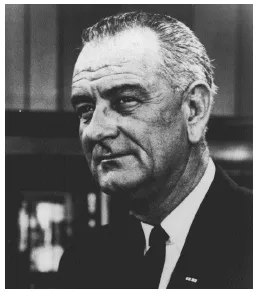
President Lyndon B. Johnson.
The United States Considers a Reprisal Attack
It was the afternoon of February 6, 1965, in Washington when news of the Viet Cong depredations at the MACV compound and Camp Holloway reached the White House. Faced with this last and most serious in a chain of “significant” Viet Cong “incidents,” President Lyndon B. Johnson braced for renewed pressure from some of his advisers to conduct an air strike on North Vietnam in reprisal. When he learned of the extent of devastation at Pleiku, he ordered a meeting of the National Security Council (NSC) for 7:45 that evening.{2}
Meanwhile, the President awaited further reports from American officials in Saigon. By coincidence, his special adviser on National Security Affairs, McGeorge Bundy, was in the South Vietnamese capital assessing the faltering military and political fortunes of the Saigon government with Ambassador Maxwell D. Taylor, Deputy Ambassador U. Alexis Johnson, and Gen. William C. Westmoreland, Commander of the U.S. Military Assistance Command, Vietnam (COMUSMACV). Bundy’s recommendation, endorsed by Taylor, Johnson, and Westmoreland, was that the two attacks at Pleiku called for an immediate air riposte on North Vietnam.{3}
Despite the unanimity of views in Saigon, the President and some of his advisers were apprehensive. On February 4, a few days before the assault at Pleiku, Soviet Premier Alexei N. Kosygin, arrived in Hanoi accompanied by military and economic advisers. It was assumed, and soon confirmed, that the Soviets would offer more aid to North Vietnam. Their presence in the capital prompted American officials to delay and then cancel a special patrol by the U.S. Seventh Fleet, planned earlier and nicknamed De Soto, off the coast of North Vietnam, and to order the Coral Sea and the Hancock, two of three Seventh Fleet carriers, to “stand down” from a “fully alert” status and head for the American naval base at Subic Bay in the Philippines. Only the carrier Ranger was instructed to remain “on alert” at the Yankee Station area in the Gulf of Tonkin off the North Vietnamese coast. The main purpose of the De Soto patrol, normally a one-destroyer type of operation to collect electronic intelligence and harass the North Vietnamese,{4} was to make a “show of force” and elicit a military response that might justify a retaliatory air strike by the United States. In preparation for this eventuality, at the request of the Joint Chiefs of Staff (JCS), the Commander in Chief, Pacific Command (CINCPAC) had compiled a list of North Vietnamese targets. It contained three strike options for Seventh Fleet carrier aircraft and for Pacific Air Force (PACAF) aircraft based in South Vietnam and Thailand.{5}
The NSC members and attendees who assembled with the President on February 6 to review the attack on American installations at Pleiku included Robert S. McNamara, the Secretary of Defense; Gen. Earle G. Wheeler, Chairman of the JCS; George Ball, Under Secretary of State (sitting in for the absent Secretary, Dean Rusk); senate majority leader, Mike Mansfield; and house speaker John McCormack. General Wheeler unequivocally urged a quick reprisal air strike on the north. His recommendation was supported by and had been made repeatedly in previous months by all of the service chiefs, especially by Gen. Curtis E. LeMay, the Air Force Chief of Staff who had just retired.{6} The service chiefs were convinced that air strikes against the Hanoi regime were the quickest way to arrest the political and military decline of the Saigon government. Other advisers, particularly McNamara and Rusk, had insisted that Saigon’s military and political problems should be ameliorated before an air program was begun against the northern adversaries. The magnitude of the Viet Cong’s attack at Pleiku forcibly changed opinions.
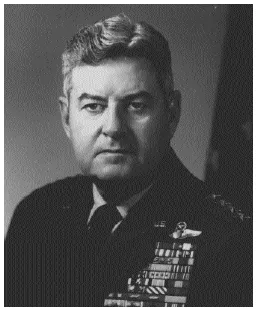
Gen. Curtis E. LeMay, Air Force Chief of Staff, 1961-1965.
With the strongly supportive views of Bundy, Taylor, and Westmoreland before them, the NSC members and attendees now agreed that a reprisal air strike was mandatory. Senator Mansfield alone was not persuaded. He feared that an air strike on the north might trigger a war with China or heal Sino-Soviet disputes. In the President’s opinion, the senator offered no alternative American response to the attack at Pleiku. The NSC conferees were heartened by the latest U.S. intelligence assessment that China would not intervene in the war unless the United States invaded the north or the Hanoi regime was in danger of being overthrown. Encouraged by the call for action by his principal officials in Saigon and Washington, the President concurred. For the chief executive, the hour was a dramatic one for intelligence assurances could not completely dispel lingering uncertainties concerning the way in which the communist countries would respond to the proposed air strike. The President later recalled:{7}
“As we talked, there was an electric tension in the air. Everyone in the room was deadly serious as he considered the possible consequence of this decision. Each man around the table knew how crucial such action could be. How would Hanoi react? Would the Chinese Communists use it as a pretext for involving themselves? What about Kosygin and the Russians in Hanoi?”
From the original three-option target list compiled by CINCPAC, the President selected four targets in southern North Vietnam associated with communist infiltration into the south, and directed U.S. aircraft to hit three and the Vietnamese air force (VNAF) to strike one. The importance of VNAF participation in action against the north to demonstrate U.S.-Vietnamese solidarity of purpose had been stressed by Ambassador Taylor and General Westmoreland in earlier planning.
In addition to strike options, the target list prepared for the Air Force and Navy contained the approximate number...
Table of contents
- Title page
- TABLE OF CONTENTS
- FOREWORD
- THE AUTHOR
- ILLUSTRATIONS
- PRINCIPLES U.S. AIR BASES
- INTRODUCTION
- CHAPTER 1-Flaming Dart
- CHAPTER 2-Planning
- CHAPTER 3-Rolling Thunder Begins
- CHAPTER 4-Gradual Expansion
- CHAPTER 5-Pause and Escalation
- CHAPTER 6-The SAM Threat
- CHAPTER 7-Toward the Thirty-seven-Day Bombing Halt
- CHAPTER 8-Diplomacy Fails
- CHAPTER 9-Rolling Thunder 50
- CHAPTER 10-The POL Strikes
- CHAPTER 11-Summary and Reappraisal
- GLOSSARY
- BIBLIOGRAPHY
Trusted by 375,005 students
Access to over 1.5 million titles for a fair monthly price.
Study more efficiently using our study tools.
Frequently asked questions
Yes, you can cancel anytime from the Subscription tab in your account settings on the Perlego website. Your subscription will stay active until the end of your current billing period. Learn how to cancel your subscription
No, books cannot be downloaded as external files, such as PDFs, for use outside of Perlego. However, you can download books within the Perlego app for offline reading on mobile or tablet. Learn how to download books offline
Perlego offers two plans: Essential and Complete
- Essential is ideal for learners and professionals who enjoy exploring a wide range of subjects. Access the Essential Library with 800,000+ trusted titles and best-sellers across business, personal growth, and the humanities. Includes unlimited reading time and Standard Read Aloud voice.
- Complete: Perfect for advanced learners and researchers needing full, unrestricted access. Unlock 1.5M+ books across hundreds of subjects, including academic and specialized titles. The Complete Plan also includes advanced features like Premium Read Aloud and Research Assistant.
We are an online textbook subscription service, where you can get access to an entire online library for less than the price of a single book per month. With over 1.5 million books across 990+ topics, we’ve got you covered! Learn about our mission
Look out for the read-aloud symbol on your next book to see if you can listen to it. The read-aloud tool reads text aloud for you, highlighting the text as it is being read. You can pause it, speed it up and slow it down. Learn more about Read Aloud
Yes! You can use the Perlego app on both iOS and Android devices to read anytime, anywhere — even offline. Perfect for commutes or when you’re on the go.
Please note we cannot support devices running on iOS 13 and Android 7 or earlier. Learn more about using the app
Please note we cannot support devices running on iOS 13 and Android 7 or earlier. Learn more about using the app
Yes, you can access Gradual Failure: The Air War Over North Vietnam 1965-1966 [Illustrated Edition] by Jacob Van Staaveren in PDF and/or ePUB format, as well as other popular books in History & Military & Maritime History. We have over 1.5 million books available in our catalogue for you to explore.