Illustrated with over a hundred maps.
When the Soviet Union invaded Afghanistan in 1979, few experts believed that the fledgling Mujahideen resistance movement had a chance of withstanding the modern, mechanized, technologically-advanced Soviet Army. Most stated that resistance was futile and that the Soviet Union had deliberately expanded their empire to the south. The Soviet Union had come to stay. Although some historians looked at the British experience fighting the Afghan mountain tribesmen, most experts discounted any parallels since the Soviet Union possessed an unprecedented advantage in fire power, technology and military might. Although Arab leaders and the West supplied arms and material to the Mujahideen, they did so with the hope of creating a permanent, bleeding ulcer on the Soviet flank, not defeating the Soviet Union. They did not predict that the Soviet Union would voluntarily withdraw from Afghanistan in 1989.
There have been few studies of guerrilla warfare from the guerrilla's perspective. To capture this perspective and the tactical experience of the Mujahideen, the United States Marine Corps commissioned this study and sent two retired combat veterans to interview Mujahideen. The authors were well received and generously assisted by various Mujahideen who willingly talked about their long, bitter war. The authors have produced a unique book which tells the guerrillas' story as interpreted by military professionals. This is a book about small-unit guerrilla combat. This is a book about death and survival, adaptation and perseverance.
![The Other Side Of The Mountain: Mujahideen Tactics In The Soviet-Afghan War [Illustrated Edition]](https://img.perlego.com/book-covers/3018411/9781782894766_300_450.webp)
eBook - ePub
The Other Side Of The Mountain: Mujahideen Tactics In The Soviet-Afghan War [Illustrated Edition]
- 402 pages
- English
- ePUB (mobile friendly)
- Available on iOS & Android
eBook - ePub
The Other Side Of The Mountain: Mujahideen Tactics In The Soviet-Afghan War [Illustrated Edition]
About this book
Information
Subtopic
Military & Maritime HistoryIndex
HistoryTHE OTHER SIDE OF THE MOUNTAIN: Mujahideen Tactics in the Soviet-Afghan War
CHAPTER 1 — AMBUSHES
The ambush is a favorite tactic of the guerrilla since it allows him to mass forces covertly, attack the enemy, seize needed supplies and retreat before the enemy can effectively react. The ambush has long been part of the Afghan warrior tradition and has been a key feature of historic Afghan warfare—whether fighting other tribes, the British or the government. The Mujahideen ambush served to attack the Soviet/DRA lines of communication, provided needed supplies, and forced the bulk of Soviet/DRA maneuver forces to perform security missions. Logistics were key to the conduct of the Soviet/Afghan War and Mujahideen ambushes threatened the resupply of Soviet and DRA forces and limited the number of Soviet troops that could be deployed into the country. The Mujahideen ambush was their most effective counter to Soviet/DRA military activity and threatened the ability of the Soviets and DRA to prosecute the war.
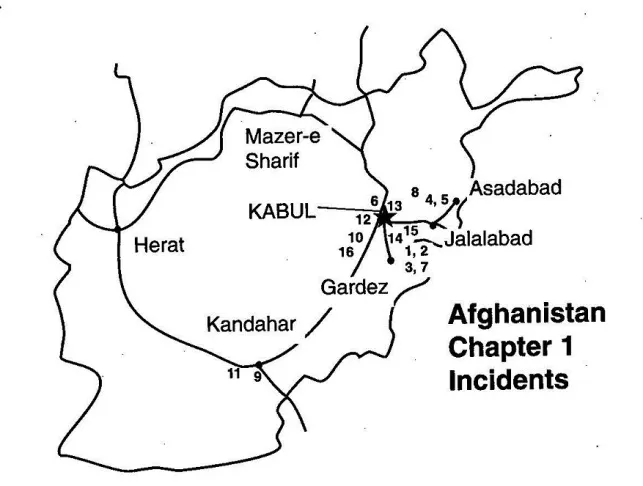

VIGNETTE 1 — AMBUSHES AT THE MAMUR HOTEL by Commander Mohammad Akbar{8}
A day seldom passed without a clash between the Mujahideen and the Soviets or DRA in Logar Province. In the summer of 1980, my group set an ambush to attack a supply column of Soviet and DRA forces moving from Kabul to Gardez on highway 157. At that time, the populace had not migrated from the area and it was full of people. The Mujahideen had contacts in the government who reported on the movement of columns along the main highway. This was to be our first attack on a major column on this highway following the Soviet invasion. The ambush site was located around the Pul-e Qandahari junction with the main highway. At this point, the Logar River comes within 200 meters of the highway to the east, and the Kuh-e Mohammad Agha hills rise some 700 meters over the highway to the west. Ten kilometers to the south, the road runs through a steep gorge where vehicles cannot easily turn back (Map 1 Mamur 1). We had 50 Mujahideen armed with Mosin-Nagant carbines, Enfield rifles and two RPG-7s. Our leader, Commander Hayat, divided our men into three groups and put one group in the Bini Sherafghan ruins some 70 meters west of the road. He put the second group to the east of the road around the Mamur Hotel and put the third group to the east in Pul-e Qandahari facing the Mohammad Agha High School. Our ambush occupied a two-kilometer stretch. At this time, I was the late Commander Hayat’s deputy commander, commanding the Pul-e Qandahari positions.
Commander Hayat ordered that the attack would start when the end of the column reached the Bini Shirafghan ruins. The DRA column came. It had about 100 vehicles carrying food, ammunition and fuel. There were quite a few POL tankers in the column. We let it pass and, as the end of the column reached the ruins, we started to attack at the end of the column. In those days, convoy escort was very weak and air support was insufficient. There was practically no resistance or reaction to our attack from the column. Even the APCs which were escorting the column were passive. We left our positions and started moving up the column, firing as we went, and damaged or destroyed almost all the vehicles. We had no casualties. I don’t know how many DRA casualties there were, but we wounded many drivers who the government evacuated later. We left the area promptly after the ambush.
The area around the Mamur Hotel was ideal for an ambush and we, and other Mujahideen groups, used it often. In September 1981, we set an ambush at the Mamur Hotel and in Pule-e Qandahari facing the high school. The Mamur Hotel group was commanded by the noted HIH commander Doctor Abdul Wali Khayat and the Pule-Qandahari position was commanded by my commander, the late Commander Hayat. There were some 35 Mujahideen armed with AK-47 rifles and three RPG-7s. The ambush site occupied about one kilometer of roadway. When the column arrived, we destroyed twelve trucks and captured three intact. The three trucks were large, heavy-duty, eight-cylinder trucks and they were loaded with beans, rice and military boots. We needed all this gear. We also captured two 76mm field guns and a heavier gun that I don’t know the type or caliber. We did not have any Mujahideen casualties.
In July 1982, the late Doctor Wali Khayat set an ambush near the Mamur Hotel. A Soviet column, moving supplies from Kabul to Gardez, entered the ambush kill zone. During the attack, one Mujahideen fired an RPG-7 at an escorting APC. It hit the APC and a Soviet officer jumped out of the damaged APC and took cover. The officer was wounded. While the fighting was going on, the column sped up and left the ambush area—and left the officer behind. Doctor Abdul Wali Khayat fired at the position where the Soviet officer was. The Soviet officer returned fire with his AK-74. Doctor Khayat fired again and wounded the Soviet officer a second time—this time in the hand. The Soviet officer dropped his AK-74 and took out his pistol. Doctor Khayat threw a hand grenade at the officer and killed him. Then he crossed the road and took his AK-74 and his Makarov pistol. He left the body where it lay and the Mujahideen left the ambush site.
The next day the Soviets returned in a column from Kabul. They cordoned off the area and searched the houses around Mohammad Agha District headquarters and the town of Kotubkhel. They went house to house looking for their missing officer. HIH commander Sameh Jan was in Kotubkhel at that time. He coordinated and organized the actions of all the Mujahideen factions which were caught in the cordon. There were about 150 Mujahideen caught in the cordon. The Mujahideen began attacking the searching Soviets. They launched sudden, surprise attacks in the close streets and alleys of the villages and in the spaces between the villages. The fighting was often at point-blank range. The fighting began in the morning and continued until the late afternoon (Map 2 Mamur 2). Soviet casualties are unknown but we think that they were heavy. The Mujahideen captured four AK-74s. Mujahideen casualties were seven KIA including Sameh Jan. Most of the dead Mujahideen had run out of ammunition. The Soviets captured the weapons of the dead Mujahideen including some AK-47s, a Goryunov machine gun, an RPG-7 and a few AK-74s captured from the Soviets in the past. As the Soviets got involved in fighting, they stopped searching. As daylight waned, the Soviets disengaged, took their dead and withdrew back to Kabul. They did find and evacuate the body of their officer who Doctor Khayat killed the day before. It was still lying where he was killed.

VIGNETTE 2 — YET ANOTHER AMBUSH AT THE MAMUR HOTEL by Toryalai Hemat{9}
My mobile regiment fought in many provinces in Afghanistan during the war. One of our battles was in Mohammad Agha District of Logar Province. The Jihad began here attacking columns between Gardez and Kabul. This action occurred on 8 July 1986. It was a joint action with the HIH Mujahideen commanded by Doctor Wali Khayat and was reported in the media. It was a small ambush involving 13 Mujahideen armed with two RPG-7s, one PK machine gun and 10 AK-47s. Seven of the Mujahideen were my men and six were HIH. We set the ambush in Kotubkhel near the Mamur Hotel which sits beside the main highway. I split the force into two groups. I put a six-man group on the east side of the road along the Logar River bank. At this point the river is some 40 meters from the road and some two meters lower than the surrounding ground. This site is by the hotel. ‘I put my seven-man group on the west side of the road on high ground. This site is a little further to the south, about 150 meters from the hotel. The high ground is known as Gumbazo Mazogani by the locals. There was an RPG-7 at both sites. We had instructed the group that if the column came from Kabul the furthest group (the western group on the high ground) would fire first to get the column into the kill zone. That would be the river site’s signal to fire. We prepared our high ground positions in a ditch which was not visible from the road. It is some 200 meters from the road. We camouflaged our positions well (Map 3 Mamur 3).
Our base was three kilometers southeast of Mohamad Agha south of the village of Qala-e Shahi near Ahmadzi Kala. We moved from Ahmadzi Kala at midnight. It took us one hour to reach the ambush site. I was with the western group. We took our positions in the ditch. At that time, there was fighting in Paktia Province, Jajai District and the enemy was moving reinforcements to the area. In the morning, a reinforcing column came. We opened fire when it reached us and the eastern ambush site opened up as well. We destroyed or damaged two armored vehicles, three jeeps and eight trucks. Some trucks turned back to Kabul and others were abandoned. There were some intact abandoned trucks outside the kill zone. Dead and wounded lay on the ground. Only damaged vehicles were left in the kill zone. We had no casualties. In one of the jeeps we found some movie projectors. We also captured 11 AKs, two pistols and one heavy machine gun (which was mounted on an armored vehicle). We took what we could and split the spoils. HIH got all the projectors. We left and went to Wazir Kala some four kilometers away. Helicopter gunships came and fired at our old positions. Four Soviet helicopters came and took away their dead and wounded. We stayed in Wazir Kala for two or three hours. The helicopters were bombing and strafing the positions all of this time. In the late afternoon, when everything settled down, we returned to the area to search and see what was left. We removed the heavy machine gun and projectors at this time. We stopped a passing bus and asked the passengers for matches. At first they refused, not wanting to be accomplices, so we searched their pockets and got some matches and set fire to the damaged vehicles. Two days later, the Soviets sent a force to search our old positions. Of the 13 men in the ambush, only Baryali, Asef of HIH and I survived the war.
COMMENTARY: Both the Soviets and Mujahideen set patterns. The Mujahideen use the Mamur Hotel ambush site over and over again, yet apparently the Soviets or DRA seldom dismounted troops to search the area to spoil the ambush or to try to set a counterambush. This last example is from 1986, yet there seems to be no learning curve on the part of the Soviets. Air support is tardy, artillery fire is unavailable and there is no reserve to move against the ambush. Aggressive patrolling, specially-trained counter-ambush forces and priority counter-ambush intelligence are lacking. The standard Soviet/DRA counter-ambush techniques include an aerial patrol in front of the column, an engineer sweep in front of the column looking for mines, armored vehicles in the front of the column, occasional armored vehicles throughout the column and a robust rear guard. Once hit, the armored vehicles in the column would return fire while the soft-skin vehicles tried to drive out of the kill zone. Seldom would the ambushed force dismount forces to clear the ambush site and pursue the ambush party.
The Mujahideen did vary ambush positions in the same ambush site. Their primary concern was to hit the column where it was weakest—usually in the middle or rear—unless the purpose was to bottle up the column. In most ambushes, a small number of highly-mobile Mujahideen were able to move and attack with little logistic support, but were unable to conduct a sustained fight. The RPG-7 was probably the most effective weapon of the Mujahideen. When used at close quarters with the element of surprise, it was devastating.
In this region, Mujahideen ambushes occupied a very wide front. This was a function of the open terrain and the spacing between convoy vehicles. Convoy SOP was to maintain 100 meters or more between vehicles. In order to have enough vehicles in the kill zone to make the ambush worthwhile, the Mujahideen had to constitute a kill zone much bigger than that employed by most Western armies.

VIGNETTE 3. — AMBUSH SOUTH OF THE TANGI WAGHJAN GORGE by Haji Sayed Mohammad Hanif{10}
In May 1981, we joined other Mujahideen for an ambush in Kolangar District, Logar Province (Map 4 Kolangar). We were 11 Mujahideen with an RPG-7, seven Kalashnikovs and two Enfields. We moved into the area the night before, spent the night in a village and set up our ambush site the next morning north of Kolangar District Headquarters. We were told that a column was coming from Kabul to Gardez, and so we had time to set up during the daylight before the column arrived, since the convoys always left Kabul in the morning well after dawn. Kabul is about 50 kilometers north of the ambush site. We set our ambush just south of the Tangi Waghjan Gorge. There, the river continues to run parallel to the road and restricts maneuver while providing better firing positions for the ambush force. We had a collapsed electric pylon that we stretched across the road as a road block. We put in an RPG firing position for Mulla Latif,{11} our RPG gunner, and put two other Mujahideen on the edge of the river in positions. Then we set up the rest of our positions and went to some nearby houses for breakfast. At that time we were so popular with the population that we didn’t have to worry about supplies and the people were always feeding us in their homes or sending us prepared food. Mulla Latif left his RPG at the ambush position since the people were moving about freely and would keep an eye on thing...
Table of contents
- Title page
- TABLE OF CONTENTS
- INTRODUCTION
- FOREWORD
- ACKNOWLEDGMENTS
- PREFACE
- CHAPTER 1 - AMBUSHES
- CHAPTER 2 - RAIDS
- CHAPTER 3 - SHELLING ATTACKS
- CHAPTER 4 - ATTACKING A STRONG POINT
- CHAPTER 5 - MINE WARFARE
- CHAPTER 6 - BLOCKING ENEMY LINES OF COMMUNICATIONS
- CHAPTER 7 - SIEGE WARFARE
- CHAPTER 8 - DEFENDING AGAINST RAIDS
- CHAPTER 9 - FIGHTING HELIBORNE INSERTIONS
- CHAPTER 10 - DEFENDING AGAINST A CORDON AND SEARCH
- CHAPTER 11 - DEFENDING BASE CAMPS
- CHAPTER 12 - COUNTERAMBUSH
- CHAPTER 13 - ENCIRCLEMENT
- CHAPTER 14 - URBAN COMBAT
- CHAPTER 15 - CONCLUSION
- REQUEST FROM THE PUBLISHER
- GLOSSARY
- SYMBOLS LIBRARY
- ABOUT THE AUTHORS
Trusted by 375,005 students
Access to over 1.5 million titles for a fair monthly price.
Study more efficiently using our study tools.
Frequently asked questions
Yes, you can cancel anytime from the Subscription tab in your account settings on the Perlego website. Your subscription will stay active until the end of your current billing period. Learn how to cancel your subscription
No, books cannot be downloaded as external files, such as PDFs, for use outside of Perlego. However, you can download books within the Perlego app for offline reading on mobile or tablet. Learn how to download books offline
Perlego offers two plans: Essential and Complete
- Essential is ideal for learners and professionals who enjoy exploring a wide range of subjects. Access the Essential Library with 800,000+ trusted titles and best-sellers across business, personal growth, and the humanities. Includes unlimited reading time and Standard Read Aloud voice.
- Complete: Perfect for advanced learners and researchers needing full, unrestricted access. Unlock 1.5M+ books across hundreds of subjects, including academic and specialized titles. The Complete Plan also includes advanced features like Premium Read Aloud and Research Assistant.
We are an online textbook subscription service, where you can get access to an entire online library for less than the price of a single book per month. With over 1.5 million books across 990+ topics, we’ve got you covered! Learn about our mission
Look out for the read-aloud symbol on your next book to see if you can listen to it. The read-aloud tool reads text aloud for you, highlighting the text as it is being read. You can pause it, speed it up and slow it down. Learn more about Read Aloud
Yes! You can use the Perlego app on both iOS and Android devices to read anytime, anywhere — even offline. Perfect for commutes or when you’re on the go.
Please note we cannot support devices running on iOS 13 and Android 7 or earlier. Learn more about using the app
Please note we cannot support devices running on iOS 13 and Android 7 or earlier. Learn more about using the app
Yes, you can access The Other Side Of The Mountain: Mujahideen Tactics In The Soviet-Afghan War [Illustrated Edition] by Lester K. Grau,Ali Ahmad Jalali in PDF and/or ePUB format, as well as other popular books in History & Military & Maritime History. We have over 1.5 million books available in our catalogue for you to explore.