eBook - ePub
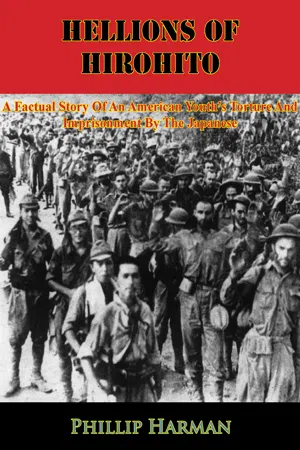
Hellions Of Hirohito: A Factual Story Of An American Youth's Torture And Imprisonment By The Japanese
- 144 pages
- English
- ePUB (mobile friendly)
- Available on iOS & Android
eBook - ePub
Hellions Of Hirohito: A Factual Story Of An American Youth's Torture And Imprisonment By The Japanese
About this book
This is a factual story of a young American civilian imprisoned and tortured by the Japanese when they conquered Hong Kong. In a foreword by General Russell Hearn, who was instrumental in organizing the quasi-military Flying Tigers, there is an interesting personal reaction to the events described in the book in which he states for the record that "I believe there is no race of people on this earth quite as treacherous as the Japanese. Theirs is a treachery veiled by soft words and cunning smiles." Harman's account mostly mirrors this sentiment. The book itself dwells on the inadequacy of the Allied defense in Hong Kong, the brave efforts of the volunteers and civilians to hold the city, and the brutal acts committed by the victorious enemy against British and American civilians. Harman found himself stranded when the city fell, having worked for several years in the East on behalf of the United China Relief agency. Reporting on the beatings, the inadequate food, even the wanton incidents of Japanese soldiers raping women, he tells a story told before, including bouts of dysentery and afflictions of beri-beri while in captivity. Eventually, Harman describes his return to safety in America when he was exchanged for a Japanese national stranded in the United States.—Great Stories of World War II
Information
Subtopic
European HistoryIndex
HistoryCHAPTER I
The Japanese officers at the concentration camp nicknamed me “Yankee Boy”...that was when they wanted me to become another “Lord Haw Haw” and broadcast from Tokyo. When they were about to disembowel me in Hong Kong, I was called by other names!
As I review all that occurred to me, my mind is always primarily focused on a great, vacant office in a certain building in Hong Kong. The happenings during the brief interval of time that I was in that room are emblazoned upon my brain, probably never to be obliterated...those cruel, grinning faces of the Japanese soldiers...that demoniacal gleam in the eyes of the Japanese officer...that long, flashing knife pointed at my stomach...my lips forming a prayer my mother had taught me as a child...
It was then that all of the important episodes of my life passed before me in fantastic, kaleidoscopic manner...everything distorted...weird....
Now that I am back in my own America, I am able to give a coherent account of all of the dramatic events that occurred.
* * * * *
I will start at the beginning.
I guess I am an average American youth. My principal distinction during my school days in Berkeley, California, was my rather exceptional skill at tennis. The old saying about being “born with a silver spoon” might be changed in my case to being “born with a tennis racket.”
I had a great love of the game...trying to outwit the player on the other side of the net...dashing back and forth to hit the elusive white ball...leaping, side stepping, bending, with the blood coursing through my veins...thrilling to the applause of the onlookers at an exceptionally skillful return of the ball....All of these things exalted me and gave a zest to life.
I believe, if a person loves to do a thing with all his heart, he can manage to excel at it. At any rate, when my father decided that it would be advantageous for me to go to school in London, England, I found that I had received sufficient recognition to be allowed to play against some of the world-famous champions of Europe. While competing in the many tennis championship matches in England, I played with such outstanding players as Miss Kay Stammers, Mary Hardwick and Bunny Austin.
My obsession for tennis possibly had a lot to do with my retaining a clean moral standard. I refused to take up the habits of smoking and drinking, fearing that indulgence would lessen my stamina in the matches; and as for the girls,—well, I just had no time for them. That is, until I met Nana in Hong Kong!
It was in London in 1938 that I met the man who was destined to be the factor in my life that would lead me into horrible adventures in the Orient.
W. C. Choy, otherwise known as “Choy Wai-cheun,” was one of the most exceptional men I have ever met. He was a Chinese gentleman in every sense of the word, a graduate of the University of Cambridge and a member of the Chinese Davis Cup Tennis team. He was only twenty-seven years of age, just eight years older than I. He was short and slender. A brilliant scholar, he spoke English perfectly, as well as several other languages. He was unusually suave and continental for a Chinese. His face was radiant; when looking into his deep-set brown eyes, one would naturally fall under the influence of his magnetic personality and be glad to have a chance to talk with him.
I first met Choy in September, 1938, while I was standing in the Croydon airport with thousands of others who had gathered to witness the arrival of Premier Chamberlain after his visit with Hitler at Munich. I was present because I had a youthful curiosity and desire to be in on unusual events.
Chamberlain alighted from his plane with a smile on his aesthetic face. In his hand he held a document which he waved at the crowd as he shouted:
“We have a treaty with Hitler!”
The dome-like walls of the airdrome resounded from the applause of the people. When the tumult had subsided, I was aware that someone next to me was muttering. Turning, I saw a Chinese gentleman standing close to me. I stared at him when I caught what he was saying.
“A treaty with Hitler is worse than a treaty with the Devil!”
Choy, for it was he, caught my gaze and smiled.
“You do not seem to be overjoyed at the fact that Mr. Chamberlain has made a peace-pact with Germany,” I remarked.
“Little can be relied upon when making a treaty with an ego-maniac,” he replied. “I have had the opportunity of studying the Fuehrer at close quarters. You English are idealistic. It is difficult for you to understand the mechanistic, materialistic German temperament.”
“But I am an American,” I told him.
“I can see that now,” he observed. “Your accent deceived me for the moment.”
I explained that I was attending school in London and that I lived nearby in Wandsworth, southwest London. Somehow I wanted to know this man better. I asked him if he would come to my quarters for tiffin. To my pleasure he accepted readily. Our long talk that evening in my room will always be a pleasant memory.
The house where I lived was very ancient and constructed after the medieval English pattern. Mrs. Burch, my landlady, fitted into the atmosphere of it splendidly...a strange, silent, elderly woman. When she brought tea and cakes for Mr. Choy and me, I caught her looking askance at him. It was apparent that she did not approve of my friendliness with a Chinese.
Choy and I sat in front of the great brick fireplace and discussed politics, the characteristics of both American and Chinese people, literature...but principally tennis. Upon learning that Choy was a member of the Chinese Davis Cup Tennis team, I was elated. When he finally departed, reluctantly I was glad to note, it was with the understanding that we would meet for a tennis match the following day.
In the following weeks Choy and I became close friends. He turned out to be an expert with the tennis racket, and, in my opinion, one of the most graceful players I have ever seen...possibly because he was Chinese. Most Chinese I have observed are graceful. He had a certain style in his playing that was delightful to watch. He was somewhat lacking in speed, but his clever knowledge of the game from its subtler aspects made up for this deficiency. His service and forehand were only fair, but his backhand was in a class all by itself and equal to that of Don Budge.
I trust I shall be forgiven for my occasional rhapsodies about tennis. You see—now—I have to talk more about it than play it. The Japanese wrecked my health to an extent where it may be a long time before I Can again put up real competition.
How true was Choy’s prediction on the day that I first met him! Hitler continued his rape of the small European countries, and it became more and more evident that England would have to go to war.
I stayed on as long as possible, regretting the thought of losing the cherished companionship of my new friend and of leaving the romantic, old-world atmosphere of England. Yet, at times, I was desperately lonely for America...I knew that no other place on earth could hold me for any great length of time.
Choy went with me to Southampton, where my ship, the S. S. Volendam of the Holland American Line was making ready to sail for New York.
“We shall meet again, Phillip,” Choy said to me as he shook my hand.
“Do you really think so, Choy?” I asked anxiously.
He smiled. “We Orientals believe very deeply the things we want to believe.”
I was unable to find words which would be suitable for a reply to his remark, so I turned and dashed up the gangway, barely reaching the deck when the whistle sounded for the plank to be taken away.
Looking back at the receding outline of the English coast, I noticed that black storm clouds were gathering and gradually hiding the white cliffs from view. I experienced a strange foreboding and walked to the foredeck to look toward the West.
Home...! To a young man who has traveled extensively in his younger years, I guess “home” means a place to come back to, to be thankful for, and then to use as a place of waiting for further adventures. At least, I’ll admit it was more or less that way with me.
It was grand to see my mother and father again...to rediscover my old friends...very satisfying to find that my tennis matches in England had won a new place for me in the California tournaments. But as the months went by I found myself longing to be on the move again.
It seemed that my wish was to be gratified for in September, 1939, I had the great privilege of playing tennis with Miss Elizabeth Ryan, former holder of nineteen Wimbledon titles and one of the greatest women tennis stars of all time.
Miss Ryan expressed an admiration for my playing and, to my surprise and somewhat to my amusement, she told me that she was on her way to Honolulu and would like to have me go with her. She smiled when she noticed the look on my face at this announcement.
“Don’t be alarmed,” she said. “I mean I would like to have you go with me to assist me in teaching tennis at the Royal Hawaiian Hotel in Honolulu.”
I was too overcome to answer her immediately. I visualized living at the Royal Hawaiian Hotel...having the honor of working with this wonderful lady and brilliant tennis player...listening to soft voiced Hawaiian girls singing against the crash of breakers on Waikiki Beach...watching great round moons peering through banyan trees...swinging my tennis racket with the same fervor the young Greek athletes in ancient days found in throwing the discus. Yes, life was very romantic to me at that time! I am not much older now, but somehow I feel that I have aged many years since my experience in Hong Kong.
My reply to Miss Ryan was brief and to the point:
“I shall be very happy to accompany you, Miss Ryan. When do we leave?”
“So steady in your tennis playing,” she replied with a smile, “and so impetuous in your decisions. Suppose you think it over and let me know tomorrow after you talk with your parents.”
Dad and mother were always wonderful sports. If I wanted to go, I should go. I think they had but one desire—my welfare and happiness. The next morning I certainly had not changed my mind!
My experience in Hawaii is another story. In this book I have but one vital, significant narrative to relate. Suffice it to say, therefore, that my work in Hawaii and my association with Miss Ryan remain among the happiest memories of my life. Probably I would have stayed on and would have been there when the Pearl Harbor episode took place were it not for my friend Choy.
It was an air mail letter received from him at the Royal Hawaiian Hotel that brought me back to Berkeley. He told me in this letter that due to the heavy bombings in London and throughout England, he had thought it advisable to return to China via America. He expected to be in San Francisco in about a month. Could I join him there?
Strange is the pull of friendship. As much as I enjoyed living in Honolulu, there was a stronger desire to see Choy. I left Honolulu on the next steamer bound for San Francisco.
Not long after my return to San Francisco, Choy arrived and took up his quarters at one of the smaller hotels. He telephoned to me at my home in Berkeley, and I hastily packed a bag. When we met, Choy and I greeted each other warmly. I engaged a room at the same hotel and there we remained for several months.
It was in those months that I developed an ambition to assist the Chinese people. Choy, during many evenings of talk, told me of the great sufferings of his people in their valiant figh...
Table of contents
- Title page
- TABLE OF CONTENTS
- FOREWORD
- CHAPTER I
- CHAPTER II
- CHAPTER III
- CHAPTER IV
- CHAPTER V
- CHAPTER VI
- CHAPTER VII
- CHAPTER VIII
- CHAPTER IX
- CHAPTER X
- CHAPTER XI
- CHAPTER XII
- CHAPTER XIII
- CHAPTER XIV
- CHAPTER XV
- CHAPTER XVI
- CHAPTER XVII
Trusted by 375,005 students
Access to over 1.5 million titles for a fair monthly price.
Study more efficiently using our study tools.
Frequently asked questions
Yes, you can cancel anytime from the Subscription tab in your account settings on the Perlego website. Your subscription will stay active until the end of your current billing period. Learn how to cancel your subscription
No, books cannot be downloaded as external files, such as PDFs, for use outside of Perlego. However, you can download books within the Perlego app for offline reading on mobile or tablet. Learn how to download books offline
Perlego offers two plans: Essential and Complete
- Essential is ideal for learners and professionals who enjoy exploring a wide range of subjects. Access the Essential Library with 800,000+ trusted titles and best-sellers across business, personal growth, and the humanities. Includes unlimited reading time and Standard Read Aloud voice.
- Complete: Perfect for advanced learners and researchers needing full, unrestricted access. Unlock 1.5M+ books across hundreds of subjects, including academic and specialized titles. The Complete Plan also includes advanced features like Premium Read Aloud and Research Assistant.
We are an online textbook subscription service, where you can get access to an entire online library for less than the price of a single book per month. With over 1.5 million books across 990+ topics, we’ve got you covered! Learn about our mission
Look out for the read-aloud symbol on your next book to see if you can listen to it. The read-aloud tool reads text aloud for you, highlighting the text as it is being read. You can pause it, speed it up and slow it down. Learn more about Read Aloud
Yes! You can use the Perlego app on both iOS and Android devices to read anytime, anywhere — even offline. Perfect for commutes or when you’re on the go.
Please note we cannot support devices running on iOS 13 and Android 7 or earlier. Learn more about using the app
Please note we cannot support devices running on iOS 13 and Android 7 or earlier. Learn more about using the app
Yes, you can access Hellions Of Hirohito: A Factual Story Of An American Youth's Torture And Imprisonment By The Japanese by Phillip Harman in PDF and/or ePUB format, as well as other popular books in History & European History. We have over 1.5 million books available in our catalogue for you to explore.