- 41 pages
- English
- ePUB (mobile friendly)
- Available on iOS & Android
eBook - ePub
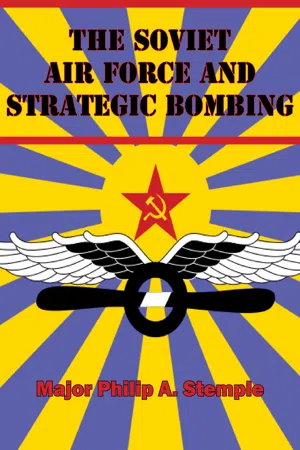
The Soviet Air Force And Strategic Bombing
About this book
It is the purpose of this project to show why the Soviet Air Force did not embrace the revolutionary Douhetian concept of strategic bombing as did other world powers during the 1920's, 30's and World War II. It is also to explain that in addition to technological shortcomings, there was a combination of theoretical and doctrinal reasons, taken to rigidity, that was responsible for this. Moreover, to show that when the revolution in military affairs (RMA) of nuclear weapons occurred strategic bombing was adopted. Additionally, that even as strategic bombing became fundamental to Soviet strategic doctrine during the Cold War, it was not at the exclusion of a more traditional Red Air Force role.
Information
Subtopic
European HistoryIndex
HistoryChapter 1 — Introduction
Why did the Soviet Union not embrace the Douhetian theory of strategic bombing while other world powers did? Throughout the 1920’s and 30’s leading nations around the world not only strove to create a viable air force for utilization in future wars, but did so with an emphasis on strategic bombing. This Revolution in Military Affairs (RMA) was viewed by its advocates as something that could potentially preclude massive, protracted land campaigns and the atrocious casualties inherent therein. Breaking the bloody paradigm of Verdun, Flanders and other costly campaigns of The Great War was on the minds of such theorists as Douhet, Trenchard and Mitchell as they developed theories of strategic bombing that that would ultimately be tested in World war II. America, Great Britain, France, Italy and even Germany endeavored (to varying degrees) to create air forces capable of striking at the heartland of an opponent. In the United States this effort was manifested in the Air Corps Tactical school developing the “industrial web” theory as a practical application of strategic bombing aimed at destroying the domestic will, infrastructure, and manufacturing capacity of an adversary.
Mainly in the European Theater of Operations (ETO) from 1942 1945, and under the overall direction of such men as Arnold and Portal, the U.S. Strategic Air Forces and the RAF Bomber Command put into practice, and modified, the strategic bombing theories that had been promulgated for two decades. Under the command of such luminaries as Spaatz, Harris, Eaker, and Doolittle the credence (or lack thereof) of strategic bombing was validated. The Soviet military was a keen observer of these efforts while adhering to a different focus for their own air force. Indeed during the interwar period the Soviet Union too had been building an air force and a doctrine for its employment. They had built so called long range bombers and even used them for strikes against Berlin in 1941. But these were more token efforts at demonstrating that they could do so, than a commitment to that particular theory of warfare. Traditional Russian insecurity with regards to the Western Powers, perceived “permanent operating conditions”, technological short comings, and certain leadership deficiencies combined to give Soviet strategic bombing endeavors secondary, even negligible, importance. Only after the advent of the nuclear age (specifically by the early 1950’s) would strategic bombing become paramount to Soviet defense doctrine.
This study is focused on showing why circumstances unique to the Soviet Union caused her to disregard a strategic bombing role for her air force, until (ironically) a second RMA (the development of nuclear weapons) required it. In doing so, the study will be broken down into six parts. First, to provide context, a brief historical review of the strategic bombing theory that became significant to air forces around the world during the interwar period. Second, (and directly related to main point number one) a more detailed account of what the Soviet military in general, and the Soviet Air Force in particular was doing during this same period to develop a doctrine and organization for national defense. Third, Soviet reaction to how the Allies applied strategic bombing in the ETO from 1942-1945, and what the Soviet Air Force was doing on the Eastern Front at this same time (this part reinforces main point one in that Soviet experience and observations during WWII reaffirmed their own decision to forsake strategic bombing). Fourth, the changes in the Soviet Union during the early 1950’s that brought about a shift toward developing a strategic bombing air force (main point number two). Fifth, how by the 1970’s the Soviet Air Force had largely returned to its traditional ground support role (main point number three). The sixth, and final, part will provide conclusions and analysis as to what other options or alternatives (if any) were not only feasible, but (moreover) more promising than that which was adopted in terms of Soviet air force doctrine and strategy.
Chapter 2 — The Advent of Strategic Bombing
The attrition heavy, stalemated campaigns of The Great War caused military theorists around the world to search for ways to return maneuver to warfare and thus reduce casualties in future conflicts. While ground warriors, such as the Briton J.F.C. Fuller, saw the maneuver potential of massed armored columns of tanks as a way to achieve this end, emerging air power theorists foresaw an even more unprecedented form of warfare as being decisive in the future strategic bombing.
One of the leading proponents of this new theory was the Italian general Giulio Douhet. Having been a member of the Italian General Staff since 1900, heavily involved in Italy’s use of dirigibles in military service prior to World War I, he also commanded the lone Italian aviation battalion in 1912. As was the case with other air power pioneers his outspokenness ultimately found him falling into disfavor with the establishment first by ordering the unauthorized construction of several Caproni Bombers in 1914 (in reaction to a dreadfully reluctant bureaucracy), then during WWI for his outspoken criticism of how the Italian government was waging war. This resulted in his court martial and dismissal from the service. In 1921 he wrote and had published The Command of the Air, that espoused an independent role for modern air forces. Douhet’s work contended that air power was revolutionary because it operated in the “third dimension” unhampered by land constraints. His thoughts on the optimum advantages of strategic bombing were that if afforded the ability to strike at an opponent’s “vital centers” (as opposed to the traditional view of hitting the field forces exclusively) from which the means to wage war came. Accordingly, he saw five primary target systems as critical: industry, transportation infrastructure, communication nodes, government buildings, and the will of the people. This last target was paramount to him as modern war entailed the involvement of not only a nation’s armies, but their citizenry as well.{1}
Another European air power advocate, and strategic bombing theorist was Great Britain’s first Chief of the Royal Air Force (RAF), 1919 1930, Air Chief Marshall Hugh Trenchard. Like Douhet, Trenchard had seen the atrocious cost in human life that the Great War had reaped. Also like Douhet, Trenchard felt that that harvest of unconscionable loss had been sown with the seeds of dogma. In short, ...
Table of contents
- Title page
- TABLE OF CONTENTS
- Abstract
- Chapter 1 - Introduction
- Chapter 2 - The Advent of Strategic Bombing
- Chapter 3 - Soviet Doctrinal Development
- Chapter 4 - Practical Application of Strategic Bombing Theory in WWII
- Chapter 5 - The Strategic Paradigm Begins to Shift
- Chapter 6 - The Cold War and Intercontinental Bombing
- Chapter 7 - Analysis and Conclusions
- Bibliography
Trusted by 375,005 students
Access to over 1.5 million titles for a fair monthly price.
Study more efficiently using our study tools.
Frequently asked questions
Yes, you can cancel anytime from the Subscription tab in your account settings on the Perlego website. Your subscription will stay active until the end of your current billing period. Learn how to cancel your subscription
No, books cannot be downloaded as external files, such as PDFs, for use outside of Perlego. However, you can download books within the Perlego app for offline reading on mobile or tablet. Learn how to download books offline
Perlego offers two plans: Essential and Complete
- Essential is ideal for learners and professionals who enjoy exploring a wide range of subjects. Access the Essential Library with 800,000+ trusted titles and best-sellers across business, personal growth, and the humanities. Includes unlimited reading time and Standard Read Aloud voice.
- Complete: Perfect for advanced learners and researchers needing full, unrestricted access. Unlock 1.5M+ books across hundreds of subjects, including academic and specialized titles. The Complete Plan also includes advanced features like Premium Read Aloud and Research Assistant.
We are an online textbook subscription service, where you can get access to an entire online library for less than the price of a single book per month. With over 1.5 million books across 990+ topics, we’ve got you covered! Learn about our mission
Look out for the read-aloud symbol on your next book to see if you can listen to it. The read-aloud tool reads text aloud for you, highlighting the text as it is being read. You can pause it, speed it up and slow it down. Learn more about Read Aloud
Yes! You can use the Perlego app on both iOS and Android devices to read anytime, anywhere — even offline. Perfect for commutes or when you’re on the go.
Please note we cannot support devices running on iOS 13 and Android 7 or earlier. Learn more about using the app
Please note we cannot support devices running on iOS 13 and Android 7 or earlier. Learn more about using the app
Yes, you can access The Soviet Air Force And Strategic Bombing by Major Philip A. Stemple in PDF and/or ePUB format, as well as other popular books in History & European History. We have over 1.5 million books available in our catalogue for you to explore.