A fascinating view of the Pacific War by the victorious commander of the US Sixth Army, who led his men through the islands and jungles against the Imperial Japanese Army to final victory in recapturing the Philippines.
"ALTHOUGH NEARLY EIGHT YEARS have passed since the end of the war with Japan, the story of the conspicuous part Sixth Army played in it remains to be told. Instead of publishing my personal reminiscences of the events in which I participated, I decided to write the story of Sixth Army. I felt that I owed this to all who served under me there—in particular to the many thousands who laid down their lives.
The result is an unadorned narrative of the long trek of Sixth Army "from Down Under to Nippon"; of much bitter fighting; of hardships and shortcomings, as well as outstanding performances; of luck and of victory. The story is based upon my own official reports and those from my subordinate units, and upon my own notes and recollections. It stresses the bold and brilliant strategic plans of our Commander in Chief, General Douglas MacArthur, which charted our course to victory in the Southwest Pacific and which were effectively carried out by his Army-Navy-Air Forces team, of which Sixth Army formed an essential part."—From author's Foreword
"History has not given him due credit for his greatness. I do not believe that the annals of American history have shown his superior as an Army commander. Swift and sure in the attack, tenacious and determined in defense, modest and restrained in victory—I do not know what he would have been in defeat, because he was never defeated."—General MacArthur
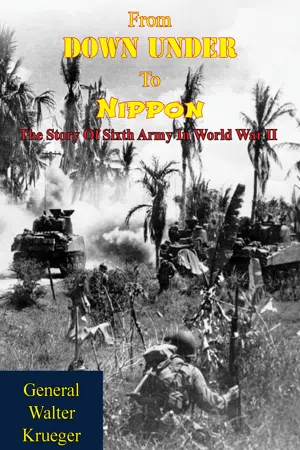
eBook - ePub
From Down Under To Nippon: The Story Of Sixth Army In World War II
- 459 pages
- English
- ePUB (mobile friendly)
- Available on iOS & Android
eBook - ePub
From Down Under To Nippon: The Story Of Sixth Army In World War II
About this book
Information
Topic
GeschichteSubtopic
Europäische Geschichte1—THE BEGINNINGS
CHAPTER ONE—ACTIVATION
ON 12 JANUARY 1943, while inspecting the 89th Infantry Division at Camp Carson, Colorado, I received the following radiogram from General MacArthur, Commander in Chief of the Southwest Pacific Area: “I have just recommended to the Chief of Staff that you and the Third Army Headquarters be transferred to this area. I am particularly anxious to have you with me at this critical time.”
The opportunity thus presented was most welcome but wholly unexpected. I had about concluded that being practically sixty-two I would be thought too old for active overseas service. My reply to General MacArthur expressed my gratification and my appreciation of his confidence in me.
Lieutenant-General Lesley J. McNair, CG of Army Ground Forces, telephoned me on the 13th, while I was at Camp Gruber, Oklahoma, that my assignment had been approved. That same day the War Department ordered me to Washington with some of my staff on the 14th to work out the details of the transfer of my headquarters to the Southwest Pacific Area (SWPA). I returned at once to Fort Sam Houston and with several key members of my staff flew to Washington where we set to work. We were disappointed to learn that General MacArthur’s recommendation for transfer of Headquarters Third Army to SWPA had been disapproved. Instead, I was directed to organize and activate the headquarters of a new army—the Sixth—but at a strength considerably below that authorized by the existing table of organization (T/O), and even below the number I had requested.{1} Major-General (later General) Courtney H. Hodges, who then commanded X Corps, was designated to succeed me as CG, Third Army.
Upon our return from Washington on 21 January 1943, we activated Headquarters, Headquarters Company and Headquarters Special Troops, Sixth Army, at Fort Sam Houston, on 25 January 1943, and made final preparations for moving to SWPA.
Although Headquarters Third Army as such could not go overseas with me, a substantial part of its key personnel was transferred to Headquarters Sixth Army. (For complete list of officers, see Appendix. 1.) It included Brigadier-General George Honnen (Chief of Staff); Colonel George H. Decker (Deputy Chief of Staff); Colonel George S. Price (G1); Colonel Horton V. White (G2); Colonel Clyde D. Eddleman (G3); Colonel Kenneth Pierce (G4); the chiefs of a number of the administrative and technical staff sections; and other selected officers, warrant officers and enlisted men. This gave Sixth Army a staff that had gained invaluable experience by rigorous training in Third Army.
I had assumed command of Third Army on 16 May 1941, upon the retirement of Lieutenant-General Herbert J. Brees. When, shortly thereafter, Brigadier-General Joseph A. Atkins (Chief of Staff, Third Army) also prepared to retire, I asked General Marshall to let me have Colonel Dwight D. Eisenhower to fill the vacancy. He approved, and after Eisenhower reported I detailed him as Deputy Chief of Staff on 2 July 1941 and as Chief of Staff of Third Army and of Southern Defense Command on 9 August 1941. (This command had been established on 7 July 1941 under my command. It embraced the states of Florida, Georgia, Alabama, Mississippi, Louisiana, Texas, New Mexico, and Oklahoma.) He proved to be invaluable, effectively coordinating the activities of the staff and handling much of the administrative work, thus enabling me to devote myself primarily to inspections, training, and tactical exercises, especially the great Louisiana Maneuvers of 1941 and the critiques on it. Upon my recommendation Colonel Eisenhower was promoted to Brigadier-General on 3 October 1941.
Toward the end of the Louisiana Maneuvers, when General Marshall asked me whom I regarded as best fitted to head the War Plans Division which I had headed several years before, I named Eisenhower, though I was loath to lose him. He was directed to report to the Chief of Staff of the Army in Washington on 12 December 1941. I replaced him with Lieutenant Colonel (later General) Alfred M. Gruenther who, after being promoted in turn to colonel and Brigadier-General upon my recommendation, was taken away from me without warning to become Chief of Staff of Fifth Army. I promptly detailed the then Deputy Chief of Staff—Lieutenant Colonel (later Major-General) George Honnen, to replace him as Chief of Staff of Third Army and of Southern Defense Command.
Third Army’s staff was composed largely of Regulars when I assumed command, but as time went on many of them were transferred to other duties and their places filled by National Guard and Reserve officers. The staff consisted of carefully selected officers and the successive chiefs of staff and I made constant efforts to increase its efficiency. My insistence that its prime function was to serve the troops, my policy of confining its membership to officers who had the faculty of working effectively in a team, and actual practice for which there was ample opportunity, did the rest.
In May 1941, and until after Pearl Harbor, Third Army consisted of three corps with eleven infantry divisions distributed among them, a cavalry division, a separate cavalry brigade, and numerous separate field artillery, antiaircraft artillery, engineer, signal, medical, and service units (see Appendix 2).
Although a number of divisions and other elements were withdrawn during 1942, it was largely augmented during that year, being charged with the organization, administration and training of an additional corps headquarters, fourteen new divisions and many other units (see Appendix 2).
The administration, training and inspection of such a large command as Third Army, with its units scattered over the entire southern tier of states from Florida to eastern Arizona, inclusive of Oklahoma and eastern Colorado, required unremitting attention and effort. But it was tremendously interesting and excellent preparation for the problems that were destined to face my staff and me later on in SWPA. The training exercises and especially the great Louisiana Maneuvers of 1941, in which Third Army was pitted against Second Army (Lieutenant-General Ben Lear), gave my staff a thorough workout and welded it into a smoothly functioning, highly effective team.
My service of forty-four years had given me ample opportunity to command troops and gain general staff experience. After commanding various minor infantry units earlier in my career, I had commanded the 6th Infantry Regiment for two years, the 16th Infantry Brigade for some eight months, the 2d Infantry Division from March 1939 to October 1940, and then VIII Corps until 16 May 1941, when I assumed command of Third Army. The Louisiana Maneuvers gave me command of an army of nearly 300,000 men in the field, over varying terrain and under simulated war conditions against an opposing force.
The conditions we were destined to face in SWPA differed materially from those of Louisiana and required novel expedients and improvisation of tactics. But the experience gained in the 1941 maneuvers was invaluable. The basic principles and vital importance of competent staff performance, morale and discipline, teamwork, efficient troop management and care of the men were the same. Moreover, the woeful shortage of weapons and equipment of all kinds taught my staff and me how to do much with little and get along with what we had.
The secrecy of the movement and destination of Headquarters Sixth Army was remarkably well preserved. Our wives naturally suspected that we were about to go overseas but did not know where. They shed tears when the moment of parting came and we said farewell and they wished us godspeed. But they faced the issue bravely, no one more so than my own wife, who bore it all as the mate of a soldier should.
We made the movement to SWPA in two echelons. The advance party of the first echelon consisted of myself, Brigadier-General Honnen, Colonels Price, White, Eddleman and Pierce, Lieutenant Colonel Ray H. Martin (my ADC and pilot), Chief Warrant Officer Curtis R. Kirkland, and Technical Sergeant Durward E. McCain and Sergeant Emery K. Conoway. It moved by air on 2 February 1943 from San Antonio, Texas, to Hamilton Field, California, left there the following night, and flew via Oahu, Canton Island, Fiji and New Caledonia to Amberley Field, near Brisbane, Australia, where it arrived on the 7th.
We were met there by one of General MacArthur’s senior staff officers, who conducted us to our quarters in Lennon’s Hotel in Brisbane. When I reported to General MacArthur the next day, he welcomed me cordially and told me something of the situation and what he expected of me.
The rest of the first echelon, some twenty-seven officers and thirty other ranks, moved to Hamilton Field by rail and then in five planes for Brisbane, the second echelon following later by rail and water. On 9 February we got the news that one of the planes had crashed at Canton Island on the 7th. All but three had perished.{2}
By direction of the President, I was relieved from command of Third Army, effective 15 February 1943, and assigned to command Sixth Army on 16 February. (This action was delayed to permit the processing of my reappointment, without loss of seniority, to the grade of Lieutenant-General, a rank I had held under existing law since 16 May 1941, by virtue of being CG, Third Army.)
My assignment having been published in general orders of GHQ, SWPA, I assumed command of Sixth Army on 16 February 1943, established its headquarters at Camp Columbia, some ten miles west of Brisbane, where an adequate number of shacks were available, and moved there with my staff.
Sixth Army was initially very small and its units widely scattered. It consisted of I Corps (with only two divisions: the 32d at Camp Cable, near Brisbane, and the 41st in the Dobodura area of New Guinea); the 1st Marine Division (under my operational command only) at Melbourne, Victoria; the 2d Engineer Special Brigade{3} at Rockhampton and Cairns, Queensland, respectively; the 40th and 41st Antiaircraft Brigades in Papua and northern Queensland, respectively; and some smaller units, among them: at Cairns, the 503d Parachute Infantry Regiment; at Camp Cable, the 158th Infantry Regiment; and at Port Moresby, New Guinea, the 98th Field Artillery (Pack) Battalion, which was later converted into the 6th Ranger Battalion. But after a few months the army was reinforced by the 1st Cavalry Division (dismounted) and the 24th Infantry Division, and later on still other units.{4}
Headquarters Sixth Army was handicapped until its second echelon, in charge of Colonel Decker (Deputy Chief of Staff) arrived in Brisbane on 17 April. But in the meantime we had familiarized ourselves with the command set-up in SWPA, and with the military situation and conditions in New Guinea; and we had inspected all Sixth Army troops and were prepared for such demands as might be made upon us.
Training in jungle warfare had already been started but this was now amplified by instruction in amphibious operations, troop management, and care for the health and welfare of the men.
The prevalence of malaria gave me serious concern. It was especially marked in the 1st Marine Division, which had fought in the Guadalcanal-Tulagi operation, in the infantry of the 32d Division, which had fought in the Buna operation, and in the 41st Division, which was still in New Guinea.
Drastic measures were instituted to combat this disease, which had already caused a great many casualties. I made prevention of malaria a command responsibility and had a Sixth Army rehabilitation center established at Rockhampton. A large number of men were cured of malaria there and returned to duty. Its success was due to Colonel Frank LaRue, its commander, and in particular to Colonel Garfield G. Duncan, its chief medical officer, a former professor of clinical medicine at Jefferson Medical College in Philadelphia.
Inspection of troops and supervision over their training activities took most of my time and that of my staff. The troops were scattered from Melbourne to New Guinea—an air-line distance of over two thousand miles. Inspection trips required adequate air transportation. Yet a suitable plane could not be obtained. The C-40 first assigned to me was a small, much-battered, old Netherlands passenger plane. It was wholly inadequate and its very limited range frequently placed me in most awkward situations. In spite of my urgent representations, it was a long time before a C-47 transport was provided. Even after operations had begun in earnest and required flights that entailed probable encounters with hostile planes, it is doubtful whether a more adequate plane would ever have been made available, if it had not been for the personal interposition of General MacArthur, who directed that an armed B-17 (Flying Fortress) be assigned to me.
CHAPTER TWO—THE SOUTHWEST PACIFIC AREA
THE SOUTHWEST PACIFIC AREA had been set up in April 1942. It embraced Australia, New Guinea, the Bismarck Archipelago, the Philippines, and the Netherlands East Indies exclusive of Sumatra. General MacArthur had been appointed Commander in Chief of the Allied forces in that area.
When I arrived in Australia, GHQ was in Brisbane and United States Army Services of Supply (USASOS), which was responsible for the administra...
Table of contents
- Title page
- TABLE OF CONTENTS
- DEDICATION
- FOREWORD
- GLOSSARY
- 1-THE BEGINNINGS
- 2-INITIAL OPERATIONS
- 3-THE ROAD TO THE PHILIPPINES
- 4-LEYTE
- 5-MINDORO
- 6-LUZON
- 7-OCCUPATION OF JAPAN
- 8-APPENDIX
Trusted by 375,005 students
Access to over 1.5 million titles for a fair monthly price.
Study more efficiently using our study tools.
Frequently asked questions
Yes, you can cancel anytime from the Subscription tab in your account settings on the Perlego website. Your subscription will stay active until the end of your current billing period. Learn how to cancel your subscription
No, books cannot be downloaded as external files, such as PDFs, for use outside of Perlego. However, you can download books within the Perlego app for offline reading on mobile or tablet. Learn how to download books offline
Perlego offers two plans: Essential and Complete
- Essential is ideal for learners and professionals who enjoy exploring a wide range of subjects. Access the Essential Library with 800,000+ trusted titles and best-sellers across business, personal growth, and the humanities. Includes unlimited reading time and Standard Read Aloud voice.
- Complete: Perfect for advanced learners and researchers needing full, unrestricted access. Unlock 1.5M+ books across hundreds of subjects, including academic and specialized titles. The Complete Plan also includes advanced features like Premium Read Aloud and Research Assistant.
We are an online textbook subscription service, where you can get access to an entire online library for less than the price of a single book per month. With over 1.5 million books across 990+ topics, we’ve got you covered! Learn about our mission
Look out for the read-aloud symbol on your next book to see if you can listen to it. The read-aloud tool reads text aloud for you, highlighting the text as it is being read. You can pause it, speed it up and slow it down. Learn more about Read Aloud
Yes! You can use the Perlego app on both iOS and Android devices to read anytime, anywhere — even offline. Perfect for commutes or when you’re on the go.
Please note we cannot support devices running on iOS 13 and Android 7 or earlier. Learn more about using the app
Please note we cannot support devices running on iOS 13 and Android 7 or earlier. Learn more about using the app
Yes, you can access From Down Under To Nippon: The Story Of Sixth Army In World War II by General Walter Krueger in PDF and/or ePUB format, as well as other popular books in Geschichte & Europäische Geschichte. We have over 1.5 million books available in our catalogue for you to explore.