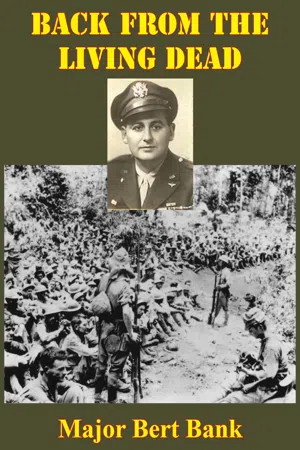
The world famous story of Major Bertram Bert Bank who survived 33 months of prison, torture and starvation at the hands of the Japanese in the Philippines during the Second World War.
"He left us to go into service in 1941 and he was called up from inactive status on his reserve commission.
"From the time he left us until he came back this year, Bert went through a lot that many other men did not survive. He was taken prisoner of the Japs on Bataan, survived the Bataan March of Death and 33 months internment in a Jap prison camp. Now he's a patient at Valley Forge General Hospital where Army doctors are attempting to restore his sight to normal. The long, gruelling months on a meager diet took its toll.
"But Bert doesn't complain. "There are a lot of other fellows less fortunate than I," he will tell you.
"Many friends have asked him to tell of his experiences. During the course of bond tours and other public appearances in the Army's behalf, Bert has recounted these experiences. And so he thought he would write them down for these friends. That's the reason for this booklet.
"The story of his capture and internment are here in Bert's own words. He is the man identified as the Captain Bert of Alabama in the late Lieutenant Colonel Edward Dyess' story "The March of Death." Bert was scheduled to make a break from the Jap prison camp with Colonel Dyess but was sick at the time and could not make it.
"So this is the story of Major Bert Bank, a native Tuscaloosan and graduate of the University of Alabama. He's one of the men who came back from the "living dead.""
eBook - ePub
Back From The Living Dead:
An Original Story Describing The Infamous March Of Death; 33 Months In A Japanese Prison And Liberation By The Rangers
- 70 pages
- English
- ePUB (mobile friendly)
- Available on iOS & Android
eBook - ePub
Back From The Living Dead:
An Original Story Describing The Infamous March Of Death; 33 Months In A Japanese Prison And Liberation By The Rangers
About this book
Trusted by 375,005 students
Access to over 1.5 million titles for a fair monthly price.
Study more efficiently using our study tools.
Information
Subtopic
European HistoryIndex
HistoryPART I—Saved From Death by Daring U. S. Rangers, Major Bank Relates Story of Sensational Raid on Cabanatuan Prison
On January 30, 1945, 511 American, Dutch, British, and civilian prisoners of war became free men again. These starved and beaten men had been subjected to three years of “hell” at the hands of the Japanese. The Americans were from Bataan and Corregidor, while the British and Dutch prisoners were survivors from a ship which had been bombed by American planes off the coast of Luzon on September 21, 1944. The Japanese had rescued the 60 survivors of a ship carrying approximately 800 and brought them to our camp at Cabanatuan. The civilians were interned at the outbreak of the war, a few being brought to Cabanatuan from Manila. There were several camps in which there were only civilian prisoners.
Rangers and Guerrillas Make Daring Raid
On the night of January 30, 1945 (Jan. 29 in the States) 100 men of the Sixth Army Ranger Infantry Battalion, assisted by approximately 200 Filipino Guerrillas, staged the most miraculous and sensational rescue in our history. Coming 28 miles behind the Jap lines they evacuated 511 hospitalized and weakened prisoners of war. Their job was not completed when they had killed every guard surrounding the camp, for it was necessary for them to carry many who were unable to walk on a jaunt which lasted from 7:30 o’clock that night until 10:00 the following morning. At that time American trucks met us and carried us to the American lines. We had no pre-knowledge of this rescue at all, and when the firepower started at 7:15 P.M. we all thought that the Japanese guards had opened up on the prisoners, as we did not expect them to turn us over to the Americans alive. Then, too, just the previous day the Japs had come over and asked our American C.O. how many could walk if it were necessary. This meant to us that they were getting ready to move us. We had also heard through some of the Filipinos that the Japs had killed many of the American prisoners of war. We were later told how at Palawan the Japanese had set fire to 190 Americans and shot them.
Prisoners, Distrustful of Japs, Keep Under Cover
The Rangers' fire power lasted approximately 13 minutes, during which time all the Americans were lying flat on the ground. At the cessation of this firing, which was the most terrific we had ever heard, the rescuers ran into the compound screaming, “The Yanks are here, run for the main gate,” but not one of the American prisoners stirred. We whispered to each other not to move, that it was a trap to get us to run and then they, the Japs, would open up on us. Of course, the Japs did not need an excuse to shoot us, but they might consider this the most convenient way out.
Nevertheless, during this effort on the part of the Americans to get us to run, I crawled down a ditch on my stomach, close to a man with a rifle, who was still screaming, “Run for the main gate, the Yanks are here.” He was crying, “What the hell is the matter with you people, don’t you want to be free?” Well, very reluctantly, I asked him if he was a Yank, to which he replied, “I’m from Oklahoma.” At that I shouted, “That is good enough for me,” and ran like hell for the main gate.
Guerrillas Blockade Road
The Rangers had come inside the camp to get us, while the guerrillas accompanying them put a blockade on the road. After we evacuated the camp, 500 Japs with 12 tanks started after us and the guerrillas fought a rear guard action as the Rangers were assisting the prisoners. The tanks were destroyed and the Japs that were not killed, fled.
Many Filipinos were outside the camp with carabao carts to carry those who could not walk. The stronger were aiding the weaker. A Ranger was helping me through the darkness of the night, as my eyes are very bad, and I was carrying a paralytic on my back. The Filipinos in the barrios were waiting for us to come through and they were all crying with joy and happiness. They were screaming “Mabahuay” which in the Philippine language means good morning, hope you are well, wonderful to see you or anything else which may indicate a word of good cheer. They were all crying and very happy as they had also been mistreated by the Japanese during the past three years. The Rangers seemed as happy as the prisoners they had freed. All during the night and the next morning they run up and down the long columns inquiring if anyone was from their home towns.
Hear of “Bazookas” and L.S.T.’s
We first received information about the new Army equipment. After they had killed all the 150 Japs guarding us and we had evacuated the camp, I asked a Ranger what type of mortar I had heard during the firing. He casually replied that it was a bazooka, whereas I and a few others standing by asked “What in the hell is our Army using now, Bob Burns' Bazooka?” The Ranger immediately realized that he was talking to men who had been out of circulation for three years and had no idea of any of the Army's new equipment. He also began speaking of L.S.T.'s and other amphibious equipment. We reminded him again of our ignorance concerning modern equipment, and her apologized and described to us some of the equipment used in the landing on Luzon.
At our first stopping point at about midnight, we were told by Lieutenant Colonel Mucchi, the commanding officer of the Rangers, that when we reached the Rizal road, approximately 16 miles ahead, we would be safe. Three days previously the Japs were in control of this road, so for 16 miles we were in danger of being ambushed by the Japs. Fortunately the
Americans had driven the Japs back and had taken control of the road during the three days interim. We were all very tired and hungry the following morning when, at 10 o’clock, we were met by American trucks and soldiers who gave us cigarettes and toilet articles and told us of the wonderful meal awaiting us at the hospital at the 12th Battalion Replacement Center. We were loaded on trucks and started for the hospital in real American vehicles and not standing on each other as we had done when we travelled with the Japanese.
Sight of “Old Glory” Thrills All
A few minutes after we had started in the trucks, we passed a barrio with a large American flag flying in the air. Every American in those 40 or 50 trucks stood at attention and saluted with large tears rolling down their cheeks. We had been through lots and lots and starved and taken beatings from the Japs and had become very tough but the sight of this “Old Glory” made us all realize that we were not really so tough and that we were real Americans and still had that emotionalism which most Americans possess.
During this ride in the trucks which lasted for about two hours, the American soldiers who had received word of our liberation were lined up along the road, cheering us as we passed. When they saw our trucks approaching they ran from their tents as far as 600 to 800 yards to yell a word of cheer to us. And they were all wonderful, and to 511 Americans it was a great satisfaction to see such a demonstration. It was also gratifying to see the large amount of supplies and equipment that our Army now has. On Bataan and Corregidor we had seen nothing like this, and during our imprisonment the Japs had told us that our Army had been defeated and we had no Navy and other similar lies. Of course we did not believe this, but after all, three years in a Jap prison camp is a long time.
Bread and Butter Favorite Food
We arrived at the hospital at about 12:30 P.M. and we were given our first real food in three years. Food such as bread, butter, meat, potatoes, milk, and other items which we knew existed but had not seen. We sat down to eat and everyone was reluctant to begin because of the fine silverware on the table. We were all afraid that we could not handle these knives and forks, but someone made the first move and that was all that was necessary. We all dove into the meal. I think everyone enjoyed bread and butter more than anything. The nurses all cried and felt sorry for us as we were ravenous and ate like animals. However, it did not take us long to regain our former table manners. I was actively engaged in devouring bread and butter when a nurse came up to me and asked me if I had ever heard of Frankie Sinatra. I turned to someone sitting next to me and seeing the expression on his face, I knew the same question was in his mind. I voiced it, “Who is this guy Sinatra?” and she told me that he sings and makes all the girls swoon. At that I yelled, “Pass more bread and butter, please.”
Embark at Leyte for U.S.A.
We remained at this place for two days and were then moved further to the rear to the Fourth Replacement Center where we remained for five days. Some remained there longer. We were fed royally and given beer each afternoon at 4 o’clock. We all picked up weight and began looking more like humans than skeletons. Many of us could not recognize each other because of the amount of weight we had gained. After being wonderfully entertained here, we flew to Leyte and remained there two days before we boarded ship, U.S.S. Anderson, and started for the good old U.S.A., the country that we had been dreaming of for three years. It took us a week to get from Leyte to Hollandia, New Guinea, because we were in a 40-ship convoy, but from Hollandia we made it to the U. S. in 14 days. At Hollandia we were aboard ship for two days and the people there certainly entertained us. They had clothing, food and entertainment. These Red Cross girls and nurses certainly looked good to us, as they were the first women we had seen in three years.
Meets Brother at Hollandia
I had a pleasant surprise at Hollandia. The Air Corps officials ascertained that I had a brother at Morotai and they flew down to get him and flew him back to Luzon. Finding that I had already left they flew to Leyte, and I had left there, too. They heard that we were stopping at Hollandia, so they flew him there and he was the first person I saw when we docked at Hollandia. We spent two days together and he gave me the first information of the homefolks that I had in three years. After leaving Hollandia we were on the water 14 days and on March 8th we passed under the Golden Gate bridge. I don't think that there was an American P.W. who did not come out on deck and cry as we passed under the bridge. We were witnessing a sight that we had been dreaming of for three years.
San Francisco Welcomes Returning P.W.'s
San Francisco had a wonderful reception for us. They had a large parade and luncheon and we were all taken to Letterman General Hospital, where we were processed and sent out to any General Hospital we chose. I selected Northington General since it was located in my home town. We were told that after we were dismissed from the hospital we would be given a 90 days leave, after which we would have two weeks at a redistribution station and then be given any post we desired as long as we were qualified for the job.
The only thing that marred the liberation at Cabanatuan was the fact that two prisoners died just as we reached the American lines the morning after the raid. They both died from a heart attack as a result of the march during the night. It was certainly a tragedy that they had to die so late in the game. However, they did have the satisfaction of dying while in the hands of Americans and being accorded a funeral usually given to Americans instead of being thrown in a hole with 20 other bodies as the Japs had done during our imprisonment.
It is useless to try to describe how wonderful it was to these Americans to be back in the States. Nevertheless, I don’t think that the hell that we have gone through for the past three years will ever be completely forgotten. Occasionally now I wake up during the night, having dreamed about some atrocity in camp, and it is hard for me to realize that it was an actual occurrence. I am sure that if these Americans had known what was in store for them when they began that horrible March of Death, very few would have been taken alive.
PART II—Horrors of The March of Death From Bataan Peninsula; Prisoners Denied Food, Water; Buried Alive
When Bataan fell those men who were not fortunate enough to get to Corregidor began this March up the National Highway which was to mean death to many. Those who were fortunate enough to survive this march were to see many days of hell at the hands of the dastardly Japanese.
The lines on Bataan disintegrated about 4 o’clock the afternoon of April 8, 1942. The American troops were driven back to Marivales, which is the southern tip of Bataan, the little peninsula where so many Americans held a vast army of Japs for four months in one of the greatest defenses ever staged in the history of America.
The following morning, General King, who was our commander, went forward to ask the Japanese for surrender terms. At approximately 9 A.M. the American Headquarters received word that the surrender had become official, but the Japanese continued to bomb and strafe the Americans on the island. We were in terrific confusion. During the day the Japs discontinued the air activity and we began this March up the National Highway which for myself lasted five days and five night. All Americans were congregated at Marivales and started marching north. I fortunately happened to be a little farther north at the time and was on this march for only five days, but many marched as long as 10 days and 10 nights.
No Water Permitted for Entire March
The Japs had just sent up 80,000 troops from Singapore to put on this final drive and when they were successful in forcing us to surrender they were very bitter. They were crack Jap front line troops and this was the first opportunity that they had had to inflict cruelty on the Americans. They did everything possible to make us feel inferior to them. They lined the Americans four abreast and made them stay in the road. We were surrounded by guards on bicycles and other vehicles. We were told when we started that we would not be allowed any water at all, and it was very difficult to restrain from getting water as there are hundreds of artesian wells along the highway. All one of us would have to do would be to step a few feet either to the left or right and we could drink all the water we desired. But we had strict orders to drink no water. If anyone of us attempted to get water, we would be shot, just as we would be if we accepted food from the Filipinos.
We found out that the Japs meant this order. They took everything they desired from us when we started this march. They took all the clothing that they wanted for themselves, all watches, fountain pens, etc. During the noon hour every day they would give us ’about face’ and march us for five or eight miles to the rear, between noon and 2 P.M. when it was terrificly hot.
Hundreds were killed by the guards or died from exhaustion.
The Japs were moving vast amounts of equipment south and installing guns along the beach preparatory to landing on Corregidor. During this march the Americans on Corregidor were firing at the Japs and we had many men who were injured from this shelling from our own lines.
Lieutenant Colonel Bayonetted for Falling Out
We saw atrocities committed by the Japs that we thought could never happen to Americans. They would not let the strong help the weak. If a strong man attempted to help the weak they would shoot both of them, so we were all reluctant to help anyone who fell out. One day I was assisting a lieutenant colonel who was very large, and he kept telling me that he was going to fall out and I was pleading with him to continue marching because they would kill him if h...
Table of contents
- Title page
- TABLE OF CONTENTS
- DEDICATION
- FOREWORD
- PART I-Saved From Death by Daring U. S. Rangers, Major Bank Relates Story of Sensational Raid on Cabanatuan Prison
- PART II-Horrors of The March of Death From Bataan Peninsula; Prisoners Denied Food, Water; Buried Alive
- PART III-Unattended Sick, Unburied Dead Litter Japanese Prison At Camp O'Donnell After Death March.
- PART IV-U.S. Prisoners Ate Dogs And Cats To Prevent Starving, Even Lizards At Foul Cabanatuan Prison Camp
- PART V-Prisoners Suffocated In Box Cars And Ship Holds, Being Transferred From Cabanatuan To Mindinao
- PART VI-American Prisoners Do Slave Labor In Rice Paddies of Davao Prison Colony As Disease And Malnutrition Kill Many
- PART VII-21 U. S. Prisoners Spent Agonizing 30 Days Awaiting Japanese Firing Squad After 2 Companions Escaped
- PART VIII-U. S. Prisoners Stuffed Into Hold of Jap Slave Ship On Foul Return To Cabanatuan Prison And Liberation
- REQUEST FROM THE PUBLISHER
Frequently asked questions
Yes, you can cancel anytime from the Subscription tab in your account settings on the Perlego website. Your subscription will stay active until the end of your current billing period. Learn how to cancel your subscription
No, books cannot be downloaded as external files, such as PDFs, for use outside of Perlego. However, you can download books within the Perlego app for offline reading on mobile or tablet. Learn how to download books offline
Perlego offers two plans: Essential and Complete
- Essential is ideal for learners and professionals who enjoy exploring a wide range of subjects. Access the Essential Library with 800,000+ trusted titles and best-sellers across business, personal growth, and the humanities. Includes unlimited reading time and Standard Read Aloud voice.
- Complete: Perfect for advanced learners and researchers needing full, unrestricted access. Unlock 1.5M+ books across hundreds of subjects, including academic and specialized titles. The Complete Plan also includes advanced features like Premium Read Aloud and Research Assistant.
We are an online textbook subscription service, where you can get access to an entire online library for less than the price of a single book per month. With over 1.5 million books across 990+ topics, we’ve got you covered! Learn about our mission
Look out for the read-aloud symbol on your next book to see if you can listen to it. The read-aloud tool reads text aloud for you, highlighting the text as it is being read. You can pause it, speed it up and slow it down. Learn more about Read Aloud
Yes! You can use the Perlego app on both iOS and Android devices to read anytime, anywhere — even offline. Perfect for commutes or when you’re on the go.
Please note we cannot support devices running on iOS 13 and Android 7 or earlier. Learn more about using the app
Please note we cannot support devices running on iOS 13 and Android 7 or earlier. Learn more about using the app
Yes, you can access Back From The Living Dead: by Major Bert Bank in PDF and/or ePUB format, as well as other popular books in History & European History. We have over 1.5 million books available in our catalogue for you to explore.