Carl Goerdeler was for a long time more than anyone else at the centre of the conspiracy against tyranny; he was in immediate personal contact with almost all of the groups and parties—and not only as a tirelessly active director and recruiting officer for the movement, but at the same time as its most productive mind when it came to working out comprehensive and mature plans dealing with both foreign and domestic problems. The German Resistance movement in its entirety can be surveyed very clearly from the vantage point of his biography. And conversely his biography is of historical significance only in the framework of this general setting. His work can be correctly estimated only when it is constantly compared with that of his colleagues. The history of the German resistance movement has hitherto been written predominantly in the form of a justification and defence against its critics, accusers, and apostates. Not infrequently it has acquired something of the flavour of a gallery of heroes or even of the lives of saints.
We are here attempting something else; namely, to attain, by a critical and sober study, a grasp of the historical truth, and beyond this to search our own hearts with a new understanding. For this purpose it was indispensable to depict the German Resistance movement against the background of international politics, so far as relevant sources are now available. Likewise, the development of the movement's ideals of freedom and plans for reform had to be traced back into the time of the Weimar Republic. And finally, its development and the political attitude of its leaders needed to be appreciated in terms of the internal and external history of Hitler's Reich.
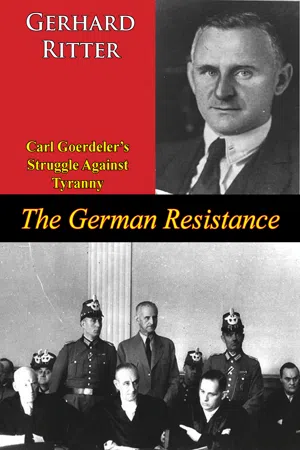
eBook - ePub
The German Resistance: Carl Goerdeler's Struggle Against Tyranny
- 352 pages
- English
- ePUB (mobile friendly)
- Available on iOS & Android
eBook - ePub
The German Resistance: Carl Goerdeler's Struggle Against Tyranny
About this book
Information
Subtopic
European HistoryIndex
HistoryCHAPTER I—THE EARLY YEARS AND THE LEIPZIG MAYORALTY
THE IMPRESSIONS of his parental home never ceased to guide Carl Goerdeler’s mental development. Over and over again, throughout his life, he speaks of the intellectual and especially the moral heritage that he received there; and even at the end, in prison, faced with a horrible death, he looked back nostalgically to the sunny bourgeois world of the nineteenth century from which he sprang. The incomplete memoirs of his youth, written during his flight from the Gestapo, are suffused with the spirit of the old conservative Prussian civil service which still persisted in the last years of the Bismarckian era: full of pride in the tradition of Frederick the Great, full of confidence in the secure might of the Prussian-German monarchy. These memoirs vividly depict life in the two West Prussian towns of Schneidemühl, where Carl Goerdeler was born on July 31, 1884, and Marienwerder, where his father took up the post of district judge in 1890. Despite a simple way of life, the circumstances in which the boy grew up were none the less comfortable: a very large and intimate circle of relatives, gay social occasions of all kinds, including considerable intercourse with the titled landowners of the neighbourhood, There was no lack of interest in the arts, but the cultural emphasis was decidedly on politics and history, especially after his father had become in 1899 a Free Conservative deputy in the Prussian Diet. The colour of the political debates in the household can be inferred from this affiliation: the Free Conservatives were the party of ‘Bismarck sans phrase’.
Carl Goerdeler studied law at Tübingen from 1902 to 1905, but by 1911 he was quite clear in his own mind that he would be most content with a career in administration and economics. Above all, municipal administration, with its manifold problems of organization, its highly modern challenges, and its close contact with economic life excited his lively mind. It was not by chance that the posts of magistrate and lord mayor in the big cities had attracted such a plethora of political talent in Germany since the nineteenth century. Goerdeler was always very proud of the personal initiative in the selection and training of the personnel, as well as in the successful completion of difficult technical tasks, that he had been able like so many of his predecessors, to develop as the administrative head of a great city. He possessed to an outstanding degree all the mental gifts and personal qualities required in such a position. His real talents lay in the field of local administration and local politics; he not only started there, but up to a point, in his thinking habits, he always remained there. The merits, but also the limitations and weaknesses of his character may be grasped most easily from this point of view.
On October 1, 1911 he went to the Rhenish town of Solingen and was soon appointed assessor. At the end of 1912 he was unanimously elected to be the principal assistant, and at times the deputy, of the lord mayor—he was the only member of the Solingen municipal administration with legal training—posts that he held (formally) until early 1920. According to the testimonials of the lord mayor he had ‘a really eminent talent for organization’, and was fully capable of discharging ‘the most difficult tasks in all fields of administration’; but they emphasize especially his ability to combine an unequivocal and firm demeanour with winning charm.
The war likewise offered him an opportunity to display his administrative ability. In 1918 he was charged with organizing the financial administration of a large area of White Russia and Lithuania occupied under the terms of the Treaty of Brest-Litovsk, a task that he approached and accomplished in a humane spirit. But the year 1918 also brought with it the fall of the monarchy and the revolution in Germany. Anyone who was as devoted as Goerdeler was to the old monarchical institutions was bound to be severely shaken by these events, and for some time he was undecided whether to remain a public official in this new republican Germany or to take up an entirely independent livelihood. Finally, in April 1919, he did take up his position again, and immediately put through a number of reforms with his accustomed zeal. But as early as June he went on leave to his West Prussian home, there to launch a political adventure that for the first time reveals some of the typical traits of character of the later conspirator.{3}
The signature of the Treaty of Versailles was imminent. In East and West Prussia there was great excitement; popular demonstrations against the cession of German territory were organized, and the idea was even mooted of secession from Germany in the last resort if the government proved incapable of active resistance to the ‘dictated peace’. In that case the plan was to form a separate state in the East whose whole population would be mobilized against Poland. It was the call of this movement for national defence that Goerdeler followed to West Prussia, a movement which passionately aroused his whole being. Nowhere was the artificial creation of the Polish Corridor and the Free State of Danzig regarded as so unnatural and taken so hard as in this strip of West Prussia just beyond the Vistula. But what Goerdeler demanded, and the manner in which he demanded it, already clearly anticipate the memoranda in which he later called over and over again for ‘action’ against Hitler. For him it was a matter not merely of preventing the Poles from marching in, but of ‘knocking them down’. When a Danzig assembly of workers under radical leadership decided on a general strike if the military should launch a frontier war, Goerdeler urged the arrest of the ringleaders and of the advocates of a Danzig Free State and the declaration of a state of siege, and persisted in these demands even after both military and civilian leaders had rejected them. He cannot escape the charge of judging in these matters purely as a patriot and not as a politician who has to take account of realities. His attitude witnesses to that magnificent fearlessness and refusal to compromise which were characteristic of him throughout his life—but also to that almost blind faith in the power of political ideals and moral principles in public life which later caused him to be meshed in so many illusions.
Goerdeler did not intend to return to Solingen again after these adventures, and he became a candidate for the post of deputy mayor in Königsberg. At first he encountered the resistance of the Social Democrats, to whom he was rightly suspect as a conservative and a nationalist; but eventually he was elected, and ten years later he had the satisfaction of seeing the Social Democrats, who had ostentatiously boycotted his inauguration, appear as a body to cheer him at his farewell ceremony. The winning power of his personality and his objective achievements quickly overcame all obstacles in Königsberg as they had in Solingen.
This biographical sketch which is principally concerned with Goerdeler as a politician may not linger long over a description of his undisputed achievements as the mayor of big cities. And, indeed, his sphere of activity soon widened: he became a member of the committee on personnel and transport of the assembly of delegates of German and Prussian towns, as well as deputy chairman of the employers’ union of the association of German communities and towns, frequently also acting in a public relations capacity on behalf of the latter body. At the same time he often had to deputize for the lord mayor in Königsberg, with whom he shared strong interest in plans for the reform of local administration. It was in fact to his prominent participation in this wider field of activity that Goerdeler chiefly owed his growing reputation, and in the spring of 1930 he was elected Lord Mayor of Leipzig. As the head of one of the largest and economically most important cities of Germany, and no longer geographically isolated as in Königsberg, he rapidly became one of the leading figures in German local politics.
The revolution of 1918, by introducing universal suffrage in local elections, had brought these into line with the national electoral system. It followed that local elective bodies became miniature copies of the state parliaments, that objective discussion of local administrative problems was disturbed and confused by partisan debates conducted with all the doctrinaire obstinacy of petty German politicians, and that party advantage became an issue in municipal appointments. A man of Goerdeler’s energy found it difficult to tolerate the unnecessary delays and bitter struggles that often ensued. The remedies that he proposed consisted of a severe restriction on the plenary sessions of municipal assemblies and the remission of most of their business to committees, and a reform in the position of the lord mayor, who must be given power to act ‘on his own initiative in cases where the local representatives act contrary to current needs’. We must guard against applying the catchword ‘reactionary’ to this attitude. The tendency was universal to adapt the cumbersome traditional system of administration by joint boards to the technical requirements of modern local government by instituting a stronger executive bureaucracy under the control of the mayor.
Goerdeler was also particularly concerned with the economic and financial aspects of local politics. In his essays he repeatedly complained of the irresponsible frivolity with which national and local bodies were constructing luxurious public buildings, fostering all kinds of cultural enterprises and sponsoring increases in wages and salaries, without regard to Germany’s grievous impoverishment due to the war, and financed by lighthearted borrowing (especially of foreign capital). Goerdeler for his part advocated the puritanical principle of thrift, to be pursued courageously even in the face of unpopularity; and he could claim that as Lord Mayor of Leipzig he had himself restored the shattered municipal finances to order by practising rigid economy. With regard to another much discussed problem Goerdeler, without abandoning liberal, i.e. non-socialist principles of political economy, urged that communities must take an active part in those areas where in the nature of the case economic problems could best (or only) be solved by a public monopoly. In this connection the question arose as to the extent of the state’s right to supervise and intervene in the affairs of the local communities, a question on which Goerdeler, contrary to majority opinion in conservative circles, strongly defended the principle of the greatest possible freedom for local self-government.
In his general political theory Goerdeler undeniably tended to authoritarianism; he mistrusted parliamentary government in the sense of the western democracies, and in cultural matters he took a frankly conservative position, as was customary in the German Nationalist Party. But the authority of the national government which he wished to strengthen was to depend not on brute force but on general confidence; it was to be strictly bound by law—though able, to be sure, to carry out unpopular measures required by the higher interests of the state. These ideas had always been common currency in German right-wing liberalism, and they took a new lease of life in the so-called young conservatism of the Weimar period—not without becoming tragically entangled in the toils of a political movement which abused them. On the other hand, Goerdeler had nothing in common with the Junkers or the industrial magnates, and his membership of the executive of the German Nationalist Party was a mere formality long before 1931. He never shared the antagonism of the true ‘capitalists’ against the social aspirations of the workers, even though his fundamental convictions in political economy were the antithesis of socialist thinking.
Disappointment was general in the Weimar Republic that the government, contrary to what the constitution promised, had in practice not increased but rather reduced the freedom of local self-government. The opposition to the conditions arising from this growing state interference burgeoned into a reform movement among German local politicians which extended not merely to matters of concern to the towns, but to the larger problem of the administrative structure of the state as a whole, for it was recognized that the special handicaps from which local government was suffering could be effectively removed only as a part of a general reform in the Reich and in the Länder. Goerdeler’s Königsberg colleague, Lord Mayor Lohmeyer, published a reform tract in 1928 entitled ‘Centralism or Self-Government’, This plan resembles later reform writings of Goerdeler’s in so many details that there can be no doubt of an intellectual connection. Even Lohmeyer’s most radical demand, for the conversion of the Länder parliaments into mere provincial Diets and of the Länder themselves into mere districts of the Reich (Reichsgaue), recurs a number of times with Goerdeler. He wished to free their deliberations, like those of the municipal assemblies, from politics, a process which would of course involve depriving the political parties of their power in this sphere. Both Goerdeler and Lohmeyer, on the basis of their practical experience, looked with apprehension on the irresponsible radicalism and thirst for popularity of democratically elected representatives, especially in financial matters. Both sought a remedy that would not involve a reactionary limitation of the right to vote, and their most important proposal was to strengthen the President’s position in relation to the Reichstag. Goerdeler went very far in this direction: in his view the President should not be bound by a vote of confidence in the Reichstag on the appointment of ministers—in other words, that he should be able to form Cabinets based on presidential favour alone! According to Goerdeler such Cabinets would enjoy the advantage of remaining in office for a considerable time (perhaps up to seven years) and of being able, if necessary, to put through unpopular measures. Important reforms, in his opinion, simply could not be executed without a fairly long clear run.
Meanwhile a move was under way to amalgamate all the leagues of local government organizations (Spitzenverbände). The plans, which had been completed before 1933, were not put into practice until the spring of that year in the wake of the National Socialist ‘co-ordination’ (Gleichschaltung) which involved the replacement of most lord mayors, mayors, and rural district councillors. Goerdeler was one of those who brought the idea of amalgamation before Hitler personally and was charged by him with supervising its execution. Subsequently he became the most influential member of the twenty-man executive of the new Diet of German Communities (Deutscher Gemeindetag).
The most important of the measures discussed in this body was the new uniform code for local government which became law on January 30, 1935 and applied to all communities. Goerdeler took a leading part in its formulation and repeatedly praised it highly, a judgement at first glance surprising in view of the fact that the code consistently enforced the so-called ‘leader principle’ (Führerprinzip) and the one-party system and severely restricted local self-government by permitting state supervision. But Goerdeler’s estimate can probably be explained by reference to the high hopes that he had set on the promulgation of such a law and to his refusal to give up these hopes even when they had been disappointed. He especially valued the financial and economic sections of the code, which he went so far as to describe as a ‘fundamental law of all political economy’; and he attempted to validate his own criticism of the economic and political policy of the Hitler régime by basing it on these provisions.
Hitler was, in fact, surprisingly amenable to Goerdeler’s proposals. The latter related, in his 1944 depositions, that Hitler had summoned him early in January 1935 to give his opinion of the code which was then about to become law. Goerdeler had stressed that, particularly in an authoritarian state, administration ought to be ‘elastically tapered downward’ by means of genuine local self-government in which citizens could share public responsibility; otherwise there would be nothing but passive waiting for apathetic commands and a dangerous shifting of responsibility upwards. Hitler may have found this last observation persuasive. At any rate he ordered some restriction on the state’s right of supervision, and he is reported to have insisted, at the Cabinet’s final consideration of the subject, that not only party members or members of party organizations but ‘ordinary citizens’ should be appointed local councillors.
If these reports are correct, then it appears that Hitler at that time was still aware that his party followers were not suitable for all administrative positions. At any rate, Goerdeler was given the impression that his opinion counted for something in this sphere, and he obstinately continued to maintain that the code of 1935 could be put right by a few simple adjustments.
The upshot of this and all the other developments related here was, in fact, disappointed hopes and paper plans for reform. Nevertheless, they are indispensable for an understanding of the history of the German Resistance movement; for they show that the opposition of the Goerdeler circle to Hitler, far from being an isolated phenomenon, was directly related to, and drew many of its ideas from, a reform movement dating from the Weimar period. Only thus can we explain the high proportion of senior civil servants in the Resistance, as well as their intensive and persistent preoccupation with detailed plans for a new administrative organization to be introduced after Hitler’s fall, even though it was very far from certain that Hitler would in fact be removed.
On the other hand, of course, the Resistance cannot be explained only or even principally in terms of plans for a reform of local government or for organic amendments to the federal constitution. By far the strongest motive was moral indignation, bitter resentment of the tyrant’s illegitimate rule of force. Still, the opposition owed much of its special character to the fact that so many of its members had been local or national administrators. Their resistance was not the vague grumbling of utopian idealists or of doctrinaire democrats. It had its roots in the ideals of free personal responsibility, ideals tested in the crucible of local self-government.
CHAPTER II—HINDENBURG, HITLER AND THE RESIGNATION FROM LEIPZIG
FROM THE time of his appointment as Lord Mayor of Leipzig (May 22, 1930) Carl Goerdeler grew in stature as a political figure, on the strength not of his party affiliation but of his personality. He exercised a strong power of suggestion, rather difficult to analyze, on everyone with whom he came in contact. He himself, however, was rather inclined to attribute his success to more objective reasons and therefore to overestimate the role of objective arguments in the political arena, a dangerous illusion.
He was much occupied with political writing,{4} concentrating in the years after 1929 on the steadily and ominously rising unemployment figures, which constituted the most difficult problem of every administrative body. Goerdeler did not see the world economic crisis of 1929 as another of those financial crises which had occurred periodically for eighty years, but rather as the result of momentous and fundamental changes brought on by the First World War, the dictated Treaty of Versailles, and the destruction of German capital in the inflation. The most pernicious of these consequences, in his opinion, were the reciprocal exclusionist policy of the industrial countries in the wake of general over-production and in the presence of excessive manufacturing costs, and the disruption of normal world trade by the system of reparations and by the constant vacillation of currency relationships. For Germany above all, with her reduced economic resources, restoration of a normal exchange of goods with the whole world was, Goerdeler thought, an urgent requirement; Germany was the last country that could afford an autarchic economy.
But how could the circulation of goods be unblocked? The crucial remedy for Goerdeler was a lowering of prices, by means of reductions in taxes and wages. The reduction in taxes was to be achiev...
Table of contents
- Title page
- TABLE OF CONTENTS
- FOREWORD
- TRANSLATOR’S NOTE
- INTRODUCTION
- CHAPTER I-THE EARLY YEARS AND THE LEIPZIG MAYORALTY
- CHAPTER II-HINDENBURG, HITLER AND THE RESIGNATION FROM LEIPZIG
- CHAPTER III-THE ORIGINS OF OPPOSITION AND RESISTANCE: I-THE POLITICAL LEFT, THE CHURCHES AND THE MIDDLE CLASS
- CHAPTER IV-THE ORIGINS OF OPPOSITION AND RESISTANCE: II. THE ARMY
- CHAPTER V-THE CZECH CRISIS, 1938
- CHAPTER VI-FROM MUNICH TO THE OUTBREAK OF WAR
- CHAPTER VII-LAST EFFORTS TO AVOID THE WORLD WAR
- CHAPTER VIII-PLANS FOR THE FUTURE OF GERMANY AND OF EUROPE
- CHAPTER IX-BEFORE AND AFTER STALINGRAD
- CHAPTER X-THE CATASTROPHE OF JULY 20, 1944
- CHAPTER XI-THE END
- BIBLIOGRAPHY
Trusted by 375,005 students
Access to over 1.5 million titles for a fair monthly price.
Study more efficiently using our study tools.
Frequently asked questions
Yes, you can cancel anytime from the Subscription tab in your account settings on the Perlego website. Your subscription will stay active until the end of your current billing period. Learn how to cancel your subscription
No, books cannot be downloaded as external files, such as PDFs, for use outside of Perlego. However, you can download books within the Perlego app for offline reading on mobile or tablet. Learn how to download books offline
Perlego offers two plans: Essential and Complete
- Essential is ideal for learners and professionals who enjoy exploring a wide range of subjects. Access the Essential Library with 800,000+ trusted titles and best-sellers across business, personal growth, and the humanities. Includes unlimited reading time and Standard Read Aloud voice.
- Complete: Perfect for advanced learners and researchers needing full, unrestricted access. Unlock 1.5M+ books across hundreds of subjects, including academic and specialized titles. The Complete Plan also includes advanced features like Premium Read Aloud and Research Assistant.
We are an online textbook subscription service, where you can get access to an entire online library for less than the price of a single book per month. With over 1.5 million books across 990+ topics, we’ve got you covered! Learn about our mission
Look out for the read-aloud symbol on your next book to see if you can listen to it. The read-aloud tool reads text aloud for you, highlighting the text as it is being read. You can pause it, speed it up and slow it down. Learn more about Read Aloud
Yes! You can use the Perlego app on both iOS and Android devices to read anytime, anywhere — even offline. Perfect for commutes or when you’re on the go.
Please note we cannot support devices running on iOS 13 and Android 7 or earlier. Learn more about using the app
Please note we cannot support devices running on iOS 13 and Android 7 or earlier. Learn more about using the app
Yes, you can access The German Resistance: Carl Goerdeler's Struggle Against Tyranny by Gerhard Ritter, R. T. Clark in PDF and/or ePUB format, as well as other popular books in History & European History. We have over 1.5 million books available in our catalogue for you to explore.