In the history of modern warfare, Weserübung Nord, the German invasion of Norway in 1940, occupies a distinguished station as the first campaign "jointly" planned and executed by ground, sea, and air forces. This paper examines the origins, concept, and planning of Weserübung Nord, as well as the execution of the landings. Brief attention is given to the defense of the landings against Allied counterstrokes and to issues associated with unified planning and direction. The origins of the campaign are found in the German naval experience in the First World War, interwar naval strategy debates, and the persona of Grand Admiral Erich Raeder, who was determined to secure a decisive role for the German Navy in the Second World War. Raeder capitalized on the fortuitous opportunities the Russo-Finnish War and the Norwegian traitor Vidkun Quisling presented to win Hitler over to his naval plans. Raeder and the Navy heavily influenced the concept development and planning of the campaign in concert with the High Command of the (German) Armed Forces, which also had a vested organizational interest in a military solution of the Norwegian issue. In executing Weserübung Nord, the German Armed Forces encountered major problems only at Oslo and Narvik. However, the operational-level success of the campaign tends to draw attention away from fundamental problems regarding unified planning and direction which emerged during the preparation and execution of the campaign.
"When the first [German] mountain troops in parachutes were dropped behind Narvik, it occurred that one fell directly in the water. The General [Dietl] came up to him as a petty officer was pulling him out of the water."
"So soldier, how do you end up here?"
"With the help of the three branches of the Armed Forces, Herr General," shouted the man quick-wittedly, "the Army sent me up here, the Air Force transported me, and the Navy pulled me out of the water."-General Dietl: das Leben eines Soldaten
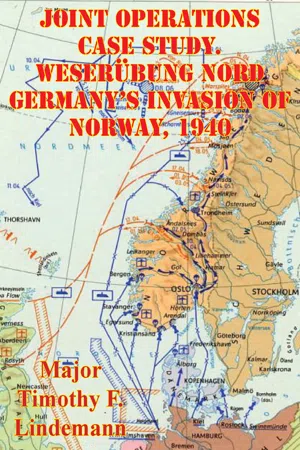
eBook - ePub
Joint Operations Case Study. Weserübung Nord Germany's Invasion Of Norway, 1940
- 63 pages
- English
- ePUB (mobile friendly)
- Available on iOS & Android
eBook - ePub
Joint Operations Case Study. Weserübung Nord Germany's Invasion Of Norway, 1940
About this book
Information
Subtopic
European HistoryIndex
HistoryChapter 1 — Origins of the Campaign
“The Chief of the Naval Staff [Grand Admiral Raeder] considers it necessary to acquaint the Führer, as soon as possible, with the possibilities for expanding naval operations to the north. It is should be examined, whether under the combined pressure of Russia and Germany, the possibility of acquiring bases in Norway exists, with the goal of a fundamental improvement in our strategic and operational situation.”—War Diary of the Naval Staff 3 October 1939{1}
Genesis
By the outbreak of the Second World War in 1939, none of the individual German military service staffs or the High Command of the Armed Forces (OKW) had developed operational plans for military action directed against Norway. In fact, the Army High Command (OKH) and High Command of the Air Force (OKL) eschewed any discussion of the concept of operations in this northern theater of war. The officers within the Naval High Command (OKM) and its predecessors, however, had been debating the necessity of operations against Norway and the importance of Norwegian bases for German maritime strategy in professional journals and war games intermittently since 1906.{2}
In the interwar years, the debate concerning Norwegian naval bases took on a new significance based on the experiences of the First World War. Influential but controversial German naval strategists maintained, had the German Fleet been able to operate from bases outside of the confined North Sea, the war at sea would have turned out differently. Bases on the west coast of Norway, specifically at Trondheim, would have been ideal for offensive operations against the Royal Navy and for commerce raiding in the Atlantic. Additionally, senior naval officers who had served in the German Navy (Kriegsmarine) during the First World could not forget Norway’s inability to maintain its neutrality steadfastly and Norway’s reluctant yet significant role in the economic blockade of Germany.{3}
As German rearmament began in the mid-thirties, the German Naval Staff (Seekriegsleitung, SKL) quickly recognized the criticality of Norwegian neutrality in a future conflict with Britain. With the loss of the iron ore mines in Lorraine after the First World War, Germany had become absolutely dependent on iron ore from the Kiruna-Gällivare fields in northern Sweden. Sweden shipped ore to Germany through the Swedish port of Luleå on the Gulf of Bothnia when Luleå harbor was ice free, and by rail through the Norwegian port at Narvik when ice closed Luleå and the Baltic ports (January through April). Approximately half of the Swedish iron ore bound for Germany passed through Narvik, and the Royal Navy could interrupt this traffic without actually occupying Norway.{4} The Royal Navy could mine the channels (leads) along Norway’s western coast, forcing German shipping which moved through the leads out into the open sea where vessels could be intercepted.
More threatening would be a British occupation of Norway. From naval and air bases in Norway Britain would be able to challenge German naval supremacy in the Baltic and exert pressure on Sweden to cease all exports to Germany.{5} Air bases in Norway would also facilitate the strategic bombing of Germany proper, although little thought was given to this danger at the time.{6}
Espousal
Considering these thoughts, it is not surprising that the impetus for military action against Norway came from the OKM. Encouraged by a Soviet offer of a base east of Murmansk (Basis Nord- Base North) the Commander-in-Chief of the Kriegsmarine, Grand Admiral Raeder, first raised the issue of bases in Norway with Hitler on 10 October 1939. At this meeting Raeder proposed a “Siege of England” (Belagerung Englands) using sea and air power, as an alternative to the plan Hitler had outlined on 27 September for a land offensive in the west (Case Yellow- Fall Gelb).{7} As part of his proposal Raeder stressed how the acquisition of naval bases on the Norwegian west coast with the help of Russian pressure would facilitate submarine warfare against England. Raeder did not raise the argument for securing ore supplies or the specter of British intentions at this time (nor did the SKL in initial internal discussions). Naturally, the Belagerung Englands strategy would entail a leading role for the Kriegsmarine and greater resources for the accelerated production of submarines. Hitler was not disposed to Raeder’s alternative to Fall Gelb at this time but Raeder would get his submarines.{8}
Thus, at the very time when the efforts of OKH and OKL were focused intensely (and reluctantly) to the west, Raeder was pushing OKM and Hitler in a totally different direction - to the North. Raeder had attempted to gain OKL, OKH, and OKW support for his proposal just prior to 10 October, but had found little encouragement. The Luftwaffe viewed the prosecution of the current war against England as strictly a Kriegsmarine task and judged the occupation of Holland, Belgium, and northern France resulting from Fall Gelb as much more critical for future air operations against Britain. The Commander-in-Chief of the German Air Force (Luftwaffe), Reichsmarshal Göring, was distressed to find the preeminent role Hitler had assigned to aircraft production becoming undermined.{9} The Army Chief of the General Staff, Generalcolonel Halder, believed the upcoming offensive in the west required concentration on Army requirements and a halt to the submarine program. He cited the military resistance of Norway and Sweden, difficult terrain, bad communications, and long supply lines as tremendous obstacles. In Halder’s view the political and economic disadvantages of a campaign in Norway far outweighed any strategic advantages the Kriegsmarine might secure.{10} The only positive response came from the Chief of the Operations Staff at OKW (Generalmajor Jodl), who thought an invasion could be easily accomplished.{11}
Halder’s views closely paralleled the collective view of Raeder’s own staff, the SKL. The SKL voiced concerns over the difficulties associated with both seizing and supplying bases over 1000 km from Germany. Furthermore, the SKL noted that the Kriegsmarine would not possess sufficient numbers of combatants (surface or subsurface) necessary to exploit the geo-strategic advantages of Norwegian bases until at least 1943, more likely 1945.{12}
As a result of the SKL’s opposition to Raeder’s proposal, the Norwegian base acquisition issue became closely connected with power struggles within the Kriegsmarine regarding organization, strategy, and resources. The individuals and organizations who supported Raeder favored limiting the influence of SKL in operational planning, bold military action such as unrestricted submarine warfare, and the concentration of naval resources on submarine production.{13}
Happenstance
Throughout the winter of 1939 Raeder never permitted the Norwegian issue to recede far from center stage. In his attempt to win the Führer over to his strategic concept, two unanticipated events fortuitously advanced his case: the Russo-Finnish Winter War (30 November 1939 - 12 March 1940) and the visit of the Norwegian politician Vidkun Quisling (10 - 18 December).
The Soviet attack on Finland on 30 November definitively determined that neither the Germans nor the Allies could avoid including Scandinavia in their strategic planning considerations any longer.{14} When the subject of economic warfare against Britain was under discussion on 8 December, Raeder again attempted to turn Hitler’s attention towards Norway. He argued, b...
Table of contents
- Title page
- TABLE OF CONTENTS
- Preface
- Abstract
- Chapter 1 - Origins of the Campaign
- Chapter 2 - Evolution of a Campaign Plan
- Chapter 3 - The Campaign Plan
- Chapter 4 - Execution
- Chapter 5 - Epilogue: Precarious Prototype
- Appendix A - Chronology
- Appendix B - Excursus on Allied Intentions and German Intelligence
- Glossary
- Bibliography
Trusted by 375,005 students
Access to over 1.5 million titles for a fair monthly price.
Study more efficiently using our study tools.
Frequently asked questions
Yes, you can cancel anytime from the Subscription tab in your account settings on the Perlego website. Your subscription will stay active until the end of your current billing period. Learn how to cancel your subscription
No, books cannot be downloaded as external files, such as PDFs, for use outside of Perlego. However, you can download books within the Perlego app for offline reading on mobile or tablet. Learn how to download books offline
Perlego offers two plans: Essential and Complete
- Essential is ideal for learners and professionals who enjoy exploring a wide range of subjects. Access the Essential Library with 800,000+ trusted titles and best-sellers across business, personal growth, and the humanities. Includes unlimited reading time and Standard Read Aloud voice.
- Complete: Perfect for advanced learners and researchers needing full, unrestricted access. Unlock 1.5M+ books across hundreds of subjects, including academic and specialized titles. The Complete Plan also includes advanced features like Premium Read Aloud and Research Assistant.
We are an online textbook subscription service, where you can get access to an entire online library for less than the price of a single book per month. With over 1.5 million books across 990+ topics, we’ve got you covered! Learn about our mission
Look out for the read-aloud symbol on your next book to see if you can listen to it. The read-aloud tool reads text aloud for you, highlighting the text as it is being read. You can pause it, speed it up and slow it down. Learn more about Read Aloud
Yes! You can use the Perlego app on both iOS and Android devices to read anytime, anywhere — even offline. Perfect for commutes or when you’re on the go.
Please note we cannot support devices running on iOS 13 and Android 7 or earlier. Learn more about using the app
Please note we cannot support devices running on iOS 13 and Android 7 or earlier. Learn more about using the app
Yes, you can access Joint Operations Case Study. Weserübung Nord Germany's Invasion Of Norway, 1940 by Major Timothy F. Lindemann in PDF and/or ePUB format, as well as other popular books in History & European History. We have over 1.5 million books available in our catalogue for you to explore.