- 31 pages
- English
- ePUB (mobile friendly)
- Available on iOS & Android
eBook - ePub
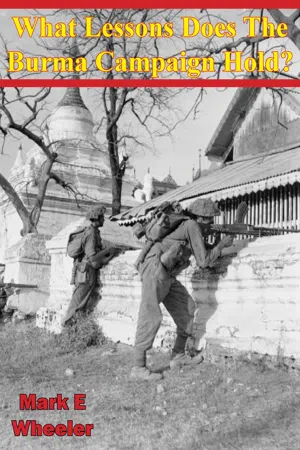
What Lessons Does The Burma Campaign Hold?
About this book
The World War II Burma Campaign was an "economy of force" theater where competition for scarce resources presented unique challenges to operational planners. The Campaign is analyzed using the Principles of War and other operational concepts. Its study shows the close, overlapping relationship between the operational level of war and the tactical and strategic levels. The campaign demonstrates the need for a well-organized theater command structure, the dependence of war plans on allied cooperation and support, the limitations imposed on operations by insufficient logistical resources, and the effect that enemy action can have on plans. The problems of resource allocation, force apportionment, and command relationships will continue to plaque military planners. The lessons from the Burma Campaign are as important and relevant today as they were in World War II.
Information
Subtopic
European HistoryIndex
HistoryWHAT LESSONS DOES THE BURMA CAMPAIGN HOLD?
CHAPTER I — INTRODUCTION
When asked about World War II, most military scholars easily recall the operations that took place in the North African, European or Pacific Theaters. However, seldom does one hear much about the remote campaign that took place in the South-East Asian Theater - the Burma Campaign. Although mostly ignored or forgotten, the campaign in Burma was arguably one of the most complex and demanding campaigns of World War II. Last priority in the overall war effort, the Burma Campaign, nicknamed “the forgotten front” and “the shoe-string theater”, offers significant lessons for those who today study the operational art.
In the World War II setting, Burma was an economy of force theater in the truest sense. Allied efforts in Europe and the Pacific would eclipse Burma in all respects, especially in the competition for scarce resources. This was to have grave consequences for the operational planners.
If any campaign can demonstrate the need for a well- organized theater command structure, the dependence of war plans on allied cooperation and support, the limitations imposed on operations by insufficient logistical resources, and the effect on your plans by enemy interaction, the Burma Campaign can.
Although the Japanese first invaded Burma on 16 Jan 1942, this analysis will concentrate primarily on the period between the Allied Combined Chiefs of Staff decision to establish the South East Asian Theater until the end of the fighting in Burma (August 1943 - August 1945).
This paper attempts to give some insight into the Burma Campaign by using the Principles of War and other operational concepts as the tools for analysis. A detailed accounting of the campaign is outside the scope of this paper. The general conduct of operations can best be sensed by viewing the maps provided (Appendix I).
CHAPTER II — BACKGROUND
Geographic Setting. Before continuing, we must first place the Burma Campaign into perspective. The terrain and climate of Burma placed greater limitations on operations than in other theaters. The Burmese terrain is extremely broken and overly compartmented with limited, mostly fair-weather lines of communication running along north-south axes through the major river valleys (Map 5). Very few roads cut across the frontier. The monsoon season, extending from May into October, brought ground movement almost to a halt. This limited the annual campaign season to essentially the period from November through May. Burma is also one of the most unhealthy spots in the world. Much of the country, and especially the river valleys were dangerously infested by malaria and scrub typhus. These conditions resulted in more casualties to Lieutenant General Slim's 14th Army from disease than from battle injuries. These environmental factors imposed limitations to sustaining an army in the field and were not easily overcome. They also affected the morale of the army.{2}
Strategic Setting. Why was Burma so important? What caused the Allied Combined Chiefs of Staff to establish a separate theater of war and fight a major campaign there? The answer becomes pretty clear when looking at the overall strategic scheme of World War II (Appendix II).
On 15 January 1942, the Japanese invaded Burma, and by mid-May 1942, they had successfully pushed the British Army up through the Central Burma Plain, beyond the Chindwin River, and into the Indo-Burmese frontier. In the process the Burma Road was cut.{3} Losing the Burma Road was potentially devastating to the overall war effort against Japan since this was t...
Table of contents
- Title page
- TABLE OF CONTENTS
- Abstract
- CHAPTER I - INTRODUCTION
- CHAPTER II - BACKGROUND
- CHAPTER III - CREATING A THEATER OF WAR
- CHAPTER IV - WAR PLANS
- CHAPTER V - CONCLUSION
- BIBLIOGRAPHY
- APPENDIX I - MAPS
- APPENDIX II - CHRONOLOGY OF EVENTS
- APPENDIX III
- APPENDIX IV
- APPENDIX V
Trusted by 375,005 students
Access to over 1.5 million titles for a fair monthly price.
Study more efficiently using our study tools.
Frequently asked questions
Yes, you can cancel anytime from the Subscription tab in your account settings on the Perlego website. Your subscription will stay active until the end of your current billing period. Learn how to cancel your subscription
No, books cannot be downloaded as external files, such as PDFs, for use outside of Perlego. However, you can download books within the Perlego app for offline reading on mobile or tablet. Learn how to download books offline
Perlego offers two plans: Essential and Complete
- Essential is ideal for learners and professionals who enjoy exploring a wide range of subjects. Access the Essential Library with 800,000+ trusted titles and best-sellers across business, personal growth, and the humanities. Includes unlimited reading time and Standard Read Aloud voice.
- Complete: Perfect for advanced learners and researchers needing full, unrestricted access. Unlock 1.5M+ books across hundreds of subjects, including academic and specialized titles. The Complete Plan also includes advanced features like Premium Read Aloud and Research Assistant.
We are an online textbook subscription service, where you can get access to an entire online library for less than the price of a single book per month. With over 1.5 million books across 990+ topics, we’ve got you covered! Learn about our mission
Look out for the read-aloud symbol on your next book to see if you can listen to it. The read-aloud tool reads text aloud for you, highlighting the text as it is being read. You can pause it, speed it up and slow it down. Learn more about Read Aloud
Yes! You can use the Perlego app on both iOS and Android devices to read anytime, anywhere — even offline. Perfect for commutes or when you’re on the go.
Please note we cannot support devices running on iOS 13 and Android 7 or earlier. Learn more about using the app
Please note we cannot support devices running on iOS 13 and Android 7 or earlier. Learn more about using the app
Yes, you can access What Lessons Does The Burma Campaign Hold? by Mark E Wheeler in PDF and/or ePUB format, as well as other popular books in History & European History. We have over 1.5 million books available in our catalogue for you to explore.