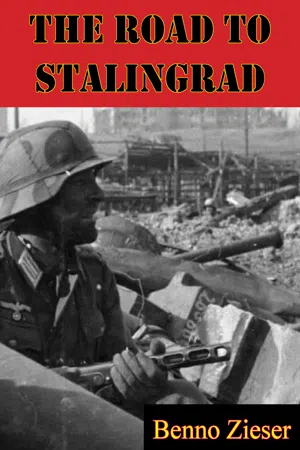
STALINGRAD...an eyewitness report of World War II's most decisive battle.
Drafted into the German infantry when he was scarcely out of school, Benno Zieser fought his way deep into Soviet Russia—advancing, retreating, digging in, destroying tanks with hand grenades, battling snipers, killing the enemy in hand-to-hand combat.
Outnumbered and outmaneuvered, he and his platoon struggled on, till their bravery was no longer an act of patriotism but a desperate effort to survive. Few of them did. At Stalingrad, the Wehrmacht soldiers reached the end of the line: nothing could spring the giant trap set by Russian crack troops closing in on them.
Zieser's account of the war's most brutal battle is intensely moving and honest—a personal ordeal with a universal meaning.
On the last day of January, 1943, the German Sixth Army surrendered to the Russians at Stalingrad. After a winter campaign of unparalleled horror and hardship, the Wehrmacht was beaten.
THE ROAD TO STALINGRAD is a shattering eyewitness account of that lost battle—written by a survivor. Benno Zieser was drafted at the age of nineteen and fought in the infantry at Stalingrad. In this book he tells of his first naive enthusiasm—then the shocking realities:
The frozen wastes of an unconquerable continent...gutted roads strewn with abandoned equipment...the anonymous graves by the wayside...the colossal fraud behind Hitler's promise of victory.
Not since All QUIET ON THE WESTERN FRONT has a German author written such a powerful indictment of war—but Benno Zieser's book is fact, not fiction.
- 132 pages
- English
- ePUB (mobile friendly)
- Available on iOS & Android
eBook - ePub
The Road To Stalingrad
About this book
Information
Subtopic
European HistoryIndex
HistoryTHREE
THE DAY I got my feet frostbitten was March 25, 1942. The green-edged progress chart in the hospital was explicit: Toes second degree, left heel third degree, right heel second to third degree. I learned only later how near I got to losing my feet. “You may be lucky,” the field surgeon had said —and I was.
When the sun was beginning to thaw the snow and the hard-frozen earth, and when the whole country turned into an incredible morass, my feet slowly returned to life. The doctors had cut out the rotting flesh and prescribed ointments that stank to high heaven. The numbness gradually gave way to pain, and then the changing of dressings —the slightest touch—was hell. I kept my feet high, so as not to feel the blood pulsing in them. It wasn’t for some weeks that the pain began to subside. And when the roads at last became usable one day, together with some wounded, scarlet fever and jaundice cases I was bundled into an ambulance and taken to a hospital farther to the rear. Here I met the Sheikh again.
The term hospital was somewhat exaggerated, suggesting as it did snow-white linen and neat Red Cross nurses, whereas we just lay in our underwear and sweaters in long rows on dusty mattresses on the floor and our only attendants were the peasant-faced regulars. The medic, a young physician with a Prussian manner, used to make his rounds once a day to register our complaints. Even while we were flat on our backs, he insisted on military bearing and discipline. But his main concern was to pick those men he could pack off back to the front.
The Sheikh was just beginning to get on his feet again. I, too, had recovered far enough, so we spent our days hobbling around together trying to kill time. At first we played chess with a vengeance, but soon it palled on us, so we were full of enthusiasm when on the first floor we found a little gambling den.
Outwardly indifferent, a man picks up the cards; outwardly indifferent, he makes his contribution to the pool; outwardly indifferent the banker shows his cards. But if you looked closer, you could see the glitter of eyes, the jerky movements of hands and the voracious way the winner grabbed his pile. You could catch the quiver in the men’s voices and feel the excitement which triumphed over the numbness that comes with a long service in the army.
At first we played it safe, then it got hold of us. The excitement gradually entered our blood. The first evening the Sheikh lost two months’ pay, but the next day he won back twice as much. We became regulars and for hours would be lost to the world.
One evening while we were gambling a medical NCO came in and asked whether we’d all taken our smears. “What the hell does he mean?” I asked one of the men. “You innocent bastard,” he said with a grin. “Don’t tell me you hadn’t noticed that most of the guys here got VD?”
“And what’s VD?” I asked.
“For Christ’s sake, the clap, man, the clap!”
“It’s not half as bad,” another man said. “Nowadays it’s just a joke. Why, they’ve got some dope now that’s first class; it hardly lasts a fortnight, and then it’s all over, but it means a fortnight’s leave.”
“You mean, since it’s so harmless, the thing to do is to get it on purpose?”
“Why, of course, you damn fool! What’ll you give me if I let you in on a whore near here who’s absolutely surefire? All she wants is some cigarettes, and you’ve got it. Best thing to do is to get a dose just before they discharge you. Only, don’t report it the very first day, or all you’ll get is a shot and all your trouble’s been for nothing.”
“But don’t you get three days in solitary if you report it too late?”
“Of course! So you spend three days in the doghouse, which means three days less at the front.”
I said thanks, I would think it over. It’s a wonder, I said to myself, what some people will dream up. But the Sheikh turned like a shot to the fellow who’d given me such disinterested advice. “I suppose you wouldn’t know of any other tarts within reach,” he said. “One that hasn’t got the clap but also doesn’t look like an animated broomstick. It’s worth ten cigarettes to me.”
“You don’t want much, do you?” said the other. “You get the doctor to write you out a prescription.”
Besides the Croats, who were the most persistent gamblers, there were also a few young Walloons in the hospital. They kept to themselves and would often carry on whispered debates for hours. Only one of them was wounded. The others were down with Volhynia fever, which was widespread, a little-known variety of trench fever with periodical rise and fall of temperature coupled with severe headaches and pains in the limbs.
I decided to talk to them, and the Sheikh joined me. We sat down beside them and with our school French tried to carry on a conversation. First we talked about our ailments, then about the terrible cold of the past winter and the new German offensive which was in the offing. Then the Sheikh put it to them straight: why on earth had they, as Belgians, volunteered to fight on the eastern front?
They seemed surprised he should ask the question. Why were we here? they asked. Why, that was obvious—to keep Bolshevism at a good distance from our homeland! Wasn’t all Europe doing its best to that end?
The Sheikh wanted to know what they thought of the war in Russia. Yes, they admitted, they’d expected it to be quite different. Most of all they’d underestimated the mental strain. They made no bones about the fact that their initial enthusiasm had given way to a more fatalistic attitude. But they would go on fighting, that was their duty as they saw it. They knew very well why they were here, they said, but they felt the average German soldier wasn’t at all clear about it. And a dark-haired fellow with intelligent eyes and pallid, sunken cheeks said: “You Germans are strong because you’re united and have a strong man at the helm. For that, we envy you. But you’re strong only as a mass. You fight like the devil, but the individual does it without conviction. He fights only because he’s learned to obey orders.”
Later, when we stretched out on our mattresses, the Sheikh said: “Poor loonies, volunteering to go through all this mess just for the fun of it!”
I said they were real idealists.
“Yes, I suppose that’s one way of looking at it.”
Gambling was of course prohibited. If we were caught at it every penny on the table would be confiscated. For this reason one of us always stood guard, in case the chief physician or the paymaster turned up. All the same, one day we were taken by surprise. The warning whistle sounded at the last moment. Like lightning everybody grabbed his money and tried to rush off when the potbellied paymaster appeared in the doorway.
“Gambling again, you hypocritical bastards!” he bellowed, his face flushed scarlet. “Let me catch you red-handed, just once!”
Then his eyes lit on the Sheikh. “What in the name of God are you doing up here? Don’t you belong on the ground floor?”
The Sheikh was so rattled that for once his presence of mind failed him; he just stammered. The paymaster was thoroughly mad, because he’d raced up those stairs for nothing, so now he was letting off steam.
“Is that the proper way to speak to me?” he demanded. “Stand at attention! You don’t seem to be aware of the respect due an officer.”
Though he was only a damned clerk, he held officer’s rank and he particularly emphasized that magic word, Offizier. He had the Sheikh bubbling all over with “Yessirs” and “Nosirs,” and all seething inside.
“Get down where you belong!” bellowed Potbelly. It irked the Sheikh to see his gloating roommates peering up the stairs. All he could think of was revenge. “You just wait,” he said. “I’ll get even with this bastard if it’s the last thing I do.”
A few days later, that’s precisely what he did. It was a unique revenge. Only someone like the Sheikh could have dreamed it up.
Senta was the paymaster’s pure-blooded Alsatian bitch; he just adored that animal, and talked to her as if she were human. The Sheikh discovered that Senta was in heat. Then the fun began. All he needed to carry out his sinister plan was someone who could talk Russian. He soon found a man who was only too happy to cooperate. The two of them put their heads together at the window of our billet and called to a young Ukrainian who happened to pass. There was a brief confab, the boy scratched his head a moment, accepted some tobacco the Sheikh offered him and made off, grinning.
An hour later the young fellow was back, dragging a reluctant mangy hound on a leash.
“That will do,” the Sheikh said authoritatively. “Finest mongrel I ever saw.” He ran to the paymaster’s room, where Senta usually was locked up. The key was outside. Out came Senta, tail-wagging and slobbering all over her liberator. “Come along, old girl,” said the Sheikh. “Why shouldn’t you have a bit of fun for once!”
That bitch didn’t have to be told twice. Nor did the mongrel. When he scented her, there was no holding him. The Ukrainian slipped the line, and the dog leaped at Senta. Now the Sheikh was off to the paymaster’s office.
“Quick, sir,” he cried. “It’s your bitch! She’s going to be in trouble!”
Out rushed the paymaster, all puffing and blowing.
“Senta! In the name of heaven, what do you think you’re doing, Senta? Here, I tell you, come here!” he hollered.
But Senta no longer gave a damn. The desperate paymaster yelled for a bucket of water. But before this could be brought, he seized the stump of the hound’s tail with both hands, tugging hard to terminate the shameful proceedings. The hound growled and snapped at him, but without letting go his grip. Cursing, the paymaster rushed to meet the medical orderly with the bucket and sluiced its contents over both sinners. The startled mongrel ducked, shook his coat, looked around suspiciously and ambled off. The whole hospital was at the windows, hysterical with laughter. The Sheikh turned to the men around him. “Now we’ve got to get that dog’s name and find out where he lives,” he said dryly.
“What for?”
“Slow on the uptake, eh? For alimony, of course!”
The hospital roared.
The weather was fine now. The sun was blazing down on the dusty streets. There was an uninterrupted flow of men and munitions to the front. The big new German offensive had begun. The whole of that tremendous front was set in motion.
A bomb fell in the street in front of the hospital. The window panes splintered all over the place. The blast swept us back against the walls. Half across the deep crater was an army officer’s car, front wheels hanging over the rim, but apparently undamaged. Two dazed officers clambered out, a colonel and a lieutenant, both white as a sheet.
At one go fifty men were discharged from hospital. The Sheikh and I were among them. With heavy hearts we made our way back to the front.
We hitchhiked on army trucks, gradually feeling our way from one front-line position to another. We were told our division was somewhere near Kharkov. That didn’t cheer us particularly, seeing that Kharkov always seemed to be in the news as being in the thick of the fighting.
Behind our truck trailed a cloud of dust, and in no time there was a thin gray coating on uniform, hair and face. The dust clogged up our noses and mouths, and parched our throats. Everything was shimmering with the heat.
There was a dead man lying beside the road. A Russian, in his earth-brown uniform. Since we were still a long way from the front, we wondered how he’d got there. A few minutes later the Sheikh pointed to the other side of the road—”But there’s another!” After that we saw more and more corpses. For many miles the bodies we...
Table of contents
- Title page
- TABLE OF CONTENTS
- ONE
- TWO
- THREE
- FOUR
Trusted by 375,005 students
Access to over 1.5 million titles for a fair monthly price.
Study more efficiently using our study tools.
Frequently asked questions
Yes, you can cancel anytime from the Subscription tab in your account settings on the Perlego website. Your subscription will stay active until the end of your current billing period. Learn how to cancel your subscription
No, books cannot be downloaded as external files, such as PDFs, for use outside of Perlego. However, you can download books within the Perlego app for offline reading on mobile or tablet. Learn how to download books offline
Perlego offers two plans: Essential and Complete
- Essential is ideal for learners and professionals who enjoy exploring a wide range of subjects. Access the Essential Library with 800,000+ trusted titles and best-sellers across business, personal growth, and the humanities. Includes unlimited reading time and Standard Read Aloud voice.
- Complete: Perfect for advanced learners and researchers needing full, unrestricted access. Unlock 1.5M+ books across hundreds of subjects, including academic and specialized titles. The Complete Plan also includes advanced features like Premium Read Aloud and Research Assistant.
We are an online textbook subscription service, where you can get access to an entire online library for less than the price of a single book per month. With over 1.5 million books across 990+ topics, we’ve got you covered! Learn about our mission
Look out for the read-aloud symbol on your next book to see if you can listen to it. The read-aloud tool reads text aloud for you, highlighting the text as it is being read. You can pause it, speed it up and slow it down. Learn more about Read Aloud
Yes! You can use the Perlego app on both iOS and Android devices to read anytime, anywhere — even offline. Perfect for commutes or when you’re on the go.
Please note we cannot support devices running on iOS 13 and Android 7 or earlier. Learn more about using the app
Please note we cannot support devices running on iOS 13 and Android 7 or earlier. Learn more about using the app
Yes, you can access The Road To Stalingrad by Benno Zieser, Alec Brown in PDF and/or ePUB format, as well as other popular books in History & European History. We have over 1.5 million books available in our catalogue for you to explore.