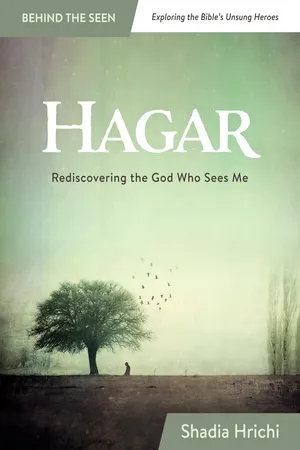
You are "The God Who Sees Me."
Discover a close relationship with God—no matter the pain or suffering in your life. Witness the depths of God's compassion through the eyes of Hagar, a runaway slave who meets the living God in a desert of despair, where she gives Him the name El Roi, "The God Who Sees Me." A largely forgotten Old Testament character, Hagar is actually one of only a few people who have ever spoken directly with the LORD.
Through this seven week study, you will find that when you surrender your life into God's hands, your trials and triumphs serve a magnificent purpose: to draw you into the arms of the faithful God who sees you.
This week, we will trace Hagar’s origins through the story of Abraham and Sarah. As soon as the couple begins to make headway toward the Promised Land, they are diverted into Egypt, where trouble awaits. Could what appears to be a disastrous detour actually be a part of God’s sovereign plan?
Day One Experiencing God’s Presence in Life’s Detours
When I was growing up, my family moved more often than I wish to count. By my thirteenth birthday, we had moved nearly a dozen times, from the hustle and bustle of New York City, to a quiet suburb outside tourist-laden Las Vegas, to Morocco, where donkeys, cars, and camels shared the roads. Next was a rent-controlled apartment in Queens, New York, where car horns and police sirens lulled me to sleep, followed by the eerie silence of a house atop a small mountain in upstate New York. Each place we lived had a culture all its own, and no matter where we went or how hard I tried, I never seemed to fit in. I either did not look right, act right, or talk right. Or all three!
Being repeatedly uprooted, trying to make new friends only to say good-bye a year later, and never feeling settled or having a place to call home was definitely challenging. Yet, looking back, I discovered those challenges created an advantage for me rather than a handicap. I am grateful for the lessons I gained in adjusting to change, which, as time went on, came a little easier. Because I lived a year in Morocco and have parents who each immigrated to the United States and speak several languages, I feel at ease around people who are different from me, even when I do not understand what they are saying.
Pause to Ponder
How about you? Reflect on a time when you felt like you did not belong or fit in. Share one or two positive outcomes you gained from your experience.
Record your thoughts in the margin; do this for all Pause to Ponder sections.
Looking Back
Before we dive into the life of Hagar, let’s spend some time exploring the backstory that led up to it.
We begin this week’s lesson with one of the Bible’s most renowned couples: Abraham and Sarah. Like many other stories from Scripture, it opens with God calling people out of their comfort zone. Ten generations and 367 years after the famous worldwide flood, a man named Abraham received a divine message from God. (Actually, his name was Abram at the time, and God later changed it to Abraham. God also changed Abraham’s wife’s name from Sarai to Sarah. To avoid confusion, I’m going to use Abraham and Sarah throughout this study, except in Scripture quotations that use the older versions of their names.)
Learn about Abraham’s background by reading Joshua 24:1–3. What word best describes Abraham’s father? Circle one.
shepherd idolater priest elder warrior
Does Abraham’s upbringing surprise you? Why or why not?
Read Genesis 12:1–9. Which of the following statements best reflects Abraham’s response to God’s command?
He obeyed after receiving his wife’s approval.
He waited for a more convenient time to travel
He obeyed and went.
Pause to Ponder
Think about a time when God asked you to step out in faith. What was your initial response? Were you hesitant? Expectant? Resistant? Why do you suppose you responded the way you did? Did God ask you to leave someone or something behind? In what ways did the experience shape your relationship with God?
Genesis 12:1 really bothers me: “Now the LORD said to Abram, ‘Go from your country and your kindred and your father’s house to the land that I will show you.’” I do not know about you, but I like to know where I am going. For me, it is hard enough being directionally challenged without the added problem of not knowing where I am supposed to end up.
I get lost. A lot. My close friends know this and graciously cover me in prayer whenever I travel. The Bible teaches that God determines the time and place each of us is born (Acts 17:26). I wonder if He waited until the invention of GPS before sending me into the world.
I once remember driving with a new friend to a large park where we were planning to walk the trails. Within minutes of fastening our seat belts, I realized my friend was just as devoid of an internal compass as I was. This was a couple of years before smartphones, so neither of us had GPS on our cell phones. We could have printed out a map from the Internet, but because I had lived in the area for over twelve years, I did not think we needed one. I was wrong. For nearly forty-five minutes, we drove in circles, trying to find the park.
Exasperated, I called my friend Liz who was familiar with the area and my tendency to get lost. I could imagine her shaking her head as she recited the directions. When my friend and I arrived at the park, we realized it had been practically a stone’s throw away the entire time we were driving. To this day, I still get lost and am often asked, “Why don’t you use your phone’s GPS?” To which I reply, “I do—once I realize I’m lost.” Something about data and dollars and . . . sigh.
Walking by Faith
Abraham had no idea where he was going when God told him to leave. He had to trust God to lead him every step of the way. Talk about walking by faith!
Glance back at Genesis 12:4–8.
List each of the family members Abraham took with him.
What else did Abraham take with him when he set out for Canaan?
Read Genesis 11:30. What additional detail do we learn here?
Describe the location where Abraham called on the name of the Lord. Be specific.
“The heart of man plans his way, but the LORD establishes his steps. —Proverbs 16:9
Considering Abraham’s family background, how much significance would you ascribe to Abraham’s decision to call on the name of the LORD in Genesis 12:8? Place an X on the line to indicate your response.
not very significant _________________________ very significant
Explain your response.
In Joshua 24:3, Scripture teaches us that God Himself took “Abraham from beyond the River and led him through all the land of Canaan.” Think back to the first time you sensed in your heart a longing for God. Do you believe God guided your steps to reach that point?
In John 6:44, Jesus said, “No one can come to me unless the Father who sent me draws him.” Take a few moments to meditate on that thought. Reflect on your own journey with God up to this point. Where would you place an X on the line?
I went looking for God ____________________ God came looking for me
Over the past week, how often did you call on the name of the Lord?
In my set daily prayer time
Whenever I needed something
Throughout the day
Only when I blew it
An Unexpected Detour
When God asked Abraham to leave nearly everything that was familiar to him, Abraham and Sarah packed up their little family and began the journey. However, just as they were starting to make some headway, the couple found themselves having to take a detour.
Read Genesis 12:10–16. Briefly summarize the events in your own words.
While Abraham was wise to take steps to protect his family from starvation, in fear for his life, he failed to protect his wife from the hungry eyes of Pharaoh. The servants of Pharaoh were so taken by Sarah’s beauty (even at age sixty-five!) that when they told Pharaoh about her, he took Sarah int...
Table of contents
Cover Page
Title Page
Copyright Page
Contents
Acknowledgments
About the Author
About the Study
A Note from the Author
Introduction
Part I: Wounded
Part II: Wandering
Part III: Waiting
Part IV: Wedding
Trusted by 375,005 students
Access to over 1.5 million titles for a fair monthly price.
Study more efficiently using our study tools.
Frequently asked questions
Yes, you can cancel anytime from the Subscription tab in your account settings on the Perlego website. Your subscription will stay active until the end of your current billing period. Learn how to cancel your subscription
No, books cannot be downloaded as external files, such as PDFs, for use outside of Perlego. However, you can download books within the Perlego app for offline reading on mobile or tablet. Learn how to download books offline
Perlego offers two plans: Essential and Complete
Essential is ideal for learners and professionals who enjoy exploring a wide range of subjects. Access the Essential Library with 800,000+ trusted titles and best-sellers across business, personal growth, and the humanities. Includes unlimited reading time and Standard Read Aloud voice.
Complete: Perfect for advanced learners and researchers needing full, unrestricted access. Unlock 1.5M+ books across hundreds of subjects, including academic and specialized titles. The Complete Plan also includes advanced features like Premium Read Aloud and Research Assistant.
Both plans are available with monthly, semester, or annual billing cycles.
We are an online textbook subscription service, where you can get access to an entire online library for less than the price of a single book per month. With over 1.5 million books across 990+ topics, we’ve got you covered! Learn about our mission
Look out for the read-aloud symbol on your next book to see if you can listen to it. The read-aloud tool reads text aloud for you, highlighting the text as it is being read. You can pause it, speed it up and slow it down. Learn more about Read Aloud
Yes! You can use the Perlego app on both iOS and Android devices to read anytime, anywhere — even offline. Perfect for commutes or when you’re on the go. Please note we cannot support devices running on iOS 13 and Android 7 or earlier. Learn more about using the app
Yes, you can access Hagar by Shadia Hrichi in PDF and/or ePUB format, as well as other popular books in Theology & Religion & Biblical Studies. We have over 1.5 million books available in our catalogue for you to explore.