The appeasement of Nazi Germany by the western democracies during the 1930s and the subsequent outbreak of World War II have been a major referent experience for U.S. foreign policymakers since 1945. From Harry Truman's response to the outbreak of the Korean War to George W. Bush's decision to overthrow Saddam Hussein, American presidents have repeatedly affirmed the "lesson" of Munich and invoked it to justify actual or threatened uses of force. However, the conclusion that the democracies could easily have stopped Hitler before he plunged the world into war and holocaust, but lacked the will to do so, does not survive serious scrutiny. Appeasement proved to be a horribly misguided policy against Hitler, but this conclusion is clear only in hindsight - i.e., through the lens of subsequent events.
Dr. Jeffrey Record takes a fresh look at appeasement within the context of the political and military environments in which British and French leaders operated during the 1930s. He examines the nature of appeasement, the factors underlying Anglo-French policies toward Hitler from 1933 to 1939, and the reasons for the failure of those policies. He finds that Anglo-French security choices were neither simple nor obvious, that hindsight has distorted judgments on those choices, that Hitler remains without equal as a state threat, and that invocations of the Munich analogy should always be closely examined.
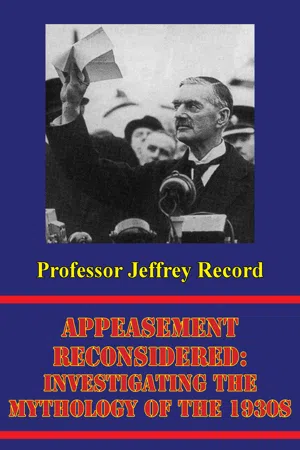
eBook - ePub
Appeasement Reconsidered: Investigating The Mythology Of The 1930s
- 64 pages
- English
- ePUB (mobile friendly)
- Available on iOS & Android
eBook - ePub
Appeasement Reconsidered: Investigating The Mythology Of The 1930s
About this book
Information
Subtopic
European HistoryIndex
HistoryCONCLUSIONS AND RECOMMENDATIONS
Hitler Remains without Equal as a State Threat.
No post-1945 foreign dictatorship bears genuine comparison to the Nazi dictatorship. The scope of Hitler’s nihilism, ambitions, and military power posed a mortal threat to Western civilization. No other authoritarian or totalitarian regime has managed to employ such a powerful military instrument in such an aggressive manner to fulfill such a horrendous agenda. Stalin had great military power but was cautious and patient; he was a realist and neither lusted for war nor discounted the strength and will of the Soviet Union’s enemies. Mao Zedong was reckless but militarily weak. Ho Chi Minh’s ambitions and fighting power were local. And Saddam Hussein was never in a position to reverse U.S. military domination of the Persian Gulf. Who but Hitler was so powerful and unappeasable and undeterrable?
Anglo-French Security Choices in the 1930s Were Neither Simple Nor Obvious.
They were at every turn severely constrained by domestic politics, economic difficulties, perceptions of military inadequacy, and Hitler’s effective strategic deception regarding Nazi Germany’s intentions and capabilities. Appeasement of attempted German revision of the Versailles Treaty made both moral and strategic sense because the treaty was unjust, strategically short-sighted, and unenforceable. Nor was it politically possible for the democracies to forcibly oppose the reunification of the German nation within a single state; the victors of 1918 had violated Woodrow Wilson’s sacred principle of self-determination by prohibiting union of Germany and Austria and by creating the polyglot state of Czechoslovakia with unhappy German minorities in that state’s border areas with Germany.
Appeasement became untenable the moment Hitler demanded, under the threat of force, the dismemberment of Czechoslovakia – which was not only a democratic state prepared to grant the Sudeten Germans considerable autonomy but also a significant military counterweight to German territorial ambitions in Eastern Europe. Yet neither Britain nor France was in a military position to defend Czechoslovakia, although Chamberlain’s threat of a general war deterred Hitler from seizing all of Czechoslovakia in 1938.
Beware of Hindsight; It Is Not 20/20 Vision.
Many hindsighters believe they now know what Britain and France (and for that matter the United States) should have done in the 1930s – regime change in Berlin via Hitler’s assassination or, failing that, an invasion of the Third Reich – because we all know that World War II and the Holocaust were the consequences of appeasement. These facts were hardly self-evident at the time. Today’s should runs afoul of yesterday’s could not and would not. British and French statesmen did not know they were on the road to general war; on the contrary, they were seeking to avoid it. In any case, neither assassination of the head of a major state nor the launching of preventive war against ...
Table of contents
- Title page
- TABLE OF CONTENTS
- FOREWORD
- BIOGRAPHICAL SKETCH OF THE AUTHOR
- SUMMARY
- APPEASEMENT RECONSIDERED: INVESTIGATING THE MYTHOLOGY OF THE 1930s
- CONCLUSIONS AND RECOMMENDATIONS
Trusted by 375,005 students
Access to over 1.5 million titles for a fair monthly price.
Study more efficiently using our study tools.
Frequently asked questions
Yes, you can cancel anytime from the Subscription tab in your account settings on the Perlego website. Your subscription will stay active until the end of your current billing period. Learn how to cancel your subscription
No, books cannot be downloaded as external files, such as PDFs, for use outside of Perlego. However, you can download books within the Perlego app for offline reading on mobile or tablet. Learn how to download books offline
Perlego offers two plans: Essential and Complete
- Essential is ideal for learners and professionals who enjoy exploring a wide range of subjects. Access the Essential Library with 800,000+ trusted titles and best-sellers across business, personal growth, and the humanities. Includes unlimited reading time and Standard Read Aloud voice.
- Complete: Perfect for advanced learners and researchers needing full, unrestricted access. Unlock 1.5M+ books across hundreds of subjects, including academic and specialized titles. The Complete Plan also includes advanced features like Premium Read Aloud and Research Assistant.
We are an online textbook subscription service, where you can get access to an entire online library for less than the price of a single book per month. With over 1.5 million books across 990+ topics, we’ve got you covered! Learn about our mission
Look out for the read-aloud symbol on your next book to see if you can listen to it. The read-aloud tool reads text aloud for you, highlighting the text as it is being read. You can pause it, speed it up and slow it down. Learn more about Read Aloud
Yes! You can use the Perlego app on both iOS and Android devices to read anytime, anywhere — even offline. Perfect for commutes or when you’re on the go.
Please note we cannot support devices running on iOS 13 and Android 7 or earlier. Learn more about using the app
Please note we cannot support devices running on iOS 13 and Android 7 or earlier. Learn more about using the app
Yes, you can access Appeasement Reconsidered: Investigating The Mythology Of The 1930s by Professor Jeffrey Record in PDF and/or ePUB format, as well as other popular books in History & European History. We have over 1.5 million books available in our catalogue for you to explore.