Do you ever find that you are less effective with clients who are provocative, angry, shut down, or emotionally labile? Would you like to be more effective helping clients with challenging problems, including trauma, addictions, and comorbid conditions?
Clients can arouse strong emotional reactions in therapists, often termed experiential avoidance or countertransference. To be effective with these challenging cases, therapists must build their psychological capacity to stay self-aware, attuned, and clinically flexible while having strong reactions. This manual provides clear and practical deliberate practice exercises to help you master these inner skills so you can be a more effective therapist and enjoy your work more. This manual features a training plan that is based on the principles of deliberate practice, works with all major models of psychotherapy, aids all levels of therapist development, from beginning trainees to experienced clinicians, helps therapists be more effective with their most challenging clients, and protects the boundaries and privacy of trainees.
Louis G. Castonguay, Professor, at Penn State University, said the book "is an innovative addition to the movement of deliberate practice, " and that "this book offers troves of ideas, tools, and resources for therapists of varied theoretical orientations and experience levels." Catherine Eubanks, president-elect of the society for the Exploration of Psychotherapy Integration, commented that "by practical techniques for increasing therapists' capacity to be present and attuned in the therapy session, Rousmaniere draws attention to one of the most important ways to advance our field and improve our ability to help our patients."
eBook - ePub
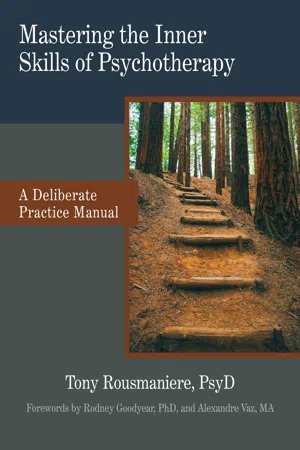
Mastering the Inner Skills of Psychotherapy
A Deliberate Practice Manual
- 152 pages
- English
- ePUB (mobile friendly)
- Available on iOS & Android
eBook - ePub
About this book
Information
PART I

The Training Plan
In part I of this manual, we will review the rationale and research that are the basis for this deliberate practice training program:
• Chapter 1: Introduction—This chapter explores the limits of psychotherapy training as it is currently practiced and introduces you to the rationale for using deliberate practice to master the inner skills of psychotherapy and develop psychological capacity.
• Chapter 2: A Case Example—This chapter shows you the benefits of deliberate practice via an illustrative case example.
• Chapter 3: Psychological Capacity—This chapter takes you deeper into the concept of psychological capacity with examples of how it can benefit or limit your clinical practice.
• Chapter 4: Stimuli for Deliberate Practice—This chapter explores the importance of identifying appropriate stimuli for your deliberate practice of psychotherapy.
• Chapter 5: Principles of Training—This chapter reviews principles and guidelines that guide this deliberate practice manual, including the importance of privacy and appropriate boundaries.
• Chapter 6: Training Safely—This chapter gives you tools to ensure that your deliberate practice is safe and beneficial.
Please note that this manual focuses tightly on clinical training. For a broader discussion of deliberate practice and more in-depth review of the relevant empirical research basis, see Rousmaniere (2016) and Rousmaniere, Goodyear, Miller, & Wampold (2017).

CHAPTER 1

Introduction
This book proposes a new approach to psychotherapy training based on two findings from psychotherapy research:
1. Some of the most important skills for therapists are interpersonal relational skills, including attunement, empathy, and responsiveness (Anderson, Ogles, Patterson, Lambert, & Vermeersch, 2009; Boswell & Castonguay, 2007; Hatcher, 2015; Norcross, 2011). Relational skills are necessary for all major models of therapy. Indeed, research suggests that therapists’ relational skills have more than ten times the impact on the outcome of therapy than their choice of a model or adherence to a model (Wampold & Imel, 2015).
2. Therapists’ relational skills are limited by their intrapersonal (inner) skills and psychological capacity to stay attuned to clients while the therapist experiences discomfort. For example, a therapist may experience discomfort when clients are angry or suicidal or they describe trauma. This can cause the therapist to detach, change the subject, or even argue with clients. Termed experiential avoidance, this process has been identified as a major barrier to success across a wide range of therapy models, from cognitive behavior therapy to psychodynamic psychotherapy (e.g., Eubanks-Carter, Muran, & Safran, 2015; Greenberg, 2010; Hayes, Follette, & Linehan, 2004; Hembree, Rauch, & Foa, 2003).
Many excellent guides have been written on how therapists can improve their therapy-related interpersonal skills. However, precious little guidance has been provided on how therapists can build their intrapersonal (inner) skills and psychological capacity to use these skills, particularly when helping clients whom the therapist finds provocative or interpersonally challenging. The goal of this book is to fill this gap by providing a training program to improve therapists’ psychological performance. Before we review the training program, however, let’s explore what it looks like when a therapist doesn’t have sufficient psychological capacity to be effective. This is best illustrated by a case I had a few years into my training as a therapist.
I was working with a male African American client in his early twenties. (Details of clinical cases in this book have been modified to protect client privacy.) My client started therapy with chronic anxiety, recurring waves of depression, and angry outbursts. He had a tough upbringing, including neglect by his mother and physical abuse by his father. In early grade school he was given a diagnosis of oppositional defiant disorder and mandated therapy and psychiatric medication, both of which had been unhelpful. Since graduating from high school, he had cycled through unfulfilling relationships and dead-end jobs. However, he was also smart, perceptive, and motivated. He wanted to turn his life around and attend college. I liked the client and felt invested in his success.
In our therapy, I used an empirically supported treatment that I had studied carefully and knew how to perform competently. We bonded quickly in the first few sessions as we explored his goals, strengths, and symptoms. However, we hit a roadblock around the sixth session when the client told me that he had started using opiates he had bought from a friend to self-medicate his anxiety. I was surprised by his disclosure and did not react well.
I know I reacted poorly because I later reviewed the video of the session with my supervisor with the client’s consent. The video showed that after the client disclosed his drug use, I got flustered and gave him a minilecture about the dangers of opiate addiction. The client replied, “But you encouraged me to talk to a psychiatrist. How is this different?”
I retorted, “Do you want to add drug addiction to your challenges?”
The client stared at me for a moment and then replied with a raised voice, “It’s the same drug, but it’s only okay if the doctor says so?”
I replied, “I know you’ve had bad experiences with medications before. However, that was a long time ago. Your friend doesn’t have medical training. Are you never going to trust a psychiatrist?”
My client’s body tensed up and his eyes narrowed as he looked at me. His voice was raised even higher, “Why should I trust the psychiatrist?”
I took a big breath, looked away for a moment, and then said, “Okay, I can see you’re getting angry, so let’s talk about something else. Did you try the homework we discussed last week?” My client scowled and went silent.
My supervisor paused the video and asked me, “Can you hear the defensive tone in your voice?”1 I cringed and nodded my head. “What happened?” asked my supervisor.
I reflected for a moment. “I think I felt scared for him.”
My supervisor replied, “Sounds like you had a wave of uncomfortable and complex feelings. How about we list them? You, of course, don’t have to disclose anything that feels too personal.2 But exploring your reactions may help you understand how you get defensive.”
Although I was apprehensive, I saw his point and nodded in agreement. He picked up a pen and started a list on a piece of paper. “First, you felt fear for his well-being?”
“Yes,” I replied, “I also felt worried that he would get angrier and have an outburst.”
My supervisor wrote down “fear” and asked, “Any other reactions?”
I looked away for a moment and then replied, “Yes, I felt frustrated that we’d made good progress for a few sessions, and now he might risk it all for drugs.”
My supervisor wrote down “frustration.” He then looked carefully at me. “I notice you look down as you notice your frustration,” he said. “Could you also feel some guilt?”
I sighed heavily and replied, “Yes, I feel guilty for being intimidated by his anger. He’s been labeled as an ‘angry black man’ since he was a young child, and now I, his white therapist—I’m treating him the same way.”
My supervisor wrote “guilt.” He may have heard my voice soften because he asked, “So you also care for him?”
“Yes,” I replied.
“The positive feelings can feel the most vulnerable,” he said, writing down “care.”
I felt frustrated with myself. I had studied the treatment model thoroughly and knew that I was not providing it competently. I said, “I really don’t know why I reacted that way.”
My supervisor replied, “You understand the treatment model in your mind, but you can lose it when you have strong reactions to clients. This is normal. We all do it.”
I didn’t like what he was saying, but I knew it was accurate. I nodded in agreement. My supervisor continued, “Even worse than forgetting the treatment model, you lost your attunement and empathy for the client. This is not surprising; research has shown that empathy requires that you have the inner skill and capacity to tolerate psychological discomfort.”3
With a helpful smile, my supervisor handed me the paper with the list of my feelings that I couldn’t tolerate. “His life has given him plenty of reasons to be angry, and you’ve given him one more. He may have more vulnerable feelings under this anger. However, you can’t help him get to the bottom of it all unless you can build your capacity to stay self-reflective when you have strong emotional reactions in therapy. You don’t need to agree with everything he says, but you do need to be able to stay attuned to him rather than get defensive, especially when there is a rupture between you two or when you feel uncomfortable. Do you want to learn how to do this, so you can help this man?”
I hesitated. I hate to admit it, but I briefly considered ways to get out of working with this client. I could have labeled him as angry or unmotivated, like many of his previous therapists had done. I could have transferred him to another therapist or even suggested that he was inappropriate for treatment.
However, I knew that this client wasn’t the only one with whom I got defensive or argumentative. For the rest of my career, was I going to transfer every client who made me uncomfortable?4 In my rough estimation, I had this problem with at least half my clients.5 For example, I worked with an anxious woman who frequently told me her thoughts about committing suicide but refused to tell me if she had a plan to do so. An older man had seemingly unending depression about his adult son’s suicide. A woman who had been sexually abused as a child had chronic unhealthy relationships and had recently told me that she was attracted to me. I wanted to help these clients, but I didn’t know how to tolerate the discomfort they caused me.
I took a deep breath and said to my supervisor, “Okay, how can I learn this?”
He said, “The good news is that it is possible to improve your capacity to stay attuned with your client and be self-reflective while experiencing uncomfortable feelings. I can show you some good books to read about this. But, most important, you must get many, many hours of experience working with clients you find challenging.”
I smiled at my supervisor and nodded while thinking, “Are you nuts?” As I pictured myself heading back to session with this client, I shuddered. It wasn’t the client that worried me—I liked him a lot—but the image of me sitting with him and being unhelpful for hour after hour was dreadful. Furthermore, the plan that most of my clinical skills would accrue from face-to-face experience with clients seemed as ridiculous as a pilot learning to fly with real passengers in the plane or an athlete going to the Olympics without getting in shape first.
I asked my supervisor, “Is there any way to speed up the process?”
He smiled and replied, “Yes. Do your own therapy.”
My immediate thought: “Crap.” My supervisor didn’t know it, but I had already been in my own therapy for years.
A Thought Experiment
Think back to a competitive sport you played when you were younger. Or if you didn’t play a sport, think of a musical instrument you learned to play or any other skill you wanted to acquire through serious training, like dance, chess, martial arts, or acting. Now imagine yourself telling your coach or teacher, “I really love this sport/instrument/activity. In fact, I want to get good enough to perform professionally when I’m older. However, I just don’t have time to practice. Instead of practicing, is there a way that I could attain a professional level of skill by reading a lot of books about it, writing some papers about it, and then playing a lot of games/doing a lot of performances?” If you had said this, how would your coach or teacher have responded?
Professional training for most fields goes far beyond cognitive learning. It requires building trainees’ capacity to perform at advancing levels of difficulty. Professional performance in most fields requires augmented physical and psychological strength and endurance acquired through many hours of deliberate practice.
What about therapists? While psychotherapy does not require physical endurance, we need as much or more psychological and emotional capacity as any other profession. We must sit for hours eye to eye with clients who are in severe distress, desperate f...
Table of contents
- Cover
- Title Page
- Copyright Page
- Contents
- Foreword by Rodney Goodyear, PhD
- Foreword by Alexandre Vaz, MA
- Part I. The Training Plan
- Part II. Deliberate Practice Exercises
- Part III. Advanced Deliberate Practice Exercises
- Part IV. Training Strategy
- Part V. Resources
- References
- Acknowledgments
- Index
- About the Author
Trusted by 375,005 students
Access to over 1.5 million titles for a fair monthly price.
Study more efficiently using our study tools.
Frequently asked questions
Yes, you can cancel anytime from the Subscription tab in your account settings on the Perlego website. Your subscription will stay active until the end of your current billing period. Learn how to cancel your subscription
No, books cannot be downloaded as external files, such as PDFs, for use outside of Perlego. However, you can download books within the Perlego app for offline reading on mobile or tablet. Learn how to download books offline
Perlego offers two plans: Essential and Complete
- Essential is ideal for learners and professionals who enjoy exploring a wide range of subjects. Access the Essential Library with 800,000+ trusted titles and best-sellers across business, personal growth, and the humanities. Includes unlimited reading time and Standard Read Aloud voice.
- Complete: Perfect for advanced learners and researchers needing full, unrestricted access. Unlock 1.5M+ books across hundreds of subjects, including academic and specialized titles. The Complete Plan also includes advanced features like Premium Read Aloud and Research Assistant.
We are an online textbook subscription service, where you can get access to an entire online library for less than the price of a single book per month. With over 1.5 million books across 990+ topics, we’ve got you covered! Learn about our mission
Look out for the read-aloud symbol on your next book to see if you can listen to it. The read-aloud tool reads text aloud for you, highlighting the text as it is being read. You can pause it, speed it up and slow it down. Learn more about Read Aloud
Yes! You can use the Perlego app on both iOS and Android devices to read anytime, anywhere — even offline. Perfect for commutes or when you’re on the go.
Please note we cannot support devices running on iOS 13 and Android 7 or earlier. Learn more about using the app
Please note we cannot support devices running on iOS 13 and Android 7 or earlier. Learn more about using the app
Yes, you can access Mastering the Inner Skills of Psychotherapy by Tony Rousmaniere, PsyD in PDF and/or ePUB format, as well as other popular books in Psychology & Education in Psychology. We have over 1.5 million books available in our catalogue for you to explore.