Lt Col John J. Zentner's The Art of Wing Leadership and Aircrew Morale in Combat addresses the role that the air force wing commander plays in affecting the level of aircrew morale during combat. More specifically, Colonel Zentner's study seeks to identify and define those unique characteristics associated with leading airmen that sustain aircrew morale in the face of significant losses.
Colonel Zentner defines aircrew morale as the enthusiasm and persistence with which an aviator flies combat missions. He then offers three historical case studies to establish a framework within which aircrew morale can be assessed. The first case study is of Maj Adolf Galland and Jagdgeschwader 26 during the Battle of Britain. The second case study considers Lt Col Joseph Laughlin and the 362d Fighter Group during the invasion of France in the summer of 1944. The third case study examines Col James R. McCarthy and the 43d Strategic Wing during Operation Linebacker II. Drawing heavily on the results of questionnaires and personal interviews, each case study is focused on the importance that aircrews ascribed to three general areas: individual needs, group cohesion, and unit esprit de corps.
Colonel Zentner concludes that aircrew control over development of combat tactics was the single most important element affecting morale. This finding supports one of the fundamental truths about the employment of airpower, centralized control and decentralized execution that has become embedded in the airman's culture. In each of the three cases studied by the author, morale generally improved when the wing commander either displayed a personal flair for tactical innovation or allowed his subordinates to become innovative. Conversely, morale declined when higher headquarters placed burdensome and unsound restrictions on aircrew tactics.
- 108 pages
- English
- ePUB (mobile friendly)
- Available on iOS & Android
eBook - ePub
The Art Of Wing Leadership And Aircrew Morale In Combat
About this book
Trusted by 375,005 students
Access to over 1.5 million titles for a fair monthly price.
Study more efficiently using our study tools.
Information
Subtopic
European HistoryIndex
HistoryCHAPTER 1 — INTRODUCTION
“I would describe the morale [of US troops] in the desert as adequate.”—Sen. Kay Bailey Hutchison May 1998
The intensity of aerial combat often masks the brevity of the engagement under examination. The fighting spirit of the combatants must sustain them not only through the brief life-or-death struggles in the air but also through the more mundane and more frequent interludes. Wartime morale is shaped by the various elements to which airmen are exposed.{1} It has been argued that the single most powerful influence on morale is exerted by the commander who leads airmen into battle.{2} This study explores the relationship between air force wing commanders and aircrew morale during combat in which significant losses are experienced.
LEADERSHIP AND MORALE IN AIR COMBAT
The post-cold-war leveling-off of American defense spending combined with sharp cuts in aircraft major weapon systems procurement could place the United States at a quantitative disadvantage against a future adversary. Advanced technology traditionally has provided qualitative advantages in combat capability, but aircrew morale has demonstrated in the past that it too has been a combat multiplier.{3} For centuries military commanders have realized that raising troop morale magnifies their combat potential. It stands to reason that competent air force leaders will use every means at their disposal to capitalize on any advantage in war. This study addresses an issue that, in today’s USAF at least, often is either ignored or misunderstood.{4}
Uncertainty is another reason that a specific focus on morale during attrition warfare is important. The US military has been both skillful and fortunate in mission execution during combat engagements in the past 10 years. Losses of aircraft and friendly casualties have been extremely low even though aerial warfare has become the preferred means of American coercion. Although USAF leaders expected a far higher level of attrition in the Persian Gulf War, nothing on the verge of attrition-style combat has been waged since Vietnam. However, no one can be certain that in the near future the United States will not become engaged in much riskier scenarios that include significant combat losses. The will to sustain heavy losses rests with the political leaders and people of a democracy, yet the psychological burden of conducting this type of warfare is borne by combat leaders and their subordinates. The time and circumstances surrounding combat often are yielded to the enemy; but by trying to understand the consequences of attrition on morale, future leaders may be prepared for the situation should it arise.
This study was inspired by the author’s desire to better understand leadership, especially in combat settings. The ambiguity of morale has always created a somewhat unsatisfying perception of the topic, which was highlighted on a recent rotation to Southwest Asia.{5} The comment in the epigraph at the beginning of this chapter was made by a well-meaning US senator after a trip to the area to assess US troop morale. Some of the deployed aircrew who read the senator’s remarks in the newspaper were on their third deployment to the desert in 13 months. Issues involving long-range strategic goals, rules of engagement, and high operations tempo all affected the morale of the deployed airmen. Sen. Kay Bailey Hutchison’s perception of adequate morale and that of the airmen involved was not the same.
EXISTING THOUGHTS ON MILITARY MORALE
Asking military commanders, historians, or psychologists for their views about morale in combat situations is akin to the story of three blind men trying to describe an elephant.{6} Each description is correct based on the individual perception, but each description is also wrong in the larger sense. The thousands of books and papers written on the subject of military morale span the spectrum of interest and depth. While they all touch on aspects of morale, some notable works stand out as hallmark contributions to the body of knowledge regarding military morale.
Accounts relating to actual warfare offer some of the most riveting discussions on morale. As a primer on the most basic concept of morale, Leo Tolstoy’s classic War and Peace illustrates the importance of the fighting spirit of an army and its ability to increase combat power. Lord Moran dissected morale by studying the human capacity for courage in his World War I treatise The Anatomy of Courage. An engaging, though controversial, World War II treatment can be found in S. L. A. Marshall’s book, Men Against Fire. The unique circumstances of the maintenance of morale for bomber aircrews in World War II have been covered by Mark K. Wells in Courage in Air Warfare and Allan D. English in The Cream of the Crop. Issues of morale for jet fighter pilots in combat have been vividly recreated by Jack Broughton in his two works, Thud Ridge and Going Downtown.
The more clinical and abstract viewpoints of psychologists and military theorists have contributed to our understanding of military morale as well. A well-researched study on the motivation of soldiers is presented by Anthony Kellett in Combat Motivation. J. F. C. Fuller’s exploration of the interaction of various elements in combat relies heavily on morale and the moral domain of war in The Foundations of the Science of War. Finally, the seminal work by Ardant du Picq, Battle Studies, also stresses the importance of morale and cohesion in combat.
Missing Link
This study addresses an overlooked question connecting the actions of the commander with the fighting spirit of the aircrew: Is it possible to identify those characteristics of leadership that show a noteworthy ability to sustain aircrew morale within a combat environment involving significant losses? For all the focus on morale across the years, very little has been written about the causal link between the actions of the combat leader and the level of morale in the unit. Most works focus on individual aspects of morale or on clinical treatment of combat stress reactions. Even less has been written about the specific issue of leadership’s impact on aircrew morale. Where these topics have intersected, the premise is rarely in a historical setting of high combat losses.
METHODOLOGY
The approach to this topic involves a historical comparison of the combat experience of units that suffered heavy losses yet continued to function effectively. By studying the actions of the unit’s leader and the perception of morale among the unit’s aircrew in light of the context of the battle, it may be possible to identify some predominant actions that influenced overall morale. Similarities between cases are scrutinized to determine if some actions can be prescribed universally to raise or sustain morale in the aircrew.
The reason for approaching the study in this way is because historical air battles add flesh to the theoretical skeleton of the concepts of aircrew morale. Certainly the study of history cannot answer all the questions of why airmen in combat are motivated in particular ways, but it can provide a basis to make some general—and, hopefully, useful—observations. The findings of this research synthesizes these observations to provide future air commanders a guidepost for reasoned action. History provides lessons for war fighters. The challenge is finding the correct analogy. This study of history may be no substitute for personal experience, yet it may be the only tutor available for aspiring air force commanders. Honing leadership skills in combat is always necessary but is sometimes very costly. Peacetime offers the best opportunity to consider issues of leadership that have been demonstrated by others in the crucible of combat.
Other research has studied the effects of combat on morale. The emphasis of those works has been on preserving the fighting ability of the warrior in spite of the stresses of combat. This study instead focuses on the effects of leadership on morale. Col Dale O. Smith summarized the relationship between leadership, morale, and unit effectiveness in the Air University Quarterly Review in 1951.{7} Good leadership will lead to good morale, which will lead to good performance, which will reinforce the perception of good leadership, which will lead to good morale, and so on. Figure 1 illustrates this relationship. This study focuses on the mechanism that connects leadership to morale in this chain. Three distinct areas are covered to conduct this research and reach conclusions.
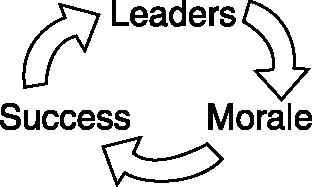
Figure 1. Basic Relationship Model
Morale for Aviators
Clarity must be the goal of any discussion. A workable definition of what morale is and how it is considered in the application of airpower must be established. Although morale may be an intangible quality, the scope of the topic needs to be bounded in order to frame the research and analysis. With this in mind, the concept of morale is specifically defined in a fashion that approaches common sense for airmen.
Three Case Studies
The first case study considers a German Luftwaffe fighter wing in the Battle of Britain in 1940. The replacement of a weak wing commander by a successful one allows some comparative analysis of leadership styles between the two. Additionally, pilot morale during the evolution of the campaign is considered in light of commander actions and the tactical and operational results achieved. Primary source information is employed where possible; however, extensive secondary source material is used to fill in any apparent gaps where necessary.
The second case study follows an American fighter group assigned to support Gen George S. Patton’s Third Army as it broke out from Normandy in the summer of 1944. Once again, a replacement of the group commander during this campaign invites comparison of leadership styles. Extensive primary source materials provide the details necessary to analyze the morale implications of the leader’s actions. This material is derived from unit histories and also from questionnaires completed by surviving members of the unit and from correspondence between them and the author.
The third case study examines the morale of B-52 aircrews flying over Hanoi during the Linebacker II operation of December 1972. The B-52 wing commander remained the same throughout the brief operation; however, changes in tactics and the important influence exerted by higher headquarters furnish a baseline for understanding the effect of command actions on aircrew morale. Both primary and secondary sources are used to describe the situation and to afford a basis for judgments about the actual versus perceived level of morale. Once again, questionnaires and correspondence are used to supplement unit histories.
Conclusions and Recommendations. The implications of the study are addressed with an emphasis on their relevance to the application of airpower in general and the application of American airpower in particular. Additionally, recommendations are offered to assist the USAF in the development of professional military education (PME) programs and operational doctrine as they apply to the connection between leadership and morale.
LIMITATIONS
This is a study of morale in wartime. The factors required to motivate aircrew in peacetime will not be identical to those that are paramount in combat. This study is further limited to the realm of combat that involves suffering casualties in action. Considerations of morale made by a commander under these circumstances may differ from those made by a commander participating in operations other than war.
To facilitate usable conclusions, it is necessary to compare combat units of approximately the same size and complexity. The units selected for the case studies contained herein were wing size (60–120 aircraft and crews). With this in mind, the lessons drawn from group or wing commanders may not be applicable to squadron or flight commanders in air forces today. The value of studying groups and wings is that they represent the largest air force units in which the leader is typically also a tactical war fighter. This perspective allows the wing commander to experience the issues of morale first-hand and still have the span of control to achieve an operationally significant effect on the overall success of a campaign. The quantity and quality of research material available also persuaded the author that more meaningful conclusions might be made from an analysis of cases involving these larger groups. These conclusions hopefully will contribute to the scarce literature av...
Table of contents
- Title page
- TABLE OF CONTENTS
- FOREWORD
- ABOUT THE AUTHOR
- ACKNOWLEDGMENTS
- CHAPTER 1 - INTRODUCTION
- CHAPTER 2 - THE MORALE PROBLEM
- CHAPTER 3 - MAJ ADOLF GALLAND: JAGDGESCHWADER 26
- CHAPTER 4 - LT COL JOSEPH LAUGHLIN: 362D FIGHTER GROUP
- CHAPTER 5 - COL JAMES R. MCCARTHY: 43D STRATEGIC WING
- CHAPTER 6 - CONCLUSIONS
- REQUEST FROM THE PUBLISHER
- BIBLIOGRAPHY
Frequently asked questions
Yes, you can cancel anytime from the Subscription tab in your account settings on the Perlego website. Your subscription will stay active until the end of your current billing period. Learn how to cancel your subscription
No, books cannot be downloaded as external files, such as PDFs, for use outside of Perlego. However, you can download books within the Perlego app for offline reading on mobile or tablet. Learn how to download books offline
Perlego offers two plans: Essential and Complete
- Essential is ideal for learners and professionals who enjoy exploring a wide range of subjects. Access the Essential Library with 800,000+ trusted titles and best-sellers across business, personal growth, and the humanities. Includes unlimited reading time and Standard Read Aloud voice.
- Complete: Perfect for advanced learners and researchers needing full, unrestricted access. Unlock 1.5M+ books across hundreds of subjects, including academic and specialized titles. The Complete Plan also includes advanced features like Premium Read Aloud and Research Assistant.
We are an online textbook subscription service, where you can get access to an entire online library for less than the price of a single book per month. With over 1.5 million books across 990+ topics, we’ve got you covered! Learn about our mission
Look out for the read-aloud symbol on your next book to see if you can listen to it. The read-aloud tool reads text aloud for you, highlighting the text as it is being read. You can pause it, speed it up and slow it down. Learn more about Read Aloud
Yes! You can use the Perlego app on both iOS and Android devices to read anytime, anywhere — even offline. Perfect for commutes or when you’re on the go.
Please note we cannot support devices running on iOS 13 and Android 7 or earlier. Learn more about using the app
Please note we cannot support devices running on iOS 13 and Android 7 or earlier. Learn more about using the app
Yes, you can access The Art Of Wing Leadership And Aircrew Morale In Combat by Lt Col John J. Zentner in PDF and/or ePUB format, as well as other popular books in History & European History. We have over 1.5 million books available in our catalogue for you to explore.