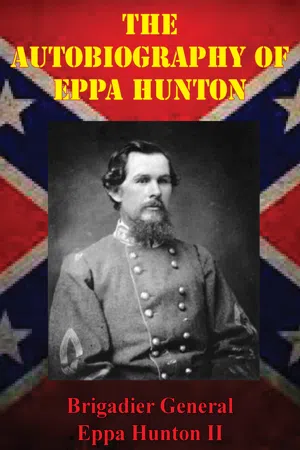
Eppa Hunton II (1822-1908), was a prominent figure in Virginia throughout his career as a lawyer, soldier and Congressman. Although his autobiography was written mainly for his family it contains much to interest the general reader and Civil War historian alike.
In 1861 Hunton was among the delegates to the Virginia Succession Convention and voted for secession; immediately thereafter he was commission as a colonel in the 8th Virginia Infantry. He saw much action in the early years of the war, at First Bull Run and the battle of Ball's Bluff; he commanded a brigade in Longstreet's Corps under Pickett. His memories of Pickett's charge in which he was wounded are among the ever written, having recovered he served in the Army of Northern Virginian as a Brigadier General at Cold Harbor and the defence of Petersburg. He was again wounded at the battle of Sayler's creek and captured by Union forces.
A gem of a Civil War memoir.
- 218 pages
- English
- ePUB (mobile friendly)
- Available on iOS & Android
eBook - ePub
The Autobiography Of Eppa Hunton
About this book
Information
Subtopic
19th Century HistoryIndex
HistoryAUTOBIOGRAPHY OF EPPA HUNTON
CHAPTER I.
My Birth — Genealogy Of My Parents — Father Died In 1830 — My Brothers And Sisters —Was Educated At New Baltimore Academy — Taught School And Studied Law Three Years —Licensed And Settled At Brentsville —Elected Commonwealth’s Attorney Twice —Married Lucy C. Weir — Genealogy Of Wife’s Parents —Purchased Home In Brentsville — Mrs. Clara B. Weir — Again Elected Commonwealth’s Attorney — Daughter Lizzie Born — My Son Eppa Born —Delegate To National Convention — Sectional Excitement — Lincoln Elected President — Secession Of Cotton States —Jeff Davis President Confederate States — Virginia Secession Convention Of Which I Was A Member
I WAS born on the 22nd day of September, 1822, on my father’s farm, “Springfield,” on the road from New Baltimore to Thoroughfare, in Fauquier County, Virginia.
My father, Eppa Hunton, was the son of James Hunton, and a grandson of William Hunton, both of said County of Fauquier. He was born January 30, 1789.
The Virginia branch of Huntons came from England and settled in Lancaster County in the early history of the Virginia colony about the year 1700. In the first half of the Eighteenth Century William Hunton and two brothers left Lancaster County. One brother settled in Albemarle County, one in Madison County and William settled at “Fairview,” near New Baltimore, in said County of Fauquier. He married Judith Kirk, and from them sprung many of the citizens of Fauquier County. “Fairview” has always remained in the possession of their descendants, and is now owned and occupied by Joseph G. Hunton, a grandson—an old bachelor about eighty years old. My grandfather, James Hunton, was their eldest son and resided at “The Valley” adjoining “Fairview.”
James Hunton married Hannah Logan Brown of King George County, and had four sons and three daughters. My father, Eppa, was the second son. He taught school for several years in a school house near Old Broad Run Church, Fauquier County. He purchased “Springfield,” and married Elizabeth Marye Brent.
My father was a very active business man, of the quickest perception and promptest action. He was very popular and was twice elected to the Legislature. He was a prosperous man and at his death owned three good farms: “Springfield,” “Mount Hope” and a farm in Prince William County. He possessed military qualifications of a high order, and was an officer in the War of 1812.{1} He was at Bladensburg and Craney Island and was a brigade inspector of the Virginia militia. He purchased “Mount Hope” that he might be a mile nearer to New Baltimore, where there was a fine academy for both boys and girls. He died on the 8th of April, 1830, aged 41 years.
The Huntons of Virginia were remarkable for their intelligence, hospitality, integrity and good conduct. The records of the courts will be searched in vain to find any proceeding against one of the name for any breach of law and order.
My mother was the daughter of William Brent. He lived in Dumfries, and married Hannah Neal. Soon after his marriage the Revolutionary war began. He raised a company and was made its Captain. Fearing trouble to his family from the incursions of the British up the Potomac River, he purchased a farm in Fauquier County, near Bealeton, and moved his family there. On this farm my mother was born, and married.
The Brents came to America with Lord Baltimore, and settled in Maryland—said to be cousins of Lord Baltimore. Two of them crossed the river and settled in Stafford County, Virginia. One purchased “Richland,” and the other “Woodstock,” on the Potomac, both very fertile farms. My mother descended from the Woodstock Brent.
The Brent family is one of the most numerous in the United States. Its members will be found in Virginia, Maryland, Kentucky, Ohio, Missouri and many other States. They have been noted for intelligence and patriotism.
My father had eleven children, to-wit: Virginia Freedonia; Hannah Neale; John Heath; Judith Ann; Silas Brown; James Innis; myself; Elizabeth Marye; George William; Mary Brent and Charles Arthur. The oldest and youngest died in infancy. The others grew to maturity—some of them to old age—and became useful and highly reputable citizens. My sister, Mary Brent, the widow of Thomas R. Foster, and myself, are the only surviving children. My father’s estate wound up badly. It took all his personality, and his Prince William Farm, to pay his debts.
My mother, at the age of thirty-eight years, was left with nine children, none of them grown, and comparatively poor. She was the most anxious and devoted mother I ever saw, and applied herself to rearing and educating her children with a singleness of purpose and unselfishness never equalled. She was a model mother, lived to a good old age, and saw all her children (except the two who died in infancy), become useful and reputable men and women.
I was educated almost entirely at the New Baltimore Academy. It was a most excellent institution of learning for that day, presided over by the Rev. John Ogilvie. I was ambitious from early boyhood to become a lawyer, and desired to obtain a very good Latin and English education; but my funds gave out and I had to borrow money to go to school the last year, 1839. I completed my English course, and then commenced my Latin the 1st of September, 1838, and finished the full course of Latin by the end of 1839.
In 1840 I taught school for Richard Rixey and Sylvester Welsh at a log school house on the road leading from Warrenton to The Plains, near the latter town. I devoted my leisure time during this year to the study of history, and was especially interested in the history of England, from which I learned its feudal system, on which the great system of the Common Law is founded.
The next year I opened a public school at Buckland, Prince William County, Virginia. This was in the neighborhood of John Webb Tyler, who afterwards became Judge of the Circuit Court of that circuit. He sent five boys to me, and gave me instruction in law gratuitously, and furnished me with the books to read. I taught there during the years 1841 and 1842, and in June, 1843, I obtained a license to practice law.
During the period of my stay at Buckland I boarded with my brother, Silas B. Hunton, whose wife, Margaret, formerly Margaret Rixey, was as kind to me as my own sister. Both promoted my comfort in every possible manner, and both remained till their death most affectionate brother and sister.
After getting a license to practice law, under the advice of John Webb Tyler I determined to settle at Brentsville, the county seat of Prince William County, which was a small town. There was not a great deal of law business in that county, but there were very few lawyers, and Mr. Tyler advised me to go there and learn to practice, and then to move to some place where business was better. I found but one lawyer at Brentsville—Daniel Jasper—though there were two or three others in the county, and the Warrenton lawyers always attended the courts.
I was slow in getting business in Prince William. Daniel Jasper had preceded me nearly a year; he was a very active man and a very sprightly, smart fellow, and got most of the business for a year or two.
In the winter of 1847-48, John Webb Tyler was elected Judge of the Circuit Court. Mr. Jasper and I were candidates to succeed him as Commonwealth’s Attorney. At that time the County Court consisted of twenty or thirty magistrates, who elected the Commonwealth’s Attorney. The race between Mr. Jasper and myself was a very close one. I was successful.
On the 14th of June, 1848, I married Lucy Caroline Weir, of “Hartford,” Prince William County, Virginia. She was the daughter of Robert and Clara Boothe Weir. Her father was of a highly reputable Scotch family; was for many years a merchant of Tappahannock, Virginia; later in life he purchased and occupied the “Hartford” farm in Prince William County. He died about 1840, leaving his widow, three daughters and two sons surviving him.
My wife’s mother was a Miss Smith, of Williamsburg—a granddaughter of Judge Benjamin Waller, who was also the grandfather of Littleton Waller Tazewell, one of Virginia’s most distinguished men and most popular Governors. She was the daughter of John Smith and Sarah Waller.
This marriage was a most happy one. My wife was in every respect an affectionate, loving help-mate.
We remained with Mrs. Weir during the balance of the year 1818. The farm “Hartford” was sold during the year, possession to be given the 1st of April, 1849. I purchased a comfortable home in Brentsville, and went to housekeeping the first of January, 1849. On the 1st of April following, when Mrs. Weir gave possession of “Hartford,” she and her two daughters, Bettie and Martha, came to us and made our house their home. We were a happy family, and after adding to my house in Brentsville I had a very comfortable and beautiful home, which was destroyed by the Union soldiers in 1862.
Mrs. Weir was one of the nicest and most charming old ladies I ever knew. I have often said that I had two of the best mothers any man ever had. She was devoted to me and died in my arms in Warrenton, in 1870. Martha died at my house in 1882. Bettie remained with me till the death of my wife. She is now with her nieces in Clarke County, Virginia.
In 1852 a new Constitution was adopted by the State of Virginia, which affected all the offices and made most of them—Commonwealth’s Attorney among them—elective by the people. Jasper and myself were again candidates for the position of Commonwealth’s Attorney. It was a long, arduous and exciting contest, resulting in my election by a large majority. I carried every precinct in the county. I retained this office until my absence from the county in the Confederate Army, in 1861.
In 1848 I was elected Colonel of the Militia Regiment of Prince William County, and in 1857 was elected Brigadier-General of Militia, by the Legislature of Virginia.
On the loth of June, 1853, my daughter Elizabeth Boothe was born. She was as beautiful and sweet as a daughter could be. The second summer, so fatal to children, took her from us. We carried her to “Mount Hope,” my mother’s residence, for a change of air. She improved notably. We returned to Brentsville in September, and on the 30th day of that month, 1854, God took her to Himself. It seemed that he had loaned her to us to brighten our home and cement our love. She was named after her two grandmothers, and was much petted by them. We grieved bitterly for the dear child. She was our only daughter.
On the 14th of April, 1855, my son Eppa was born. His birth tended to moderate our grief for dear little Lizzie. My son was named after my father and me. He still lives and has been the greatest comfort to his mother and to me. He has never given me an hour’s trouble, except in smoking cigarettes. He has become a lawyer of distinction, and is loved by all who know him. I cannot be thankful enough for the gift of my son. He has ever been affectionate and kind to me, and his devotion to his mother was beautiful and touching. His life has been interwoven with mine more closely than is usual with father and son, and he will be often mentioned in this biography.
I was a Democrat from my earliest youth. My father before me was a Democrat. All of the Hunton name were Democrats. I took an active interest in politics from the time I was grown, and was put upon the stump by my party in every presidential canvass from 1840.
In 1856 I was one of the delegates to the National Convention at Cincinnati. Franklin Pierce was President, and I favored his re-nomination, though my ultimate choice was R. M. T. Hunter, of Virginia. Mr. James Buchanan, of Pennsylvania, was nominated and elected.
During this period, up to 1860, I had practiced my profession at Brentsville, with some success. I got a good practice and accumulated property. Excitement sometime before had begun to run very high between the North and the South. The question of slavery was the exciting cause. The North had the largest territory and the greatest population, and became very violent against the South on the question of slavery. Seward, one of the leading statesmen of the North, declared that this Union could not exist one-half slave and the other half free. Scenes of turmoil and violence occurred in both houses of Congress, and the patriotic and peace-loving man looked forward with the utmost dread to the future.
In 1860, the Democratic Party, which had been a unit up to that time and had always managed to hold the balance of power, was divided upon the “free-soil” question. The Party met in convention at Charleston, South Carolina, April 23, 1860, and was divided between Douglas and Breckinridge—Douglas representing the Northern “Free-Soil” wing, and Breckinridge the “States-Right” wing of the Party. Violent scenes occurred in the convention, and finally it was disrupted. Then two conventions were held, one in Baltimore, which nominated Stephen A. Douglas, of Illinois, and the other in Richmond, which nominated John C. Breckinridge, of Kentucky. The old Whig Party in convention nominated John Bell, of Tennessee. The Republicans nominated Abraham Lincoln, of Illinois.
These candidates were all men of great ability. Lincoln was a rough man, and was called the “Illinois Rail Splitter.” He was one of the most vulgar men that ever attained high position in the United States.
It soon became apparent that there was great danger of the election of Abraham Lincoln, owing to the division in the Democratic Party. This increased the intense feeling between the sections. The people in many of the Southern States declared in convention assembled that they would not remain in the Union if the country elected a sectional president. I was elector on the Breckinridge ticket and actively canvassed the State of Virginia in the interest of that wing of the Democratic Party.
At that time my wife became ill. She seemed to be suffering with neuralgia of the liver, and subject to violent attacks of pain. These attacks continued with more or less violence until 1862. They interfered a good deal with my activity in politics. I was very devoted to my wife, and she to me, and when she was ill I wanted to be with her, and she desired my presence.
Abraham Lincoln was elected on November 6, 186°. Although he got only a minority of the popular vote he got a majority of the electoral vote. The country from the Potomac to the Rio Grande was at once convulsed with excitement. Several of the “Cotton States” took early action for secession. James Buchanan was the President. He was a good man, but timid. After the “Cotton States” had all withdrawn from the Union they formed the Confederate States government at Montgomery, Alabama, with Jefferson Davis as President, and sent Commissioners to Washington to treat with the Buchanan administration for recognition as a nation. Mr. Buchanan promised time and again that he would recognize them, but his timidity interfered, and he postponed it until his term as President expired.
In the meantime Virginia had not taken any steps. Up to the 1st of January, 1861, she had made no movement towards secession. Soon thereafter the Legislature, then in extra session, passed a law calling for a convention to determine the course of Virginia in the premises. The election was to take place February 4, 1861. I declared myself a candidate for this convention. Mr. Allen Howison, a very estimable Whig gentleman of the county, was a candidate against me. I was for immediate secession. Mr. Howison was unconditionally for the Union. I published a card in which I took the ground that I was for immediate secession for the s...
Table of contents
- Title page
- TABLE OF CONTENTS
- FOREWORD
- DEDICATION
- PREFACE
- CHAPTER I.
- CHAPTER II.
- CHAPTER III.
- CHAPTER IV.
- CHAPTER V.
- CHAPTER VI.
- CHAPTER VII.
- CHAPTER VIII.
- CHAPTER IX.
- CHAPTER X.
- CHAPTER XI.
- CHAPTER XII.
- CHAPTER XIII.
- CHAPTER XIV.
- CHAPTER XV.
- CHAPTER XVI.
- CHAPTER XVII.
- CHAPTER XVIII.
- ADDENDUM
- APPENDIX I.
- APPENDIX II.
- APPENDIX III.
Trusted by 375,005 students
Access to over 1.5 million titles for a fair monthly price.
Study more efficiently using our study tools.
Frequently asked questions
Yes, you can cancel anytime from the Subscription tab in your account settings on the Perlego website. Your subscription will stay active until the end of your current billing period. Learn how to cancel your subscription
No, books cannot be downloaded as external files, such as PDFs, for use outside of Perlego. However, you can download books within the Perlego app for offline reading on mobile or tablet. Learn how to download books offline
Perlego offers two plans: Essential and Complete
- Essential is ideal for learners and professionals who enjoy exploring a wide range of subjects. Access the Essential Library with 800,000+ trusted titles and best-sellers across business, personal growth, and the humanities. Includes unlimited reading time and Standard Read Aloud voice.
- Complete: Perfect for advanced learners and researchers needing full, unrestricted access. Unlock 1.5M+ books across hundreds of subjects, including academic and specialized titles. The Complete Plan also includes advanced features like Premium Read Aloud and Research Assistant.
We are an online textbook subscription service, where you can get access to an entire online library for less than the price of a single book per month. With over 1.5 million books across 990+ topics, we’ve got you covered! Learn about our mission
Look out for the read-aloud symbol on your next book to see if you can listen to it. The read-aloud tool reads text aloud for you, highlighting the text as it is being read. You can pause it, speed it up and slow it down. Learn more about Read Aloud
Yes! You can use the Perlego app on both iOS and Android devices to read anytime, anywhere — even offline. Perfect for commutes or when you’re on the go.
Please note we cannot support devices running on iOS 13 and Android 7 or earlier. Learn more about using the app
Please note we cannot support devices running on iOS 13 and Android 7 or earlier. Learn more about using the app
Yes, you can access The Autobiography Of Eppa Hunton by Brigadier General Eppa Hunton II in PDF and/or ePUB format, as well as other popular books in History & 19th Century History. We have over 1.5 million books available in our catalogue for you to explore.