eBook - ePub
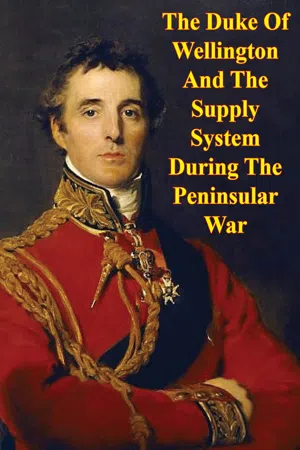
The Duke Of Wellington And The Supply System During The Peninsular War
- 69 pages
- English
- ePUB (mobile friendly)
- Available on iOS & Android
eBook - ePub
The Duke Of Wellington And The Supply System During The Peninsular War
About this book
Napoleon's invasion of the Iberian Peninsula brought Spain, Portugal, and Britain into a close, if sometimes uneasy alliance. When an expeditionary force led by General Sir Arthur Wellesley, later the 1st Duke of Wellington, disembarked in Portugal in August 1808, the British Army had been at war with France for five years. If the experience gained during campaigns on five continents had sharpened the efficiency of the Commissary Department, whose staff supplied and transported its rations, Wellington might not have complained after only one week in Portugal: "I have had the greatest difficulty in organizing my commissariat for the march. The logistic challenges faced by the Duke of Wellington during the Peninsula War were daunting. The role logistics played in deciding the outcome of the war in the Peninsula as well as detailing the needs of the troops is important in understanding how the war was conducted. The procurement, transport, distribution, and payment of supplies for the use of the Anglo-Portuguese Army during the Peninsula War played a direct role in determining its final outcome.
Information
Subtopic
British HistoryIndex
HistoryCHAPTER 1 — INTRODUCTION
In 1806, France’s inability to defeat the British on the sea coupled by the Royal Navy’s dominance of the English Channel, Napoleon decided to embargo all traffic between Europe and Great Britain. Napoleon had hoped to “conquer the sea by the power of the land.”{1}The Berlin Decrees of 1806 were the first in a series of sanctions against Britain’s trade known collectively as the Continental System. The political plan behind the Continental System was to bring Britain to its knees through economic strangulation. Funding for Britain’s war effort ultimately depended upon her overseas trade. The sanctions placed the United States and other unaligned European states in an unenviable position; they had to take sides in the contest between their more powerful neighbors. While the British and United States squabbled over the trade embargo, France turned her attention to Portugal, which was an important entry point. Napoleon believed the European mainland would, because of the abundance of resources and population, prevail in any economic competition with a smaller state that relied on its commercial and maritime strengths to fund its wars. Napoleon truly believed that if he could control Britain’s trade with the European continent he would force Britain to meet his demands and capitulate. Napoleon stated, “The nation of shopkeepers’ would fall victim to bankruptcy, mass unemployment, and possibly even revolution.”{2} Paramount to this plan was sealing off the entire coastline of Europe, which included Portugal. By 1810-1811, the French had 300,000 troops within the Peninsula, and yet only 70,000 confronted Wellington; the remainder were pinned down elsewhere by the threat of local insurrections and the actions of guerrillas. With the French unable to concentrate their forces against the British-Portuguese Army, Wellington was able to move on to the offensive in 1812.{3}
What the French did not have was a competing navy. Britain’s Navy, coupled with Spain’s ensured the French would not have unlimited access to the numerous ports and river routes throughout the region. This point is where the balance of power within the region shifted to Britain. The importance of the British Navy with their ability to transport, provide supplies, troops, equipment, and move troops and equipment unimpeded along the coast of Portugal to area of operations, were critical to the success of Wellington’s logistical system. The Royal Navy could embark and disembark troops and supplies at will along the Portuguese coast and its ports. They would provide covering fires and indirect fire support when needed, understated. We will examine their contribution and significance in chapter 4

Napoleon’s invasion of the Iberian Peninsula brought Spain, Portugal, and Britain into a close, if sometimes uneasy alliance. When an expeditionary force led by General Sir Arthur Wellesley, later the 1st Duke of Wellington, disembarked in Portugal in August 1808, the British Army had been at war with France for five years. If the experience gained during campaigns on five continents had sharpened the efficiency of the Commissary Department, whose staff supplied and transported its rations, Wellington might not have complained after only one week in Portugal: “I have had the greatest difficulty in organizing my commissariat for the march. This department needs your serious attention.”{4}
The logistic challenges faced by Wellington during the Peninsula War were daunting. The role logistics played in deciding the outcome of the war in the Peninsula as well as detailing the needs of the troops is important in understanding how the war was conducted. The procurement, transport, distribution, and payment of supplies for the use of the Anglo-Portuguese Army during the Peninsula War played a direct role in determining the final outcome. A sideshow to the main conflict in Europe, the war persisted for six years. Considered a secondary theatre of war, however, the Peninsula was important in forcing the French to commit ever increasing front-line troops in an effort to pacify this rebellious region. The troops sent to the Peninsula would become sorely missed once Napoleon launched his invasion of Russia in 1812. The inability of the French to capitalize on their vast numerical superiority led to a protracted war of attrition where increasing numbers fell to the British, Portuguese, and Spanish armies, or to starvation.
Chapter 1 presents a broad overview of the peninsular region topography during the British operations of 1809 to 1812, the overall political climate that brought Great Britain into the region, and Wellington’s logistical success overall, his support plan for the Peninsula War.
Much of the success of the Anglo-Portuguese Army was due to the effectiveness of Wellington’s supply system. The ability of Wellington to keep his army supplied presented him with an enormous advantage over the French. Wellington’s ability to defeat. French forces despite a substantial numerical disadvantage presents the thesis that the efficiency of Wellington’s logistical system influenced the strategic situation to a significant degree. While superior logistics alone cannot win a war, their absence can lead to defeat, as the French learned to their detriment.
In The British Commissary, Havilland Le Mesurier wrote, “Hay, straw and fuel, wagons or means of transport are always to be found in a country if it is inhabited: but requires judgment and dispatch to procure them and honorable treatment to prevent desertion.”{5}That may have been true in northern Europe, but not in the Peninsula, where some regions of Estremadura were near deserts. Food and drink were bought locally wherever possible, but most essentials were distributed from magazines at Lisbon, Oporto, and other satellite ports, where stores from as far away as Turkey and America were delivered and stock-piled. Adequate supplies were usually available at the depots, but the difficulty of transporting them hundreds of kilometers to the front over unpaved roads that rarely went in the desired direction was a major cause of the Commissariat’s difficulties.
The Peninsula constitutes a rough square, three and half sides bounded by water, altogether comprising a coastline in excess of 1,500 miles. The coastline offered another significant impact to the overall logistical success that Wellington employed. Most of the principle Iberian centers of population were on the coast. Of the other five larger Spanish towns with 50,000 or more inhabitants, only Seville was inland, all the others, Barcelona, Valencia, Cadiz, and Malaga, were ports.
Similarly, in Portugal the two most populous places, Lisbon and Oporto, were on the coast. There are four main rivers; the Ebro, Guadalquivir, Douro, and Tagus. All four provided a transportation network to move supplies and troops. Unless armies could use the sea for at least part of their movement they were condemned to the roads for all transportation, as of course were all the combatants in the central regions.{6} Where transport by river barge was practical, as on stretches of the Tagus River almost to the satellite depot at Abrantes, it helped tremendously, but rivers have a habit of not going in the desired direction, as depicted by William Reid:{7}
The rivers of Spain and Portugal are not highways, or lines of communication but barriers torrents sunk in gorges cut deep below the level of the face of the land. The chief roads, with few exceptions, avoid, instead of courting, the neighbourhood of the great streams. As a matter of fact, Spain and Portugal turn their backs upon each other; the smaller realm looks upon the sea; her strength and wealth lie on the Atlantic coast; the inland that touches Spain is rugged and unpeopled, in many parts a mere waste of rock and heath.{8}
This afforded Wellington the opportunity to defend with his back to the seas and resupply his army via the ports and supply depots along the coast. This was a choice the French did not have, thus weakening French overall combat power.
Some of the available roads in Spain were as good as any in Europe. They were designed to connect Madrid with the periphery towns such as, Corunna, Badajoz, Cadiz, Cartagena, Barcelona, and Irun were straight, 30 to 60 feet wide and often flanked by retaining walls. However, due to the government’s inability to complete the networks, parts of the network remained unfinished prior to the war. Moreover, some of the major networks were falling into decay.{9} When the major highways could not be used armies would have to rely on caminos, primitive roadways or trails. Decent roads during dry weather, when the rainy season came they would turn into muddy masses. A second alternate supply route, the carrils or ordinary trails with two narrow bands of stone paving to accommodate cart wheels, were useful on level terrain, but in rough areas they degenerated into paths suitable only for pack animals.{10}
Roads always took the “line of least resistance “ in early days, and would seek for easy passes, not for short cuts. The idea that “time is money “, and that instead of going around two sides of a triangle it may be worthwhile to cut a new path across its base, in spite of all the engineering difficulties, was one very unfamiliar in Spain. Nothing shows more clearly the state of mediaeval isolation in which the kingdom still lay in 1808 than the condition of the roads. Wherever the country presented any serious obstacles, little or no attempt had been made to grapple with them since the early years of the 1760s. What roads there were, when the War of 1808 broke out, were in a state of dreadful neglect. There were many other points at which a division travelling in light order without guns or baggage could cross the watershed, but for an army travelling with all its impedimenta such bypaths were impracticable.
Summing up the general characteristics of the road system of Spain, the main routes are at right angles to the great rivers rather than parallel to them. Just because the roads do not cling to the valleys, but strike across them at right angles, they are always crossing watersheds by means of difficult passes.{11}
In his Diary of Campaigns in the Peninsula, Lieutenant William Swabey, Royal Horse Artillery, notes on 20 May 1812, “Close to this town (Torremexia) runs a road, or rather the remains of one, made by the Romans and formerly reaching from Merida to Lisbon, these relics of which there are many in Spain are called Calhada.”
George Ticknor, American historian of Spanish literature, when first visiting the country before any form of “diligence service” had been set up, remarked:
There was no travelling in Spain. Between Barcelona and Madrid, in a journey of thirteen days, we met only a few muleteers, a few carts and one single coach like our own, only half a dozen in all; and yet the road was the main highway between the capital and one of the principal cities of the kingdom’; but it had long been so. Major William Dalrymple, travelling in the Peninsula while on leave from the Gibraltar garrison in 1774, set out from Ponferrada for Galicia, had remarked on the road being ‘very bad’ after having ‘travelled on a new road for about two miles, which is intended to be carried to the sea,’ adding: ‘And here I must observe, that except at La Carolina in the Sierra Morena, and for a few leagues about Madrid, I never seen any made (i.e. surfaced) roads. There are no heavy carriages in the country I have passed, otherwise it would be impossible, particularly in winter, for them to travel. Left the Camino Real (the Royal Road) and came into an abominable road … began to ascend the mountain, the road like steps of stairs.{12}
In Portugal, the situation was no better. The main supply routes, those accessed by wheeled traffic, were equally few in number and confined to the sides of mountains. The lesser Portuguese trails had all the restrictions and defects to be found in those area across the border.{13}
In the British Rules and Regulations for the Formations, 1803 edition, page 368, it is stated: “The Column of Route…. All marches are therefore made in column of divisions of the line, and never on a less front than 6 files where the formation is 3 deep, or 4 files where it is 2 deep. “{14}Another picture emerges from Wellington’s general orders 16 March 1811:
The Commander of the Forces requests that for route marches each company in every battalion of infantry may be told off in threes; when the column is to be formed for the march the companies must be wheeled up or backward by threes, and each stand in column of 3 men in front, which is as large a number as the greater proportion of the roads in Portugal will permit.{15}
Wellington changed the rules of march for Portugal due to their narrowness and construction. He wrote, in a dispatch dated 2 May 1809, that the rules of march were to be as follows: “The troops will march in two principal columns, the right composed of about 6,000 infantry and 1,000 cavalry, by the route of Vizeu to Lamego; the left of about 20,000 infantry and 1,400 cavalry, by the route of Vouga towards Oporto. “{16}It must be therefore considered that with the majority of the roads in Portugal being of this width, an artillery team, two horses wide, and the men on the foot march could have significant challenges with movements.
The Peninsula is comprised of a vast exposed frontier. It was widely believed at the time that defending Portugal from the Pyrenees, not at Lisbon, was the best course of action. It was an open frontier, all equally rugged but all equally to be penetrated. Sir John Moore stated, “The frontier is not defensible against a superior force.”{17} Its defense presents several acute challenges. The main challenge to Portugal’s defense was not the vast frontier, but the ability to meet a simultaneous threat at the three widely separated entrances; the Tagus River, which is not conducive for resupply, the land route thro...
Table of contents
- Title page
- TABLE OF CONTENTS
- ABSTRACT
- ACKNOWLEDGMENTS
- ILLUSTRATIONS
- CHAPTER 1 - INTRODUCTION
- CHAPTER 2 - SUPPORTING THE PENINSULA ARMY
- CHAPTER 3 - SUPPLYING THE FORCE: 1809 to 1811
- CHAPTER 4 - THE OFFENSIVE, 1812
- CHAPTER 5 - THE CONCLUSION: THE DUKE OF WELLINGTON AND THE SUPPLY SYSTEM DURING THE PENINSULA WAR
- ILLUSTRATIONS
- APPENDIX A - CHART OF REVENUE OF THE TREASURY OF PORTUGAL, 1809
- APPENDIX B - MEMORANDUM OF AN ARRANGEMENT FOR THE PORTUGUESE COMMISSARIAT
- REQUEST FROM THE PUBLISHER
- BIBLIOGRAPHY
Trusted by 375,005 students
Access to over 1.5 million titles for a fair monthly price.
Study more efficiently using our study tools.
Frequently asked questions
Yes, you can cancel anytime from the Subscription tab in your account settings on the Perlego website. Your subscription will stay active until the end of your current billing period. Learn how to cancel your subscription
No, books cannot be downloaded as external files, such as PDFs, for use outside of Perlego. However, you can download books within the Perlego app for offline reading on mobile or tablet. Learn how to download books offline
Perlego offers two plans: Essential and Complete
- Essential is ideal for learners and professionals who enjoy exploring a wide range of subjects. Access the Essential Library with 800,000+ trusted titles and best-sellers across business, personal growth, and the humanities. Includes unlimited reading time and Standard Read Aloud voice.
- Complete: Perfect for advanced learners and researchers needing full, unrestricted access. Unlock 1.5M+ books across hundreds of subjects, including academic and specialized titles. The Complete Plan also includes advanced features like Premium Read Aloud and Research Assistant.
We are an online textbook subscription service, where you can get access to an entire online library for less than the price of a single book per month. With over 1.5 million books across 990+ topics, we’ve got you covered! Learn about our mission
Look out for the read-aloud symbol on your next book to see if you can listen to it. The read-aloud tool reads text aloud for you, highlighting the text as it is being read. You can pause it, speed it up and slow it down. Learn more about Read Aloud
Yes! You can use the Perlego app on both iOS and Android devices to read anytime, anywhere — even offline. Perfect for commutes or when you’re on the go.
Please note we cannot support devices running on iOS 13 and Android 7 or earlier. Learn more about using the app
Please note we cannot support devices running on iOS 13 and Android 7 or earlier. Learn more about using the app
Yes, you can access The Duke Of Wellington And The Supply System During The Peninsular War by Major Troy T. Kirby in PDF and/or ePUB format, as well as other popular books in History & British History. We have over 1.5 million books available in our catalogue for you to explore.