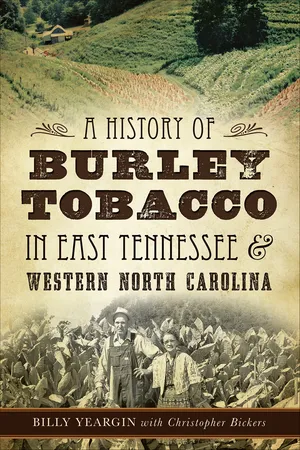
Burley tobacco revolutionized the industry in east Tennessee and western North Carolina. What started from two farmers planting white burley in Greeneville ignited an agricultural revolution and significantly changed crops, production and quality. Burley transformed the tobacco industry with new cultivation techniques and a shift from dark and flue-cured tobacco. By the 1990s, burley tobacco production in the region had drastically declined, and it is a tradition that few local farmers still practice. Agricultural experts Billy Yeargin and Christopher Bickers take a nostalgic look at the historic rise of burley tobacco and its gradual decline.
eBook - ePub
A History of Burley Tobacco in East Tennessee & Western North Carolina
- 160 pages
- English
- ePUB (mobile friendly)
- Available on iOS & Android
eBook - ePub
A History of Burley Tobacco in East Tennessee & Western North Carolina
About this book
1
THE BIRTH OF BURlEY IN THE HILL COUNTRY
It is not the only type of tobacco ever grown in the foothills of the Appalachians and the headwaters of the Tennessee River. It wasn’t even the first. But when burley—or white burley, as it was called back then—made its appearance in the 1880s, it quickly displayed characteristics that made it a near-perfect cash crop for farmers in the mountains, ridges and valleys of east Tennessee, southwest Virginia and western North Carolina.
And that wasn’t its geographic limitation. Indeed, the history of tobacco in these states is one of burley slowly migrating from the hills to the central basin of Tennessee, where it has taken its rightful place in that area’s agriculture.
But let’s go back to the beginning. A cash crop was mightily needed in the late nineteenth and early twentieth centuries in the hill country. Except for the occasional dairy farm, there was hardly any agricultural enterprise that could generate cash for off-farm purchases in this area, characterized as it was by small farms, small fields and, in many cases, steep slopes.
But other types of tobacco just didn’t fill the need. Dark tobacco was grown extensively in the early years. And for fifteen or twenty years near the end of the nineteenth century, hill country farmers tried hard to make flue-cured tobacco work in this environment. They weren’t able to, but as the twentieth century got started, more and more of them enjoyed success with burley.

Two boys and a goat enjoy a break from tobacco in Greene County, Tennessee, in the early 1970s. Photo by Bob Hurley.
Robert Shipley of Watauga County, North Carolina, a farmer who was born in 1912 and remembers that era better than almost anybody, describes the economic situation at the time.
“Before burley arrived, most of our people were employed in what we would call subsistence farming,” he said in interviews in 2011 and 2013. “They were self-sufficient in food and produced pretty much what they ate. They killed hogs for their meat supply and would sometimes kill cattle for beef. Everybody had a garden, and it was standard practice to preserve and can produce. Sometimes you didn’t have to do even that. You could keep potatoes and cabbage for a long period of time just by burying them. So our folks didn’t go hungry: they just weren’t used to having a lot of money.”
That changed after farmers learned about the potential of burley. It soon proved to be the only realistic choice as a cash crop, says Shipley. “We didn’t have any other dependable cash crop in this area. That was the big reason that burley spread in the mountains.”
But adoption wasn’t immediate, Shipley remembers. It didn’t really get going until a federal program was developed to stabilize production and marketing: “It led to an increase in price, so that farmers who grew it had some money left over after paying their expenses of growing tobacco. It was a good change, definitely. From that time, tobacco paid taxes and supported the schools and churches of this land.”
For all practical purposes, the new white burley didn’t appear in the Tennessee-Carolina-Virginia hill country until 1887, when two farmers, Clisbe Austin and Silas Bernard, procured some of the new seed and brought it to the Greeneville area. They convinced many of the local farmers to plant burley rather than attempting to compete in growing flue-cured tobacco with growers in North Carolina and other states to the east. But flue-cured was in much greater demand than burley, and up until 1916, burley plantings were largely limited to Greene and Washington Counties. After that, when demand for burley was spurred by the popularity of the Camel brand cigarette, its growth spread throughout most of the state.

A burley-growing couple shows pride in a good crop in Greene County, Tennessee, in the early 1970s. Photo by Bob Hurley.
It eventually reached the dark tobacco–producing areas of middle Tennessee. George Marks of Clarksville, Tennessee, remembers, “This area traditionally produced dark tobacco, but we didn’t start producing burley until after World War II. Burley came here at a good time. So many farmers were looking for an alternative to dark tobacco, and a lot took up burley then. If you wanted to make [up] for the loss of dark demand or to expand, it was the only way.”
“It became a stable factor in the economy all across the state,” said the late Johnny Shipley of Chuckey, Tennessee, in an interview before his passing. “Without burley, it would have been hard to keep the farm in the family,” he said. “It was the only big cash crop we had. It was your Christmas money, it was your back to school money, it was your shoe and clothing money.”
Bill Harmon of Sugar Grove, North Carolina, says, “It was the one crop you could just about be certain you would get rewarded on. In 1973, I made enough off an acre of tobacco to buy a tractor in one year. How much was that? I gave $3,600 for the tractor. I may have had a little left. Tobacco was mighty good to us.”
In the deregulated economy of the twenty-first century, some younger growers are less optimistic than their fathers might have been. “I don’t know how confident I feel about the future of tobacco in this area because of the labor issue and because costs are so high and input costs absolutely are not decreasing,” says David Miller of Abingdon, Virginia.
Kenneth Reynolds, also of Abingdon, puts it all in perspective: “Forty or fifty years ago, everybody made money growing tobacco; it was just a matter of how much you got paid. Today, it is a matter of survival of the fittest.
When the federal government ended the supply control program for tobacco in 2004, there was considerable concern that burley might disappear from the hill country altogether, and maybe from the rest of Tennessee as well. What a catastrophe that would have been—like Mississippi without cotton or Iowa without corn. But that hasn’t been the case. Some farmers have gotten out of the crop, a few have gotten in and many have gotten bigger. There has definitely been a change in location. Greene County, for many years, was the leading burley producer in these three states, but now Macon County near Nashville is by far the leader. But that just shows that these states still have plenty of resources when it comes to growing this type of tobacco. It seems safe to say that as long as the world wants high-quality tobacco, burley will be grown in Tennessee, North Carolina and Virginia.
WHERE TOBACCO CULTURE WAS BORN
It should be noted that burley in Tennessee descends by a direct line from the tobacco that was developed by Jamestown colonist John Rolfe, and many of the practices that Tennessee’s early tobacco growers used were perfected in the fields of central Virginia in the seventeenth and eighteenth centuries.
As described by Lee Pelham Cotton, park ranger at the Colonial (Virginia) National Historical Park in Williamsburg, the Jamestown colonists soon learned to grow seedlings in beds covered with pine boughs. They would be set in the field in knee-high hills spaced every three or four feet using a hoe. “This task was considered the most arduous one in the tobacco cultivation process,” Cotton says. “An experienced adult could prepare no more than five hundred hills a day.”

A costumed reenactor at the Jamestown (Virginia) Settlement Park demonstrates how America’s first tobacco farmers planted their tobacco in “hills” created with a hilling hoe. Photo by Chris Bickers.

Of all the pests in the tobacco of Jamestown, the most feared was the hornworm. These two reenactors show how the colonists would scout for it. Photo by Chris Bickers.

Ensuring that the water requirements of young tobacco plants were met would have been a top priority for the Jamestown colonists. Photo by Chris Bickers.
Until the plant reached knee height, weekly cultivation was necessary to deter both weeds and cutworms. “The work was done both with a hoe and by hand, the hills around the tobacco being reformed at the same time,” says Cotton. When the leaves were ripe, the plants were cut with a sharp knife between the bottom leaves and the ground.
In the first few years of tobacco cultivation, the plants were simply covered with hay and left in the field to cure or “sweat.” This method was abandoned after 1618, and growers chose instead to hang the leaves on lines or sticks, at first outside on fence rails and later in barns.
BURLEY IN THE HILLS
Throughout its history and growth, tobacco has played an important part in the development of Tennessee, southwestern Virginia and western North Carolina. Its seeds arrived with the first settlers. Its cultivation spread rapidly throughout the area. It became the livelihood for thousands of farm families in the three states. Tobacco culture has created jobs in manufacturing, processing and numerous other industries related to the tobacco industry. Tobacco sales over retail counters have added millions of dollars in excise taxes to both state and federal treasuries. The development of tobacco in Tennessee and its eastern neighbor states closely parallels that of Kentucky. Both states shared the growth of the three main types of tobacco cultivated in that part of the country—dark air cured, dark fire cured and the light air cured–type burley. But of these types, burley—which we probably ought to call “white” burley—became and continues to be the most widely cultivated type in Tennessee, western Virginia and North Carolina.
The dominant type of burley before the American Civil War was a dark air cured–type known as “red burley,” which seems to have been used primarily in plug tobacco products. It has since faded to near nonexistence. A related strain that arose from a quite unintentional bit of plant breeding led to the almost complete decline of red burley in favor of a new “white” strain that appeared in Brown County, Ohio, in 1864.
Remember that at this time, chewing products dominated domestic consumption, with plug tobacco a popular consumer choice. Large-scale cigarette production was years in the future, but the new burley strain quickly took a place in the manufacture of chewing production. Indeed, the initial appeal of white burley to manufacturers may have been aesthetic—light-colored leaves taken from it could be used to wrap plug products that otherwise probably contained very dark leaf.
Burley gained in popularity almost immediately, and its growth spread throughout Kentucky and down to Tennessee and then into West Virginia, Virginia and North Carolina and points farther away. Its position has never slackened.
Prior to 1924, burley production in Tennessee was largely confined to the eastern part of the state, and the total acreage for the state that year was 31,500 acres. Burley farmers in 1924 harvested just over twenty-seven million pounds. Production of burley has increased considerably since that time.
Smokers have found that the taste of cigarettes improves considerably with the addition of burley tobacco. Traditionally, about one-third of the tobacco in American-blend cigarettes is burley. The leaf is also used in domestic pipe and chewing tobaccos, and a little goes into some varieties of snuff.

A costumed reenactor at Jamestown Settlement Park demonstrates how the colonists would have scouted for suckers and insect pests. Photo by Chris Bickers.
THE PORT OF NEW ORLEANS
We might say that tobacco first gained its status as a commercial crop in Tennessee at about the time that the American Revolution ended. Most of the tobacco then was used purely for domestic purposes because it was extremely difficult to export mountain tobacco to major ports in the country. It could have been shipped to New Orleans via the Mississippi River, but New Orleans was controlled by the Spanish, who did not allow the tobacco to enter that port. “Roading” the hogsheads of tobacco over the Appalachians was virtually impossible.
Nevertheless, in 1787, an American general named James Wilkinson loaded two flatboats in the vicinity of Frankfort, Kentucky, with many consumer items, including bacon, flour and a good quantity of tobacco valued at two dollars per one hundred pounds.
Wilkinson intended his shipment for New Orleans, but he was well aware that the authorities would seize his two flatboats when they reached the Natchez area. This happened, but the confiscated cargo was released, and Wilkinson was asked to meet with Don Esteban Miró, then governor of Louisiana. Good relations were established between these two men, and thus the “Spanish intrigue,” which has since puzzled historians, had its start.
Many believed that Wilkinson, a famous American general who served with Benedict Arnold in the Quebec campaign, was involved in a plot to separate the western territories from the United States and place them under the protection of Spain. Whether or not this was true, when Wilkinson returned to Frankfort in February 1788, New Orleans was opened to American trade. The Spanish authorities, already large buyers of Mississippi and Louisiana tobacco, now offered to buy the commodity from both Kentucky and Tennessee.
THE MISSISSIPPI OPENS TO TOBACCO
In December 1788, a royal order issued in Seville permitted Americans to enter goods at Mississippi River ports on payment of the Spanish entry duty. Initially, Wilkinson was shocked at hearing of the Spanish order. He had planned to monopolize trade with the Spanish at New Orleans. He was now competing with the rest of the country. Though the river was open to those who dared risk its passage, Wilkinson had the advantage of precedence, the right political connections and a developing organization.
All shipments were at the owners’ risk—and the risks were significant. Apart from the physical hazards of river traffic that caused boats to capsize, sink or run aground, there were river pirates and Indians to contend with. For a while, too, outlaws and white renegades infested the long route. A call for help, if answered, frequently resulted in the seizure of a boat and the massacre of its crew.
Much of the tobacco used during this period was manufactured at home in the form of “twists” for chewing and cigars. Practically all country stores sold “sticks” of twists, which were commonly used by the average working man. The elite used only James River tobacco and smoked Spanish cigars.
By the turn of the nineteenth century, tobacco figured more profitably in proportion to total income to the farmers of the Cumberland Valley. One of the first warehouses in the area was built ...
Table of contents
- Front Cover
- Title Page
- Copyright
- Contents
- Preface
- 1. The Birth of Burley in the Hill Country
- 2. Veteran Growers Remember Burley in the Old Days
- 3. How the Quota Buyout Impacted Burley Farmers, by William Thomas Jarrett
- 4. How Growers Created a Stable Market
- Bonus Section. A History of Tobacco Auctions
- Bibliography
- About the Authors
Trusted by 375,005 students
Access to over 1.5 million titles for a fair monthly price.
Study more efficiently using our study tools.
Information
Publisher
The History PressYear
2015Topic
HistoryPrint ISBN
9781626199606
Subtopic
Business BiographieseBook ISBN
9781625854988
Index
HistoryFrequently asked questions
Yes, you can cancel anytime from the Subscription tab in your account settings on the Perlego website. Your subscription will stay active until the end of your current billing period. Learn how to cancel your subscription
No, books cannot be downloaded as external files, such as PDFs, for use outside of Perlego. However, you can download books within the Perlego app for offline reading on mobile or tablet. Learn how to download books offline
We are an online textbook subscription service, where you can get access to an entire online library for less than the price of a single book per month. With over 1.5 million books across 990+ topics, we’ve got you covered! Learn about our mission
Look out for the read-aloud symbol on your next book to see if you can listen to it. The read-aloud tool reads text aloud for you, highlighting the text as it is being read. You can pause it, speed it up and slow it down. Learn more about Read Aloud
Yes! You can use the Perlego app on both iOS and Android devices to read anytime, anywhere — even offline. Perfect for commutes or when you’re on the go.
Please note we cannot support devices running on iOS 13 and Android 7 or earlier. Learn more about using the app
Please note we cannot support devices running on iOS 13 and Android 7 or earlier. Learn more about using the app
Yes, you can access A History of Burley Tobacco in East Tennessee & Western North Carolina by Billy Yeargin,Christopher Bickers in PDF and/or ePUB format, as well as other popular books in History & Business Biographies. We have over 1.5 million books available in our catalogue for you to explore.