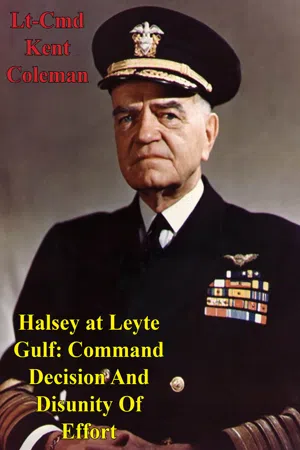
eBook - ePub
Halsey At Leyte Gulf: Command Decision And Disunity Of Effort
- 91 pages
- English
- ePUB (mobile friendly)
- Available on iOS & Android
eBook - ePub
Halsey At Leyte Gulf: Command Decision And Disunity Of Effort
About this book
In October 1944, US forces executed amphibious landings on the Japanese-occupied island of Leyte in the central Philippines. Japanese naval forces, severely outnumbered by the US Third and Seventh Fleets, attempted to stop the invasion by attacking US amphibious shipping in Leyte Gulf. Due to the divided US area commands in the Pacific theater during World War II, the Third and Seventh Fleet commanders, Adm. Halsey and Vice Adm. Kinkaid, reported to separate superiors, Adm. Nimitz and Gen. MacArthur, even though both fleets were supporting the operation. Although the Japanese were soundly defeated, one of the Japanese forces, under Vice Adm. Kurita, nearly reached its objective. Many historians have criticized Halsey for ordering his carrier force to close with a Japanese carrier force that was acting as a decoy, thus leaving the US forces in Leyte Gulf unprotected. Although Halsey was effectively decoyed, the divided US naval chain of command amplified problems in communication and coordination between Halsey and Kinkaid. This divided command was more important in determining the course of the battle than the tactical decision made by Halsey and led to an American disunity of effort that nearly allowed Kurita's mission to succeed.
CHAPTER 1 — INTRODUCTION
Gen. Douglas A. MacArthur promised “I shall return” after escaping to Australia from his fortress of Corregidor in the Philippines in early 1942 as Japanese forces closed on remaining US and Filipino positions on the Bataan Peninsula.{1} As MacArthur fulfilled this promise by wading off an American landing craft onto the shores of the central Philippine island of Leyte on 20 October 1944, the Battle of Leyte Gulf, widely considered the largest naval battle in history, was about to be fought (see figure 1).{2} Over the course of several days, Japanese and American naval and air forces engaged in a series of combat actions that spanned thousands of miles of seas around the Philippine Islands (see figures 2 and 3). The Japanese made a valiant effort to stop the American landings on Leyte, but were ultimately unsuccessful.{3} In the larger context of World War II in the Pacific theater, the Battle of Leyte Gulf was significant for two reasons. First, it was the initial step in the liberation of the Philippines from Japanese occupation which consequently restricted Japanese movement along supply lines to their Southern Resources Area. Second, it ended the Japanese ability to mount coordinated, effective defensive measures with air and naval forces.{4}
Although the battle resulted in victory for the US Navy, Adm. William F. “Bull” Halsey Jr. has been criticized for a tactical decision he made to move his Third Fleet north at a key moment of the action. The divided US naval chain of command at Leyte Gulf has received much less attention by historians. The effects of this divided chain of command were a large factor in Halsey’s decision to move his fleet north in pursuit of Japanese carrier forces on the evening of 24 October. This movement resulted in two of the major actions of the Battle of Leyte Gulf. The first action, the Battle of Cape Engano (see figure 4), was a series of engagements between part of Halsey’s fleet and Japanese carrier forces under the command of Vice Adm. Ozawa Jisaburo.{5} The second is known as the Battle off Samar (see figure 5). It occurred on the morning of 25 October northeast of the location where US transport ships, part of the US Seventh Fleet, were continuing the landing of supplies and equipment on the island of Leyte.
A relatively small US task group code-named Taffy 3, also part of Seventh Fleet, comprised of escort carriers, destroyers, and destroyer escorts, met an overwhelming Japanese force of battleships, cruisers, and destroyers.{6} The engagement between these forces off Samar surprisingly resulted in a Japanese withdrawal away from the vulnerable American landing forces in Leyte Gulf.{7} The Battle off Samar highlighted flaws in the Japanese operational plan and opened the commander of the Japanese force, Vice Adm. Kurita Takeo, to criticism for not pressing the fight while he still had the advantage in speed and firepower. Although Kurita has been disparaged, much more historical criticism has been directed at Halsey who, by moving his task force to the north in pursuit of Japanese carrier forces, arguably exposed Taffy 3, the other escort carrier groups, and the landing forces in Leyte Gulf to the danger of attack from the large guns of Kurita’s force. According to Kenneth I. Friedman:
The controversy over whether Halsey made the right decisions at Leyte Gulf continues to this day. One can safely state that history’s verdict on Halsey’s behavior at Leyte Gulf has been, to say the least, less than complimentary.{8}
Halsey’s decision, in hindsight, turned out to be wrong because he allowed himself to be decoyed by Ozawa’s carrier force, which was devoid of a significant complement of aircraft, at the expense of blocking Kurita’s movement toward Leyte Gulf. The criticism directed toward him, while justified based on the evidence, is not particularly useful. Although Halsey made several unfounded assumptions and misjudged the tactical situation, his fellow fleet commander, Vice Adm. Thomas C. Kinkaid, who commanded Seventh Fleet during the battle, made similar errors. Historians have focused much more attention on ]Halsey; he was more well-known and his decision to proceed north much more controversial than any of the other decisions he and Kinkaid made during the battle. Most of the criticism of Halsey also does not adequately consider that the command structure implemented by Halsey’s and Kinkaid’s superiors violated one of the fundamental principles of war, unity of command. Instead, the structure facilitated a disunity of command that nearly led to the destruction of US landing forces during a major amphibious operation. This disunity of command is crucial to understanding why Halsey ordered his forces north on 24 October in pursuit of the Japanese carrier force.
Most criticism of Halsey’s decision is not constructive because it fails to address the primary reason why Kurita came so close to succeeding in his attack on the landing forces in Leyte Gulf: the fundamental flaws of the US armed forces command structure in the Pacific theater during World War II. These flaws, which were apparent at previous times during the war, contributed to miscommunication between Halsey and Kinkaid, which led to the Battle off Samar. Careful analysis of the orders and information available to Halsey prior to and preceding the battle, along with a review of the US command structure, reveals that Halsey’s controversial decision should have been understandable and predictable, especially by superiors who allowed a fundamentally unsound command arrangement to persist throughout the war for mainly parochial reasons. Although he did err, most significantly by not coordinating his actions more closely with Kinkaid, Halsey’s errors were fostered by the US naval command structure. The two fleet commanders Halsey and Kinkaid were responsible for separate naval fleets supporting the amphibious landings at Leyte in close geographic vicinity to each other. A unified naval command structure with one admiral in command would have likely facilitated more effective employment of the US naval forces at the Battle of Leyte Gulf.
In addition to the divided command structure, the two admirals answered to different superiors. Kinkaid reported to MacArthur, the commander of the Southwest Pacific Area, and Halsey reported to Adm. Chester W. Nimitz, the commander of the Pacific Ocean Areas (see figures 6 and 7). Regarding military operations in their respective areas, MacArthur and Nimitz each technically reported to the Joint Chiefs of Staff (JCS) in Washington, not to a single person.{9} But because the JCS were a committee, MacArthur and Nimitz effectively coordinated with or reported to their respective service chiefs on the JCS. MacArthur, because of his seniority, coordinated with Gen. George C. Marshall, Chief of Staff of the Army. Nimitz reported to Adm. Ernest J. King, Commander in Chief, US Fleet (COMINCH) and Chief of Naval Operations (CNO).
As COMINCH and CNO, King was responsible for all naval operations and administrative matters worldwide, both in MacArthur’s area and Nimitz’s areas. But, operations involving all services working in unison within the areas were the responsibility of the respective area commanders who answered to the JCS. King’s role in directing these multi-service operations was that of only one committee member. Therefore, because no one member of the JCS had authority to speak for the committee as a whole, the first common individual in Halsey’s and Kinkaid’s operational chains of command was President Franklin Delano Roosevelt. Even to those unfamiliar with military or naval operations, the fact that the commanders of two naval forces operating in close vicinity to each other in support of the same operation would not have a common superior closer than the president in Washington, DC, makes little sense. Unity of command was obviously not a priority.
Four months prior to the Battle of Leyte Gulf, Adm. Raymond A. Spruance faced a situation similar to Halsey’s at Leyte Gulf, but in a unified naval organization where unity of command was easier to accomplish. Spruance was tasked with commanding Operation Forager, the US invasion of the Japanese-held Marianas Islands, in June 1944.{10} Unlike the Leyte landings, Forager did not present the problems of coordinating operations among the forces of two separate areas. Geographically, the Marianas were well within the Central Pacific Area, part of Nimitz’s Pacific Ocean Areas command. Therefore, although it was a multi-service operation involving Army and Army Air Force units, only one US fleet was involved. Spruance had both overall command of the entire operation and overall command of all naval forces. As at Leyte Gulf the following October, the Japanese fleet challenged this US move to assault a Japanese-occupied island. Like Halsey, Spruance had to balance two objectives: protection of amphibious landing forces and destruction of the Japanese fleet.
In what came to be known as the Battle of the Philippine Sea (see figure 8), Spruance initially decided to remain in the vicinity of the US landing forces at Saipan, the first island in the Marianas targeted for amphibious assault, instead of moving his carrier force to the west to decrease the range to the Japanese fleet. Spruance made this decision because of his concern about a possible “end run” by Ozawa with part of his fleet to attack US landing forces. According to historian Samuel Eliot Morison, this concern about a separate Japanese force was probably based upon Spruance’s knowledge of previous Japanese Navy battle plans. Japanese admirals had divided their forces in many previous World War II battles, including Midway in June 1942, where Spruance commanded a carrier task group. Spruance’s decision not to proceed west led directly to what is now known as the Great Marianas Turkey Shoot, when US air defenses, both carrier-launched fighter aircraft and antiaircraft fire from surface ships, decimated four waves of Japanese air attacks from their aircraft carriers on 19 June.{11}
Due to the massive losses of aircraft and pilots (after beginning with 430, only 35 serviceable carrier aircraft were available after the battle), this action effectively ended the Japanese fleet’s ability to employ their carriers in an offensive manner. But, because Spruance had not closed the range with the Japanese carrier forces due to his concern about a divided Japanese fleet, US carriers were unable to launch effective strikes against Ozawa’s carrier force. The Americans were successful in sinking three of the nine Japanese carriers by torpedo attack, one by air and two by submarines, but were unable to destroy the remaining six.{12} According to Spruance biographer (and staff officer during World War II) Vice Adm. Emmet P. Forrestel:
It had been an overwhelming victory for the US but the sense of elation which ran through the force was tempered by a feeling that the victory might have been greater. Though in retreat with its air striking arm almost wiped out, most of the Japanese fleet had survived without coming to grips with the US surface force and without having been subjected to full-scale air attacks. Spruance himself was keenly disappointed that the Japanese fleet had been so nearly within his reach and that he had not been able to close the distance enough to ensure its annihilation.{13}
The US victory at the Philippine Sea was not decisive. The bulk of the Japanese carrier force along with the battleships and cruisers escaped to the northeast and remained a possible threat to further US advances. The same carriers that escaped were used by Ozawa as part of his decoy force at Leyte Gulf, leading to Halsey’s decision to proceed to the north and leave San Bernardino Strait unguarded. Halsey’s choice was similar in many ways to that faced by Spruance at the Philippine Sea
Spruance and Halsey have both been criticized for their respective decisions. The basis for these criticisms is how each commander balanced two conflicting objectives, the protection of amphibious landing forces and the destruction of the enemy fleet. The critics have pointed out flaws in the admirals’ decisions that affected the outcomes of the battles. There seems to be a general consensus among scholars that Spruance acted correctly by prioritizing the protection of landing forces and not pursuing the Japanese fleet and that Halsey acted incorrectly by pursuing Japanese aircraft carriers at the risk of the landing forces. But these opinions run contrary to doctrine that had developed for the employment of US fast carrier forces during World War II, which affirmed their offensive role and need for mobility in order to position aircraft within striking range of enemy fleets.
One of the important differences between the situations that the two admirals faced was that Spruance commanded one fleet and reported to one area commander in a unified organizational structure. This structure left little room for confusion as to whose orders were to be followed. Spruance answered to Nimitz and Nimitz, as commander of the Pacific Ocean Areas, answered to the JCS. This contrasted to Halsey’s situation at Leyte Gulf where he was one of two separate fleet commanders who, even though the operation was within MacArthur’s area, each answered to a separate area commander. Spruance was the overall, joint force commander for his operation, with control of Army and Army Air Force units as well as the Navy and Marines. Halsey was, in effect, nothing more than a fast carrier force commander at Leyte Gulf, who answered to a separate operational chain of command from MacArthur. This leads to the important question of what effect the fleet organizational structure at Leyte Gulf, with two separate chains of command, had on Halsey’s critical decision to proceed north at Leyte Gulf.
After Rear Adm. Clifton A. F. “Ziggy” Sprague, commander of Taffy 3, fought the running battle off the coast of ‘Samar with his small force against the massive guns of Kurita’s battleships and cruisers, the ramifications of decisions about how to organize US command and control in the Pacific became apparent. The best way to begin to formulate an understanding of how the US Pacific command structure was established is to consider the Japanese attack on Pearl Harbor on 7 December 1941. There were two separate US commands there, the Army’s Hawaiian Department under Lt. Gen. Walter C. Short and the Navy’s US Pacific Fleet, under Adm. Husband E. Kimmel.{14} Although Pearl Harbor was a completely different situation than Leyte Gulf nearly three years later, it is useful to begin to understand how the command structure in place at Leyte Gulf began to develop.
As commander of the Pacific Fleet, Kimmel “had no direct responsibility for the protection of his vessels when they moored in Pearl Harbor” because, as the Navy Court of Inquiry that investigated the circumstances of the attack stated, according to doctrine “the defense of a permanent naval base is the responsibility o...
Table of contents
- Title page
- TABLE OF CONTENTS
- ABSTRACT
- ACKNOWLEDGMENTS
- ILLUSTRATIONS
- CHAPTER 1 - INTRODUCTION
- CHAPTER 2 - TACTICS AND STRATEGY
- CHAPTER 3 - BATTLE PLANS AND PRELIMINARY ACTIONS
- CHAPTER 4 - BATTLE AND DECISION
- CHAPTER 5 - CONCLUSION
- APPENDIX A - ILLUSTRATIONS
- APPENDIX B - LEYTE GULF ORDERS OF BATTLE
- APPENDIX C - US NAVAL CHAINS OF COMMAND
- APPENDIX D - JAPANESE NAVAL CHAINS OF COMMAND
- REQUEST FROM THE PUBLISHER
- BIBLIOGRAPHY
Trusted by 375,005 students
Access to over 1.5 million titles for a fair monthly price.
Study more efficiently using our study tools.
Information
Publisher
Verdun PressYear
2014Topic
HistorySubtopic
European HistoryeBook ISBN
9781782895138
Index
HistoryFrequently asked questions
Yes, you can cancel anytime from the Subscription tab in your account settings on the Perlego website. Your subscription will stay active until the end of your current billing period. Learn how to cancel your subscription
No, books cannot be downloaded as external files, such as PDFs, for use outside of Perlego. However, you can download books within the Perlego app for offline reading on mobile or tablet. Learn how to download books offline
Perlego offers two plans: Essential and Complete
- Essential is ideal for learners and professionals who enjoy exploring a wide range of subjects. Access the Essential Library with 800,000+ trusted titles and best-sellers across business, personal growth, and the humanities. Includes unlimited reading time and Standard Read Aloud voice.
- Complete: Perfect for advanced learners and researchers needing full, unrestricted access. Unlock 1.5M+ books across hundreds of subjects, including academic and specialized titles. The Complete Plan also includes advanced features like Premium Read Aloud and Research Assistant.
We are an online textbook subscription service, where you can get access to an entire online library for less than the price of a single book per month. With over 1.5 million books across 990+ topics, we’ve got you covered! Learn about our mission
Look out for the read-aloud symbol on your next book to see if you can listen to it. The read-aloud tool reads text aloud for you, highlighting the text as it is being read. You can pause it, speed it up and slow it down. Learn more about Read Aloud
Yes! You can use the Perlego app on both iOS and Android devices to read anytime, anywhere — even offline. Perfect for commutes or when you’re on the go.
Please note we cannot support devices running on iOS 13 and Android 7 or earlier. Learn more about using the app
Please note we cannot support devices running on iOS 13 and Android 7 or earlier. Learn more about using the app
Yes, you can access Halsey At Leyte Gulf: Command Decision And Disunity Of Effort by Lt-Cmd Kent Stephen Coleman in PDF and/or ePUB format, as well as other popular books in History & European History. We have over 1.5 million books available in our catalogue for you to explore.