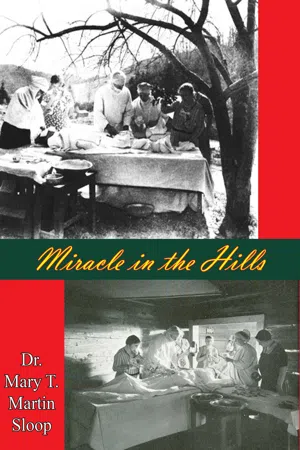
Dr. Sloop and her husband began their lifelong dedication to the mountain people when they rode horseback into the remote hill region of North Carolina in 1909. The conditions they encountered were shockingly primitive. The people had neither doctors, nor schools and were suspicious of medicine and "larnin'." Electricity and running water were unheard of, roads were rough mountain paths and the diet consisted of "hog meat, greens and grease." The main industry was moon shining.
Dr. Sloop declared a personal war on moonshiners, tracking down hidden still with a reluctant sheriff in tow. She fought against child marriages and in a region where girls often married at the age of fourteen. With the help of the mountain people, she reinvigorated the weaving trade, built a church and a modern well equipped hospital. Her spirited support of education resulted in a modern twenty-five-building school.
An amazing story of a unique crusade in the hill country of North Carolina.
- 227 pages
- English
- ePUB (mobile friendly)
- Available on iOS & Android
eBook - ePub
Miracle in the Hills
About this book
Information
Subtopic
American Civil War HistoryIndex
History1
FROM my office in the center of the Administration Building here at Crossnore School I can see outside in two directions. I can look down or up, I can recall past days of struggle and challenge and modest achievement, or I can foresee in imagination larger challenges and greater accomplishments in the years ahead.
Through the window at my right I can look down the hill, a long way down toward the little circle of level land that is the heart of the village of Crossnore. It was here in the long ago that old George Crossnore kept store and here some years later stood the old shed that was the first school building in this community.
But if I turn my head slightly to the left and look out through the short hallway and the front door, I can see up the steep slope, past the music building and the dining hall and the Middle Girls’ dormitory and even beyond the bell tower toward the gymnasium and the new Big Boys’ dormitory on the other side of the athletic field.
Through the window I can see all the way down the hill, except where trees and rhododendrons and mountain laurels screen off the view, to the place where that old school building crouched in the flat. I can see—and well I can remember—the very birth spot of Crossnore School as it looked more than twoscore years ago.
But looking toward the left, I cannot see to the top of the slope and the end of the Crossnore campus on that side; the rectangle of the open doorway provides only a limited view. Nor can I see—but I am thankful that I am privileged still to dream—how high and how far Crossnore in the days to come will climb.
The Administration Building sits only a little above the point from which we began to grow upward, and yet in that day when we built it we felt that we were far up the hill and along the rising path. I sit here in my office from day to day, and nearing eighty years of age I look down the hill and back through many years. But I am thankful to a kind Providence that I can still look also—and more often do—out through the door that frames a view up the hill.
It’s interesting how towns get their names, don’t you think?
It was about the middle of the last century, the old folks around here say, that George Crossnore moved into the community and bought land on which he planned to raise cattle. On this little spot which is now the center of Crossnore, the only level area of any size hereabouts, he built a one-room store with a little lean-to in the back for his living quarters. He was never married, as far as people in this section knew. Soon George Crossnore became the leading citizen in the sparsely settled region.
Twelve miles north, almost on the Tennessee line, were the iron mines, operated by a New Jersey company. The quality of the ore was excellent, and the pig iron smelted down by charcoal made at Cranberry Gap—called that because of the immense cranberry bogs there—was hauled out over a little narrow-gauge railroad. In the course of time the Southern Railway extended its line from Salisbury in the direction of Asheville as far as Morganton. The old people say that the beginning of the Civil War caused work on that road to stop when it reached Morganton. At any rate, there was no railroad between Cranberry and Morganton, and so the mail was carried by an old man who traveled that route. And the route brought him by George Crossnore’s store.
There were hardly any roads in those days—only trails that led along creek bottoms and often in the beds of the streams. When the weather was good, this old man, the story is, would ride his beast, but when it was foul he went afoot. As all mountain people will understand, that was because he did not dare run the risk of having his horse break a leg in fording some rocky, swiftly flowing stream.
The mailman would always stop at George Crossnore’s store to warm himself at the potbellied stove in the winter-time, and to exchange the news with the storekeeper.
In those days there was a woman living in the community who was something of a rarity. She was determined to keep up with what was going on in the world, so she took a weekly newspaper. But it was a long trip each week to Cranberry to get that paper, so she appealed to George Crossnore to have a post office established in the community.
One day she was at the store when the old mailman stopped.
“Here’s your man,” Mr. Crossnore said to her, as he pointed to the mail carrier. “He’s the fellow to see about gettin’ a post office.”
So they talked about the problem. The mailman thought it might be arranged, and he asked what she thought the post office should be named if the Post Office Department agreed to establish it there.
“I don’t care what the name is just so long as I can get my paper and keep me and my young ‘uns posted on what’s agoin’ on in the world,” she told him.
“Well, I’ll see what can be done about it,” he said. “And if they give you ‘uns a post office, I want ‘em to name it for the kindest-hearted man I ever knew, and that’s George Crossnore.”
The post office was established in George Crossnore’s store, and it was named Crossnore. To this day in Crossnore, North Carolina, I understand, is the only post office by that name in the United States.
Little else has been recorded of George Crossnore. After living some fifty years in this community, he moved away. Years ago I asked Uncle Newt Clark—he wasn’t my uncle; we call many old men in the mountains “Uncle” simply as a term of affectionate respect—I asked him where Mr. Crossnore came from. Uncle Newt was one of our best local historians.
When I asked him that question, he seemed puzzled.
“Well,” he drawled, after a while, “I jes’ never thought to aks him.”
“When he left here, then, Uncle Newt,” I said, “where’d he go?”
Again his face was thoughtful. “I knowed him a many a year,” he said, “and I was at the store the day he closed up and pulled out. But I jes’ never thought to aks George Crossnore where he was agoin’.”
The little store of the old bachelor has long ago vanished. So has the first school building. I am sorry, especially that the school has disappeared. They tore it down years ago when I was away on a trip. I’d like to have it standing down there in the flat. I could show it to our visitors and then lead them up the slope to our fine new consolidated high-school building and the dormitories and all the rest. They could see then how far Crossnore has advanced in forty years. We have come a long way—from that old boarded-up shed in the flat to our twenty-five buildings clutching the steep side of the long hill. But maybe it’s best that the old school’s gone. Maybe I brag too much as it is.
2
I HAVE always loved the mountains. As a child going with my family to the mountains in the summer I was always thrilled when we began to get up into the high hills. Because I have lived in them more than half my life and have come to know the mountain people so well, I suppose the mountains have got into my blood.
Frequently someone from the lower country says to me, “Mrs. Sloop, I just can’t stay in the mountains more than a few days at a time. I love the scenery; I think the mountains are beautiful. But after a day or two they begin to crowd down upon me and choke me. I can’t see out. I feel as though I were about to suffocate. If I could just get on top and see beyond them, maybe it would be different. But it seems that there is always a huge mountain cutting off my vision. I seem always to be in a valley, hemmed in from the rest of the world, imprisoned.”
I can understand that feeling. I was born and reared in the Piedmont region of North Carolina, the great and beautiful rolling land between the mountains and the coastal plain. In the mountains you never see out all around you, of course. But I don’t have the feeling of being fenced in. Instead, I feel on top of the world, even though I may be in a sheltered little valley. To me the mountains are inspiring, uplifting, challenging. They seem to beckon to higher things.
Have you ever observed how a mountain man or woman who lives down in the lower country must get back now and then—as often as he can manage it—to the mountains? Give him a day or two away from his work, and he’ll go flying back to the mountains like a homing pigeon. You can get a mountain man out of the mountains, as the old saying goes, but you can’t get the mountains out of the mountain men.
This is a characteristic of mountain people in all lands, no doubt. I know it’s true of our people of the southern Appalachians. The Appalachians, the geologists say, are very old mountains. Some declare they are the oldest in the world, though how they can figure it I cannot understand. Back in the days of Dr. Elisha Mitchell, who measured the towering peak that now bears his name, I understand they said that our Appalachians were millions of years old. But I had no idea they were as old as some of the scientists today say they are. In fact, I had no idea the world was that old.
Some time ago I was reading about a report that a Yale professor of geology had made at a meeting of the American Association for the Advancement of Science. This gentleman was telling about the age of the Appalachians. He said that the first great Appalachian range arose some 800 million years ago, very likely before there was any life on this planet. Over many millions of years, he said, these great mountains, once probably higher than Mount Everest’s 29,000 feet, were worn down until finally they were washed into the ocean.
Then, said this professor, about 600 million years ago a second range of Appalachians was thrust up, and after another 200 million or so this range in turn washed down. Some 350 million years ago the third range arose. By this time the land was covered with vegetation: that was the beginning of the period when the coal deposits were being laid down. In these great forests of tree ferns lived the most primitive of the backboned animals.
But this range lasted only 100 million years, and our present one was raised much higher some 50 million years later by great earth convulsions. It is steadily wearing away, but our Yale man assures us that it will be here many millions of years before it in turn washes into the sea.
How did he find out all this history of our Appalachians? He determined the ages of various Appalachian rocks from the rate of decay of radioactive minerals, such as uranium and thorium. Fragments of these various ranges remain, and their ages can be measured. It is truly amazing what these scientists in this atomic age are doing. Just reading about it leaves an old-time country doctor wide-eyed with wonder.
From the ridge out in front of my house at Crossnore I can look across other ridges and over there in the north-west see Grandfather Mountain. Often a filmy white cloud obscures him; but when the cloud moves on, there he is, lying flat upon his back looking into the sky, his nose, his chin, his beard, his chest, his hands folded at his waist, his long legs outlined clearly against the blue beyond.
Grandfather, some geologists believe, is the oldest rock on the face of the earth. I wonder. I have walked many times over him, I have raced past him along the beautiful Blue Ridge Parkway. Yet I never go near him or even look out upon him from the ridge above my home without experiencing a feeling of awe. Can it be that I am looking upon the oldest bit of the Creators handiwork upon the surface of His earth?
My old bones may be aching, for I’m an ancient rock myself—though I insist I’m no fossil. But even eighty years, by some standards of measurement, is a mighty short period. And when I look upon Grandfather I feel young, and transient. And very humble.
3
MY home is in the mountains and has been for almost half a century. My children are here, and my grandchildren, and many, many beloved friends. I call myself a mountain woman, and I plan to live out my remaining days here at Crossnore.
But I’m an outlander, a come-lately. Many mountain families trace their lines, unbroken, back beyond the Revolutionary War, and not a generation in those long years has forsaken the hill country. Yet not even my parents were mountain people.
Father was from Richmond, Virginia, and Mother was reared in the low country, at Wilmington, North Carolina. Both cities were far from the mountains, and even farther in customs and traditions.
Part of me—of every man and woman, in fact—is my parents and the lives they led. And, in my case, I suspect, their war. Yet, though I am proud of the lives and feats of my Southern ancestors, I have never been one to keep fighting the War Between the States. I have little patience with those professional Confederates who, from the safe retreats of musty library reference rooms and armed with genealogical charts, wage relentlessly their wars of resounding words.
Father was a graduate of the University of Virginia. He was teaching in Washington and Jefferson College in western Pennsylvania when Dr. Elisha Mitchell, an eminent professor at the University of North Carolina, lost his life on the towering mountain, the highest in eastern America, they later named for him. Dr. Mitchell died on June 27, 1857. Shortly afterward Father was called to Chapel Hill to take Dr. Mitchell’s chair.
When the Civil War came on, Father was chosen by the students and the younger professors to form a military company and drill it.
“Where did you ...
Table of contents
- Title page
- TABLE OF CONTENTS
- DEDICATION
- LIST OF ILLUSTRATIONS
- FOREWORD
- 1
- 2
- 3
- 4
- 5
- 6
- 7
- 8
- 9
- 10
- 11
- 12
- 13
- 14
- 15
- 16
- 17
- 18
- 19
- 20
- 21
- 22
- 23
- 24
- 25
- 26
- 27
- 28
- 29
- 30
- 31
- 32
- 33
- 34
- 35
- 36
- 37
- 38
- REQUEST FROM THE PUBLISHER
Trusted by 375,005 students
Access to over 1.5 million titles for a fair monthly price.
Study more efficiently using our study tools.
Frequently asked questions
Yes, you can cancel anytime from the Subscription tab in your account settings on the Perlego website. Your subscription will stay active until the end of your current billing period. Learn how to cancel your subscription
No, books cannot be downloaded as external files, such as PDFs, for use outside of Perlego. However, you can download books within the Perlego app for offline reading on mobile or tablet. Learn how to download books offline
Perlego offers two plans: Essential and Complete
- Essential is ideal for learners and professionals who enjoy exploring a wide range of subjects. Access the Essential Library with 800,000+ trusted titles and best-sellers across business, personal growth, and the humanities. Includes unlimited reading time and Standard Read Aloud voice.
- Complete: Perfect for advanced learners and researchers needing full, unrestricted access. Unlock 1.5M+ books across hundreds of subjects, including academic and specialized titles. The Complete Plan also includes advanced features like Premium Read Aloud and Research Assistant.
We are an online textbook subscription service, where you can get access to an entire online library for less than the price of a single book per month. With over 1.5 million books across 990+ topics, we’ve got you covered! Learn about our mission
Look out for the read-aloud symbol on your next book to see if you can listen to it. The read-aloud tool reads text aloud for you, highlighting the text as it is being read. You can pause it, speed it up and slow it down. Learn more about Read Aloud
Yes! You can use the Perlego app on both iOS and Android devices to read anytime, anywhere — even offline. Perfect for commutes or when you’re on the go.
Please note we cannot support devices running on iOS 13 and Android 7 or earlier. Learn more about using the app
Please note we cannot support devices running on iOS 13 and Android 7 or earlier. Learn more about using the app
Yes, you can access Miracle in the Hills by Dr. Mary T. Martin Sloop in PDF and/or ePUB format, as well as other popular books in History & American Civil War History. We have over 1.5 million books available in our catalogue for you to explore.