Though the battle of the Little Big Horn, June 25, 1876, received widespread publicity because of the magic personality of General George Armstrong Custer and the mystery surrounding the massacre of half of the 7th Cavalry regiment, the Battle of the Rosebud, thirty miles southeast and occurring one week earlier—virtually unknown except to a few students—involved more troops, had fewer casualties, lasted for most of a day, and was of far greater historical significance.
The Battle of the Rosebud covered an area four miles long east and west and two miles wide north and south along the banks of the little Rosebud River in southern Montana.
Northward into this territory in middle June, 1876, Brigadier General George Crook led a large column of U.S. Cavalry and Infantry. This column numbered in excess of 1325 soldiers, Indian allies, packers and miners besides some Army servants who were made part of the fighting force. Regarded at the time as the main force against the infractious Indians, the command was intercepted by a party of Sioux and Cheyennes under Crazy Horse at the big bend of the Rosebud River. After a battle which lasted nearly a day, General Crook was compelled to return to his base forty miles away on the present site of Sheridan, Wyoming.
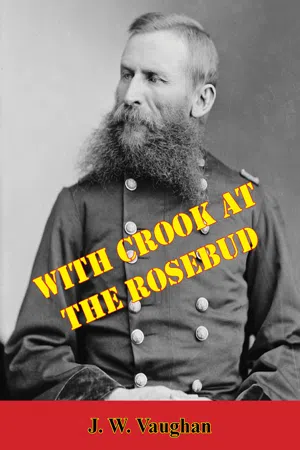
- 293 pages
- English
- ePUB (mobile friendly)
- Available on iOS & Android
eBook - ePub
With Crook At The Rosebud
About this book
Trusted by 375,005 students
Access to over 1.5 million titles for a fair monthly price.
Study more efficiently using our study tools.
Information
Subtopic
Social Science BiographiesIndex
Social SciencesCHAPTER 1—THE CAMP AT FORT FETTERMAN
GOLD! Yellow kernels of lode for which men of all nations have fought and died, fired the adventurous hearts of this country when discovered in the Black Hills, 1874, bringing an invasion of prospectors into the Dakotas. This was Indian territory; and the eyes of the warriors glaring across the council circle at White River, September 20, 1875, were hot and resentful. Retaliation they had had. The murdered bodies of their victims were legion. The Government officers, attempting to settle differences peacefully at this council near Fort Robinson, realized by the bitter words spoken that they had failed. Neither white nor red man could know this was the prelude to the decisive battle of the Rosebud, {1} the companion battle to Custer’s fight on the Little Big Horn.
By the terms of the treaty of Fort Laramie, 1868, the Sioux and Cheyenne tribes were given control over wide territory in Montana, Wyoming, Nebraska, and western portions of the Dakotas. The Government had agreed to vacate the territory, abandoning its forts, including Fort Reno and Fort Phil Kearney, and endeavor to keep out white men. However, because of the influx of gold-mad miners, encroaching European immigrants from all directions and the continual use of the Bozeman Road, the attempt had been unsuccessful. Therefore, the Government’s commissioners at the Peace Council sought to purchase the Black Hills.
Captain Anson Mills, in command of the soldiers present told of the Council:
“On June 18, 1875, Mr. Ed. P. Smith, the Commissioner of Indian Affairs, organized a commission to treat with the Sioux. It was composed of very distinguished men. Senator William B. Allison was the president, and General Terry among the thirteen members who met at Fort Robinson, September 20, 1875. I commanded the escort, consisting of my own and Captain Eagan’s white horse company of the 2d Cavalry.
“The majority of the Indians refused to enter the post, declaring they would make no treaty under duress. The commission agreed to meet in a grove on the White River, eight miles northeast of the post. Spotted Tail, who accompanied me from Fort Sheridan, warned me it was a mistake to meet outside the post, and kept his best friends around my ambulance.
“The commission sat under a large tarpaulin, the chiefs sitting on the ground. Senator Allison was to make the introductory speech, and Red Cloud and Spotted Tail were scheduled to reply favorably to the surrender of the Black Hills for certain considerations.
“There were present an estimated 20,000 Indians, representing probably 40,000 or 45,000 of various tribes. Probably three-fourths of the grown males of the consolidated tribes were present and might have subscribed to a new treaty in accordance with its provisions, that it be with the consent of three-fourths of the Indians, which supposedly meant the grown people, although the treaty did not so state. The Indians were given to understand that the whites must have the land, so that they became alarmed, and most of them threatened war.
“Eagan’s Mounted company, drawn up in single line, I placed on the right of the commission, my own on the left. Allison began his address, during which hostile Indians, well-armed, formed man for man in the rear of Eagan’s men. “Young-Man-Afraid-of-His-Horses,” a captain of a company of friendly Indians, asked permission to form his men in the rear of the hostile Indians, to which I consented.
“When Red Cloud was about to speak, “Little-Big-Man,” astride an American horse, two revolvers belted to his waist, but otherwise naked save for a breech clout, moccasins and war headgear, rode between the commission and the seated Indian chiefs and proclaimed, “I will kill the first Indian chief who speaks favorably to the selling of the Black Hills.”
“Spotted Tail, fearing a massacre, advised that the commission get back to the fort as quickly as possible. General Terry consulted with Allison, and then ordered the commission into ambulances to make for the post. I placed Eagan’s company on each flank and my own in the rear of the ambulances, At least half the men warriors pressed about us threatening to kill some member of the commission.
“One young warrior in particular, riding furiously into our ranks, frenziedly declared that he would have the blood of a commissioner. Fortunately we reserved our fire.
“A friendly Indian soldier showed him an innocent colt grazing about one hundred yards away and told him he could appease his anger by killing it. Strange to say, he consented, rode out and shot the colt dead, and the whole of the hostile Sioux retired to the main body at the place of our meeting. Thus ended the efforts of this commission to formulate a treaty.” {2}
It was now necessary for the Bureau of Indian Affairs to adopt regulations demanding that all Indians in the northwest live on reservations, setting January, 1876, as the final date for infractious tribesmen.
The Crows, having lost their territory by the terms of the treaty, had moved to the western side of the Big Horn Mountains, where they lived neighbors with the Shoshone. These two tribes, on friendly terms with the U. S., were long standing enemies of the Sioux and Cheyenne, who refused to return to their reservations. Under the leadership of Sitting Bull of the Hunkpapa tribe of Sioux, these latter tribes, concentrated for mutual protection, moved north and westward into eastern Montana.
Helpless, the Indian Bureau turned the problem over to the military and Lt. General P. H. Sheridan, Commander of the Division of the Missouri, wherein the hostile tribes were located.
Subsequently, Brigadier General George Crook, an Ohioan, in his 48th year, on orders from the War Department, March, 1876, led a column of infantry and cavalry north from Fort Fetterman by the Bozeman Road, then northeastward to the Powder River. A portion of his command under Colonel J. J. Reynolds surprised a large village believed to be Oglala Sioux under the leader Crazy Horse. Reynolds captured and destroyed the village and supplies, but was driven back after the Indians rallied and recaptured their horses. Though the Indians claimed this was a village of Cheyenne under Chief Two Moon, who after the battle sought refuge in Crazy Horse’s village, there was public ridicule of the defeat.
General Crook, mortified, critical of Reynold’s failure, arranged a court martial upon his return to Fort Fetterman:
“Owing to the age and feebleness of Colonel Reynolds,” wrote Mills, “and the bitter feud that existed in the regiment (similar to that in the 7th Cavalry between Colonel Sturgis and his friends and Colonel Custer and his friends, that proved so disastrous at the Little Big Horn), this attack on the village on Powder River proved a lamentable failure. Reynolds disobeyed Crook’s order to hold the village until his arrival, abandoning the field and retiring in the direction of Fetterman.” {3}
Failure of Crook’s expedition meant all-out war. General Terry commanding the Department of Dakota, and General Crook, commanding the Department of the Platte, were instructed to organize large commands for the purpose of pursuing and punishing derelict Sioux.
General John Gibbon left Fort Ellis, near the present site of Bozeman, Montana, to move southeast, with 450 men, including six companies of infantry and four troops of cavalry. Descending the Yellowstone River, he kept his men stationed at various points to see that the Indians did not escape to the north.
From Fort Abraham Lincoln, near Bismarck, North Dakota, General Alfred H. Terry set out in a westerly direction with a column composed of 950 men, May 17. A portion of this force, composed of three companies of infantry and a battery of Gatling Guns (early rapid fire machine guns), met the advance forces of Gibbon on June 8 at the mouth of Glendive Creek, where the balance of Terry’s command, 650 men of the 7th Cavalry under General Custer, did not arrive until several days later.
The third column of cavalry and infantry under General Crook was destined to leave Fort Fetterman, May 29th, following the Bozeman Road northward into hostile territory.
Thus, the three commands were acting in concert to complete a pincers movement closing in on the concentration of Sioux and Cheyennes, believed to be somewhere west of the Rosebud River.
All during May, Crook’s column was assembling and outfitting at his base located ten miles northwest of where Douglas, Wyoming, now stands. Situated on a small plateau, Fort Fetterman was a quarter mile from the south bank of the North Platte River near the point where the old Oregon Trail running east and west intersected the Bozeman Road. Named for Brevet Lt. Col. W. F. Fetterman, Captain in the 27th Infantry, who was massacred with his whole command near Fort Kearney, December 21, 1866, it was one of the larger western forts with accommodations for three infantry companies, four cavalry troops and one hundred citizen employees.
A small column of troops under the command of Major Evans, {4} an old classmate of Crook’s, assembled at Medicine Bow Station on the Union Pacific Railroad, marched across country to join Crook at Fort Fetterman on May 25th. {5} But the main body of troops with wagons, supplies and pack train assembled at Fort Russell near Cheyenne, Wyoming, under command of Colonel Royall, that “tall handsome Virginian,” marching via Fort Laramie and the old Mormon Emigrant Trail to Fort Fetterman. They went into camp on the north side of the river across from the fort and east of Major Evans’ men, waiting for the other troops to be brought over for the anticipated march.
There were however, no bridges across the stream, and the North Platte River, swift and running from bank to bank, presented the first major obstacle to General Crook.
“The Command Was Taken Over On a Ferry Boat”
Lieutenant Daniel C. Pearson, 2nd Cavalry, a young officer appointed to the Military Academy from Massachusetts and graduated in the class of 1870, describes in his article “Military Notes, 1876, U.S. Cavalry Journal, September 1899,” the difficulties encountered:
“Below, and near at hand to the fort, swiftly ran the North Platte River, bank-full at that time of year. The command was, with the exceptions of horses that could be made to swim, taken over on a ferry boat, which was propelled to and fro by presenting sides, alternately, obliquely to the current, with the help of ropes, blocks and pulleys operating upon a cable that was stretched from bank to bank. {6} The process of swimming the horses was interesting, more particularly when it came to those of one troop which positively refused to take the water. With that mount, as was the case with all, the men of the troop formed a semi-circle about the horses, the ends of the circle resting at the water’s edge, to force the horses into the river. The particular mounts referred to were young and new to the service. They broke through the line of men; they turned tail to the river; they sailed past the fort like the wind, and then they disappeared in the mountains southward, the most of them never to be recovered. {7}
“This column having collected on the north bank of the river, was then inspected. As a result of this inspection, a car-load of the personal effects of officers and men had to be sent back to the fort, to be left in the quartermaster’s warehouse. In fact, many of these effects were yet on the river bank as the column pulled out to the north. Every pound that could be dispensed with was left behind. Currycombs and brushes were not allowed to the cavalry. Clothing, blankets, and equipage were closely scanned, and reduced by an inflexible rule in the case of every individual. Herein the infantry suffered most. Many nights were spent by them hovering over camp-fires, while the cavalryman was sleeping well under the additional cover afforded by saddle blanket and another extra blanket, which was carried beneath the saddle in the daytime with no detriment to the horse.”
“Bustle and Activity Prevailing In Camp”
Lieutenant John G. Bourke, aide-de-camp to General Crook, wrote in his diary about the enormous task of getting men and supplies over the river:
“May 26. The hausers of the ferry broke this morning about 11 o’clock. Not mu...
Table of contents
- Title page
- TABLE OF CONTENTS
- DEDICATION
- ACKNOWLEDGMENTS
- PERSONAL ACKNOWLEDGMENTS
- PREFACE
- CHAPTER 1-THE CAMP AT FORT FETTERMAN
- CHAPTER 2-THE MARCH TO GOOSE CREEK
- CHAPTER 3-THE ARRIVAL OF THE CROW AND SHOSHONE ALLIES
- CHAPTER 4-THE MARCH TO THE ROSEBUD
- “‘We will have a fight tomorrow, mark my words-I feel it in the air.’” CHAPTER 5-IN THE SIOUX CAMP
- CHAPTER 6-OUTLINE OF THE BATTLE
- CHAPTER 7-WITH MILLS ON THE RIGHT FLANK
- CHAPTER 8-WITH CROOK ON THE CENTER
- CHAPTER 9-WITH ROYALL ON THE LEFT FLANK
- CHAPTER 10-WITH CRAZY HORSE
- CHAPTER 11-RETURN TO GOOSE CREEK
- CHAPTER 12-AFTERMATH OF THE BATTLE
- APPENDIX A-NAMES OF TROOPS IN THE CAMPAIGN
- APPENDIX B-OFFICIAL REPORTS OF THE BATTLE
- BIBLIOGRAPHY
- PERIODICALS
Frequently asked questions
Yes, you can cancel anytime from the Subscription tab in your account settings on the Perlego website. Your subscription will stay active until the end of your current billing period. Learn how to cancel your subscription
No, books cannot be downloaded as external files, such as PDFs, for use outside of Perlego. However, you can download books within the Perlego app for offline reading on mobile or tablet. Learn how to download books offline
Perlego offers two plans: Essential and Complete
- Essential is ideal for learners and professionals who enjoy exploring a wide range of subjects. Access the Essential Library with 800,000+ trusted titles and best-sellers across business, personal growth, and the humanities. Includes unlimited reading time and Standard Read Aloud voice.
- Complete: Perfect for advanced learners and researchers needing full, unrestricted access. Unlock 1.5M+ books across hundreds of subjects, including academic and specialized titles. The Complete Plan also includes advanced features like Premium Read Aloud and Research Assistant.
We are an online textbook subscription service, where you can get access to an entire online library for less than the price of a single book per month. With over 1.5 million books across 990+ topics, we’ve got you covered! Learn about our mission
Look out for the read-aloud symbol on your next book to see if you can listen to it. The read-aloud tool reads text aloud for you, highlighting the text as it is being read. You can pause it, speed it up and slow it down. Learn more about Read Aloud
Yes! You can use the Perlego app on both iOS and Android devices to read anytime, anywhere — even offline. Perfect for commutes or when you’re on the go.
Please note we cannot support devices running on iOS 13 and Android 7 or earlier. Learn more about using the app
Please note we cannot support devices running on iOS 13 and Android 7 or earlier. Learn more about using the app
Yes, you can access With Crook At The Rosebud by J. W. Vaughn in PDF and/or ePUB format, as well as other popular books in Social Sciences & Social Science Biographies. We have over 1.5 million books available in our catalogue for you to explore.