- 228 pages
- English
- ePUB (mobile friendly)
- Available on iOS & Android
eBook - ePub
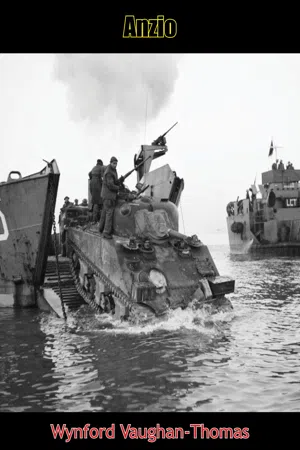
Anzio
About this book
The explosive story of World War II's bloodiest beachhead—where everything failed but courage.
'THIS IS A BASTARD OF A PLACE...'
said a soldier on the Anzio beachhead. This was the bitter truth. What started as an easy victory turned abruptly into a massacre. Over 18,000 Allied soldiers were wounded and 4,400 killed in the early months of 1944
First published in 1961, this book, by a man who was there to the very end, tells the whole, shocking story.
"Explains in vivid detail...what the soldiers...and one general can be proud of and what other generals need to explain."—LIFE
"Must reading"—New York Times
'THIS IS A BASTARD OF A PLACE...'
said a soldier on the Anzio beachhead. This was the bitter truth. What started as an easy victory turned abruptly into a massacre. Over 18,000 Allied soldiers were wounded and 4,400 killed in the early months of 1944
First published in 1961, this book, by a man who was there to the very end, tells the whole, shocking story.
"Explains in vivid detail...what the soldiers...and one general can be proud of and what other generals need to explain."—LIFE
"Must reading"—New York Times
Trusted by 375,005 students
Access to over 1 million titles for a fair monthly price.
Study more efficiently using our study tools.
Information
1 — Prologue
The time—the small, cold hours after midnight on 22 January 1944; the place—the deck of a landing craft out to sea from the sleeping port of Anzio, thirty miles south of Rome; for me, and for thousands of Allied soldiers, the most uncomfortable yet surprising moment in the whole of World War II.
For we were about to invade Hitler’s European fortress six months before D-Day in Normandy. This was to be one of the most daring moves yet carried out by the High Command; we were to fling ourselves boldly ashore in the darkness far behind the German lines. We had been briefed in numerous ‘pep-talks’ about the vital importance of our mission. We were going to break the dismal deadlock which had gripped the Italian front through the winter of 1943. We would outflank the formidable defences of the Gustav Line, ‘roll back the Boche’. Rome in ten days! And then, who could count the glittering prizes which might fall into our hands—the Germans flung back to the Apennines, the Balkan front ablaze, the whole course of the war triumphantly altered? So the bright visions played over our expedition and over Allied Headquarters far behind us at Naples and Algiers.
But for us, watching the minutes tick on to Zero Hour, the world had now shrunk to one precise danger-point—the dark line to the east that marked the shore. Soon, far too soon for most of us, the orders would be given. Quietly we would heave ourselves down slippery ladders into the waiting boats. Then, full speed ahead, we would race towards the beaches. What would happen? Were we five minutes away from another Salerno?
The men in this invasion had bitter memories of Salerno and the way the Germans had waited for them to come close inshore. Then the storm of bullets and shellfire and all the hell of a contested landing!
We couldn’t banish it from our minds as we waited for 2 a.m., the scheduled time for our assault. I was sailing in the headquarters craft which carried the splendidly named naval officer entitled SNOL (Senior Naval Officer Landings) and the HQ company of the 2nd Brigade of the British 1st Infantry Division. I took comfort from this roll-call of naval and military designations; it made me feel that I was part of the great fighting machine of the invasion even though I had no control over the working of it.
I was the BBC’s war correspondent for the landing. My only weapon of war was the new, cumbersome portable recorder which I was to be the first to take into action—a gramophone type affair which had to be cranked up every few minutes and used discs instead of tape. It sounds a creaking antique now, but it was a revolutionary invention in 1944. On it I hoped to capture the strange, tense atmosphere of a landing at night from the sea.
The shore remained a vague, dark line on the surface of the waters somewhere out to the east, but the night now started to fill with little local sounds—the faint creak of the davits as the assault craft were swung out, the quiet thud of the screws of the LSTs moving closer to the beaches. Some of these sounds must have been carried eastwards by the night breeze, but there was still no sign of life from the land. It did not seem possible that the enemy was still unaware that a vast armada of ships—cruisers, destroyers, troop-carriers, minesweepers, landing craft of all shapes and sizes—was now lying silent only two miles out to sea.
0153 hours; the uncanny silence of the night was torn apart with sudden brutality, the whole sky to port seemed to flare into fire and a crashing explosion rocked the anchorage as if an ammunition ship had gone up. For a moment we could see the long line of assault craft poised like race-horses at the starting gate. Out to seaward the whole great fleet was silhouetted against the glare.
It was the rocket ship going into action—792 5-inch rockets hurtling onto the beach, all exploding within ninety seconds. The ground must have heaved under them like an earthquake. No minefield or any German near it could possibly have survived.
A muffled figure on the bridge at my side muttered, ‘That’s shaken them. Now we’re in for it.’ I braced myself for the shock of the searchlights stabbing out from the shore, followed by the tracers pouring over the waters. But again a silence more intense than ever held the whole area as the assault craft crept in.
0200, Zero Hour itself, and suddenly the radio on board began to crackle. The first wave had touched down, and not a shot had been fired. The incredible had happened. We had got the one thing we had never bargained for, utter and complete surprise. The reports poured in and our Brigadier stood with SNOL in the tiny blacked-out cabin where the maps of the beaches had been laid out under hooded lights. The first news was that the beaches were awkward—there was trouble with sandbanks offshore, and mines had been found on the dunes and in the pine woods beyond.
‘We must take a risk,’ a helpful officer declared. ‘We ought to get the troops to push on.’ (The appropriate comment on this suggestion appeared in the official report after the landing: ‘It must be realized that no amount of shouting through loud hailers will induce troops to advance through a minefield.’)
But gradually the position became clearer, and a feeling of quiet optimism pervaded the cabin. The first elements were through the pine woods; they were crossing the coast road, probing carefully forward in the darkness and had met nothing.
Now the sky was beginning to lighten, and it was our turn to land. SNOL came down from the bridge to see us off into the small craft which was to take us onto the beach. He was a man with many cares on his mind, but he still felt that, in keeping with the long tradition of the Royal Navy, he should give a formal farewell to his guests.
He looked down on the little huddled group in khaki now gathered in the well of the LCA. ‘Goodbye,’ he shouted, ‘and good...’ But his farewell stopped in mid-career. The steersman of the landing craft had allowed it to scrape the immaculate topsides of the headquarters ship. SNOL seized his loud-hailer and roared, ‘You there! Don’t stand about like a half-plucked fowl. Cast off!’
Propelled by the force of SNOL’s farewell we made for the shore, wading through the chill water to reach the beach. Our steps were clogged as, heavily loaded, we struggled through the sands and muffled voices warned us of minefields. Our little party picked its way carefully along the lines of white tape and stumbled out into the woodlands.
Overhead came an unpleasant whine followed by a crash and the faint smell of high explosive. It was the first shell from a German self-propelled gun. Instinctively the men cringed and ducked. The Brigadier, now outlined in clear cut profile against the growing light in the east, looked neither right nor left but issued the crisp order ‘Forward, Brigade’ and led us onward like the headmaster leading a school ‘crocodile,’ while the antennae of the pack radio carried by his signaller shook against the dawn.
And as the light strengthened so did our surprise and relief at the fantastic ease of our landing. Dawn was fine and chill, and not an enemy in sight!
There before us were the long line of marching troops entering the woodlands behind Anzio, the first guns coming ashore and the tanks lumbering after them. Still no enemy—only an odd shell from somewhere out ahead. Nothing to worry about. We had achieved utter and complete surprise.
The only Germans we saw were a forlorn group standing under guard at a farmhouse door. They had been fast asleep when we landed, and clad in pyjamas had jumped into their car, driven it out through the door of the bam and had been rounded up before they had gone a hundred yards.
The sun strengthened and we pushed on to the main road running out of Anzio towards Rome. We could see the smiling countryside ahead untouched by war and, in the distance, the graceful, welcoming outline of the Alban Hills. Beyond lay Rome, and there was nothing to stop us driving straight down the road to the Eternal City.
‘Bliss was it at that dawn to be alive.’ The peasants crowded around the jeeps and pointed excitedly down the road. ‘Niente Tedeschi?’ we asked in our broken Italian. ‘Nobody, nothing. A Roma, pronto!’ came the reply.
Time for a quick ‘brew up’ and then, surely, the orders would arrive to push on at all speed, to occupy the Alban Hills and reconnoitre to the very gates of Rome. We held the whole world in our hands on that clear morning of January 1944.
So we waited for the orders to advance.
We went on waiting...the hours passed...the sun became warm...the road stretched invitingly ahead...but still no instructions reached us to get into our jeeps. ‘Well,’ said the sergeant who was with us, ‘that’s that, lads. It doesn’t look as if we’ll be moving before night. Better kip down where we are and get ready for an early start. They’re bound to push us up that road soon.’
Four months later British soldiers were still halted at the same spot, but the landscape around them had undergone a violent change. The farmhouses were heaps of rubble, the trees mere shell-torn skeletons, and the fields churned by tanks into a sodden morass. A complicated trench-system zigzagged across the tortured countryside.
At night the star-shells soared up over shell-holes and barbed wire while the guns rumbled and flashed far to the rear. Just before dawn in late April a British sentry in a forward trench cocked his Bren gun and peered into the darkness. A deep voice suddenly said, ‘Good evening.’ The startled sentry crouching in his slot in the ground, jerked his head back in time to see a German officer looking down on him.
‘Hullo, Tommy,’ said the officer in perfect English, ‘are you still there?’ And before the soldier could swing his Bren round the German disappeared.
The adventurous officer was given no chance to repeat his exploit, but his question went on puzzling his opponents during the weary, frustrating months they spent at Anzio. It has continued to puzzle them ever since.
After all, this was 1944 not 1917!
What, indeed, were the Tommy and his comrade-in-arms the American GI doing in malodorous slots in the ground, fighting for the only time in World War II a battle which, for long weary months, seemed to belong to the trench warfare of World War I; a struggle in the mud, complete with duckboards, trench-raids and patrols in no-man’s-land, a miniature Passchendaele in the era of the Blitzkrieg?
What went wrong with one of the boldest and most adventurous strokes planned by the Allies in the whole of the 1939-45 war?
The passage of time brings an order and clarity into battles which was never apparent to the men who did the actual fighting. Today, after the generals and the war leaders have published their memoirs, we can see only too clearly why Anzio failed to fulfil its first bright promise. The answer to the problem is simply this—the adventure was launched under divided counsels and against the inner conviction of one of the partners. The men in Britain who were responsible for the higher conduct of the war believed in Anzio; their American colleagues did not. When Allies disagree they have to compromise, but compromise never won a battle yet. No wonder that the general selected to lead the troops into battle muttered as he left the final conference, ‘This is going to be worse than Gallipoli!’
A battle, even a campaign as important as that of Normandy, is only an incident in the great sweep of events that goes to make a world war. The compromise over Anzio, the disagreement amongst the Allies and the agony and final triumph of the Beachhead can be understood only when they are seen as part of the wider picture. There is no need here to go into the details of that picture. It will be enough for our purpose if we give a brief outline of the position of the Allies in 1943 and their discord over the presence of Anglo-American armies on the soil of Italy. From this basic disagreement over the conduct of the Italian campaign the difficulties of the troops at Anzio flowed with the inevitability of a law of nature.
The early months of 1943 marked a turning-point in the fortunes of the Allies. The Germans had been cleared out of North Africa, their armies were reeling back from Stalingrad, and the Japanese had been decisively checked in their Pacific advance. Hitler had been sealed into his stronghold of Fortress Europe.
It was clear that the Allies could hardly lose the war, but it was equally clear that they had not yet won it. To do this they must break into Hitler’s fortress. The great debate raged amongst the leaders of Britain and America as to how this break-in could best be achieved.
The Chiefs of Staff at Washington felt that the right way to end the war was by a powerful blow to the heart—’Overlord’, the landing in Normandy. Everything should be subordinated to this. Said one general discussing the problems ahead, ‘In America we don’t solve our problems, we overwhelm them!’
The British, while agreeing that ‘Overlord’ was essential, favoured a more indirect approach. A campaign in the Mediterranean would do two things—draw the German reserves south away from the Normandy front and open up a rewarding second front. Where else but in the Mediterranean could the Allies fight the enemy while they waited for the launching of ‘Overlord’?
Reluctantly the Americans allowed themselves to be persuaded.
The Allies occupied Sicily. In September they advanced into the mainland of Italy. The British Eighth Army under General Montgomery pushed up the east coast along the Adriatic while the American Fifth Army under General Mark Clar...
Table of contents
- Title page
- TABLE OF CONTENTS
- ACKNOWLEDGMENTS
- DEDICATION:
- AUTHOR’S NOTE
- 1 - Prologue
- 2 - The Code Name is ‘Shingle’
- 3 - The Shadow on the Plan
- 4 - The Landing
- 5 - Advance at Last
- 6 - Lancing the Abscess
- 7 - ‘Beachhead-Deathshead’
- 8 - The Crisis
- 9 - What We Have We Hold
- 10 - Break-out
- 11 - Epilogue
- Bibliography
- REQUEST FROM THE PUBLISHER
Frequently asked questions
Yes, you can cancel anytime from the Subscription tab in your account settings on the Perlego website. Your subscription will stay active until the end of your current billing period. Learn how to cancel your subscription
No, books cannot be downloaded as external files, such as PDFs, for use outside of Perlego. However, you can download books within the Perlego app for offline reading on mobile or tablet. Learn how to download books offline
Perlego offers two plans: Essential and Complete
- Essential is ideal for learners and professionals who enjoy exploring a wide range of subjects. Access the Essential Library with 800,000+ trusted titles and best-sellers across business, personal growth, and the humanities. Includes unlimited reading time and Standard Read Aloud voice.
- Complete: Perfect for advanced learners and researchers needing full, unrestricted access. Unlock 1.4M+ books across hundreds of subjects, including academic and specialized titles. The Complete Plan also includes advanced features like Premium Read Aloud and Research Assistant.
We are an online textbook subscription service, where you can get access to an entire online library for less than the price of a single book per month. With over 1 million books across 990+ topics, we’ve got you covered! Learn about our mission
Look out for the read-aloud symbol on your next book to see if you can listen to it. The read-aloud tool reads text aloud for you, highlighting the text as it is being read. You can pause it, speed it up and slow it down. Learn more about Read Aloud
Yes! You can use the Perlego app on both iOS and Android devices to read anytime, anywhere — even offline. Perfect for commutes or when you’re on the go.
Please note we cannot support devices running on iOS 13 and Android 7 or earlier. Learn more about using the app
Please note we cannot support devices running on iOS 13 and Android 7 or earlier. Learn more about using the app
Yes, you can access Anzio by Wynford Vaughan-Thomas in PDF and/or ePUB format, as well as other popular books in History & European History. We have over one million books available in our catalogue for you to explore.