This study is an historical analysis of the background and demonstrated leadership attributes of 332 World War II German corps commanders on the Eastern, Italian, and Western Fronts. Overall characteristics are determined based on each officer's experience and performance based on available historical records. These records focus on age, nobility, background, education, branch, previous command and staff positions, membership in the General Staff, demonstrated military achievement, promotion, and subsequent higher command.
Among the many conclusions which could be drawn from this investigation are: most successful corps commanders possessed an excellent educational background, performed well in previous significant command and staff positions, and demonstrated the capability for independent action; and, political factors played a minor role in the selection of officers for corps command.
The study concludes that the Eastern, Western, and Italian Fronts all had competent German corps commanders conducting operations; no Front had a preponderance of successful commander's to the detriment of the other two.
- 73 pages
- English
- ePUB (mobile friendly)
- Available on iOS & Android
eBook - ePub
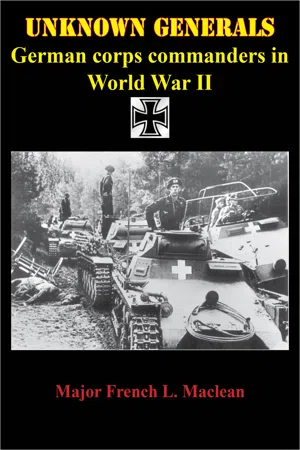
Unknown Generals - German Corps Commanders In World War II
About this book
CHAPTER 1 — DEFINING THE PROBLEM
INTRODUCTION
The purpose of this study is to examine the background and proficiency of German corps commanders in World War II. It is evident that these men, the links between operational and tactical levels, were key components in the resulting successes and failures of the Wehrmacht. Present United States AirLand Battle doctrine draws extensively on the German experience in this conflict.
Current examination of German generalship in World War II suffers from two deficiencies: identification and generalization. Although most high level commanders (army and above) have been identified and their proficiency analyzed, such is not the case with the Commanders of the ninety-three German corps.
Research at both the German Army Military Archives at Freiburg, West Germany, and at Fort Leavenworth, reveals that no single complete listing of corps commanders exists. However, by combining sources found at both places, a comprehensive list can be documented identifying these corps commanders.
The second major deficiency concerns generalization of leaders. Current literature too often categorizes German general officers as stiff Prussian aristocrats with almost superhuman military expertise. Naturally, they varied in background, proficiency, and potential. With the identification of the commanders completed, one can conduct an examination of individual careers. This is especially critical for further investigation of the German military tenets on which so much of U.S. doctrine is based.
This study will focus on the background, previous command and staff experience, demonstrated military achievement, and subsequent promotion to higher command to identify prominent characteristics of these individuals. The analysis will conclude by comparing corps commanders on the Eastern Front with those on the Western Front.
HISTORICAL BACKGROUND
The German Army in World War II was an extremely large, multifaceted organization which conducted operations on two continents. Personnel strength numbered in the millions. The Army was divided into two major sub-organizations, the Field Army and the Replacement Army. Personnel figures through the war for both are shown below.{1}

To control this large force, the Germans developed several echelons of command. The highest field command was the army group. Eighteen army groups were created during the war with the mission to control two to four armies in a single theater of operations for a single campaign. A field marshal most frequently commanded an army group.{2}
Immediately subordinate to the army groups were the armies. An army was a more permanent command and was not formed for just a specific campaign. Twenty-seven armies were established between 1939 and 1945. Each army theoretically directed two to six corps. An army was commanded by a field marshal, a colonel general, or a general of infantry, panzer, artillery, etc.{3}
The ninety-three corps and their commanders are the major subject of this thesis. They will be discussed in detail in chapters three, four, and five. Each corps directed the activities of from two to six divisions and was commanded by a general of infantry, panzer, etc., a lieutenant general, or a major general.
The lowest general officer commands were the divisions. Within the Army, the number of divisions peaked in June 1944 at 283. In addition, both the Waffen SS and Luftwaffe provided ground divisions for combat.{4}
More than 2400 personnel served as general officers in the German Army. David Downing, author of The Devil’s Virtuosos, states that “The German generals were the finest thinking and fighting soldiers of modern history.”{5} The level of competence of corps and division commanders was high. However, there was a wide variance in prospects for advancement. Some officers had potential for promotion to higher commands, some lost favor personally or politically, and some were not viewed as professionally competent for future major operational responsibility.{6} It is the purpose of this study to examine these factors of capability.
RESEARCH QUESTIONS
The major research questions this study will focus on are:(l) What were the prominent background, experience, and achievement characteristics exhibited by German corps commanders in World War II? and (2) Given these characteristics as a whole, were the German corps commanders faced by the British and Americans on the Western/Italian Fronts less or more proficient than those fighting the Soviets on the Eastern Front?
SIGNIFICANCE OF THE STUDY
The compilation of a definitive list of corps commanders should add to the body of information concerning German leadership in World War II. Conclusions concerning background, education, command and staff experience, and demonstrated military achievement may assist our own efforts at senior leader development.
METHODOLOGY
The methodology used for this study is three-fold. First, prominent characteristics for German general officers will be identified from post-war published sources. Second, each commander will be analyzed according to background, education, previous command and staff experience, demonstrated military achievement, and subsequent promotions. With these baselines established, the corps commanders on the Eastern Front will then be compared and contrasted with those on the Italian and Western Fronts.
CHAPTER 1 is a definition of the problem central to the thesis. The historical background of the study is presented as well as the methodology to be followed.
CHAPTER 2 presents a detailed review of literature. Sources essential to the study to be discussed include manuscripts of the U.S. Foreign Military Studies of the Historical Division, United States Army Europe (USAREUR); captured German records microfilmed at Alexandria, Virginia; German records at the Bundesarchiv-Militärarchiv, Freiburg, West Germany; and post-war German, British, and American literature.
CHAPTER 3 provides a background study of the German corps system. This chapter will assist in putting later personnel issues in perspective.
CHAPTER 4 is an in-depth presentation of prominent factors of background, education, and previous command and staff experience.
CHAPTER 5 presents factors of demonstrated military achievement, promotion, and subsequent higher level command.
CHAPTER 6 establishes baseline characteristics determined by criteria presented in chapters 4 and 5. Overall traits for all corps commanders are presented, and a final comparison and contrast of commanders on the Eastern Front with those on the Italian and Western Fronts is made. Conclusions are based on the evaluated information.
ANNEX A explains abbreviations used throughout the study and presents a concise list of German terms and definitions to assist future researchers with the many untranslated sources.
ANNEX B is a comprehensive listing of all German Army corps commanders.
CHAPTER 2 — REVIEW OF LITERATURE
The purpose for presenting a detailed review of literature for this thesis is two-fold. First, it will familiarize the reader with the wide variety of both English and German material available. Second, it provides succeeding researchers with a synopsis of the information relating to the German corps and corps commanders in World War II.
The review of literature for this thesis consists of books, manuscripts of the U.S. Foreign Military Studies of the Historical Division USAREUR.., and captured German records microfilmed at Alexandria, Virginia. The research process entails examination, analyzation, contrast, and comparison of the information from these sources.
Material originated from many locations. The German Army Archives at the Bundesatchiv-Militärarchiv, Freiburg, FRG was the primary source for documenting the list of corps and corps commanders. The Combined Research Library (CARL) at the United States Army Command and General Staff College (CGSC), Fort Leavenworth, Kansas, provided the foundation for documenting the remainder of the thesis.
The research material used in this thesis was unclassified. The sources range from those written during World War II to the present. Pre-1945 material consists of primary sources with little author interpretation. Sources written immediately after 1945 include interviews with senior German commanders. Recent literature includes memoirs and recently opened archive files.
The review of literature applicable to this thesis is divided into two sections. Part I concentrates on information about the corps and corps commanders. Part II focuses on those prominent leadership characteristics emphasized by the Germans, the promotion and awards systems, and the General Staff. For nontranslated German works I have provided an English translation of the title in parentheses. Other literature is included in the bibliography. The following sources were the most useful.
PART I
BOOKS
John Angolia’s work On the Field of Honor, A History of the Knight’s Cross Bearers (Volume 1-2) is an excellent source of information on German military personalities in World War II. These two works provide short biographies of the winners of Germany’s highest military awards, including many corps commanders. The two books are the first of a planned seven volume series. General career information is excellent, although not all dates of assignment are accurate.
R. James Bender and Warren W. Odegard are the authors of Uniforms, Organization and History of the Panzertruppe. This work provides a wealth of information related to German panzer units, equipment, and uniforms. The section concerning personalities provides lists of commanders of panzer armies, corps, and divisions with only a few discrepancies.
Dermot Bradley and Richard Schulze-Kossens are the editors of the Tätigkeitsbericht des Chefs des Heerespersonalamtes General der Infanterie Rudolf Schmundt: 1.10.42-29.10.44. (Daily Reports of the Chief of the Army Personnel Office General of Infantry Rudolf Schmundt: October 1, 1942 to October 29, 1944) This massive work contains all of the daily communications from the Army Personnel Office. Promotions and demotions are covered along with valuable information on reliefs of commanders, details of killed in action reports, and the involvement of officers in the 20 Jul...
Table of contents
- Title page
- TABLE OF CONTENTS
- ABSTRACT
- LIST OF TABLES
- CHAPTER 1 - DEFINING THE PROBLEM
- CHAPTER 2 - REVIEW OF LITERATURE
- CHAPTER 3 - THE GERMAN CORPS SYSTEM
- CHAPTER 4 - BACKGROUND, EDUCATION, AND EXPERIENCE
- CHAPTER 5 - PERFORMANCE, PROMOTION, AND POTENTIAL
- CHAPTER 6 - OVERALL CHARACTERISTICS
- APPENDIX A-ABBREVIATIONS
- APPENDIX B-COMMANDERS
- BIBLIOGRAPHY
Trusted by 375,005 students
Access to over 1.5 million titles for a fair monthly price.
Study more efficiently using our study tools.
Information
Publisher
Lucknow BooksYear
2014Topic
HistorySubtopic
European HistoryeBook ISBN
9781782895220
Index
HistoryFrequently asked questions
Yes, you can cancel anytime from the Subscription tab in your account settings on the Perlego website. Your subscription will stay active until the end of your current billing period. Learn how to cancel your subscription
No, books cannot be downloaded as external files, such as PDFs, for use outside of Perlego. However, you can download books within the Perlego app for offline reading on mobile or tablet. Learn how to download books offline
Perlego offers two plans: Essential and Complete
- Essential is ideal for learners and professionals who enjoy exploring a wide range of subjects. Access the Essential Library with 800,000+ trusted titles and best-sellers across business, personal growth, and the humanities. Includes unlimited reading time and Standard Read Aloud voice.
- Complete: Perfect for advanced learners and researchers needing full, unrestricted access. Unlock 1.5M+ books across hundreds of subjects, including academic and specialized titles. The Complete Plan also includes advanced features like Premium Read Aloud and Research Assistant.
We are an online textbook subscription service, where you can get access to an entire online library for less than the price of a single book per month. With over 1.5 million books across 990+ topics, we’ve got you covered! Learn about our mission
Look out for the read-aloud symbol on your next book to see if you can listen to it. The read-aloud tool reads text aloud for you, highlighting the text as it is being read. You can pause it, speed it up and slow it down. Learn more about Read Aloud
Yes! You can use the Perlego app on both iOS and Android devices to read anytime, anywhere — even offline. Perfect for commutes or when you’re on the go.
Please note we cannot support devices running on iOS 13 and Android 7 or earlier. Learn more about using the app
Please note we cannot support devices running on iOS 13 and Android 7 or earlier. Learn more about using the app
Yes, you can access Unknown Generals - German Corps Commanders In World War II by Major French L. MacLean in PDF and/or ePUB format, as well as other popular books in History & European History. We have over 1.5 million books available in our catalogue for you to explore.