This Letort Paper provides a detailed chronology and analysis of the intelligence failures and successes of the Cuban Missile Crisis. The author, Mr. Kenneth Absher, contends that, when our national security is at stake, the United States should not hesitate to undertake risky intelligence collection operations, including espionage, to penetrate our adversary's deceptions. At the same time, the United States must also understand that our adversary may not believe the gravity of our policy warnings or may not allow its own agenda to be influenced by U.S. diplomatic pressure.
As both a student of and key participant in the events of the crisis, the author is able to provide in-depth analysis of the failures and successes of the national intelligence community and executive leadership during the build-up to the confrontation, and the risky but successful actions which led to its peaceful settlement. From his analysis, the author suggests considerations relevant to the collection, analysis, and use of intelligence which have continuing application.
eBook - ePub
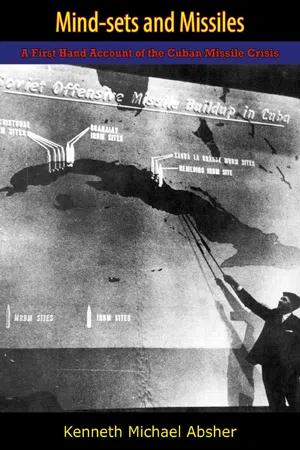
Mind-sets and Missiles
A First Hand Account of the Cuban Missile Crisis
- 85 pages
- English
- ePUB (mobile friendly)
- Available on iOS & Android
eBook - ePub
About this book
Information
INTRODUCTION—FAILED MIND-SETS
Policy and intelligence failures laid the groundwork for the 1962 Cuban Missile Crisis, the most dangerous crisis of the Cold War. This monograph will discuss and analyze the different mind-sets, or fixed mental attitudes, which policymakers and other officials brought to the task of analyzing intelligence and making foreign policy decisions. Soviet leader Nikita Khrushchev’s secret policy decision to place SS-4 medium and SS-5 intermediate range missiles in Cuba was based on an erroneous assessment that once the missiles had secretly been emplaced, President John F. Kennedy would accept them as a fait accompli. Kennedy’s perceived lack of confidence during the failed Bay of Pigs invasion of Cuba in April 1961, was one reason Khrushchev thought he could get away with placing the offensive missiles in Cuba. Khrushchev also had an ideological mind-set that believed history was on the side of socialism and communism, and that capitalism and constitutional democracy were weak and would ultimately be defeated by communism and the Soviet Union. In Khrushchev’s mind-set, the extra-human forces of “history” were major drivers of political, economic, and foreign policy decisions, and he demonstrated that he was prepared to be an obedient agent of these forces, regardless of the risk of war and bloodshed. As an agent of forces that promote violent change, he nonetheless realized the utility of engaging in diplomacy as a means of possibly buying time to prepare for violent change, and even to acquire allies in his efforts to have outside forces achieve their objectives.
For its part, the American Intelligence Community (IC) had a status quo mind-set that concluded Khrushchev would not place such missiles in Cuba because the Soviets had never before placed such offensive missiles outside the Union of Soviet Socialist Republics (USSR) and the Warsaw Pact. American Intelligence also thought that Khrushchev would not risk provoking the strong U.S. reaction which would certainly be generated by placing such missiles (with their nuclear warheads) in Cuba. Khrushchev, however, did not see it the way we thought he would, or the way we thought he should. Kennedy was unsuccessful in the 16-month aftermath of the failed June 1961 Vienna Summit in efforts to disabuse Khrushchev of his erroneous mind-sets about the weakness of Kennedy and the superiority of history and communist ideology.
President Kennedy activated U.S. military reserves and issued strongly worded warnings to Khrushchev emphasizing U.S. military and nuclear superiority over the USSR. But Khrushchev remained convinced that Kennedy was weak, and the United States, as a capitalist state, was doomed by history to be defeated by socialism and ultimately by communism. Only when confronted by the growing certainty of a U.S. bombing and invasion of Cuba, and the predictable obliteration of life in the Soviet Union by U.S. missiles and bombers should he choose general nuclear war, did Khrushchev step back from the precipice.
There was also a mind-set of American intelligence and policy officials that favored intelligence from technical sources, while downgrading information from human sources such as clandestine espionage agents and refugee debriefings. This mind-set was formed in part by the larger volume and greater familiarity with intelligence collected from overt technical platforms such as vehicles, ships, aircraft, and satellites. One example of this mind-set was the U.S. Air Force’s use of inflated assessments of Soviet nuclear and missile strength to defend its budget. When these erroneous assessments were contradicted by intelligence from a highly valuable and reliable espionage agent, Colonel Oleg Penkovsky, a Soviet Military Intelligence officer jointly run by the Central Intelligence Agency (CIA) and British intelligence (MI-6), this information was not given the credibility it deserved until it was subsequently confirmed by our first generation Corona satellite reconnaissance.
There was also a U.S. policy mind-set that caused a delay in authorizing critical U-2 flights over the interior of Cuba. This mind-set was fearful of the political and diplomatic consequences of Soviet surface to air missiles shooting down a U-2 on the eve of the 1962 U.S. mid-term elections. This mind-set was finally overcome at the insistence of Director of Central Intelligence (DCI) John McCone who, as leader of the IC, obtained the President’s approval to resume such flights in time to discover the missiles before they had become operational. Using earlier Corona photography of missiles inside the USSR and the top secret operating manuals of the SS-4 and SS-5 missiles which had been clandestinely photographed by Penkovsky and provided to the CIA and MI-6, photographic interpreters were able to identify the missiles being installed and determine when each missile site would become operational. The President thus knew how much time he had to formulate and implement a policy to convince Khrushchev to remove the missiles before having to take direct military action.
There was also a U.S. policy mind-set which sought revenge for the April 1961 defeat of the Bay of Pigs operation aimed at overthrowing Castro. The Kennedy administration mounted a second covert action to remove Castro, Operation MONGOOSE. This operation was pursued vigorously despite intelligence indicating that efforts to create an internal opposition strong enough to overthrow Castro were just not working. This mind-set even led to some consideration of assassinating Castro.
Once the missiles were discovered, it was clear to the author and others in the Office of National Estimates (ONE) that President Kennedy was unwavering in his policy commitment to remove the missiles from Cuba, either by diplomacy backed by a show of military force, or direct U.S. military action. The President announced this policy to the world in a remarkable crisis speech on October 22, 1962. All of the information and feedback the ONE staff received as a result of White House briefings attended by senior intelligence officials clearly indicated that it had been decided the missiles must be removed. Based on the evidence discussed in this monograph and the author’s recollection, a U.S. bombardment and airborne invasion of Cuba were within 48 to 72 hours of being launched when Khrushchev announced publicly on October 28, 1962, that he would remove the missiles. On November 20, 1962, he also announced that he would withdraw the Soviet IL-28 bombers and the tactical nuclear weapons that had also been sent to Cuba. (Nuclear warheads for the missiles and nuclear bombs for the IL-28 bombers were also removed.)
In the end, faulty intelligence assessments and erroneous policy mind-sets were overcome when at the insistence of the DCI, U-2 reconnaissance flights resumed over the interior of Cuba. Using intelligence provided clandestinely by an on-island espionage agent, the U-2 photographed the first SS-4 missile site on October 14. (Annex C contains information on some of the Soviet and U.S. intelligence sources that were operational during the crisis; and basic definitions of clandestine operations.)
THE SEEDS OF CRISIS-1961
The year 1961 was not a good year for the United States in the Cold War. On April 12, Soviet Cosmonaut Major Yuri Gagarin was the first person to orbit the earth in outer space. This event fuelled speculation that the Soviets were ahead of the United States in the development of ballistic missiles.{1}
A counterintelligence failure came to light when British intelligence officer George Blake was arrested for espionage on April 4. He had been working for the Soviet Committee for State Security (KGB) since 1953. There was also the tragic failure at the Bay of Pigs, as CIA-trained and equipped Cuban exiles invaded Cuba in an attempt to overthrow Castro. Planning for this operation began in 1960, with President Eisenhower’s concurrence, and President Kennedy approved it. Castro announced the defeat of this operation on April 20, 1961.
Other threatening events included the failure of the June 1961 summit with Khrushchev in Vienna; the building of the Berlin Wall on August 13, 1961; Khrushchev’s threat to turn over access to West Berlin to the Communist East German regime; and Khrushchev’s unilateral resumption of nuclear testing in the atmosphere in early September contrary to the promise he made to Kennedy at the Vienna summit.{2}
Despite all of these negative events, there was a good, albeit secret, development. Colonel Oleg Penkovsky was a Soviet army officer assigned to the Glavnoe Razvedyvatelnoe Upravlenie (GRU), the chief intelligence directorate of the general staff. On April 20, 1961, he arrived in London as the head of a six-man Soviet delegation from the State Committee for the Coordination of Scientific Research Work. This committee served as a cover for KGB and GRU officers who were conducting espionage to steal Western technology. However, Penkovsky had the intent of volunteering his services to the CIA and MI-6, and he was successful with the help of his host, British businessman Greville Wynne, who was co-operating with British Intelligence.{3}
The information received from Penkovsky was tightly held. There is no evidence that either Attorney General Robert Kennedy or the Assistant to the President for National Security Affairs (i.e., National Security Advisor) McGeorge Bundy knew about Penkovsky or the importance of his information. The President knew of Penkovsky, however, and took a personal interest in the “Soviet colonel’s work.” DCI Allen Dulles showed the President copies of Penkovsky’s information, including verbatim transcripts of clandestine meetings with him. Dulles’s successor, John McCone, continued to keep the President informed of the status of this case after he became DCI in November 1961.{4}
CIA and MI-6 officers met with Penkovsky for about 140 hours during his two trips to London and one to Paris, About 1,200 pages of transcripts were produced. He supplied 111 exposed rolls of film, 99 percent of which were legible. An estimated 10,000 pages or more of intelligence reports were produced from his information, which included the top secret operating manuals for the SS-4 and SS-5 missiles. The manuals had been clandestinely photographed by Penkovsky in Moscow and passed to the CIA and MI-6 in clandestine meetings in London in 1961.
By comparing the U-2 photography with information in the manuals provided by Penkovsky, analysts were able to identify positively the specific missiles being placed in Cuba and to determine on a daily basis the stage of construction of each missile site. They were, therefore, able to tell President Kennedy when each site would become operational. This information was critical in enabling the President to know how much time he had to determine and apply a policy of diplomatic and military pressure against Khrushchev before having to take direct military action.{5}
Penkovsky was one of the most important espionage agents of the Cold War. During his brief yet remarkable career, he was run jointly by the CIA and the British MI-6. Wynne served as a principal agent in contacting Penkovsky on behalf of both agencies. He arranged clandestine meetings with Penkovsky in both London and Paris in 1961 and was used to pass and receive information from Penkovsky during visits to Moscow. Brush contacts for exchanging messages with Penkovsky in Moscow were also arranged utilizing the wife of an MI-6 officer stationed in Moscow. Penkovsky came under suspicion by the KGB in about January 1962 and was never allowed to visit the West again. He also lost his acce...
Table of contents
- Title page
- TABLE OF CONTENTS
- THE LETORT PAPERS
- DEDICATION
- FOREWORD
- SUMMARY
- INTRODUCTION-FAILED MIND-SETS
- BIBLIOGRAPHY
- ABOUT THE AUTHOR
- ANNEX A-THE OFFICE OF NATIONAL ESTIMATES
- ANNEX B-THE UNITED STATES INTELLIGENCE BOARD
- ANNEX C-MAJOR INTELLIGENCE SOURCES USED DURING THE CRISIS
- REQUEST FROM THE PUBLISHER
Trusted by 375,005 students
Access to over 1.5 million titles for a fair monthly price.
Study more efficiently using our study tools.
Frequently asked questions
Yes, you can cancel anytime from the Subscription tab in your account settings on the Perlego website. Your subscription will stay active until the end of your current billing period. Learn how to cancel your subscription
No, books cannot be downloaded as external files, such as PDFs, for use outside of Perlego. However, you can download books within the Perlego app for offline reading on mobile or tablet. Learn how to download books offline
Perlego offers two plans: Essential and Complete
- Essential is ideal for learners and professionals who enjoy exploring a wide range of subjects. Access the Essential Library with 800,000+ trusted titles and best-sellers across business, personal growth, and the humanities. Includes unlimited reading time and Standard Read Aloud voice.
- Complete: Perfect for advanced learners and researchers needing full, unrestricted access. Unlock 1.5M+ books across hundreds of subjects, including academic and specialized titles. The Complete Plan also includes advanced features like Premium Read Aloud and Research Assistant.
We are an online textbook subscription service, where you can get access to an entire online library for less than the price of a single book per month. With over 1.5 million books across 990+ topics, we’ve got you covered! Learn about our mission
Look out for the read-aloud symbol on your next book to see if you can listen to it. The read-aloud tool reads text aloud for you, highlighting the text as it is being read. You can pause it, speed it up and slow it down. Learn more about Read Aloud
Yes! You can use the Perlego app on both iOS and Android devices to read anytime, anywhere — even offline. Perfect for commutes or when you’re on the go.
Please note we cannot support devices running on iOS 13 and Android 7 or earlier. Learn more about using the app
Please note we cannot support devices running on iOS 13 and Android 7 or earlier. Learn more about using the app
Yes, you can access Mind-sets and Missiles by Kenneth Michael Absher in PDF and/or ePUB format, as well as other popular books in Politique et relations internationales & Histoire de la Russie. We have over 1.5 million books available in our catalogue for you to explore.