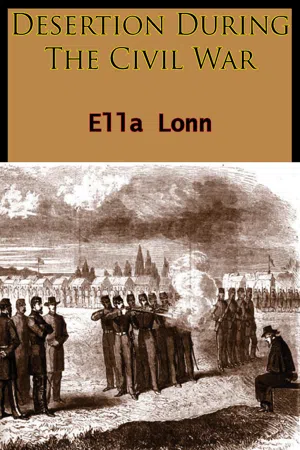
Desertion during the Civil War, originally published in 1928, remains the only book-length treatment of its subject. Ella Lonn examines the causes and consequences of desertion from both the Northern and Southern armies. Drawing on official war records, she notes that one in seven enlisted Union soldiers and one in nine Confederate soldiers deserted.
Lonn discusses many reasons for desertion common to both armies, among them lack of such necessities as food, clothing, and equipment; weariness and discouragement; non-commitment and resentment of coercion; and worry about loved ones at home. Some Confederate deserters turned outlaw, joining ruffian bands in the South. Peculiar to the North was the evil of bounty-jumping. Captured deserters generally were not shot or hanged because manpower was so precious. Moving beyond means of dealing with absconders, Lonn considers the effects of their action. Absenteeism from the ranks cost the North victories and prolonged the war even as the South was increasingly hurt by defections. This book makes vivid a human phenomenon produced by a tragic time.-Print ed.
"[The book is] better calculated to convey a sense of the sickening realities of the Civil War than many volumes of military history."—American Historical Review
"An excellent piece of historical research."—Journal of Negro History
- 275 pages
- English
- ePUB (mobile friendly)
- Available on iOS & Android
eBook - ePub
Desertion During The Civil War
About this book
Information
Subtopic
19th Century HistoryIndex
HistoryPART I—DESERTION IN THE CONFEDERACY
CHAPTER I—CAUSES OF CONFEDERATE DESERTION
The causes of desertion from the Confederate armies are so numerous and complex that to catalogue all in detail would be to tell a considerable part of the story of the Civil War. And yet the enumeration and weighing of these elements of dissatisfaction is the understanding, in no small measure, of the ultimate failure of the effort at disunion. Hence, a brief consideration of the reasons for the manifestation of this great evil is unavoidable.
First, and probably foremost, in the minds of the Confederate leaders as an explanation of dissatisfaction stood the character of many of the privates. Some, untutored and narrow-minded, dragged from the rocky mountains of the Carolinas, Georgia, and Alabama, from the pine hills and lowlands of Louisiana, and from the swamps of Florida and Mississippi, were ignorant of the real issues at stake and were but little identified with the struggle. So ignorant were some of them that when paroled by the North after capture they actually supposed that it released them from further obligation to the Confederacy.{1} The illiterate backwoodsman, variously termed “cracker,” “mossback,” “kasion,” “bushwhacker,” or “hillbilly,” according to the section in which he was located, almost cut off from the mass of his fellow-men, was little interested in the economic aspect of the war, as he could see nothing in it for himself. When dragged from his farm plot into the Southern army, he often proved a passive Union sympathizer, as he was ready to fall back into his neutrality as deserter at the first opportunity. The controlling motive with these men was frequently not love for the Union, but a determination to avoid military service. They cared little for the approbation or condemnation of their fellows, especially distant officials at Richmond. In fact, they showed a conspicuous lack of that quality which we applaud as patriotism, while a few proved, as is true in every army, downright cowards. The usual stories of men maiming themselves to avoid service are to be found.{2}
Still, the fact must be recognized that some of these same ignorant mountaineers were distinctly out of sympathy with the cause of slavery as the foundation stone on which was built the prestige of their proud neighbors of the lowlands, while scattered through the States were a small number, to state the fact conservatively, who cherished a real love for the old Union. The records of conscripts who promptly deserted to the Northern armies are too numerous to be disregarded as evidence. Making all due allowance for insincerity in so explaining their defection, indubitably some spoke the truth when they declared that they did not like the cause in which they were fighting and wished to live once more under the Stars and Stripes.{3} When a deserter raised a company in border territory to enter the service of the Union, his genuineness can scarcely be questioned.{4}
The net of the conscript service, moreover, dragged in men of Northern birth and also foreigners, particularly Germans and Irishmen,{5} who knew little and cared less for the burning American question of State rights. Northern-born men were in most cases holders of considerable property or large traders for their communities. Included in this group were merchants, lumbermen, real estate dealers, bankers, doctors, and even a few planters. Many had gone into the far South recently, after 1850, so that their ties were still mainly with the North and their traditions antislavery. The reports of the Northern officers are full of instances of citizens of Northern States who had settled in the South and who had been impressed into Southern regiments. These reports are sufficiently confirmed by Confederate officers when they tersely remark, “He is a Yankee, gone to his brethren,”{6} or when they allude to him openly as a Northern or Union man. Irishmen are encountered frequently who deserted from the rebels and “cheerfully took the oath of allegiance,”{7} while the case of a Scotsman was noted who forsook his duties with the commissary department to join the North.
The records show clearly that Mexicans were enlisted in the Southern service but proved utterly unreliable. Starting with no particular affection for American institutions, Northern or Southern, they early passed back over the Rio Grande to take part in the difficulties which soon beset their own land.{8} Evidently the Confederacy even tried to conscript Mexicans under the laws of Texas, which at that time required residents of ten days’ time to do military duty. General H. P. Bee writes from Victoria, Texas, on December 4, 1863, “When the state troops were called out and a draft ordered, the attempt to enforce it, not only failed, but caused bad feeling and a protest from the Mexican authorities, who claimed, and justly, I think, that under the Treaty of Guadaloupe de Hidalgo citizens of Mexico in that territory were not liable to forced military service.” General Bee wisely suspended the Texan law.{9}
Among the recruits from Kentucky especially were a goodly number bankrupt in fortune and reputation who eagerly embraced the Southern cause, as any change offered hope of possible advantage. Evil propensities brought soldiers into trouble, whereupon, faced with the probability of execution, they fled to the foe. Men, anxious to raise companies or battalions, sought recruits in all quarters and hence sometimes enlisted genuine ruffians. Eggleston tells of some interesting characters who had found release from durance in a Richmond jail by enlistment. One, a pirate and deserter from the British navy, was the most interesting of the group, but helps us to understand the statement that “except as regarded turbulence and utter unmanageability” they proved excellent soldiers.{10} Such men would leave General Morgan’s service as readily as they had entered it.{11}
Almost from the beginning many of the volunteers were mere boys, fourteen to eighteen years of age, foolish, deluded youths,{12} of whom the Confederates had no right to expect the stamina and courage of mature men. The Conscript Law after April 16, 1862, took in, with some exceptions, every male from eighteen to thirty-five years of age; the second Conscript Act of September 27 following added those between thirty-five and forty-five years; and after February 17, 1864, the draft reached lads just turned seventeen and men up to fifty, while others were liable to service in the home guard up to sixty.{13} Youths of seventeen at military schools were allowed to remain until they had attained the ripe age of eighteen on condition of being regularly drilled and of being subject to be called to the field if necessary. Everyone is familiar with the part played by the youths from the Virginia Military Academy at the Battle of New Market, May 15, 1864.{14}
Obviously, men conscripted for service, or hired as substitutes, would be potential material for desertion, as their hearts were not devoted to a cause for which they had failed to volunteer. And conscription became necessary for the Confederacy in the second year of the war. Naturally, a few good soldiers entered the army as conscripts, but for the most part the men whose bodies were dragged in by force had, as Eggleston says, no spirit to bring with them, for they had already learned to brave the contumely of their neighbors for confessed cowardice.{15} But it must not be thought that conscripts had any monopoly of desertion. In northeastern Georgia it was held in 1862 that one half of the men had deserted though the conscript law had not yet been enforced.
Substitutes enjoyed a reputation not much better among the soldiery. One officer reports that four fifths of his deserters were substitutes, who deserted within twenty-four hours of being received at his headquarters; and in 1863, because of the high average of desertion in this class of recruits, the War Department ordered substitutes accepted only if their moral, physical, and soldierly qualifications clearly equaled those of the soldier excused, and then only on the authority of the commanding general.{16} And in the Confederate Senate it was openly urged in 1863 that it would be no breach of contract to call on those who had furnished substitutes, as the system had excited dissatisfaction among those who had been unable thus to escape service.{17} Such action was taken by the Confederate Congress and warmly defended by Jefferson Davis.
Second in the list of causes came, undoubtedly, lack of the most ordinary necessities for the soldier—food, clothing, pay, and equipment. When men are pinched for food for three months at a stretch, at the same time that they are being subjected to protracted and arduous campaigns and constant exposure; when they have not been paid or furnished with any new clothing in from six to ten months; and when their government is not even able to put arms in their hands, the courage and enthusiasm of the bravest will ebb. The suffering of the Confederate soldier is an oft-told tale, but some further evidence rehearsed here will serve to sharpen the impression of hardships as a prime cause in the tremendous amount of desertion.
There was constantly, after the first eighteen months, complaint of a lack of proper and sufficient clothing to be at all comfortable even in the mildest weather. An adjutant general complained that there were some Louisiana troops without a particle of underclothing, while overcoats from their rarity were objects of curiosity. Summer clothing and no bedding were poor equipment for a winter campaign. In some divisions, as early as March, 1863, the men had scarcely clothing to hide their nakedness. The surgeon chief attributed much of the disease to a lamentable lack of blankets, while the destitution of clothing was not compensated for by tents. During the last winter strips of old carpet were to be seen serving for blankets.{18}
But the incessant cry was for shoes. Longstreet reported over 6,000 men in his corps without shoes in November, 1862; the purchase of 5,000 pairs of shoes by private individuals in September of that year was by no means sufficient to supply the need. Possibly there is a modicum of truth in the charge made by an officer in the fall of 1862 that a number in order to be left behind threw away their shoes. But it was not long before the lack of footgear was no excuse.{19} One year later Longstreet reported one half of his troops without shoes, while Johnston sent a requisition for 13,000 pairs in February, 1864. Striking indeed is the following statement: “The Fifth Regiment is unable to drill for want of shoes. The Eighth Regiment will soon be unfit for duty from the same cause; and indeed, when shoes are supplied, the men will be unable to wear them for a long while, such is the horrible condition of their feet from long exposure.”{20} Limping on the hard turnpikes with blistered feet, they literally traced their path with blood. Sometimes they ploughed through mud over their ankles or again they slipped on roads hard and sharp with ice so that they were falling and their guns going off all down the column. It was not unusual to require them to march under such conditions fifty miles a day.{21} As a feeble substitute for shoes, the men flocked to the cattle-pens when cattle were being butchered for food, to cut strips for moccasins before the hides were cold. But the moist, fresh skins without soles slipped about so that the wearers, constantly up and down, would finally kick them off to wrap their feet in rags or in straw or to limp along barefoot. Ragged and shoeless, clothed in a medley of garments which could not be called uniforms, they amply merited the name of “Lee’s tatterdemalions.”{22}
Beginning as early as October, 1862, the pressure for food grew steadily more insistent. A ration of hominy and a quarter of a pound of beef for breakfast, a pint of rice and the same quantity of beef for dinner, and nothing for supper, the ration allowed during the fall and winter of 1863-1864, but poorly fills the “stomachs on which soldiers must fight.”{23} A few months later Lee’s men had the luxury of a few peas and a small amount of dried fruit. About a year later Longstreet reported that his men in Tennessee were living on half rations of meat and bread without reason to hope for better prospects. Even the beasts were limited to half rations, with hope of fresh pasturage only for the distant future.{24} The ration of one half pound of flour, provided in October, 1864, was not, according to the chief surgeon, sufficient. The beef issued was found nearly always poor, with the bone constituting most of the weight. Cornmeal and brackish water was the unvaried diet for Texan troops in September, 1863, while two deserters reported a cavalry company as living for three days on berries and persimmons{25} To be without anything ...
Table of contents
- Title page
- TABLE OF CONTENTS
- PREFACE
- PART I-DESERTION IN THE CONFEDERACY
- PART II-DESERTION IN THE NORTHERN ARMY
- APPENDIX
- BIBLIOGRAPHY
Trusted by 375,005 students
Access to over 1.5 million titles for a fair monthly price.
Study more efficiently using our study tools.
Frequently asked questions
Yes, you can cancel anytime from the Subscription tab in your account settings on the Perlego website. Your subscription will stay active until the end of your current billing period. Learn how to cancel your subscription
No, books cannot be downloaded as external files, such as PDFs, for use outside of Perlego. However, you can download books within the Perlego app for offline reading on mobile or tablet. Learn how to download books offline
Perlego offers two plans: Essential and Complete
- Essential is ideal for learners and professionals who enjoy exploring a wide range of subjects. Access the Essential Library with 800,000+ trusted titles and best-sellers across business, personal growth, and the humanities. Includes unlimited reading time and Standard Read Aloud voice.
- Complete: Perfect for advanced learners and researchers needing full, unrestricted access. Unlock 1.5M+ books across hundreds of subjects, including academic and specialized titles. The Complete Plan also includes advanced features like Premium Read Aloud and Research Assistant.
We are an online textbook subscription service, where you can get access to an entire online library for less than the price of a single book per month. With over 1.5 million books across 990+ topics, we’ve got you covered! Learn about our mission
Look out for the read-aloud symbol on your next book to see if you can listen to it. The read-aloud tool reads text aloud for you, highlighting the text as it is being read. You can pause it, speed it up and slow it down. Learn more about Read Aloud
Yes! You can use the Perlego app on both iOS and Android devices to read anytime, anywhere — even offline. Perfect for commutes or when you’re on the go.
Please note we cannot support devices running on iOS 13 and Android 7 or earlier. Learn more about using the app
Please note we cannot support devices running on iOS 13 and Android 7 or earlier. Learn more about using the app
Yes, you can access Desertion During The Civil War by Ella Lonn in PDF and/or ePUB format, as well as other popular books in History & 19th Century History. We have over 1.5 million books available in our catalogue for you to explore.