"I am not worried about the fighting. I know you're fairly bloody-minded. But I want to speak of discipline during the battle."
"You must get ashore, if you have to swim, and I hope some of you will return as you'll be very useful for the next show."
The words of a Commando officer to his men before they stormed the beaches of Sicily under heavy machine-gun fire sum up the swashbuckling, devil-may-care spirit of the toughest fighting men produced—the Commandos.
For their raids and battles far behind enemy lines in France, North Africa, Sicily, Italy and Burma the men in the Green Beret have become a legend.
This book shows how this legend was forged.
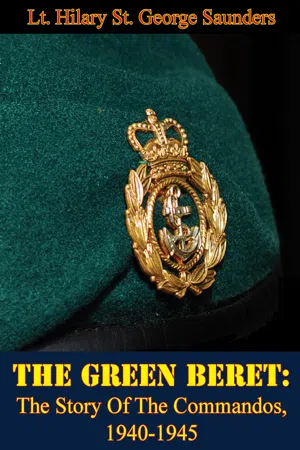
- 361 pages
- English
- ePUB (mobile friendly)
- Available on iOS & Android
eBook - ePub
The Green Beret: The Story Of The Commandos, 1940-1945
About this book
Information
Subtopic
European HistoryIndex
HistoryCHAPTER ONE—Twenty Men and a Battery
AT 04.10 hours on the morning of the 19th August, 1942, Landing Craft Personnel No. 16, an unarmoured wooden vessel called by its designer a Eureka, was approaching the coast of France. A few minutes earlier Lieutenant H. T. Buckee, R.N.V.R., her commander, had seen a steam gun boat, the S.G.B.5, reel across his bows, out of action and out of control. The gun boat had been leading a flotilla of landing craft, having on board the officers and men of No. 3 Commando, and they were making for two beaches at Berneval and Belleville-sur-Mer, two small villages on the coast east-north-east of Dieppe, with orders to land and destroy a battery of 5.9-inch coastal guns to which the code name Goebbels had been given.
The passage across the Channel had been uneventful until the small force—there were twenty-three landing craft sailing in two lines abreast—had the misfortune to encounter some four or five miles from Dieppe a German tanker, escorted by armed trawlers. They were making down channel, probably towards Le Havre, and their crews were alert and vigilant. The action could have but one ending. The steam gun boat had no armament heavier than an Oerlikon; the landing craft none at all except the small arms carried by their passengers. The German trawlers opened fire, choosing as their main target the steam gun boat, which at the end of ten minutes was reduced to a floating wreck, every gun silenced, all wireless equipment destroyed and four out of every ten on board wounded.
Before the flotilla set out it had been decided that, should the enemy be encountered at sea, its units were to scatter and make for home. Some landing craft, however, held on. Among them was Lieutenant Buckee’s. Through the tracer-lit darkness he resolutely maintained his course and presently the fire died away. A promise of dawn appeared to port, but it was still very dark when Buckee turned to Major Peter Young, M.C., the senior Commando officer on board, and pointed ahead.
‘There you are,’ he said, indicating a dark line scarcely visible against the slowly lightening sky, ‘there’s your beach.’
‘What do we do now?’ replied Young.
‘My orders,’ said Buckee, ‘are to land even if there’s only one boat.’
‘Those are my orders, too: we are to land whatever happens, even if we have to swim.’
Five minutes before zero hour the landing craft touched down and those on board stepped ashore.
All told they numbered twenty, and belonged to No. 6 Troop of No. 3 Commando. In addition to Young in command, there were two other officers, Captain J. J. Selwyn (13/18th Hussars), the officer commanding No. 3 Troop, and Lieutenant A. F. Ruxton (Royal Ulster Rifles). With them was Lance-Corporal White and Lance-Corporal Bennett. The rest were Commando soldiers and formed part of the Headquarters party of the Commando. They had with them a 3-inch mortar with four bombs and a 2-inch with six; one Garand rifle,{1} nine Service rifles, one Bren gun, six Tommy guns, and three pistols. With these arms they set out to attack a battery held by some two hundred of the enemy.
Buckee very staunchly offered to go with them with his four men but Young asked him to keep off shore as long as he could so as to take them back to England if, against all probability, they ever returned to the beach. Above it rose cliffs and rocky ledges, up which a footpath led inland through a very narrow gully to the road running from Belleville-sur-Mer to Dieppe. The gully held in its mouth a formidable obstacle, a fence of rabbit wire, ten feet high, backed by rolls of stout barbed wire. More wire choked the cleft in the cliff behind.
Leading the way, Young began to climb the fence, but almost immediately fell backwards into the arms of Selwyn, who, doubtless mindful of the orders issued at the start, urged that they should return. This not unreasonable suggestion so angered Young ‘that I was more than ever determined to carry on.’ Once more he addressed himself to the fence, this time successfully, and surmounting it led the way up the cliff beside the gully, more barbed wire found there being used as a fixed, if prickly, climbing rope. A further aid was provided by Driver J. Cunningham, a Commando soldier from the Royal Army Service Corps, who joined together the toggle ropes carried by each man of the party. With these aids it took Young twenty minutes to reach the top of the cliff followed by all his men. They at once took cover in a small wood, and Young harangued them, telling them that though they might find it impossible to accomplish their full purpose, they would still be able to inflict hurt upon the enemy, which ‘was the only reason for their existence.’
He then divided them into three parties, placing each in charge of an officer, and they advanced south through cornfields, Young in the van, until they reached the edge of the road leading to Dieppe. Here they met a sixteen-year-old boy on a bicycle. A few questions told them exactly where they were, and Young dismissed him. The boy stared at him for a moment and then, leaning forward, quickly kissed him on the cheek.
As though to emphasize this salute, the guns of ‘Goebbels’ battery roared out a short distance away. They were firing, as Young knew, at the main attack, now making for the beaches of Dieppe itself. He must hurry. The small band pushed on down the road towards the village of Berneval, cutting the telephone wires on the way, and eventually reached the neighbourhood of the church. Here they met with a man wheeling his mother in a wheelbarrow; she had, it appeared, been wounded by a fragment of a bomb dropped by the Royal Air Force which had attacked the battery at dawn. The inhabitants began to come out of their houses, including some wearing the bright brass helmets of the local fire brigade. They seemed friendly and one of them undertook to shew the Commandos exactly where the battery was situated. As they were talking, fire was opened upon them from the right flank; Ruxton and Selwyn replied with their Tommy guns, and the shooting ceased. Young then entered the church and made for the tower, hoping to climb to the top and there set up his Bren gun. He could not, however, find the staircase, which was not altogether surprising, for it began ten feet up inside the tower, the gap between the floor and the first stair being bridged by a ladder which had been removed. Abandoning the church, all three parties stalked on through orchards and in a few minutes came across a dummy gun which had been clearly visible on the air photographs, and which they knew as ‘Pansy.’ The crucial moment had arrived.
A man as brave, but less clear-headed than Young, might have led a charge. It would assuredly have failed, for what could twenty men inadequately armed have accomplished against ten times their number, entrenched, alert, and prepared to defend their guns to the last? Young therefore adopted a plan which did honour to his intelligence and his training. He formed his men in two lines thirty yards apart; each line was a hundred yards long and two hundred yards from the enemy. The standing com gave the men good cover and they set about sniping the battery looming ahead through the smoke, firing from the knee and frequently changing position. ‘It was harassing fire, more or less controlled,’ reported Young later. ‘The guns were about twenty to thirty yards apart and well concreted.’ The Germans fired back and it was presently found that about fifteen feet of standing com successfully stopped a bullet.
All this time the battery continued to fire but at a very slow rate, discharging between twenty and thirty rounds. None of them did any damage to the main force of destroyers and landing craft off Dieppe. Throughout this period, which lasted for more than an hour and a half, neither Young nor his men saw a German, for they were well dug in. Nevertheless, the fire of the Commando soldiers must have proved most galling, for about eight o’clock the Germans swung one of their heavy guns round and tried to shell their attackers, who continued to pour small arms fire into the black and yellow fumes which rose whenever the gun fired. It could not be sufficiently depressed and the shells went whining overhead to burst somewhere in France.
So this strange combat continued. The dawn had long come. How thin Young’s men were upon the ground could now be clearly seen, and some Germans began to move round their right flank.
The Commandos’ ammunition was almost exhausted; they could do no more. It was time to go back to the beach. Selwyn was sent back to form a bridgehead, and to enter into contact, if he could, with Buckee. He was to fire three white Very lights when he had done so. He moved off, and Young with Ruxton and two or three others continued to fight with dwindling hopes and dwindling ammunition. The minutes went slowly by. The Germans were now in Berneval itself. At that very critical moment three lights flashed for a moment, white against the blue of the summer sky. ‘I never saw a more heartening sight,’ records Young.
He gathered his men together and they retreated across the fields towards the gully, ‘followed at a respectful distance by some of the enemy.’ The gully down which they scrambled was found to be mined at its foot, and had they used this natural passage up the cliffs when climbing them in the darkness three hours before, they must have suffered many casualties. As it was, only one of them was hurt, Lance-Corporal H. A. R. White (the Devon Regiment) who trod on a mine which exploded, wounding him in the foot. This did not prevent him from bringing the 3-inch mortar, left at the foot of the cliff, into action. He fired all the four bombs with unobserved results, and then with the rest stumbled out to sea, for the gallant Buckee was still there.
He had remained offshore, taking what shelter he could from the intermittent smoke screens laid by aircraft and destroyers to cover the main force. Soon after 08.00 hours he made for shore, coming in as close as the tide permitted, covered by the fire of Motor Launch 346.
Young’s men waded out to his craft. ‘It was,’ said Young, ‘like those dreams you have of trying desperately to walk and making no progress.’ Under fire from the cliff, they scrambled on board; Ruxton laid his Bren gun on his ‘Mae West,’ and pushed it in front of him. Together with Private Abbott, and Young himself, he strode through the water for several precarious minutes in the wake of the rest. A line was thrown from the landing craft and the three men were towed half a mile out to sea, before being dragged, exhausted, over the side of the Eureka.
Soon after mid-day they were all of them on the quayside at Newhaven, and before tea-time Young had made his report in person to Lord Louis Mountbatten, Chief of Combined Operations, at his headquarters in London.
What the authorities thought of this gallant action against ‘Goebbels’ battery may be conjectured from the number of decorations the King was pleased to award. Young and Buckee were admitted to the Distinguished Service Order; Selwyn and Ruxton each received the Military Cross; Driver Cunningham, a ‘tough, cunning type,’ the Distinguished Conduct Medal; and Lance-Corporal White, Privates Hopkins and Abbott, Adderton, Craft, and Clark the Military Medal.
The exploit of Young and his men at Berneval was one of the long series of amphibious assaults made between June 1940 and January 1945. They were carried out in places as far apart as Stamsund in the Arctic circle, and Akyab off the coast of Burma; during those five years assault craft carried to battle armed and determined men over the waters of the North Sea, the Channel, the Atlantic, the Mediterranean, and the Indian Ocean. The grey pebbles of Dieppe, the white sands of Madagascar, the glutinous mud of Myebon, felt the impress of their feet, and the firs of Norway, the oaks of Normandy, the mangroves of Arakan were mute witnesses of their prowess. Within their ranks were men from every quarter of the Empire, and from many Allied and even enemy nations. They came from all classes, from all occupations. Among them were cracksmen and peers, poachers and bank clerks, bookmakers and university graduates. They fulfilled the precept of Hobbes ‘that force and fraud are in war the two cardinal virtues,’ and in so doing aroused such a passion of hate and fear in the heart of their enemies that first von Rundstedt, then Hitler, ordered their slaughter to the last man. They were young, they were strong, they were able, and the spirit of adventure was hot in them. How that spirit was trained and directed, what exploits it caused them to perform, must now be set down. Like all tales of war it is a record of triumph and disaster, of caution and enterprise, of frustration and accomplishment. But through it runs a strand of the very stuff of life; the courage of the simple soldier, that fortitude which, since England became a nation, has been displayed on a hundred battlefields and has brought her victory not once but many times.
Here is their story.
CHAPTER TWO—The Force is Conceived
ON THE EVENING OF 4th June, 1940, Lieutenant-Colonel Dudley Clarke (Royal Artillery), General Staff Officer, first grade, with some twenty years of soldiering behind him, was walking back from the War Office to his flat in Stratton Street, Mayfair. At that time he was Military Assistant to Sir John Dill, Chief of the Imperial General Staff. His thoughts, he records, were grim, for ‘in the War Office on that night it was not easy to view the future with optimism,’ and indeed though the great bulk of the British Army had been withdrawn ‘out of the jaws of death and shame to their native land’ from Dunkirk, they had lost all their guns and equipment, and would be in no condition to fight for many weeks to come.
In the brief space of forty-nine days the Wehrmacht had over-run and occupied Denmark, Norway, Holland, and Belgium, France was now on the verge of collapse, and the Channel ports were in the hands of the enemy. What, Dudley Clarke asked himself, had other nations done in the past when their main armies had been driven from the field and their arsenals captured by a superior enemy? His mind, roving back through history, recalled the guerillas of Spain in the Peninsular War, and ninety years later the Boer Commandos which for two years had harried more than 250,000 British troops. Coming still nearer to the present day, the Colonel recalled his own experiences as a Staff Officer in Palestine in 1936. In that year he had seen with his own eyes ‘how a handful of ill-armed fanatics’ had been able to ‘dissipate the strength of more than an Army Corps of regular troops.’ Could something of the same kind be attempted at this grim hour? Could desperate men, armed only with the weapons they could carry, disdaining artillery, baggage trains and all the paraphernalia of supply, carry on guerilla warfare against an enemy whose forces were stretched out from Narvik to the Pyrenees? One form of transport they would, of course, need, and one only; ships of some kind would have to take them across the Channel or the North Sea to the conquered coasts of Europe, take them across and bring them back again. His imagination stirred, took wing, and ‘before I went to bed I tried to marshal my ideas into the outline of a plan jotted down in note form on a single sheet of...writing paper.’
Dudley Clarke had the ear of the all-powerful Chief of the Imperial General Staff, Sir John Dill, who, in his turn took fire and promised to speak to the Prime Minister on the very next day. He did so and Clarke was given a free hand provided that his proposals did not run counter to two fixed conditions. These were simple: first, that no unit should be diverted from its most essential task, the defence of Britain, which might very soon have to face invasion; and secondly, that this force of amphibious guerillas would have to make do with the minimum quantities of arms. Both conditions, particularly the second, were inevitable, for to such straits had twenty years of uneasy peace culminating in the inglorious surrender of Munich brought us, that our arsenals were empty, our factories but beginning to replenish them, and our whole economy most ill-prepared for sudden and desperate battle. Two days later Dill informed Dudley Clarke that his Commando scheme was approved, and that he was to mount a raid across the Channel ‘at the earliest possible moment.’ That afternoon Section M.O.9 of the War Office was brought into being, under the general direction of Brigadier Otto Lund, Deputy Director of Military Operations.
Fortunately the first recruits lay ready to hand in the ranks of the Independent Companies. Composed of volunteers they had been formed in haste to take part in the Norwegian campaign, and it had been determined that they should be self-contained in their own ship, which was to be at once their floating base and their means of transport to the scene of action. Of these companies, ten in number, one half under the command of Colonel C. McV. Gubbins, M.C., had already seen service in the rugged mountains and valleys of Norway at Bodo and Mo. At that time they were still in Norway in the Narvik area. The other five companies had been left behind in Scotland employed in training and guard duties in Glasgow and elsewhere, and on garrison duty in various coastal towns.
Clarke then approached the Navy. ‘What!’ exclaimed the Assistant Chief of the Naval Staff, he records, ‘the Army want to get back to fight again already? That’s the best news I’ve heard for days. For that you can have anything you like to ask for from the Navy.’
The Second Sea Lord was equally enthusiastic, and in a few days Captain G. A. Garnons-Williams, D.S.C., R.N., fresh from an expedition to block the port of Zeebrugge, had established his headquarters in the yacht Melisande lying in the Hamble. He soon gathered round him a collection of craft, mostly private motor boats, some of which had passed many quiet years ploughing the Norfolk Broads. Their design and sea-going qualities were as varied as the rel...
Table of contents
- Title page
- TABLE OF CONTENTS
- FOREWORD
- PREFACE
- CHAPTER ONE-Twenty Men and a Battery
- CHAPTER TWO-The Force is Conceived
- CHAPTER THREE-What Manner of Men were These?
- CHAPTER FOUR-Lofoten to Vaagso
- CHAPTER FIVE-The Exploits of Layforce
- CHAPTER SIX-The Greatest Raid of All
- CHAPTER SEVEN-A Classic Operation of War
- CHAPTER EIGHT-The Hand of Steel
- CHAPTER NINE-The ‘Majestic Enterprise’
- CHAPTER TEN-Re-enter the Royal Marines
- CHAPTER ELEVEN-No. 3 Commando Bridge
- CHAPTER TWELVE-Bova Marina
- CHAPTER THIRTEEN-The Pass of La Molina
- CHAPTER FOURTEEN-Termoli
- CHAPTER FIFTEEN-Expansion and a Miscellany
- CHAPTER SIXTEEN-Small Raids and Friendly Foreigners
- CHAPTER SEVENTEEN-The Long Italian Trail
- CHAPTER EIGHTEEN-Anzio and Anzio
- CHAPTER NINETEEN-The Island of Vis
- CHAPTER TWENTY-The Hilltop of Brac
- CHAPTER TWENTY-ONE-Overlord
- CHAPTER TWENTY-TWO-The Isles of Greece
- CHAPTER TWENTY-THREE-The Seizure of Walcheren
- CHAPTER TWENTY-FOUR-Water Water Everywhere
- CHAPTER TWENTY-FIVE-From the Maas to the Elbe
- CHAPTER TWENTY-SIX-The Hill in the Jungle
- CHAPTER TWENTY-SEVEN-The Battle to the Strong
Trusted by 375,005 students
Access to over 1.5 million titles for a fair monthly price.
Study more efficiently using our study tools.
Frequently asked questions
Yes, you can cancel anytime from the Subscription tab in your account settings on the Perlego website. Your subscription will stay active until the end of your current billing period. Learn how to cancel your subscription
No, books cannot be downloaded as external files, such as PDFs, for use outside of Perlego. However, you can download books within the Perlego app for offline reading on mobile or tablet. Learn how to download books offline
Perlego offers two plans: Essential and Complete
- Essential is ideal for learners and professionals who enjoy exploring a wide range of subjects. Access the Essential Library with 800,000+ trusted titles and best-sellers across business, personal growth, and the humanities. Includes unlimited reading time and Standard Read Aloud voice.
- Complete: Perfect for advanced learners and researchers needing full, unrestricted access. Unlock 1.5M+ books across hundreds of subjects, including academic and specialized titles. The Complete Plan also includes advanced features like Premium Read Aloud and Research Assistant.
We are an online textbook subscription service, where you can get access to an entire online library for less than the price of a single book per month. With over 1.5 million books across 990+ topics, we’ve got you covered! Learn about our mission
Look out for the read-aloud symbol on your next book to see if you can listen to it. The read-aloud tool reads text aloud for you, highlighting the text as it is being read. You can pause it, speed it up and slow it down. Learn more about Read Aloud
Yes! You can use the Perlego app on both iOS and Android devices to read anytime, anywhere — even offline. Perfect for commutes or when you’re on the go.
Please note we cannot support devices running on iOS 13 and Android 7 or earlier. Learn more about using the app
Please note we cannot support devices running on iOS 13 and Android 7 or earlier. Learn more about using the app
Yes, you can access The Green Beret: The Story Of The Commandos, 1940-1945 by Lt. Hilary St. George Saunders in PDF and/or ePUB format, as well as other popular books in History & European History. We have over 1.5 million books available in our catalogue for you to explore.