- 353 pages
- English
- ePUB (mobile friendly)
- Available on iOS & Android
eBook - ePub
The 91st Infantry Division in World War II
About this book
Originally published in 1947 by Infantry Journal Press, this is the official unit history for the 91st Infantry Division in World War II. The 91st Infantry Division arrived in North Africa, 18 April to 10 May 1944, and trained intensively at Arzew and Renan, French Morocco. Leaving by units, the entire Division was in Italy, 19 June 1944. Meanwhile, the 361st RCT landed at Anzio, 1 June, and fought near Velletri south of Rome from 3 June. The 363d RCT entered combat near Riparbella, 4 July. On 12 July, the Division fought as a unit near Chianni, Italy, for the high ground dominating the Arno River. By the 19th it had reached the river. The 363d RCT participated in the capture of Livorno, 19 July, and in a quick thrust to the north, two units entered Pisa, 24 July. From 24 July to 12 September 1944, the 91st held their positions along the Arno while they underwent extensive training. On the 13th, the Division attacked the Gothic Line, took Monticelli, 18 September, and advanced to the Santerno River through stubborn resistance, 23 September. Moving through rocky escarpments and other natural barriers as well as heavy opposition, the 91st occupied Livergnano, 13 October. The offensive was canceled, however, and the 91st assumed defensive positions below Pianoro, 31 October. During November, the 91st remained on the defensive, sending out small patrols. After resting in December, the Division returned to the line and maintained a static defensive front until 20 March 1945, when the Division retired to Gagliano and Villanova to prepare for a new offensive. This final assault began on 15 April 1945. The 91st entered Bologna, 21 April, and moved along Highway No. 64 against slight resistance. After crossing the Po River on the 23d, the Division swung to the northeast, crossing the Adige River, 26 April, and reaching. Treviso on the 29th. All enemy forces in Italy surrendered, 2 May... General Nickname: Powder River Division. Slogan: Always Ready—Print ed.
Trusted by 375,005 students
Access to over 1.5 million titles for a fair monthly price.
Study more efficiently using our study tools.
Information
Subtopic
European HistoryIndex
HistoryPART ONE — THE OLD 91ST AND THE NEW
CHAPTER 1 — WORLD WAR I
THE HISTORY of the 91st Infantry Division begins with World War I, in which it served gallantly and with great distinction.
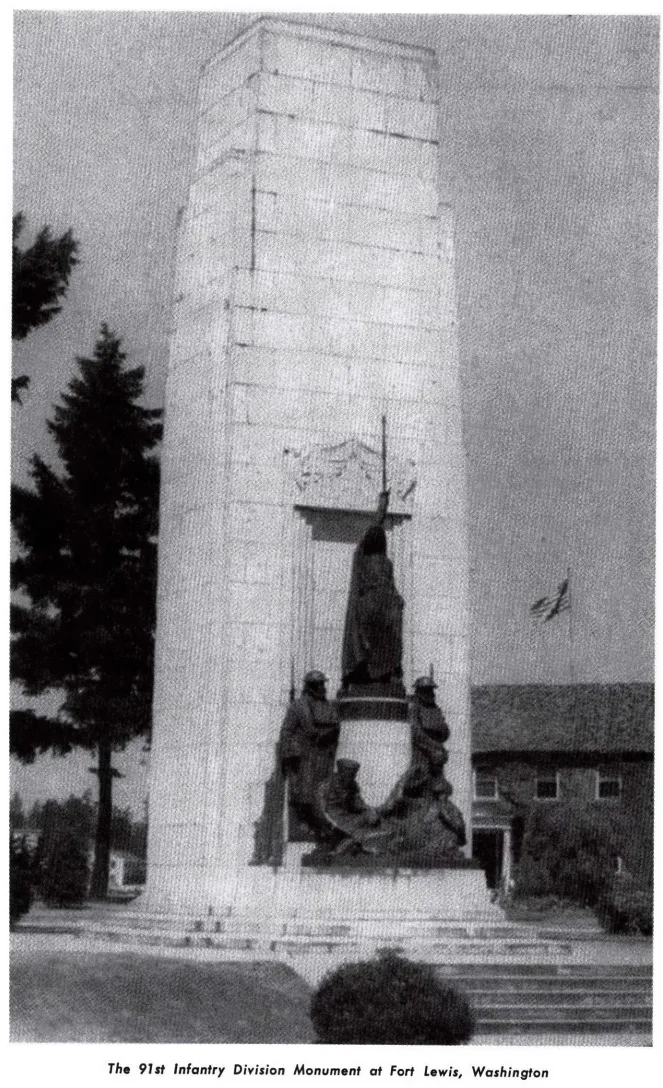
In 1917, five months after the United States declared war on Germany, the original 91st was activated and organized at Camp Lewis, Washington. Most of the men came from the states of the Northwest, which explains the many distinctively Western traditions and emblems which were part of the heritage of the Division in World War II. It also explains the Division’s nickname and battle cry—“Powder River! Let ’er Buck!”—which it adopted after a bunch of Montanans used it in 1918 to answer a sergeant who asked them where they hailed from. The Powder River is a stream in Montana around which much early Western romance is built.
In line with the organizational structure of infantry divisions of the time, the Division consisted of the 181st Infantry Brigade (361st and 362nd Infantry Regiments and the 347th Machine-Gun Battalion) and the 182nd Brigade (363rd and 364th Infantry Regiments and the 348th Machine-Gun Battalion). In addition, it included the 316th Engineer Combat Regiment, the 316th Trains and Military Police, the 316th Field Signal Battalion, and the 166th Field Artillery Brigade (346th 347th and 348th Field Artillery regiments) the 346th Machine-Gun Battalion, and the 316th Trench Mortar Battery.
Activated under the command of Major-General H. A. Greene, the Division immediately, on 5 September 1917, plunged into training for the big task ahead. The men were so eager to commence their training that they began drilling in civilian clothes.
To gather combat experience at first hand so that he could give his men the soundest and most realistic training possible, General Greene spent four months—November 1917 to March 1918—observing the fighting in France. During the few short months between his return and the day of the Division’s departure for ports of embarkation, he passed on to his men, through a program of intensified training, the lessons he had learned.
It was just ten months after its activation that the Division made ready to go overseas. On the eve of its departure, General Greene was reassigned and ordered to the Philippine Islands. Brigadier General Frederick S. Foltz, formerly commander of the 182nd Infantry Brigade, became Commanding General of the Division. Civilians cheered and feted the soldiers as the troop trains sped across the continent, and after being examined and re-outfitted at the staging area—Camp Merritt, New Jersey—the first elements sailed for France on 6 July 1918.
By August 1918, the infantry brigades were grouped at Montigny-le-Roi, and the artillery brigades at Camp de Souge and Clermont Ferrand. At these places the men underwent a month of incessant drilling and long hours of marching, until they were declared ready for actual combat. On 29 August Major-General William H. Johnston assumed command of the Division, and on 7 September it was assigned to the reserve of the American First Army during the St. Mihiel Offensive. Its headquarters were at Sorcy.
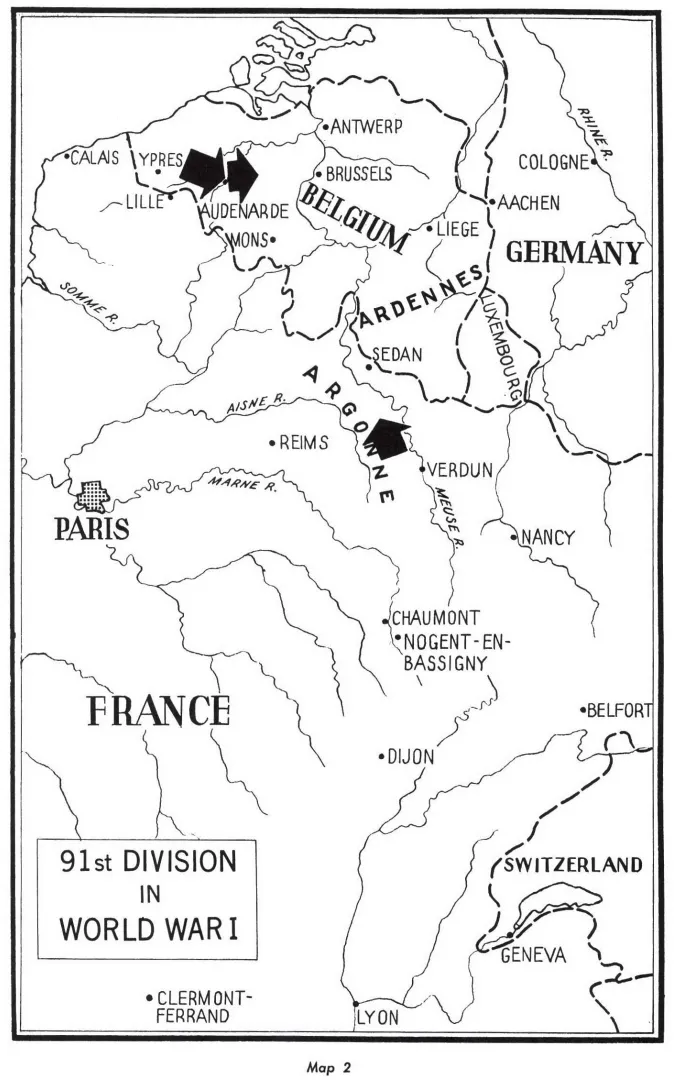
When the success of the St. Mihiel Offensive was assured, the 91st entered the Meuse—Argonne sector prepared to attack. Nearly every other division in the Meuse—Argonne operation had had previous combat experience; the 91st had not. Yet it gave a notable account of itself. On 25 September, General John J. Pershing, Commander-in-chief of the American Expeditionary Forces, visited General Johnston to express his confidence in the 91st before it went into battle. The next day the Division proved that General Pershing’s confidence had not been misplaced by breaking through two German lines and penetrating a third, advancing eight kilometers. The enemy was driven from the strongpoints of Véry, Épinonville, Gesnes, Éclisfontaine, and Tronsol Farm.
Despite the fact that this offensive was the Division’s first experience in combat, it captured more artillery, machine guns, and prisoners and advanced a greater distance under fire than many divisions with previous combat experience.
These achievements brought high tribute from Major-General George H. Cameron, Commanding General of V Corps, who said, in an order to General Johnston:
At a time when the divisions on its flanks were faltering and even falling back, the 91st pushed ahead and steadfastly dung to every yard gained. In its initial performance, your Division has established itself firmly in the list of the Commander-in-chief’s reliable units. Please extend to your officers and men my appreciation of their splendid behavior and my hearty congratulations on the brilliant record they have made.
On 4 October, the Division was relieved by the 32nd Division and assembled near Contrisson.
The 181st Brigade’s period of rest and rehabilitation was of short duration, however, for on 6 October it was detached from the Division, and its elements were assigned to the 1st and 32nd Divisions. From the 7 to 12 October, the 361st and 362nd Infantry Regiments, plus the 347th Machine Gun Battalion, fought for a second time in the Meuse-Argonne Offensive. The 181st Brigade was finally relieved on the night of 11 October by the 64th Brigade of the 32nd Division.
One of the great honors given the Division came on 16 October, when, along with the 37th Division, it was made part of the armies in Flanders. These armies, under Albert, King of the Belgians, were about to launch the final crushing drive against the enemy in Belgium. The 91st attacked in the early morning mists of 31 October. From then until the Armistice (1100 hours on 11 November), the Division drove the enemy steadily back. Although the German troops had been ordered to hold the heights between the Lys and the Escaut (Scheldt) rivers to the death, the 91st smashed them the first day and by evening of 1 November was on the outskirts of Audenarde. The next day the town was secured, and the Division pushed on to capture, in rapid succession, Welden, Petegem, and Kasteelwijk.
In recognition of the courage and fighting ability the 91st Division had shown, the following order was issued by Major-General DeGoutte, who had resumed command of the French Sixth Army:
In addressing the divisions of the United States Army who covered themselves with glory in the Château-Thierry Offensive, I said that orders given by the commanding officers were always accomplished irrespective of the difficulties arising thereby or the sacrifices to be made.
I have found the same spirit of duty and discipline freely given in the 37th and 91st Divisions, United States Army, which brings about valiant soldiers and victorious armies.
On the heights between the Lys and the Escaut, the enemy was to hold “to the death.” The American troops belonging to these divisions, acting with the French divisions of the Flanders Army Group, smashed them on October 31, 1918, and after hard fighting threw them back upon the Escaut.
Then in an operation of extraordinary daring, the American units crossed the Escaut under the enemy fire and maintained themselves on the opposite bank, notwithstanding enemy counterattacks.
Glory to such troops and to such commanders. They have bravely contributed to the liberation of a part of Belgian territory and to final victory.
The great nation to which they belong can be proud of them.
The Commanding General of the Army:
DEGOUTTE
After the Armistice, elements of the 166th Field Artillery Brigade moved into Germany and occupied the village of Wittlich until February 1919. The infantry of the Division, after parading triumphantly with the men of the 37th Infantry Division before the cheering crowds of Brussels, patroled the Franco-Belgian border west of Poperinghe, from Beveren to Warande, for a short time. On 2 January the first contingent of men sailed for home, and echelons sailed thereafter as transportation became available. Division Headquarters, last of the Division to leave France, sailed on 6 April. Final demobilization of the Division was completed at camps in California, Washington, and Wyoming by 14 May 1919.
During the years between World War I and World War II, the memory of the heroic accomplishments and rich traditions of the 91st was perpetuated by the 91st Infantry Division Association, organized at La Ferté Bernard, France, before the Division embarked for its journey home. Strongest in the major cities along the West Coast, active chapters of the Association have—by holding annual reunions, picnics, patriotic celebrations, and performing civic functions—kept in touch with each other and served conspicuously the communities in which they live.
CHAPTER 2 — REACTIVATION ...
Table of contents
- Title page
- DEDICATION
- HEADQUARTERS UNITED STATES FORCES IN AUSTRIA
- COMMANDING GENERAL’S MESSAGE
- FOREWORD
- PART ONE - THE OLD 91ST AND THE NEW
- PART TWO - COMBAT
- PART THREE - AFTER VE-DAY
- CONCLUSION
- PART FOUR - APPENDIX
- SOURCE MATERIALS USED
Frequently asked questions
Yes, you can cancel anytime from the Subscription tab in your account settings on the Perlego website. Your subscription will stay active until the end of your current billing period. Learn how to cancel your subscription
No, books cannot be downloaded as external files, such as PDFs, for use outside of Perlego. However, you can download books within the Perlego app for offline reading on mobile or tablet. Learn how to download books offline
Perlego offers two plans: Essential and Complete
- Essential is ideal for learners and professionals who enjoy exploring a wide range of subjects. Access the Essential Library with 800,000+ trusted titles and best-sellers across business, personal growth, and the humanities. Includes unlimited reading time and Standard Read Aloud voice.
- Complete: Perfect for advanced learners and researchers needing full, unrestricted access. Unlock 1.5M+ books across hundreds of subjects, including academic and specialized titles. The Complete Plan also includes advanced features like Premium Read Aloud and Research Assistant.
We are an online textbook subscription service, where you can get access to an entire online library for less than the price of a single book per month. With over 1.5 million books across 990+ topics, we’ve got you covered! Learn about our mission
Look out for the read-aloud symbol on your next book to see if you can listen to it. The read-aloud tool reads text aloud for you, highlighting the text as it is being read. You can pause it, speed it up and slow it down. Learn more about Read Aloud
Yes! You can use the Perlego app on both iOS and Android devices to read anytime, anywhere — even offline. Perfect for commutes or when you’re on the go.
Please note we cannot support devices running on iOS 13 and Android 7 or earlier. Learn more about using the app
Please note we cannot support devices running on iOS 13 and Android 7 or earlier. Learn more about using the app
Yes, you can access The 91st Infantry Division in World War II by Robert A. Robbins in PDF and/or ePUB format, as well as other popular books in History & European History. We have over 1.5 million books available in our catalogue for you to explore.