Prize-winning True Stories of the Supreme Moment—When Men Suddenly Face Death
Some of these true stories are already famous because they have been dramatized on television. All of them take you straight to the heart of great moments of crisis.
You'll know what it's like to look down at the wide Pacific and realize that your plane is going to ditch there.
You'll twist the wheel of your racing car as it takes a narrow turn at Indianapolis.
You'll struggle in cabin 56 of the S.S. Andrèa Doria during its five last frantic hours.
In these and other stories, Cornelius Ryan, ace journalist, has caught the essence of that split-second that may be a man's last. Two of these pieces have won Benjamin Franklin Magazine awards.
"One Minute To Ditch!"—Thirty-one men, women and children high over the mid-Pacific in a failing plane. (Dramatized on TV.)
Five Desperate Hours in Cabin 56—A story of the sinking of the S.S. Andrèa Doria told in gripping minute-by-minute detail. (Dramatized on TV.)
The Major of St. Lô—A classic of the Normandy invasion, an unforgettable true story of quiet heroism. (Dramatized on TV.)
These and other factual accounts are moving documents of crisis: of courage against the sudden fact of very possible death.
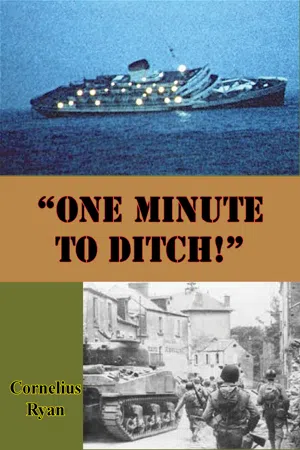
- 101 pages
- English
- ePUB (mobile friendly)
- Available on iOS & Android
eBook - ePub
"One Minute to Ditch!"
About this book
Information
Subtopic
European HistoryIndex
History“ONE MINUTE TO DITCH!”
Winner of a Benjamin Franklin Magazine Award and dramatized on television, this is a tense account of the end of a crippled Pacific Strato cruiser—and the very human story of thirty-one men, women and children aboard her.
Their car was still a long way from the airfield when they first saw the plane. Relaxed and rested after a forty-six-hour layover, Pan American’s Captain Dick Ogg and his flight crew drove rapidly through the tropical evening toward Honolulu’s International Airport. First Officer Lee Haaker nudged Purser Patricia Reynolds and, pointing with his cigar, said, “Bet you fifty cents that’s our baby.”
As they rolled up to the terminal building, they saw he was right. The plane, standing alone in the loading area, was the only Stratocruiser (Pan Am calls it a Strato-Clipper) on the field. High on the nose, in big white letters, was her name: Sovereign of the Skies.
Haaker’s brick-red face broke into a triumphant grin. “Okay, Pat,” he said. “Pay up.”
It was a jovial, good-humored crew that entered Operations for the pre-flight briefing a little after six. Within a few hours they would be far out over the ocean, heading for San Francisco and home.
All over the field, in half a dozen places, other men and women were preparing Flight 943 for its 2,395-mile hop across the Pacific. Through the windows of the Operations office, the flight crew could see workers crawling all over the 72-ton, double-decked Clipper. She had landed at 6:09 P.M., only a few minutes before, having flown 4,280 miles from Tokyo, with a pause at Wake Island for fuel. Now eight mechanics, six ramp crewmen and two cleaners, under the direction of brittle-tempered Phil Chase, were busily grooming the blue and white Sovereign of the Skies.
She was a proud matron; she had come off the Boeing assembly lines in 1949, when she was purchased by American Overseas Airlines for the Atlantic service at a cost of $1,500,000. In 1951, American Overseas was merged with Pan American, and sometime later the plane moved over to the Pacific run. In her lifetime she had flown 19,800 hours, most of it at a speed of about 320 miles an hour. Her engines had been changed many times; one had flown fewer than 300 hours, another more than 1,300.
Now she needed trivial repairs. Chase, good-natured but without patience for anything less than perfection, personally supervised the changing of a mixture control—like the choke on an automobile—on number four engine. Several other minor adjustments were made before he was finally satisfied. “Over water,” Chase had told his mechanics again and again, “you can’t take a chance on anything.”
The refueling gang filled the wing tanks up to 6,410 gallons. The cleaners brushed the royal-blue upholstery and swept the gray carpeting in the cabin and lower-deck cocktail lounge. Fresh food, fruit and choice liquors were loaded into the galley, back in the tail. Meticulously, the Clipper was readied for the journey.
But sometimes nothing man can do is enough. The ground crews didn’t know it, but they were preparing the luxurious Sovereign of the Skies for her last flight.
In Operations, Captain Ogg and his crew listened soberly as dispatcher Denis Sunderland briefed them on the flight plan. For the first half of the trip they would fly at an altitude of 13,000 feet. At the halfway point, almost over “weather station November”—the Coast Guard cutter Pontchartrain—they were to climb to 21,000 feet. Sunderland droned off the weather conditions they might expect—at San Francisco, at Sacramento, the alternate landing area, and at Honolulu, should a return become necessary.
He also told them the conditions they would probably find at sea level if they had to ditch.
“Any questions?” he asked.
Ogg shook his head. The tall, forty-three-year-old captain, with almost 20 years of flying experience, knew it was a routine flight, with good weather all the way.
Out on the ramp, Dick Schaub, twenty-seven, Pan American’s Honolulu cargo controller, wondered about the weather, too. He was shipping 44 cases of canaries, two dogs and a parakeet on the flight.
Schaub was particularly taken by one of the dogs—a tiny snow-white spitz named, improbably, Fido. Fido reminded Schaub of his own dog. But, in the exasperating bustle of feeding and watering the more than 3,000 twittering canaries, Schaub had little time to get to know the spitz.
The blue parakeet, Tippy, was going home to his owner, Coast Guard Chief Boatswain’s Mate Cecil Green. A fluent talker, Tippy enlivened the proceedings as the animals and birds were loaded into the clipper’s forward cargo compartment. He chirped over and over, “Chief go bye-bye—where’s the chief?” Schaub hoped the flight wouldn’t be bumpy.
In the barnlike terminal building, thirty-two-year-old Bob Reece, Pan American’s traffic supervisor, was watching the processing of the 25 passengers booked on Flight 943. Only 10 were boarding at Honolulu; the other 15 were in transit from Tokyo. The plane was only half full, but even so the processing was involved and time-consuming because there were passengers of many nationalities. Besides 13 Americans the passengers included four Filipinos, three Japanese, two Chinese (one from Formosa, one from Hong Kong), one Dutchman, one Frenchman and one Indonesian. They were being shuttled from one area to another for inspection by officers of the U. S. Public Health Service, the Immigration Service, Department of Agriculture, and Customs.
Reece, who no longer really hears the languid Hawaiian music that flows out of the airport loudspeakers 24 hours a day, strolled into customs. He saw that his multilingual staff had everything under control. Everybody seemed cared for and happy—except Mr. Man Ow, the Chinese passenger from Hong Kong.
Ow had run into trouble. On his declaration form he had valued a two-carat diamond at only $400. The customs officer was not satisfied.
“But diamonds are cheap in Hong Kong,” protested Ow. “Anyway, I am not stopping in the United States, I’m going to Caracas, Venezuela.”
The officer was still not satisfied—Ow would have to pay the duty or have the diamond bonded. If he had it bonded, he would not have to pay any duty and the diamond would be returned to him when he arrived in Venezuela. But the documentation required for bonding would take some time; Ow would not be able to continue on Flight 943.
Reece conferred with his Chinese interpreter, Andy Zane, and the customs officer. Then he came up with a solution. “How about taking Flight eight-oh-two?” he asked Ow. “It’s leaving at ten. I can get you a seat on it.”
Ow vigorously shook his head. He might miss his connection.
Reece calmed him. “Eight-oh-two is a fast DC-seven and it will arrive in San Francisco within fifteen minutes of the Strato-Clipper.”
Ow agreed. He bowed politely to Reece. Flight 943 now had only 24 passengers—including the crew, a total of 31.
Reece next turned the attention to Richard and Jane Gordon and their twin daughters Maureen and Elizabeth, aged two and a half. Little “Momo” and “Beth” were restless and uncomfortable after their long journey from the Philippines, where their father, a U.S. Information Service official, had been stationed. “Can they go ahead with their mother while I go through customs for all of us?” Gordon asked. Reece promptly got permission from the customs officer.
The rest of the passengers, through with all the formalities, moved into the busy main passenger lounge with its hurrying porters, ticket counters, telephone booths and shops, to await the boarding announcement.
Over by the main entrance, Mrs. Louise Walker, fifty-eight, of Oakland, California, glanced at her watch and wondered if she’d have enough time to rush back to Honolulu. She’d priced four rings—one for each of her daughters—at a jeweler’s the day before. Now, on impulse, she decided to get them. She glanced at her watch once more and rushed out of the airport.
A few passengers chatted with friends and relatives who had come to see them off. Others looked at souvenirs and trinkets at the gift shop; some took out insurance policies from the automatic dispensing machine. But Tjong Soen Lie, forty, from Djakarta, Indonesia, on his first trip away from home, wasn’t quite sure what he’d get from the machine. He decided against it.
Jingling the bright silver American coins in his hand—the first he’d ever seen—he put one of them in a candy machine instead.
Mrs. Rebecca Jacobe, thirty-four, from the Philippines, carrying her three-year-old daughter Joanne in her arms, searched the lounge for a mailbox. She couldn’t find one, so she decided to mail her letters and cards when she arrived in San Francisco.
Near the telephone booths, Commander Kenneth Strickler, forty-one, of the U.S. Navy Supply Corps, was trying to decide whether or not to call his wife Betsy in Piedmont, California. He knew she had long since become reconciled to his traveling—in the previous eight months he’d flown 89,000 miles and this was his fourth trip across the Pacific this year. But tonight an old uneasiness came back to plague him. He was worried about the youngest of his four children, six-year-old Chuck. The Stricklers live on a Piedmont hillside beside a curving road. It was Chuck and this road—a favorite with the local hot rodders—that often worried Strickler. But he didn’t call his wife. After all, he told himself, he’d be home in about 10 hours, assuming the plane left on time.
But at least one man—Herbert Ho, an elegant middle-aged Chinese American businessman with homes in both Penang, Malaya and Los Angeles—was sure the plane would never leave on time. He had encountered delays ever since he left Hong Kong. He was becoming fatalistic about it. Standing with Chich-Ren Chu, a young student from Formosa en route to Stanford University, Ho gazed at the clock through his pink-lensed glasses and noted that it was already 7:20. Flight 943 still hadn’t been announced and it was due to leave in 10 minutes.
Just then Mrs. Walker returned, breathless but triumphant. On her left hand she wore four rings, each with a different stone symbolizing her daughters’ birthdays. She needn’t have rushed. Ho was right. Flight 943 was going to be late.
The passengers continued to wait a little impatiently, doing the things that ordinary people do when they are caught up in circumstances beyond their control. It was after 8:00 when the loudspeakers blared: “Flight 943 for San Francisco now loading. All aboard, please.”
The 24 men, women and children trooped out to the plane. Mrs. Jacobe and her daughter were helped by two fellow Filipino passengers, Dr. Cleto Cortes and Dr. Manuel Pangan. Between them the doctors carried Mrs. Jacobe’s two flight bags, which contained her few priceless possessions—an oil painting, hand-embroidered luncheon and dinner sets made of exquisite gauze silk, delicately carved giant opalescent shells carrying native legends and dainty hand-embroidered dresses for herself and Joanne.
One of the last to head for the plane was pretty, forty-four-year-old Mrs. Ruby Dami, of Oakland, California. Around her neck she wore seven leis in a variety of colors.
An old friend, Manuel Guiterrez, called after her, “You must throw away a lei before leaving and you will return.”
Mrs. Dami turned back. “Aloha,” she said, and placed one of the leis around his neck. Then she boarded the plane.
At the top of the loading steps the passengers were greeted by the two stewardesses, trim in their blue-gray suits. Honolulu-born Katharine Araki, twenty-three, showed the 13 tourist-class passengers to their seats in the forward section, directly behind the cockpit and extending halfway back over the wings. Lynn Daniel, twenty-five, ushered the 11 first-class passengers into their section, back of the wings and separated from the tourist class by a bulkhead.
In the cockpit, Captain Ogg and First Officer Haaker finished the long pre-take-off check. Haaker had already switched on the Fasten your seat belt; no smoking sign back in the passenger compartments. Now, Flight Engineer Frank Garcia, sitting behind the pilots, started the four 3,500-horsepower engines, one by one.
As the engines came to life and the plane moved away from the terminal building, Purser Pat Reynolds, thirty, made her routine announcement over the cabin loudspeakers: “Good evening, ladies and gentlemen....Welcome aboard Strato-Clipper Nine-forty-three....Most of you know that all public conveyances carry safety equipment and that all sea-going vessels conduct safety drills. Your stewardesses, Miss Araki and Miss Daniel, are now going to demonstrate the type of life jacket carried aboard t...
Table of contents
- Title page
- TABLE OF CONTENTS
- DEDICATION
- ACKNOWLEDGMENT
- “ONE MINUTE TO DITCH!”
- THE MAJOR OF ST. LÔ
- WHAT MADE VUKY RACE?
- I RODE THE WORLD’S FASTEST SUB
- FIVE DESPERATE HOURS IN CABIN 56
- ABOUT THE AUTHOR
- NOTES BY THE AUTHOR
Trusted by 375,005 students
Access to over 1.5 million titles for a fair monthly price.
Study more efficiently using our study tools.
Frequently asked questions
Yes, you can cancel anytime from the Subscription tab in your account settings on the Perlego website. Your subscription will stay active until the end of your current billing period. Learn how to cancel your subscription
No, books cannot be downloaded as external files, such as PDFs, for use outside of Perlego. However, you can download books within the Perlego app for offline reading on mobile or tablet. Learn how to download books offline
Perlego offers two plans: Essential and Complete
- Essential is ideal for learners and professionals who enjoy exploring a wide range of subjects. Access the Essential Library with 800,000+ trusted titles and best-sellers across business, personal growth, and the humanities. Includes unlimited reading time and Standard Read Aloud voice.
- Complete: Perfect for advanced learners and researchers needing full, unrestricted access. Unlock 1.5M+ books across hundreds of subjects, including academic and specialized titles. The Complete Plan also includes advanced features like Premium Read Aloud and Research Assistant.
We are an online textbook subscription service, where you can get access to an entire online library for less than the price of a single book per month. With over 1.5 million books across 990+ topics, we’ve got you covered! Learn about our mission
Look out for the read-aloud symbol on your next book to see if you can listen to it. The read-aloud tool reads text aloud for you, highlighting the text as it is being read. You can pause it, speed it up and slow it down. Learn more about Read Aloud
Yes! You can use the Perlego app on both iOS and Android devices to read anytime, anywhere — even offline. Perfect for commutes or when you’re on the go.
Please note we cannot support devices running on iOS 13 and Android 7 or earlier. Learn more about using the app
Please note we cannot support devices running on iOS 13 and Android 7 or earlier. Learn more about using the app
Yes, you can access "One Minute to Ditch!" by Cornelius Ryan in PDF and/or ePUB format, as well as other popular books in History & European History. We have over 1.5 million books available in our catalogue for you to explore.