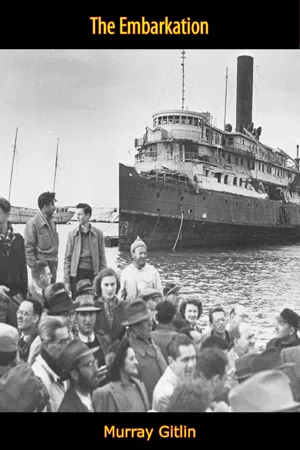
What makes a Jew a Jew? This question is often heard among young American Jews who have not been brought up to understand the spiritual values which the Jews gave to the world. "The Embarkation," Murray Gitlin's emotional novel, first published in 1950, gives to a certain extent a psychological answer to this question.
The central figure in the novel, Martin Tester, is an American soldier who is forced to become a deserter due to the anti-Semitism of his commander. He wanders around for two years in Italy, knowing that a court martial awaits him if he ever returns to the United States. An American who works for British Intelligence in Italy discovers him and guarantees that everything will be forgiven and forgotten, provided he spies on ships carrying "illegal" Jewish immigrants from Italy to Palestine. Having no choice, he accepts the offer. However, coming face to face with the first transport of Jewish refugees, he decides to help rather than denounce them to the British agents. He is helped in this by an Italian girl who falls in love with him and by other Italians of good will, who ask no questions…
"The book is very well-written and makes absorbing reading."—The Wisconsin Jewish Chronicle
- 135 pages
- English
- ePUB (mobile friendly)
- Available on iOS & Android
eBook - ePub
The Embarkation
About this book
Information
Subtopic
Middle Eastern HistoryIndex
History1.
THE YOUNG MAN SAT ON THE FRONT SEAT BESIDE THE DRIVER and looked at the sun. A thin twist of cloud bisected it. The periphery was like a circle drawn with a compass, the contents reddish. He wore an old gray hat and a too small topcoat, rumpled as though it had been slept in. He looked thirty-five but could have been thirty.
“This part of the world,” the driver said, “reminds me of Wyoming. Have you ever been to Wyoming?”
It was a narrow macadam road and on each side of it the terrain had flattened out into a high plain rising slightly toward the side horizons.
“I’ve never been farther west than Albany,” the young man answered. He did not take his eyes off the sun-ball directly ahead of them. The eyes were engaged so intently in seeing and thinking that one felt their activity.
“Haven’t you been all through this territory before?” the driver said.
“No. The fighting was on the other side. The Naples side.”
The driver was smoking a pipe. He took it out of his mouth and knocked it against the sill of the open window. He had a clipped moustache and wore a drab-colored coat with a beaver collar.
“Why is it, Tester, that practically all the deserters headed north for Rome?” he said. “You’d think they’d try to lose themselves in Naples, wouldn’t you? Why didn’t you?”
“I don’t speculate on the things I didn’t do,” Tester said. “I, on the other hand, like to speculate.”
On the left side three strong hills appeared, treeless, the grass short-cropped at the base, and on them and around them no houses could be seen.
The driver knocked his pipe once more against the sill of the open window. “You speak Yiddish?” he asked.
“Yes.”
“How well?”
“Pretty good.”
“I understand there are many accents and dialects. Which is yours?”
“Mine is what’s called Lithuanian Jewish, one of the most common.”
The driver said: “I’m told that a big percentage of them speak Hebrew. Do you speak it?”
“I can only read it.”
“Lithuanian Jewish with an American accent?”
“I don’t think so.”
“How come?”
“We always spoke Yiddish at home.”
“And at your uncle’s?”
“There too.”
“Your father is from Galicia. Does he speak with a Lithuanian Jewish accent?”
“No. His accent is called Galician Jewish. But we children spoke with a Lithuanian Jewish accent.”
“You think you can get by with it?”
“I’m pretty sure.”
“I’m told there are Roumanians coming across the Austrian frontier now.”
“I don’t know.”
“And Hungarians. The Hungarians, I’m told, don’t speak Yiddish at all.”
“I don’t know. I wouldn’t know these things.”
The young man pulled a map out from the crack between the two seats, opened it and spread it on his lap. Beyond Clitunno were two parallel red lines—a secondary road. There were no towns and farther on along the coast no parallel lines. He put a finger on Clitunno and then, with another, measured the distance from it to the coastline. The coast was low wasteland. It was in white on the map.
“You’ll take over from there, Tester,” said the driver, without turning his head.
“Along the coast?”
“No. At Clitunno. Any truck coming down the road has to slow down in Clitunno. The streets are narrow. You’ll have time to look the trucks over. It’s open road out of Clitunno right to the coast road—and no traffic. A car that tried to follow would leave itself wide open. The two ends of the coast road are covered, from the Taranto side and the other side. You’ll cover this one.”
“A truckload of people in a tarpaulin-covered truck won’t look any different from a truckload of oranges,” he said. “One can’t go over and feel the sides.”
“It’s up to you to figure out a way.”
Peasants on bicycles returning from the fields had passed on to Altamura, and now toward them from the direction of Clitunno came the wagons drawn by the horses. From the foreheads of the horses hung silver and tin spangles, from the arched hames, the blinders of the harness embellished in white metal. The sun caught the burnished surfaces and flashed beams to the windshield of the car. The processional of bright-painted wagons reached to the end of the vista. Old men and women and the younger people were in the wagons. Across the shoulders and the black hair of the women the gay shawls and scarves made a spring mixture of color. It was late winter.
“Is your Italian as good as your Yiddish, Tester?”
“Better.”
“Where did you learn it?”
“By speaking it for two and a half years in Rome.”
“That means you were staying with Italians?”
“Yes.”
“They knew you had deserted?”
“Yes.”
“A wonderful people these Italians.”
Fog was hanging close to the ground. It was still light. The streets of Clitunno were blocked by the late afternoon crowd, peasants ambling down the middle, housewives in wooden clogs and shawls hurrying bottles of wine and olive oil home. The car could not go on but had to stop, creep along and stop again. In the side streets the night had come. They drove up an alley and got out at a trattoria. Two old peasants were sitting at a table drinking red wine. The owner was behind the counter at the coffee-making machine. Tester and the driver sat down by the door.
“We’ll have some coffee,” the driver said. “What’s yours? Espresso?”
“Cappuccino.”
The driver called out the order.
“The one question, Tester, which you have been wanting to ask for some time now—correct me if I’m wrong—is: Am I in my right mind to entrust such a mission to a man I hardly know? On the face of it to detect a truckload of Jewish refugees on their way to a ship is of little consequence. By this time you know better than that. I think you see its real significance. Unless you do you will get yourself involved in an issue of right or wrong, moral or immoral. You will not be an informer, Tester. You will be participating in an act of mercy! Remember that. I’ll take my chances on you. Nothing in your life, as I’ve been able to put it together—let’s leave out the desertion—shows any instability. You’ve gone along from youth to school to job in a straight line. You’d be a married man with a family by now if that other hadn’t happened.”
Outside could be heard the sound of wooden clogs on the cobblestones.
“Here is where I’m going to leave you,” said the driver. “You’re on your own. I thought we might have dinner together, but it’s a small town. Let’s not get into trouble when we don’t have to. I’ll drive on back to Bari tonight.” From inside his coat pocket he took an oblong envelope and laid it on the table.
Tester glanced at it but did not touch it.
“You’ll find your soggiorno inside and my phone number and two hundred thousand lire. Spend as much as you have to. The moment they pass, get me on the phone. Phone me whenever you feel like it, but phone me at least every day.”
Tester was sitting with his hands folded across his chest. The expression on his face did not change. The eyes were still intent and preoccupied. The cappuccino was in its final stage of preparation.
“You’ll find fifty dollars in tens in the envelope. They’re always handy to have in your pocket,” the driver said.
Tester did not reply. The coffee came.
“You’ve said so little in these two days, Tester, that I’ve been wondering whether by nature you’re a man who doesn’t talk much or whether you feel a certain remorse at leaving behind two and a half years of hiding in Rome. I’m not sarcastic. Are you trying to hide—how shall I put it?—a personal negative reaction to me because I found you on those steps that night? I’ll predict that you’ll be changing your mind about me, Tester. The time will come when you’ll call me the man who saved you from dying of slow boredom in Rome. Clitunno, Clitun...
Table of contents
- Title page
- TABLE OF CONTENTS
- DEDICATION
- 1.
- 2.
- 3.
- 4.
- 5.
- 6.
- 7.
- 8.
- 9.
- 10.
- 11.
- 12.
- REQUEST FROM THE PUBLISHER
Trusted by 375,005 students
Access to over 1.5 million titles for a fair monthly price.
Study more efficiently using our study tools.
Frequently asked questions
Yes, you can cancel anytime from the Subscription tab in your account settings on the Perlego website. Your subscription will stay active until the end of your current billing period. Learn how to cancel your subscription
No, books cannot be downloaded as external files, such as PDFs, for use outside of Perlego. However, you can download books within the Perlego app for offline reading on mobile or tablet. Learn how to download books offline
Perlego offers two plans: Essential and Complete
- Essential is ideal for learners and professionals who enjoy exploring a wide range of subjects. Access the Essential Library with 800,000+ trusted titles and best-sellers across business, personal growth, and the humanities. Includes unlimited reading time and Standard Read Aloud voice.
- Complete: Perfect for advanced learners and researchers needing full, unrestricted access. Unlock 1.5M+ books across hundreds of subjects, including academic and specialized titles. The Complete Plan also includes advanced features like Premium Read Aloud and Research Assistant.
We are an online textbook subscription service, where you can get access to an entire online library for less than the price of a single book per month. With over 1.5 million books across 990+ topics, we’ve got you covered! Learn about our mission
Look out for the read-aloud symbol on your next book to see if you can listen to it. The read-aloud tool reads text aloud for you, highlighting the text as it is being read. You can pause it, speed it up and slow it down. Learn more about Read Aloud
Yes! You can use the Perlego app on both iOS and Android devices to read anytime, anywhere — even offline. Perfect for commutes or when you’re on the go.
Please note we cannot support devices running on iOS 13 and Android 7 or earlier. Learn more about using the app
Please note we cannot support devices running on iOS 13 and Android 7 or earlier. Learn more about using the app
Yes, you can access The Embarkation by Murray Gitlin in PDF and/or ePUB format, as well as other popular books in History & Middle Eastern History. We have over 1.5 million books available in our catalogue for you to explore.