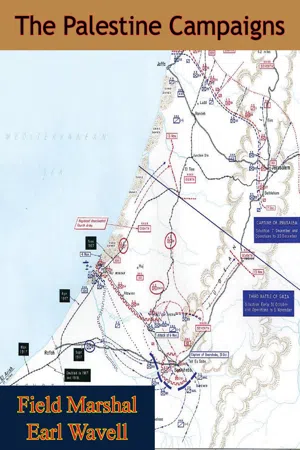
In this thoughtful and well written account of the Palestinian campaigns, Field Marshal Wavell (at that time a Colonel) gives not only a very readable account of the actual campaigns themselves but also highlights the military maxims that gave success to the British Forces. Wavell himself was on the staff of the Egyptian Expeditionary Force in 1917 and had a deep and firsthand knowledge of the operations and the theatre of war. As one of the most forward thinking leaders in the British Army of the time, Wavell's conclusions on the future of war that he advanced in this book were quite prescient; the use of armoured vehicles and strategic mobility to mention but two.
"The Palestine campaigns have been acclaimed as a triumph for cavalry and as the vindication of that arm in modern war. And quite certainly the skilful use of the mounted arm is the outstanding feature of the operations. But the true lesson is not so much the value of the horseman as the value and power of mobility, however achieved.
"The campaigns are a classic illustration of this power, and are well worth careful study for this reason alone, since the chief aim of military thought at the present time must be to recapture the power of movement and manœuvre, which was lost in the principal operations of the late war in Western Europe."—Extract from book
- 215 pages
- English
- ePUB (mobile friendly)
- Available on iOS & Android
eBook - ePub
The Palestine Campaigns
About this book
Information
Subtopic
British HistoryIndex
HistoryTHE SECOND PHASE—PALESTINE
CHAPTER IV—THE THIRD BATTLE OF GAZA
“Superandae erant duci nostro Turcorum pertinacia, Teutonum astutia, locorum iniquitas, aquarum denique inopia.”—(Oration to Lord Allenby on receiving an honorary degree at Oxford.)
1. The Foundations of the Battle.—General strategical situation—The “Yilderim” army—The British plan—Preparations and training—Move of “Yilderim” army to Palestine front—Strengths and dispositions of opposing forces.
2. The Battle of Beersheba, October 31st, 1917.—The defences of Beersheba—Plan of attack—Attack of XX. Corps—Action of Desert Mounted Corps—Charge of 4th A.L.H. Brigade—Comments on the battle.
3. The Breaking of the Turkish Line.—Attack by XXI. Corps on Gaza defences—Fighting at Tel el Khuweilfeh—Attack on the Sheria position, November 6th—Turkish retreat—Comments.
Order of Battle, E.E.F.—October, 1917.
(SEE MAPS VIII., IX., X., XI.)
1. The Foundations of the Battle
The decision of the War Cabinet to reinforce the Egyptian Expeditionary Force and to undertake the conquest of Palestine was of outstanding consequence. It made this theatre the most important centre of conflict outside Europe for the remainder of the war; incidentally it involved the British Empire in fresh commitments and perplexities when the war was over. The reasons for the decision have already been briefly indicated, but require some further examination. Throughout the war there was an incessant conflict of views between “the Westerners”—those who held that every possible man and weapon should be mustered against the main army of the principal enemy, and that all outside commitments should be reduced to the minimum compatible with mere safety—and “the Easterners”—those who believed that the Western front was impenetrable to either combatant, and that victory could more easily be won by striking down Germany’s weaker allies and so gradually tightening the iron ring round Germany herself.
Mr. Lloyd George, now Prime Minister, was the most persistent and persuasive advocate of the latter policy. He had now, too, an additional impulse towards his search for a success in Palestine. The spring campaign of 1917 had been bitterly disappointing for the Allies. Russia had collapsed, the great French offensive in Champagne had been a demoralising failure, and the submarine warfare was causing the gravest anxiety. The United States had, indeed, just entered the war, but it would be long before their military help could become effective. All hope of ending the war in 1917 was gone. The Premier believed, rightly or wrongly, that some striking military success was needed to sustain, in this fourth year of war, the endurance of the civil population. It was this belief that prompted him to say to General Allenby before his departure to Egypt that “he wanted Jerusalem as a Christmas present for the British nation.” This same conviction was repeated in a telegram sent to General Allenby in August, in which he was instructed to press the Turks in order, among other reasons, “to strengthen the staying power and morale of this country.” To soldiers a faulty employment of force for the mere sake of proclaiming a spectacular victory appears a violation of the elementary canons of war; but that in a long conflict the psychology of the “Home Front” has to be studied, and may have to be taken into account, is a factor that they must undoubtedly recognise.{87}
There were also very sound strategical reasons for striking a blow on the Palestine front at this time. The collapse of Russia had set free numerous Turkish forces, and it was known that these were being assembled round Aleppo, under German guidance and leadership, for the recapture of Baghdad. The threat thus offered to the Mesopotamian sector of the battle line could be more quickly and economically countered by an offensive in Palestine than by the direct reinforcement of General Maude’s army, especially since the bulk of the reinforcements was to be drawn from the Salonika theatre, our commitments in which the General Staff at the War Office had long desired to reduce. Thus General Allenby’s main strategical objective was the defeat of the Turkish army in Southern Palestine in order to draw down the Turkish reserves from Aleppo, and so to remove the danger of an expedition against Baghdad. He arrived in Egypt charged to report on the additions required to the E.E.F. in order to accomplish this task. The predisposition of the Prime Minister in favour of a success in the East made it likely that all reasonable requests made by General Allenby would be met.
Early in 1917 Turkey was in evil plight. During the latter half of 1916 her best remaining troops had been taken to fight Germany’s battles against Russia and Rumania. Meanwhile her starved and ragged armies on the Caucasus front wasted away in the rigours of a bitter winter; her forces in Iraq suffered a decisive defeat; those on the Palestine front were falling back in face of the British advance; and the expedition to recover Mecca and to quench the Arab revolt had been dramatically checked by Feisal’s flank move to Wejh. The month of March brought some relief in the Russian Revolution and in the check to the British advance at Gaza, but brought also the fall of Baghdad. Thus of the four sacred cities in charge of Turkey, as the religious head of Islam, two—Mecca and Baghdad—were already in the hands of her enemies, while Medina was besieged and Jerusalem threatened. Not only was she losing the war, but forfeiting her religious prestige. To lose a war was no new experience to Turkey; to lose the holy places of her religion was more disturbing.
The German High Command decided that some spectacular exhibition of might and efficiency was required to restore the shrinking faith of their ally. At the end of April General von Falkenhayn was commissioned to proceed to Turkey and to discuss with the Turkish Command an operation for the re-conquest of Baghdad.{88} Von Falkenhayn was a redoubtable opponent. He had been the arbiter of German strategy for a period of two years, from September, 1914, soon after the Battle of the Marne, when he had succeeded Von Moltke as Chief of the Great General Staff, up till the end of August, 1916, when he was replaced by Hindenburg and Ludendorff. The failure of the Verdun battle shook his position, and Rumania’s entry into the war was the final cause of his supersession. He had then been employed as commander of the principal German army in the force that overran Rumania. By a series of beautifully timed operations in conjunction with Mackensen’s Danube army (composed of Bulgarians, Turks, Austrians and Germans) he had played a notable part in this most brilliant campaign. Thus the leader chosen to resuscitate the fortunes of Turkey had proved himself both in the field and in the council chamber. His failure was to show how obstinately inflexible the German mentality often is when dealing with abnormal factors, and how little capable of understanding another nation’s sensibilities and characteristics.
Von Falkenhayn reached Constantinople on May 7th, and at once set out on a tour of inspection to weigh the practicability of the proposed plan. He saw Khalil, the commander of the Sixth Army, in Iraq; he saw Djemal Pasha in Syria; and in June he reported that the move of a sufficient force against Baghdad was possible if it was carefully prepared, and provided that the Palestine front was secure.
Negotiations followed between Constantinople and Berlin in which it was decided to assemble a Turkish army at Aleppo, to support it with a special body of German troops (known as Pasha II. or the Asia Corps), and to carry out detailed reconnaissance for improvement of the lines of communication between Aleppo and Baghdad. By a decree of Enver, promulgated early in June, the projected offensive was, for secrecy’s sake, to be known by the name “Yilderim”—that is to say, “lightning.” In view of the rate at which preparations and moves were normally carried out in Turkey, the name was unduly optimistic; nor did it secure secrecy, for the plan came to the knowledge of the Intelligence Services of the Entente at a very early stage.
The nucleus of the Yilderim force was to be the III. and XV. Army Corps, which had been operating against Russia and Rumania. They were to constitute the Seventh Army, of which Mustapha Kemal{89} received the command. He soon found himself unable to stomach a control so completely German, and was replaced by the more pliable Fevzi Pasha.
The principal units of the German force which was to take part in the campaign were:—
Three battalions of infantry (numbered 701, 702, 703);
Three troops of cavalry.{90}
Three machine-gun companies (six machine guns each);{91}
Three trench mortar sections (four light trench mortars each);{92}
One battery of field howitzers;
Two batteries of field guns;
Three sections of mountain howitzers;{93}
One anti-aircraft battery;
Four squadrons of aeroplanes;
with the necessary engineer, signal, and medical units and ammunition and supply columns. Its total strength was about 6,500. The commander was Colonel von Franckenburg und Proschlitz. The men were all specially picked men.
The Germans seem from the first not only to have disregarded Turkish sentiment, but to have neglected to take proper account of local conditions. According to Liman von Sanders, his mission, which had the advantage of three and a half years’ experience of Turkey, was not even consulted in the formulation of the plan, nor was its personnel utilised. The headquarters staff of Yilderim consisted of sixty-five German officers and nine Turks; these latter were junior officers, used mainly for liaison purposes. The German staff treated the problem as if it was subject to similar rules of time and space as a problem in the Western theatre—as if, in fact, the executants were Germans. They had to discover that in Turkey an order issued was a very long way from being an order carried out, and that the delays and obstructions in troop movements over the Turkish lines of communication were almost interminable, They spent the summer working in a medium which was strange and disconcerting to them, and accomplished little.
Even before the Second Battle of Gaza the staff of Eastern Force had been considering an advance by the right as an alternative to a direct assault on Gaza. But at that time the state of the communications did not permit any deviation from the straight path along the sea coast. It was left to Sir Philip Chetwode in May, when he succeeded Sir Charles Dobell, to develop this idea and to work out the plan which, with slight modifications, was adopted and executed by General Allenby.
The obvious line of advance into Palestine was by Gaza, keeping close to the sea. This route secured the full advantages of naval co-operation, directly covered the main line of communication, and presented comparatively small difficulties of water supply. But the defences of Gaza were now too solid to be broken except by a slow and costly process of siege. Even a success would be unlikely to provide any opportunity for the mounted troops, the arm in which lay the chief superiority of the British force over the Turkish. The Turkish centre was also strong; the ground between the Wadis Ghuzze and Imleih, inside the triangle marked by the points Tel el Jemmi—Bir Ifteis—Gamli, was a flat, open plain dominated by the enemy works on the ridge above it to the north; difficulties of water supply would be considerable, and the mounted arm could not develop its full value. There remained the Turkish left, which rested about Kauwukah, some ten miles north-west of Beersheba. The defences here were weaker and less complete. The terrain also was more favourable to the attack; a force established north-west of Beersheba would be on higher ground than the Turkish works, and would thus have the advantage of observation. The open flank, too, would offer an opportunity for the mounted troops.
General Chetwode’s plan was to develop during the summer such transport and administrative improvements as would enable a force to be thrust out on to the high ground between Beersheba and Hareira. He recognised that before the Turkish left could be attacked a preliminary operation would be necessary for the capture of Beersheba, which the Turks held with a detached force, since there was not comfortable room for manœuvre between Beersheba and the Turkish left, and possession of the water at Beersheba would be essential to further operations.
General Allenby, after a close inspection of the front immediately after taking over the command, accepted General Chetwode’s plan and his estimate of the troops required—seven divisions and three mounted divisions.{94} On July 12th, a fortnight after his arrival, he telegraphed home an outline of his proposals and his requirements in additional troops. The principal items were as follows:—
(а) Two complete divisions.
(b) Field artillery to complete his existing divisions to the full scale of thirty-six 18-pdrs. and twelve 4·5-inch howitzers each.
(c) Corps artillery to provide a proportion of four 60-pdrs., eight medium howitzers (6-inch or 8-inch), and four antiaircraft guns per division.
(d) Five squadrons of aeroplanes.
(e) Two Army Troops companies R.E.
(f) Additional si...
Table of contents
- Title page
- TABLE OF CONTENTS
- DEDICATION
- PREFACE
- CHRONOLOGY OF CAMPAIGNS OF EGYPTIAN EXPEDITIONARY FORCE AND OF EVENTS IN OTHER THEATRES WHICH AFFECTED THEM
- MAPS
- INTRODUCTORY
- THE FIRST PHASE-SINAI
- THE SECOND PHASE-PALESTINE
- INTERVAL
- THE THIRD PHASE-SYRIA
- CHAPTER VIII-PURSUIT TO DAMASCUS AND ALEPPO
- FINALE
- APPENDIX I-OFFICIAL NAMES OF THE BATTLES AND ENGAGEMENTS OF THE CAMPAIGNS IN EGYPT, SINAI, PALESTINE AND SYRIA.
- APPENDIX II-BIBLIOGRAPHY OF THE PALESTINE CAMPAIGNS
Trusted by 375,005 students
Access to over 1.5 million titles for a fair monthly price.
Study more efficiently using our study tools.
Frequently asked questions
Yes, you can cancel anytime from the Subscription tab in your account settings on the Perlego website. Your subscription will stay active until the end of your current billing period. Learn how to cancel your subscription
No, books cannot be downloaded as external files, such as PDFs, for use outside of Perlego. However, you can download books within the Perlego app for offline reading on mobile or tablet. Learn how to download books offline
Perlego offers two plans: Essential and Complete
- Essential is ideal for learners and professionals who enjoy exploring a wide range of subjects. Access the Essential Library with 800,000+ trusted titles and best-sellers across business, personal growth, and the humanities. Includes unlimited reading time and Standard Read Aloud voice.
- Complete: Perfect for advanced learners and researchers needing full, unrestricted access. Unlock 1.5M+ books across hundreds of subjects, including academic and specialized titles. The Complete Plan also includes advanced features like Premium Read Aloud and Research Assistant.
We are an online textbook subscription service, where you can get access to an entire online library for less than the price of a single book per month. With over 1.5 million books across 990+ topics, we’ve got you covered! Learn about our mission
Look out for the read-aloud symbol on your next book to see if you can listen to it. The read-aloud tool reads text aloud for you, highlighting the text as it is being read. You can pause it, speed it up and slow it down. Learn more about Read Aloud
Yes! You can use the Perlego app on both iOS and Android devices to read anytime, anywhere — even offline. Perfect for commutes or when you’re on the go.
Please note we cannot support devices running on iOS 13 and Android 7 or earlier. Learn more about using the app
Please note we cannot support devices running on iOS 13 and Android 7 or earlier. Learn more about using the app
Yes, you can access The Palestine Campaigns by Field-Marshal Earl Wavell in PDF and/or ePUB format, as well as other popular books in History & British History. We have over 1.5 million books available in our catalogue for you to explore.