First published in 1918, this is the seminal biography of World War I's "best English flying man", Captain Albert Ball.
This volume contains a reprint of a collection of personal letters written by Captain Ball and is illustrated throughout with black and white photographs.
Albert Ball, VC, DSO & Two Bars, MC (14 August 1896 - 7 May 1917) was an English fighter pilot during WWI. At the time of his death he was the United Kingdom's leading flying ace, with 44 victories, and remained its fourth-highest scorer behind Edward Mannock, James McCudden, and George McElroy.
Born and raised in Nottingham, Ball joined the Sherwood Foresters at the outbreak of WWI and was commissioned as a second lieutenant in October 1914. He transferred to the Royal Flying Corps (RFC) the following year, and gained his pilot's wings in 1916. Joining No. 13 Squadron RFC in France, he flew reconnaissance missions before being posted in May to No. 11 Squadron, a fighter unit. From then until his return to England on leave in October, he accrued many aerial victories, earning two Distinguished Service Orders and the Military Cross. He was the first ace to become a British national hero.
After a period on home establishment, Ball was posted to No. 56 Squadron, which deployed to the Western Front in April 1917. He crashed to his death in a field in France on 7 May, sparking a wave of national mourning and posthumous recognition, which included the award of the Victoria Cross for his actions during his final tour of duty.
"I am sure nobody can read these letters without feeling that it is men like Captain Ball who are the true soldiers of British democracy. It is their spirit of fearless activity for the right, in their daily work, which will lead us through victory into a new world in which tyranny and oppression will have no part."—D. LLOYD GEORGE, Foreword
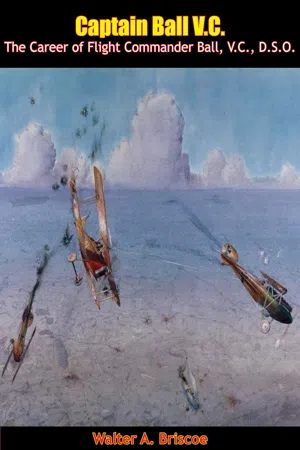
- 167 pages
- English
- ePUB (mobile friendly)
- Available on iOS & Android
eBook - ePub
About this book
Information
Subtopic
British HistoryIndex
HistoryCAPTAIN BALL, V.C.
CHAPTER 1 — THE END AND THE BEGINNING
The Birth of a hero—Albert asserts himself—Schooldays—The Spirit of Adventure—“England Expects”—Explosives—Mechanical genius—“Prepared”
“OH it was a good fight, and the Huns were fine sports. One tried to ram me after I was hit and only missed by inches. I am indeed looked after by God; but oh! I do get tired of always living to kill, and I am really beginning to feel like a murderer. I shall be so pleased when I have finished.”
These are the words of the boy who was the first great pilot in Britain’s Air Army on the Western Front. Not until this war is ended will it be possible to say whether or no he was the most wonderful fighter in the air that England has produced. Other of our incomparable young men may yet come forward to beat his record of enemy airmen vanquished, and they may even excel him in his individual feats over the battle lines. But we do know that nobody can surpass him in courage and self-sacrifice, and that whatever new and wonderful history is to be made in the air, he will always occupy a unique position because he flew into the Western sky at the crucial moment when a brilliant, fearless leadership was needed.
It was his skill, example, and resource which were of incalculable service in the months of the spring and summer of 1916 and in the spring of 1917, when the British supremacy in the air and its vital bearing on the campaigns of those years was never so gravely jeopardised. Ball’s invincible ardour and audacity rallied his hard-pressed comrades in those grim days when we were short of machines and men, and when defeat in the air would have had the gravest consequences. This simple, healthy boy who did not live to enjoy full manhood was the leader and the inspirer of those British airmen who, by their fearless work in photography, reconnaissance, observation and fighting prepared the way for the triumph of the land armies on the Somme, the Scarpe, and the Vimy Ridge, which burst through the German wall in the West.
The Ministry of Munitions has stated:—“Our command of the air is certain, but it is he who pointed out the way by fearless action, quick initiative, but always with the proper weighing of chances,” and Mr. John Buchan, the historian, has said that “all records were excelled by the British airman, Capt. Ball....No greater marvel of skill and intrepidity has been exhibited by any service in any army, in any campaign in the history of the world.”
The spirit of young Ball, the mirthful schoolboy who found a strange joy in the new warfare, is the spirit of the young British airmen who cloud the sky today and pour down fire upon the German hordes.
The story of his life is essentially the story of a lad who can scarcely be described in the same terms as one would use about a mighty warrior, but rather of a young knight of gentle manners who learnt to fly and to kill at a time when all the world was killing, and who, all the time, remained a good-natured happy boy, a little saddened by the great tragedy that had come into the world and made him a terrible instrument of Death.
It is hard to think of any boy between the age of nineteen and twenty-one, who has played such a fateful part in the battle for freedom of his country. It may occur to an historian of Armageddon to dilate upon the strange Destiny which took this lad, untrained in the art of war, from his home and sent him to inflict tremendous punishment upon the most powerful and the most cruel foe civilisation has ever known.
The words which are quoted at the beginning of this chapter were written by him to his parents shortly before he was killed, and they are a true reflection of his mind and of the impression the war had made upon him. Captain Ball never once exulted over the death of an opponent. If he never sickened at the sight of death he never gloried in his power to destroy others. His letters home are the best possible record of his brief life and achievements. They are scarcely a contribution to the fine writing that has come from the trenches and also from the aerodromes in this war, but as a simple tale of what this world-famous lad thought and endured they could not be improved upon, and it is of these that this volume largely consists.
Albert Ball was fortunate in being born in the atmosphere of a prosperous home in the Midlands. He was the son of admirable parents who put in his way all the advantages of education and healthy recreation. He was born in Nottingham on August 21st, 1896, one of a family of three, and the elder of two boys. His father (Alderman A. Ball, J.P.), an estate agent doing big business throughout the country with interests in various engineering concerns, is a prominent figure in the public life of the city, a popular Mayor in his year of office; in brief, one of the best type of energetic, enterprising business men who are assisting in the administration of the affairs of the English provincial towns.
The infant, Albert Ball, nearly put an end to his own existence at the age of five by setting fire to the nursery, following a successful excursion to the mantelpiece for a box of matches which he reached by way of a chair. This was the first of many adventures.
He went to Grantham Grammar School, then Nottingham High School, and finally Trent College, where it is said he arrived a “nervy” boy, perhaps too sensitive for a public school. But he turned out well, although he did not excel in anything, his only prize being a silver cup for the obstacle race. He was keen on photography, chemistry, mechanics and gardening.
During his second term he built a boat. He had a genius for obtaining just the things he required, and he purchased the necessary materials at a nominal cost; and soon to the gratification of his fellow-tridents, the “ark” was an accomplished fact. It was not destined to be merely a pond boat—for the mere edification of pleasure-loving juniors—but seriously intended for trips on the river. The sequel to it all was that, with willing assistance he got it to the river, and actually sailed down from Long Eaton to Nottingham. He arrived on the canal, which may be seen from his home, right in front of his own house on his own craft, to his great satisfaction, and to the surprise of his people.
During a school vacation, part of which time was spent in Skegness, he made a raft. He secured the necessary planks and fastened them together. In the centre he fixed a pole, on the top of which he nailed a cricket “blazer” to serve for a flag. One evening he was missing from the bungalow, and as it was getting dark, a family search party hied forth to the sands, where he had been last seen, with his raft tied to a stake. On arrival on the shore his people found a crowd of onlookers gazing seaward. There was young Albert on the raft hammering away to his heart’s content, by the glow from a fire contained in a bucket, oblivious of the fact that he might soon he washed out to sea, if the old rope broke. When satisfied with his work he got off the raft and walked through the water, quite unconscious about the excitement he had caused on the beach. The next morning, to his chagrin, his raft got loose. He hurriedly took off most of his clothes and jumped in after it, for it was out some distance at that time. People on the beach shouted to him to come back, as it seemed quite impossible for him to gain his object or to even get back safely. Once he went under, and he said afterwards that he almost gave up, until he thought of his mother and home, and how they might miss him; so he made an extra special effort and eventually reached the raft. He could, however, do nothing to cause it to float inland, so he thought it best to dive off, especially as it was being carried further out. His swim homeward against the tide proved to be a difficult task, but he succeeded by dint of that perseverance, pluck and determination shown in his greater days, in reaching the shore. He was thoroughly exhausted and blue with cold and ague, and warm blankets and a hot water bottle, etc., were required to restore his circulation. Some fishermen brought the raft to shore, but, as it was at the other end of Skegness, it cost him all his pocket money to get it back, so he broke it up and thus ended the raft episode.
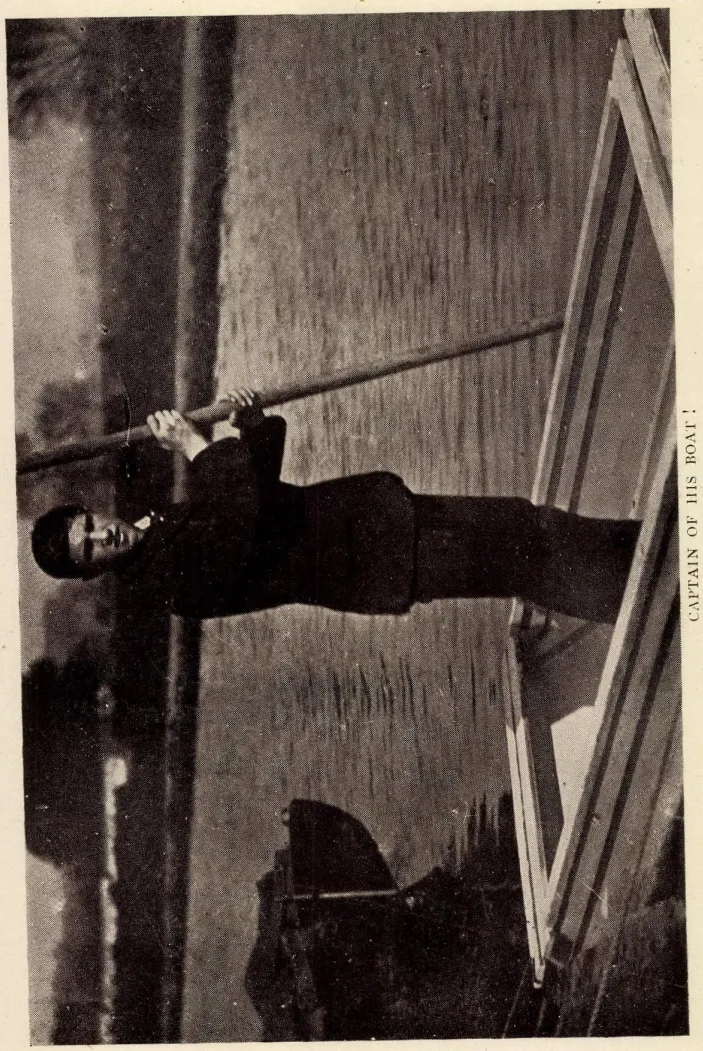
This was only another of his many early adventures.
He once got on board a steamer at Liverpool with the idea of seeking further adventures, but thought better of it at the last moment and came ashore and went back to school.
During the time he was at Trent College, his father, when Mayor of Nottingham, went to Calais to be present at the unveiling of the monument to Joseph Jacquard, inventor of the loom to which the textile industries of Nottingham are so much indebted. Young Ball went later to further strengthen L’Entente Cordiale!
The most cherished memory of Ball’s schooldays now is a snapshot of him as a boy of fifteen standing in front of the armoury door of the Cadet Corps of which he was a member. Carved above the doorway is Nelson’s message, “England expects that every man will do his duty.” A wonderful memory and a wonderful prophecy!
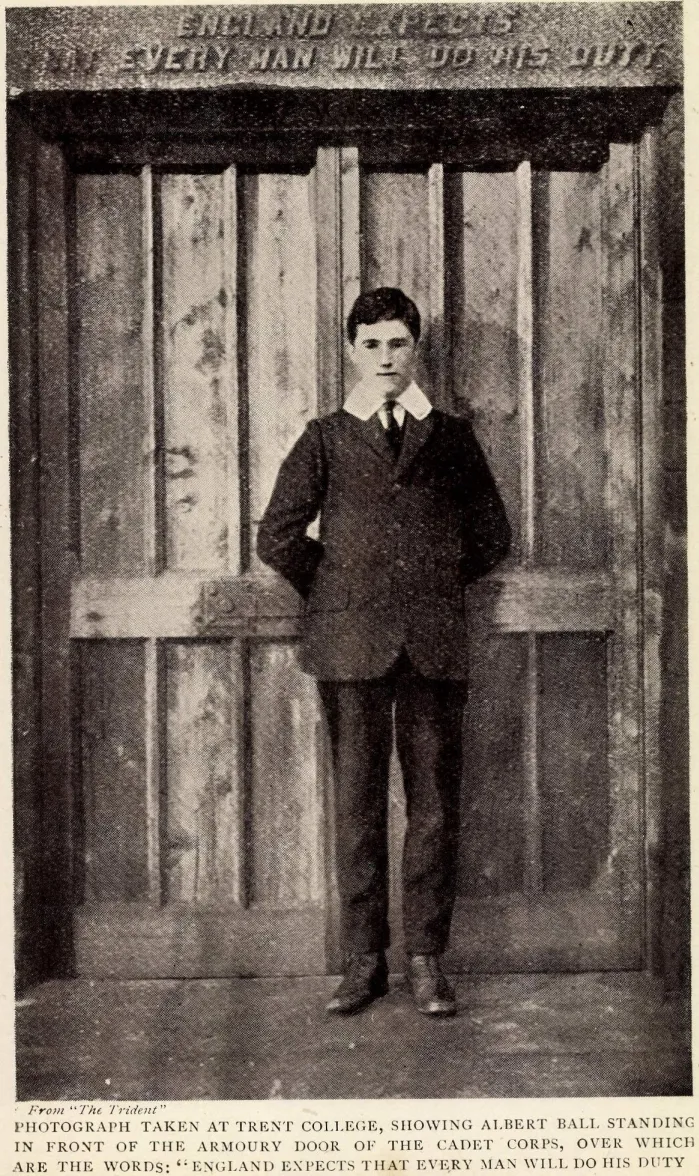
A copy of the photograph now hangs in the Royal Aircraft Factory in the office of an old Trent College boy, who says:—“It is a better incentive to do our job than many exhortations.”
One little hobby of young Ball’s was the secret manufacture of gunpowder, which was suddenly discontinued on the discovery in the boy’s room by his father of a parcel labelled “117 lbs. Gunpowder.”
He was a good revolver shot and could knock down a stick at fifty yards in his back garden.
He was keenly interested in mechanics, a knowledge that stood him in such good stead in the years that were to follow.
His workshop was always the rendezvous of a number of kindred spirits interested in his mechanical hobbies, and he was never so happy as when demonstrating to them and when instructing his young friends in the intricacies of his various ingenious contrivances. At his home at Sedgley House, The Park, he constructed in premises at the rear a wireless plant, which was one of the finest wireless installations for miles around. He could transmit very long-distance messages. Anything in the line of electricity fascinated him, and as quite a young boy he could deal with electric lighting as capably as many a professional electrician.
Engines of any description were a delight to him, and he would purchase a discarded gas engine and dynamo, and soon have it in complete working order. His father recalls how Albert and several of his boy admirers arrived at the door of the house on one occasion, with a huge second-hand engine, big enough, at first sight, to propel a liner. It looked a hopeless case, but it was, after much struggling, dragged into his workshop: and it was not long ere it was working merrily away.
His genius for things mechanical developed year by year, until in his after years, he was able to offer to the British Government an aeroplane of his own design.
If he was an “ordinary” sort of boy at school work and play, he was clearly of the opinion that he would do better when he left. A letter he wrote home during his last term is interesting. He said:—
“Everything is going well with Cyril and myself. We have many good times at school, and there is always something funny going on here. I think I ought to go to camp as it is my last chance to join in any really good thing, whilst I belong to Trent. Mr. Warner said that we ought to go and do our best for the upholding of the Corps and the school. Well, I have not got on specially well as regards knowledge, but I think I have made a slight improvement. I have a great love for my school and shall be sorry in many ways to leave, but I think that if I get into a good business I shall be spending my life in a much more profitable way and bringing the best out of myself. I shall try my level best to be a good straightforward business man, and follow to the best of my ability in my father’s footsteps. I am anxious to know what I shall be when I leave, and I do hope father is looking about well. I think there is a lot of money to be made in the way of making small electric-lighting plants for country houses. Many people have invented these sets, but they are all so large and need so much looking after. I should like to be placed in a large electrical-engineering factory where they make all kinds of machinery from the dynamo to the power to drive it. I think that the place for me is where there is plenty of work and bustle, so that I can keep my mind to it and not be troubling about other things. I should like to have the chance to work my way up from the bottom and get to the top.”
That is surely the kind of letter which a parent would rejoice at. It is instinct with the ambition to “make good,” a spirit which in pre-war days in England met with scant encouragement.
Constant reference to these keen business aims of his are to be found in his...
Table of contents
- Title page
- TABLE OF CONTENTS
- DEDICATION
- FOREWORD
- APPRECIATION
- AN APPRECIATION
- MY IMPRESSION OF CAPTAIN BALL
- LIST OF ILLUSTRATIONS
- CHAPTER 1 - THE END AND THE BEGINNING
- CHAPTER II - READY WHEN WANTED
- CHAPTER III - LEARNING TO FLY
- CHAPTER IV - A PROMISING PUPIL
- CHAPTER V - “THE EYES OF AN ARMY.”
- CHAPTER VI - THE “CRISIS” OF THE FOKKER
- CHAPTER VII - EVERYWHERE IN FRANCE
- CHAPTER VIII - “WITH GOD’S HELP”
- CHAPTER IX - “WHY I FEEL SAFE”
- CHAPTER X - THE RED BATTLE FLYER
- CHAPTER XI - BALL’S METHODS
- CHAPTER XII - “IN ENGLAND-NOW”
- CHAPTER XIII - BACK TO THE FRONT
- CHAPTER XIV - TRIUMPH
- CHAPTER XV - THE LAST FLIGHT
- CHAPTER XVI - MISSING
- CHAPTER XVII - THE SUPREME SACRIFICE
- CHAPTER XVII - “THE VICTORIA CROSS”
- CHAPTER XIX - WORLD TRIBUTES
- REQUEST FROM THE PUBLISHER
Trusted by 375,005 students
Access to over 1.5 million titles for a fair monthly price.
Study more efficiently using our study tools.
Frequently asked questions
Yes, you can cancel anytime from the Subscription tab in your account settings on the Perlego website. Your subscription will stay active until the end of your current billing period. Learn how to cancel your subscription
No, books cannot be downloaded as external files, such as PDFs, for use outside of Perlego. However, you can download books within the Perlego app for offline reading on mobile or tablet. Learn how to download books offline
Perlego offers two plans: Essential and Complete
- Essential is ideal for learners and professionals who enjoy exploring a wide range of subjects. Access the Essential Library with 800,000+ trusted titles and best-sellers across business, personal growth, and the humanities. Includes unlimited reading time and Standard Read Aloud voice.
- Complete: Perfect for advanced learners and researchers needing full, unrestricted access. Unlock 1.5M+ books across hundreds of subjects, including academic and specialized titles. The Complete Plan also includes advanced features like Premium Read Aloud and Research Assistant.
We are an online textbook subscription service, where you can get access to an entire online library for less than the price of a single book per month. With over 1.5 million books across 990+ topics, we’ve got you covered! Learn about our mission
Look out for the read-aloud symbol on your next book to see if you can listen to it. The read-aloud tool reads text aloud for you, highlighting the text as it is being read. You can pause it, speed it up and slow it down. Learn more about Read Aloud
Yes! You can use the Perlego app on both iOS and Android devices to read anytime, anywhere — even offline. Perfect for commutes or when you’re on the go.
Please note we cannot support devices running on iOS 13 and Android 7 or earlier. Learn more about using the app
Please note we cannot support devices running on iOS 13 and Android 7 or earlier. Learn more about using the app
Yes, you can access Captain Ball V.C. by Walter A. Briscoe in PDF and/or ePUB format, as well as other popular books in History & British History. We have over 1.5 million books available in our catalogue for you to explore.