"In the fourth century the Roman Empire was under threat. The Barbarians were becoming a powerful force in Europe, and the Huns, the most savage of these tribesmen, were sweeping south towards the imperial frontiers. At the same time the Empire faced growing internal social and economic problems: plague and war had diminished the agricultural population and productivity was falling; the army was under increasing strain in defending the extensive boundaries. Christianity, too, continued to prove an unsettling influence—accepted and established in Constantinople, but not in Rome. In this perceptive and stimulating book, Professor Wallace-Hadrill traces the development of Western Europe from the dissolution of the late Roman Empire to the emergence, in the tenth century, of the individual states of medieval Europe."—Print ed.
"Into the comparatively few pages at his disposal, Mr. Wallace-Hadrill has contrived to pack a surprising amount of stimulating discussion, covering many of the problems which have exercised historians during the present century. Attention may be called, in particular, to his judicious summing-up of the contrasting theories of the extent of Mediterranean trade after the fall of the empire in the west, and his reminder of the pitfalls, both in the economic and in other fields, presented by the defective nature of our sources and the state in which they have been preserved....the book reads smoothly, and interest is sustained even when the untidy tenth century, so difficult to summarize, is reached. The author is to be congratulated on a suggestive and valuable essay on a period of European history which has possibly received less attention than it deserves from the present generation of English students."—H. ST. L. B. MOSS, The English Historical Review
"Impresses by its sober and patient probing and testing of the mortal remains of these six centuries"—Eastern Churches Quarterly
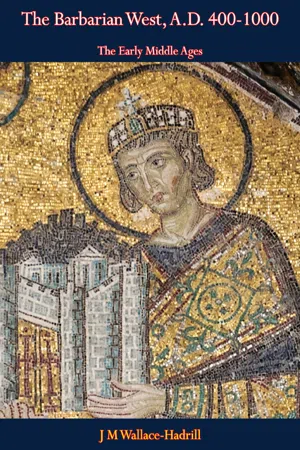
- 141 pages
- English
- ePUB (mobile friendly)
- Available on iOS & Android
eBook - ePub
About this book
Trusted by 375,005 students
Access to over 1.5 million titles for a fair monthly price.
Study more efficiently using our study tools.
Information
Subtopic
Ancient HistoryIndex
HistoryCHAPTER I—INTRODUCTORY
DURING the year A.D. 376 the Romans learned that the tribes living in the northern world, beyond the Danube frontier, were in motion. This kind of thing had happened before, and no doubt official quarters were reluctant to credit alarmist reports. But soon it became clear that the reports were anything but alarmist. The Huns, the most terrible of the barbarian peoples, had been stirred to life and were sweeping south towards the imperial frontiers, refugees streaming before them.
Our first task must be to distinguish some of the features of the civilization that was thus threatened.
We must observe, in the first place, that the time immediately preceding the irruption had been far from restful. The fourth century had, for the Romans, been an age of unquiet. That Peace of which the founder-Emperor, Augustus, had dreamt had slipped gradually away. The imperial frontiers had long since been advanced to a point where defence against external dangers was itself a burden sufficiently huge to create a new series of internal problems, economic and social. These did not, in themselves, prove fatal to the structure of the Empire; but they modified it. What were they?
In the first place, there was a labour problem. The defence in depth of an immense frontier had combined with the need to exploit all food-producing land to make every able-bodied man the object of strict and anxious state-supervision. But this, as so often happens, proved a self-destructive process; for the more rigidly men were pinned down to their wartime tasks the less able society proved to adapt itself to a rapidly changing situation. The Romans had inherited from the Greeks a strong sense of the rightness of social hierarchy. Each level of society had its function to perform; and between the levels the barriers were high. By and large, Rome had been built upon slave labour and the material achievements of her prosperity upon the exploitation of unwilling hands that shared in few of the advantages. It thus followed that in the hour of need the slave population would bear no more of the added burden than it could possibly avoid. The Later Empire was a hotbed of servile unrest.
To us, other solutions to this great social problem easily suggest themselves. Why, for example, should not stricter economy have been practised on non-essential expenditure? Why should not more interest have been taken in labour-saving methods and devices? If they could reply, the Romans would probably answer that age-long reliance on plentiful slave labour is not conducive to technical inventiveness.
As for cutting down on expenditure, no Emperor could have considered it for a moment. Fine towns and great households were the very substance of the Roman way of living. And so the Emperors continued to live beyond their means because the alternative was not to live at all. Nor, in any case, can we be certain that retrenchment at home would have done much to help Rome meet the vast additional costs of military defence on a tremendous frontier.
But rigidity of outlook and lack of adaptability showed themselves in most fields of social activity. Growing fiscal demands on the soil were met with declining, though by no means steadily declining, productivity. Endemic plague and the casualties of war further reduced an agricultural population to which the alternative of mass-brigandage was already making its appeal. Documents of the fourth century show us agricultural land going out of cultivation in every part of the Roman world, and particularly in the frontier areas. The great independent landlords saw what was happening and did what they could to check the process. Sometimes they were successful. The imperial administration also saw, but could devise no general alternative to the policy of settling the deserted properties and filling the legions with clans of barbarians.
Here, then, were some of the material difficulties that modified the shape and nature of the Empire in the fourth century; though of course there were others—most of them with roots deep in the past.
What did the Romans make of it? They were very used to speculation, not about themselves as persons so much as about society and the art of government. The shape of politics had always intrigued them, and the new threat to their Empire intensified the desire to speculate. They saw that their world was no longer the closed, Greek-speaking Mediterranean world of their ancestors, dominated by the traditions of the City of Rome. It was something bigger. Barbarians, tribesmen who knew no Greek and Latin, were part and parcel of it. Indeed, the great provinces themselves—Italy, Spain, Gaul—were already beginning to drift apart into distinct linguistic groups. Men were thinking and feeling as Europeans; but they still called themselves by the old name—Romans. Some of them were even occasionally making use of a new word, Romania, to describe the world they lived in. Self-consciousness of this sort was neither new nor unnatural, though it sometimes strikes historians as such. But it is difficult to interpret. The writers whose works we depend on were writing in the hot atmosphere of crisis about the things they loved and hated. We must not expect, and do not find, dispassion. Instead, we find distortion—not least from the pens of the really great men, of whom the fourth century was by no means devoid. There are thus, at first glance, two Romes: the ramshackle, material Rome whose disintegration fascinates the economic historian; and the Rome of men’s imagination that stands out bright with vitality from the written record. The task of the historian is to keep both Romes before him and to see that they are one.
As the material threat increased, so the Romans reflected with growing concern upon their cultural heritage. It was a complex heritage, having many facets. There was a religious facet—the cult of the pagan gods under whom the ancient world had grown up; a literary facet—the corpus of classical literature, prose and verse, of which a few strands have floated down to modern times; a legal facet, finally: and of this last something more must be said, difficult though it is.
The science of law was the bedrock of the Roman art of government. Both under the Republic and the Empire it had been zealously guarded and wisely adapted, somewhat after the fashion of our case-law. Its interpreters had not been narrow legal specialists but a learned aristocracy with the true end of law always before its eyes. So, to the ablest men of the fourth century, law and the science of law seemed their one incomparable legacy. In Gibbon’s phrase, it was “the public reason of the Romans”. The business of preserving such a heritage, the mere technical process of the conservation of tradition in manuscript form, inevitably involved a risk of petrification. Jurisprudence, like society itself, was running through a narrow channel and its shape was conditioned by the contours of the gorge. All the same, classical jurisprudence in this, its final phase was something more than a matter of haphazard salvage. It was a living art, as it had always been. The same century that produced the forebear{1} of the great law books of the Emperors Theodosius II and Justinian produced also a new venture, the collation of Mosaic with Roman Law. Furthermore, the teaching of the law schools was going on all over Europe, perhaps without as much interruption as was once supposed, and the Western legal tradition was, like the Eastern, still in the keeping of learned men, trained to love jurisprudence as the fine flower of Antiquity.
Social unrest had not proved very propitious to the established pagan cults of the Empire. The gods—and they were many—who had blessed the Romans in victory were now being called to account, as gods often are when times are bad. Other religious cults were finding adherents; and one in particular, Christianity, was moving from strength to strength. It was no newcomer, of course. Modern research tends to show that Christian communities were established in the West at an earlier date than was once supposed possible. But by the close of the fourth century, the strictest exponents of the pagan Roman tradition looked upon Christianity as their most formidable enemy and the principal element in the social disintegration they strove to prevent.{2} The historian cannot accept their verdict as it stands, any more than he can accept without qualification the Christian retort that, so far from destroying Antiquity, Christianity preserved what was best in it. He will see that there is some truth in both assertions and will understand that both were the outcome of the deepest personal conviction.
If we are to appreciate the predominant rôle of Christianity in the threatened Empire and to see why the future of Europe was to be bound up with its victory, we shall need to glance at its early relationship with Rome. But first we must distinguish between three of the main strands in the Christian tradition. With one of them—Arianism—the Christianity practised by most of the Germanic invaders of the Western Empire, we shall be a good deal concerned later on, and can afford to neglect now. The others were the Western tradition (especially as propounded in Roman Africa) and the Eastern tradition.
Eastern Christianity had grown up at the crossroads of Hellenistic and Oriental culture. It had absorbed something from both—sufficient indeed, to cause some to hold that the historic facts of the faith, uncomfortable facts, had been lost sight of. East Roman Christians saw the Kingdom of God on earth as a symbol of the Kingdom of Heaven and only secondly as an historic reality valid because of the facts of the Incarnation and the Resurrection. The greatest of the Eastern lathers, Origen of Caesarea, had laid himself open to attack on these grounds. One critic, Porphyry, even argued that though he was a Christian in his manner of life, he was a Hellene in his religious thought and adapted Neo-Platonism to the interpretation of the Scriptures. This, of course, was a gross over simplification; Origen was one of a select company whose works taught Christians not to be afraid of pagan culture; but it had a germ of truth in it. Another Caesarean, Eusebius, took Origen’s Christianity one stage further on its journey as a political and social force in writings that exercised a profound influence upon the Emperors. The Roman Emperor, for Eusebius, was the Expected One, the David of Christian prophecy, and his Empire the Messianic Kingdom.
Interpretations such as these go a long way to explain not the grip of Christianity upon the masses but the change in outlook of the Emperors themselves, from fierce hostility through spasmodic tolerance to personal, and finally official, acquiescence. War-leadership always brings with it an increase in power for public men, and a seeking after whatever will enhance personal prestige. The sacrosanct character of late Roman imperialism was of this kind. Origen and Eusebius made it possible for the Emperor Constantine to hail in Christianity, after proper trial, the most successful of the mystery cults, in which the magic of Christ’s name wrought great things for his servants and ensured them prosperous peace and victorious war. In short, the official Christianity of Constantine and of the new capital he established at the eastern extremity of his Empire was Christianity with the detonator removed. Augustus was one kind of Pontifex Maximus, Constantine another.
In the West, Christianity took a different course and met a sterner enemy; for the City of Rome was the historic home of classical paganism. That contemporaries fully appreciated this contrast is indicated by the issue of certain memorial coins on the occasion of the dedication of the new Eastern capital, Constantinople. On them appear busts of the personifications of New and Old Rome. New Rome, a female figure, bears on her shoulder the globe, balanced upon the Cross of Christ. Old Rome is depicted as the She-Wolf with her twins, above whom hover the Pantheon of pagan Rome. Some of the coins even show shepherds approaching the cave of the twins, as if in active counterpart to the shepherds of Bethlehem.
Constantine had striven to make Old Rome the seat of the new imperial cult of Christ, and had lost. The West was full of Christians, but not Rome. The senatorial families had stood their ground and driven him to found his New Rome, where he could be as Christian as he pleased. Politically, this had the effect of completing the isolation of Constantine and his successors from Rome—a tendency already well developed through long years of campaigning. Cologne, Sirmium, Milan and Antioch had often proved more convenient centres than Rome; and to this list Constantinople, the ancient Byzantium, was now added. But in the sphere of religion the senatorial victory was still more momentous; for it tended to accentuate the isolation of Western Europe not only from the Emperors but, also to some extent from the imperial brand of Christianity. It left the way open to a sterner though by no means new influence, the Christianity of Africa. Of this influence Rome, not long since a Greek as much as a Latin city, was to be the chief purveyor to Latin Christendom. Greek was no longer the common language of the Mediterranean world; nor was Latin, except to educated men.
At this point we encounter the most formidable figure of Late Antiquity, St. Augustine, Bishop of Hippo and leader of the African Church in the early fifth century. He was the child and exponent of the African or Western Christian tradition. Intensely Roman though Africa was, it was a world that bred no compromise. African Christians had learned early to know their enemies, to damn the heretic and the pagan and to thrive on martyrdom, the proper food of fanaticism. They neither gave nor expected quarter. What is more important for our present purposes, they saw what Constantinople had sometimes missed—the historical significance of the Incarnation and the Resurrection. The New Testament, historically interpreted, offered believers peace after death but none before. “My Kingdom is not of this world.”
Neither St. Augustine nor any of his African predecessors had the least doubt about the matter: Christianity was no state religion and Emperor-worship (even if the Emperor were Christian) no substitute for direct communion between God and man through Christ. The coming of the Kingdom would be a consequence of the passing of the present order. Now, St. Augustine had a deep and subtle mind, and it would have been surprising had he not reflected much, at one time or another, upon theories of government, the functions of the state and the individual’s rôle in the community. He was, after all, a son of Rome. And accordingly we find, scattered throughout his voluminous writings, discussion of such matters. It is possible, indeed, to isolate and collate these passages and to claim their author as the first political theorist of modern times. It is possible to see in him the conscious founder of the medieval church-state.
But St. Augustine could not foresee and was not interested in the Middle Ages. The task to which he gave his life was far more urgent. It was nothing less than the active defence of the full Christian doctrine; Christianity, not Christendom, was in danger. And this defence he undertook with all the art of ancient rhetoric.
What, it may be asked, could endanger Christianity now that it enjoyed imperial support? Its enemies were heresy and paganism. The former, endemic to Africa, was reinforced during St. Augustine’s lifetime by the Vandal invaders; for they were Arians. The latter, reawakened emotionally in Rome, was finding new adherents and even converts from Christianity, particularly among the great families.
Something of the atmosphere may perhaps be recaptured from a celebrated passage of arms that took place in Rome in the year 382. The statue of Victory, symbol of Rome’s glory since the time of Augustus, was removed from the altar in the senate house on imperial orders, to placate the Christians among the senators. This drew a measured protest from the spokesman of the pagan majority, Quintus Aurelius Symmachus. He said what he had to say without heat, as might have been expected of one who was an aristocrat, a scholar{3} and a public servant of high distinction. He asked, not for the suppression of Christianity but for toleration, by Christians, of the age-old cult of his class. It took all sorts to make a world, he seemed to think, and the Emperor surely stood to gain nothing by outlawing the rites practised and loved by his predecessors. Where would such iconoclasm end? Was not Roman religion (and here is the heart of the matter) inextricably tied to Roman law? If one part of the heritage went, must not others follow?
The day was saved for the Christians by the intervention of St. Ambrose, Bishop of Milan. Next to his younger contemporary, St. Augustine, St. Ambrose was the most distinguished Christian apologist of his generation. Trained in the imperial service, he had been chosen bishop of the great city of Milan by popular acclamation. Like many, perhaps most, other bishops of the time, he was the choice of the crowd. And now he came forward to deal with Symmachus. His letter to the Emperor faced squarely the issues raised by the pagan, yet did so from an entirely different set of premises. The two men used the same words but attached to them different values. The religion of St. Ambrose was the single-hearted adoration of a God to whom the arts of civility were nothing, and who came on earth to bring his own peace, which was a sword. Christianity seen thus was not a game for intellectuals.
By contrast, the religion defended by Symmachus was no more (and no less) than the ritual aspect of the whole performance of civilized man. Perhaps that was why it required no martyrs. Paganism and Christianity were joined in battle, willingly or otherwise, along the whole line. The heritage of Antiquity was at stake.
But St. Ambrose’s letter contained something else: a plain threat that the bishops would look upon the Emperor’s decision as a kind of vote of confidence. If he pandered to the pagans—“they who were so little sparing of our blood and who made rubble of our churches”—he must not expect further support from Christian bishops. The priests of the new official imperial religion would withdraw from his service.
So the Christians had their way.
The Emperor did not, however, snuff out pagan Rome. Symmachus and his friends continued until 395 to serve the shrines of their gods, personally and at heavy cost. In another great city, Athens, instruction in the learned traditions of classical civilization remained in the hands of practising pagans. Christianity was safe, officially; but paganism, in its infinite variety, was not yet dead. Th...
Table of contents
- Title page
- Table of Contents
- PREFACE
- CHAPTER I-INTRODUCTORY
- CHAPTER II-MARE NOSTRUM
- CHAPTER III-ITALY AND THE LOMBARDS
- CHAPTER IV-THE FRANKS (1)
- CHAPTER V-THE FRANKS (2)
- CHAPTER VI-IMPERIUM CHRISTIANUM
- SELECT BIBLIOGRAPHY
Frequently asked questions
Yes, you can cancel anytime from the Subscription tab in your account settings on the Perlego website. Your subscription will stay active until the end of your current billing period. Learn how to cancel your subscription
No, books cannot be downloaded as external files, such as PDFs, for use outside of Perlego. However, you can download books within the Perlego app for offline reading on mobile or tablet. Learn how to download books offline
Perlego offers two plans: Essential and Complete
- Essential is ideal for learners and professionals who enjoy exploring a wide range of subjects. Access the Essential Library with 800,000+ trusted titles and best-sellers across business, personal growth, and the humanities. Includes unlimited reading time and Standard Read Aloud voice.
- Complete: Perfect for advanced learners and researchers needing full, unrestricted access. Unlock 1.5M+ books across hundreds of subjects, including academic and specialized titles. The Complete Plan also includes advanced features like Premium Read Aloud and Research Assistant.
We are an online textbook subscription service, where you can get access to an entire online library for less than the price of a single book per month. With over 1.5 million books across 990+ topics, we’ve got you covered! Learn about our mission
Look out for the read-aloud symbol on your next book to see if you can listen to it. The read-aloud tool reads text aloud for you, highlighting the text as it is being read. You can pause it, speed it up and slow it down. Learn more about Read Aloud
Yes! You can use the Perlego app on both iOS and Android devices to read anytime, anywhere — even offline. Perfect for commutes or when you’re on the go.
Please note we cannot support devices running on iOS 13 and Android 7 or earlier. Learn more about using the app
Please note we cannot support devices running on iOS 13 and Android 7 or earlier. Learn more about using the app
Yes, you can access The Barbarian West, A.D. 400-1000 by J M Wallace-Hadrill in PDF and/or ePUB format, as well as other popular books in History & Ancient History. We have over 1.5 million books available in our catalogue for you to explore.