What is it about Freemasonry that would cause Churches to forbid or openly discourage seventy million Americans from membership? Why have eight popes condemned the Lodge?
This book, which was first published in 1958 and the first full-length treatment of this subject by an American Catholic in 50 years, was written by William J. Whelan to explain why the Church has warned her sons against affiliating with the Masonic lodge since 1738.
- 179 pages
- English
- ePUB (mobile friendly)
- Available on iOS & Android
eBook - ePub
Christianity and American Freemasonry
About this book
Information
Topic
Theology & ReligionSubtopic
BuddhismCHAPTER I—AMERICAN FREEMASONRY
Majority of World’s Masons Live in the United States
One out of every dozen American men belongs to the Masonic order, largest and oldest secret fraternal society. These 4,000,000 men belong to a lodge which has come under the severest condemnation of the Roman Catholic Church since 1738. Any Catholic who affiliates with the Masonic lodge is automatically excommunicated, forfeits any share in the public prayers of the Church, and is denied a Christian burial; any Mason who wishes to enter the Church must sever all ties with the lodge.
Masons as well as Catholics know of the historic antagonism between the two societies, Church and lodge, but few seem to know the reasons for the attitude of the Church. Some Masons attribute the Church’s ban to some musty political quarrel or imagine that the ban has something to do with the confessional. Too many Catholics are content to know that the Church forbids membership in the lodge without bothering to investigate the reasons behind this absolute prohibition.
The majority of American Masons, joining the lodge for business or social reasons and advancing no further than the basic Blue Lodge, seldom display that violent hatred of Catholicism which characterizes their Latin brethren. These “Knife and Fork” Masons demonstrate no particular interest in the philosophical and esoteric aspects of Freemasonry and consider the lodge simply a mutual benefit and friendly society.
Actually, only those Masons in the Scottish rite, Southern jurisdiction, are exposed to a systematic vilification of the Church and many of these are too fair minded to judge Catholicism by the distortions of the New Age. Many Masons in the United States entertain kindly feelings toward the Catholic Church, support its hospitals and social welfare institutions, and may even enroll their children in parochial schools and Catholic colleges and universities. They see no reason why the Church should single out their lodge for condemnation since they avoid discussing religion in the lodge room, open their Temples to men of all faiths, and try to live good Christian lives themselves. They are usually convinced that the popes have been misled regarding the nature of Anglo-Saxon Freemasonry and that the excommunication should apply only to Catholics who join the admittedly political and anticlerical Grand Orients. They see no essential differences between their lodge and the local Knights of Columbus council and wonder if this is not just another example of clerical intolerance.
These men of good will deserve a calm explanation of the position of the Church. We will attempt to outline the chief reasons for the drastic penalty which the Church attaches to lodge membership and to explain why the Church as the divinely instituted guardian of faith and morals must oppose the basis of the Masonic system. A chapter will be devoted to a survey of Latin and European Masonry but we will concentrate on the Masonic lodge in mid-century America.
Masons generally define Masonry as a system of morality veiled in allegory and illustrated by symbols. The chief allegory which forms the basis of the third or Master Mason’s degree is that of Hiram Abiff. Hiram appears briefly in the Biblical description of the building of King Solomon’s Temple but Masonry has added a legend about his assassination and burial which becomes the death and resurrection rite of the degree. Identified in the Bible as a worker in metals, he becomes a stonemason in Masonry. Mackey admits:
Hiram the Builder, therefore, and all that refers to the legend of his connection with the temple, and his fate—such as the sprig of acacia, the hill near Mount Moriah, and the lost word—are to be considered as belonging to the class of mythical or legendary symbols.{1}
In other words, Hiram Abiff as presented in the third degree has the same substance as Santa Claus. Masonry takes its symbols from the tool kit of the working mason: the square, the trowel, the compass, etc. The founders of modern Masonry might conceivably have chosen some other occupation such as printing or agriculture as their pattern but there were obvious symbolic advantages to masonry.
Modern Masonry dates from 1717 when four craft lodges gathered in a London tavern and set up a Constitution for Free and Accepted Masons. These nonworking or “honorary” Masons eventually took over the degenerate lodges of working masons and developed the system of speculative Masonry we know today. We will discuss the origin of the lodge at greater detail in the following chapter.
Today, some 240 years later, Masonry is firmly entrenched in the United States and the British Commonwealth and claims small constituencies in other countries. In many American communities, particularly in the South and Middle West, the local lodge forms a sort of pan-Protestant men’s fellowship; membership in the lodge is considered a certificate of bourgeois respectability. As we shall see, a large number of Protestant and Eastern Orthodox bodies continue to oppose the lodge but the main Protestant denominations—Methodist, Baptist, Presbyterian, Episcopalian—offer no official objection to dual membership in the lodge and the Christian church. Unlike the traditionally anti-Semitic German lodges, the American lodges admit Jews and other non-Christians. The lodge demands only belief in God and in the immortality of the soul. Since these two landmarks were rejected by the French Grand Orient in 1877, the American and other Anglo-Saxon lodges withdrew formal recognition. American Freemasonry assumes a Christian disguise which enabled it to get a solid footing in a professedly Christian nation; its fundamental naturalism and deism would never have commended it to the children of the Puritans.
Masonic authorities are unable to agree on the precise number of “landmarks,” the Masonic name for the essential points of the Craft. However, Anglo-Saxons usually include the following landmarks in any listing: the modes of recognition including signs, grips, and passwords, the three degree system including the Royal Arch, the Hiramic legend of the third degree, belief in a Supreme Architect and in a future life, the right of any Master Mason to visit any regular lodge, the use of the Volume of Sacred Law, the equality of all members of the lodge, secrecy, and the symbolic method of teaching.
Masonry bars most of mankind from its Temples. No women, minors, atheists, or cripples may enter into its secrets. President Franklin D. Roosevelt, a 32nd degree Mason, could not have been initiated after he was stricken with polio. Negroes are refused admittance to Caucasian lodges but they have organized their own parallel lodges, considered “clandestine” and irregular by white Masons.
The lodge disclaims political interests but everyone knows that in many communities Masonic backing can mean the difference between victory and defeat at the polls. The Scottish rite does not hold itself bound by the self-imposed Masonic gag on discussions of religion and politics in the lodge. Almost all non-Catholic professional politicians have taken the precaution of donning the white apron; some strengthen their lodge ties by joining the working class Odd Fellows and Knights of Pythias as well. A survey in 1942 revealed that 34 of the 48 state governors were Masons (including thirteen 32nd degree members and six 33rds) while 55 of 96 senators were also brethren. John Gunther describes the influence of the lodge in one Middle Western state:
Another powerful element in Iowa is Masonry. Of 108 members of the lower house of the legislature, about seventy belong to the Masonic lodge, though nobody ever runs “as” a Mason, and only seldom is a man asked directly if he is one or not. Governor Blue is a Mason; so is the attorney general; so is every supreme court justice. Two things explain this: (1) Masonry is a kind of badge of respectability, not only in Iowa but in almost all the Mississippi basin states; (2) A man comes up through the local Masonic lodge and, if he shows leadership, is pushed outward to the legislature almost as a matter of course.{2}
The importance of Masonic affiliation for the office seeker has led many people to believe the legend that only a Mason can become president of the United States. Investigation reveals that only 13 presidents have belonged to the lodge and of these one, Fillmore, recanted. The others were Washington, Jackson, Polk, Buchanan, Johnson, Garfield, McKinley, Theodore Roosevelt, Taft, Harding, Franklin D. Roosevelt, and Truman. Neither President Eisenhower nor Governor Stevenson, 1956 presidential candidates, were Masons.
Some chief executives have been bitter critics of secret societies. For example, John Quincy Adams wrote: “I am prepared to complete the demonstration before God and man, that the Masonic oath, obligations and penalties cannot possibly be reconciled to the laws of morality, of Christianity, or of the land.” Fillmore, the ex-Mason, warned: “The Masonic fraternity tramples upon our rights, defeats the administration of justice, and bids defiance to every government which it cannot control.”
Teddy Roosevelt joined the lodge only after he became vice-president; Taft, like Generals Marshall and MacArthur at a later date, was made a Mason “at sight “which meant that he did not have to undergo the regular initiation procedure. All Grand Masters have the prerogative of making Masons at sight but seldom exercise it. Harding became an Entered Apprentice in 1920 but opposition within his hometown lodge prevented his further advancement. By the time he died as president three years later he had become a 32nd degree member and a Shriner. Truman served as Grand Master of the Missouri lodge.
Some idea of the prestige of Masonry may be gained by a brief survey of the caliber of men who have knocked at Masonry’s doors. They include Benjamin Franklin (who helped initiate Voltaire into the lodge), Paul Revere, Alexander Hamilton, Patrick Henry, Lafayette, John Jacob Astor, Mark Twain, Henry Ford, Will Rogers, General Pershing, Henry Clay, John Philip Sousa, Bolivar, Sam Houston, Irving Berlin, Charles Lindbergh, and J. Edgar Hoover. We should note that Benedict Arnold and Aaron Burr were also Masons as were most of the leaders of the revived Ku Klux Klan.
Masonic orators and writers often assert that between forty and fifty of the 55 signers of the Declaration of Independence were Masons but the Masonic research scholar, Gen. John C. Smith of Chicago, found that only six signers could be identified as lodge members. Masonry experienced a decline from the Morgan incident until after the Civil War so that we find that neither Lincoln nor Grant, Jefferson Davis nor Lee were Masons.
All Masons belong to a local Blue Lodge just as all Catholics belong to a parish. In some Southern and Midwestern communities practically all white members of the middle class who are Protestant and 21 are nominal or active members of the lodge. A hard core of members usually supplies the lodge officers who must attend all meetings; Time magazine recently estimated that fewer than 15 per cent of the paid-up membership attend the regular meetings although more will turn out for a New Year’s Eve dance or banquet.{3} Of the 16,000 Blue Lodges in the United States in 1957, 60 use a foreign language in the ritual and business meetings and half of these are German lodges.
Blue Lodges in each state of the union and the District of Columbia are grouped in Grand Lodges directed by Grand Masters. In most countries these Grand Lodges are national bodies but all attempts to form such a nationwide Grand Lodge of the United States have failed. At one time Washington was proposed as Grand Master but this plan fell through and was shelved indefinitely after his death. In 1798 the first president wrote: “The fact is, I preside over none (lodge); nor have I been in one more than once or twice within the last thirty years.” We can excuse Masonic enthusiasts who are tempted to exaggerate the role of the lodge in the lives of such patriots as Washington and Franklin. The latter never bothered to mention Masonry in his famous Autobiography.
THE MASONIC STRUCTURE
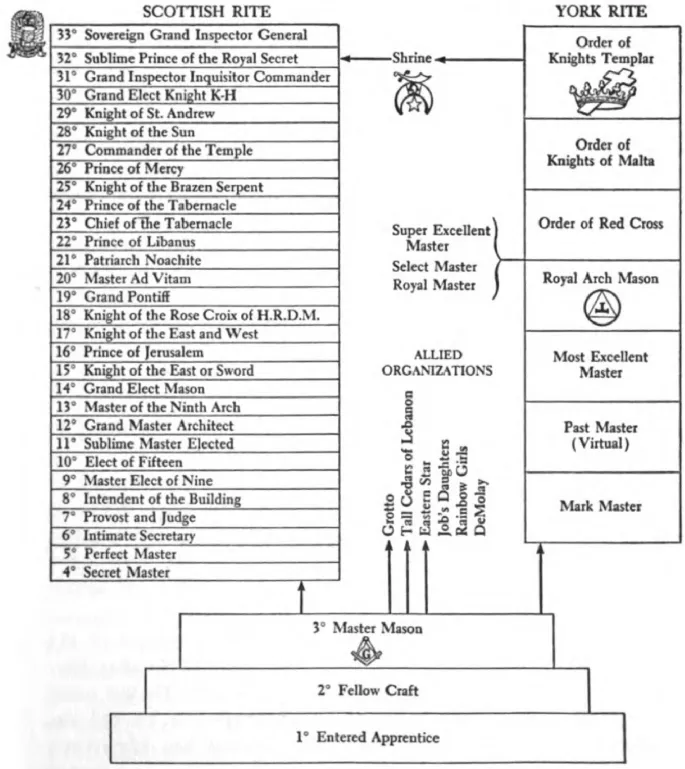
Many Masons are thoroughly bored by the routine of the Blue Lodge meetings and by its insipid initiations but are led on like a rabbit after a carrot to enter the “higher degrees.” They can advance in the Masonic hierarchy by one or both of two main routes as their spare time and pocketbook dictate: the Scottish and York rites. The former consists of 30 degrees superimposed on the basic three and topped by the honorary 33rd degree; the York rite leads to membership in the Knights Templar. Knights Templar and 32nd degree Masons are eligible for entry into the Shrine.
Masonry was transplanted to these shores from England less than a decade after the founding of the first Grand Lodge in 1717. Franklin became a member in 1731 and rose rapidly in Masonic ranks. Perhaps a majority of the colonial leaders in the Revolutionary War were Masons. A part in the Boston Tea Party is claimed by some Masonic writers since the records indicate that the Lodge of St. Andrew adjourned early for lack of members in attendance and the Minute Book is inscribed with a large “T.”
By the end of the War Masonic lodges were flourishing in the colonies and enjoyed the prestige of Washington and other national heroes who had been Masons. But Masonic growth was abruptly halted by the Morgan incident in 1826.
A 38-foot monument in Batavia, New York, has been erected to the memory of Morgan. The inscription at the foot of the monument reads: “Sacred to the memory of Wm. Morgan, a native of Virginia, a captain in the War of 1812, a respectable citizen of Batavia, and a martyr to the freedom of writing, printing and speaking the truth. He was abducted from near this spot in the year 1826, by Freemasons, and murdered for revealing the secrets of their order.”
Morgan, a disillusioned Mason, had written an exposé of the lodge which so angered the Masons in the vicinity that they kidnapped the author and took him to Fort Niagara. He was never again seen alive but a body was later identified as his and the general public concluded that for once Masons had taken their obligation to protect their secrets and punish offenders in a serious rather than a symbolic sense. Three men were eventually given prison terms for their part in the affair while Masons have insisted that Morgan simply escaped and became a missing rather than a murdered person. Some say he ended up as a Moslem.
As a result of this scandal, an anti-Masonic party was formed which polled 128,000 votes in the 1830 election and carried Vermont in the campaign against Jackson in 1832. Rhode Island and Vermont passed laws against the oaths demanded by secret societies. Thousands who had joined the lodge for business and political advantage burned their aprons. Membership in the New York lodges dropped from 30,000 to 300 in a few years time. Associations of Protestant churches denounced all secret societies, hundreds of lodges dissolved, and 130 anti-Masonic periodicals began publication as a direct result of the Morgan incident. It is only just to say that evidence that irate Masons actually murdered Morgan is inconclusive although the fact of the kidnapping itself has been established.
Meanwhile the Independent Order of Odd Fellows offered the mysteries of a secret ritual an...
Table of contents
- Title page
- TABLE OF CONTENTS
- PREFACE
- CHAPTER I-AMERICAN FREEMASONRY
- CHAPTER II-ORIGIN OF MASONRY
- CHAPTER III-MASONIC INITIATION
- CHAPTER IV-SCOTTISH AND YORK RITES
- CHAPTER V-THE MASONIC RELIGION
- CHAPTER VI-THE MASONIC OATHS
- CHAPTER VII-ANTI-CATHOLICISM IN AMERICAN LODGES
- CHAPTER VIII-PAPAL CONDEMNATIONS OF THE LODGE
- CHAPTER IX-ALLIED MASONIC ORGANIZATIONS
- CHAPTER X-LATIN AND EUROPEAN MASONRY
- CHAPTER XI-OTHER FORBIDDEN SECRET SOCIETIES
- CHAPTER XII-PROTESTANT AND EASTERN ORTHODOX CRITICISM OF MASONRY
- CHAPTER XIII-CHRISTIANITY AND THE LODGE
- APPENDIX
- BIBLIOGRAPHY
- REQUEST FROM THE PUBLISHER
Trusted by 375,005 students
Access to over 1.5 million titles for a fair monthly price.
Study more efficiently using our study tools.
Frequently asked questions
Yes, you can cancel anytime from the Subscription tab in your account settings on the Perlego website. Your subscription will stay active until the end of your current billing period. Learn how to cancel your subscription
No, books cannot be downloaded as external files, such as PDFs, for use outside of Perlego. However, you can download books within the Perlego app for offline reading on mobile or tablet. Learn how to download books offline
Perlego offers two plans: Essential and Complete
- Essential is ideal for learners and professionals who enjoy exploring a wide range of subjects. Access the Essential Library with 800,000+ trusted titles and best-sellers across business, personal growth, and the humanities. Includes unlimited reading time and Standard Read Aloud voice.
- Complete: Perfect for advanced learners and researchers needing full, unrestricted access. Unlock 1.5M+ books across hundreds of subjects, including academic and specialized titles. The Complete Plan also includes advanced features like Premium Read Aloud and Research Assistant.
We are an online textbook subscription service, where you can get access to an entire online library for less than the price of a single book per month. With over 1.5 million books across 990+ topics, we’ve got you covered! Learn about our mission
Look out for the read-aloud symbol on your next book to see if you can listen to it. The read-aloud tool reads text aloud for you, highlighting the text as it is being read. You can pause it, speed it up and slow it down. Learn more about Read Aloud
Yes! You can use the Perlego app on both iOS and Android devices to read anytime, anywhere — even offline. Perfect for commutes or when you’re on the go.
Please note we cannot support devices running on iOS 13 and Android 7 or earlier. Learn more about using the app
Please note we cannot support devices running on iOS 13 and Android 7 or earlier. Learn more about using the app
Yes, you can access Christianity and American Freemasonry by William J. Whelan in PDF and/or ePUB format, as well as other popular books in Theology & Religion & Buddhism. We have over 1.5 million books available in our catalogue for you to explore.