Dr Heilbrunn has already established himself as a historian of irregular warfare. But the subject is not merely a matter of past history, because the so-called 'nuclear stalemate', which has made total warfare improbable, has at the same time made limited warfare the only kind that the world can afford to risk. One hopes, naturally, that the risk will be avoided; but since even a conventional war of the traditional, pre-nuclear kind might easily lead unintentionally up to a total war between great powers and is therefore also likely to be avoided, there remains the residual danger of what may be called 'sub-conventional' warfare in marginal areas, which the great powers would be free to support or disown, to fan up or suppress, according to their immediate interpretation of their own interests. Such are the outbreaks which we have seen in recent years in Malaya, Vietnam, Algeria, Cyprus, Cuba, Laos and elsewhere. These are also, if Korea proves, as we hope, to have been the last conventional war between major powers, the kinds of war we must expect to see renewed in the future.The Resistance during the Second World War was the prelude to this new kind of warfare. It was not, of course, a new invention between 1940 and 1945: one remembers, on the contrary, the Spanish resistance during the Napoleonic Wars, which gave us the word guerrilla to add to our language, and the exploits of Lawrence and others during the Arab Revolt of 1917. But these were side-shows (Lawrence's own word) in support of a major conventional war, without which they would have achieved practically nothing. Since the Second World War, the corresponding outbreaks of irregular warfare have stood on their own as the major, if not the only, armed conflicts in their particular struggle, not a side-show in support of a major war elsewhere. The Spanish Civil War of 1936-8 is their archetype. Irregular warfare has accordingly become more professional and highly organized. It has had to acquire a sense of strategy, not merely of tactics. Perhaps eventually it will drop the epithet 'irregular'. Even by 1945 the 'partisans' of southern Europe and the Balkans had ceased to so describe themselves, and adopted instead the nomenclature of regular armies.Those who fought with the partisans of the Second World War will find that already there have been profound changes in the evolution of partisan warfare since 1945. But thanks to Dr Heilbrunn's keen sense of the continuity of that evolution, they will also recognize their own side-shows as forming an integral part of the history of this fascinating subject. He does us the honour of frequent quotation from our accounts of war-time experience; and it is encouraging to find that the lessons of that experience have been confirmed by later application elsewhere. His book is perhaps the first comprehensive study of the theoretical aspects of partisan warfare, at least in the English language. It is firmly grounded in practice, and likely to serve for a long time as a standard work.
- 183 pages
- English
- ePUB (mobile friendly)
- Available on iOS & Android
eBook - ePub
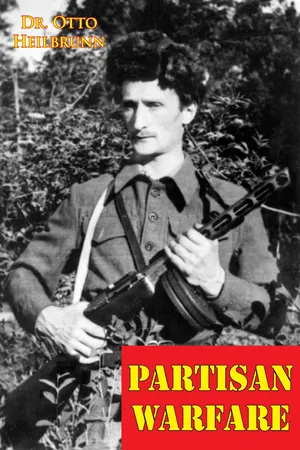
Partisan Warfare
About this book
Information
Subtopic
Military & Maritime HistoryIndex
HistoryTable of contents
- Title page
- TABLE OF CONTENTS
- AUTHOR’S NOTE
- FOREWORD BY C. M. WOODHOUSE
- MAPS
- INTRODUCTION
- CHAPTER 1-THE BIRTH OF A PARTISAN MOVEMENT
- CHAPTER 2-THE CHANCES OF SURVIVAL
- CHAPTER 3-THE CHANCES OF SUCCESS: STRATEGIC ASPECTS
- CHAPTER 4-THE CHANCES OF SUCCESS: OPERATIONAL ASPECTS
- CHAPTER 5-GUERILLA AND ANTI-GUERILLA TACTICS
- CHAPTER 6-GUERILLA AND ANTI-GUERILLA TECHNIQUES
- CHAPTER 7-RELATIONS WITH THE REGULAR ARMY
- CHAPTER 8-THE AIR FORCE IN GUERILLA WARFARE
- CHAPTER 9-GUERILLAS AND NUCLEAR WARFARE
- CHAPTER 10-THE TREATMENT OF GUERILLAS AND THE POPULATION
- CHAPTER 11-ON WHOSE SIDE VICTORY?
- CHAPTER 12: APPENDIX-ON PARTISAN WARFARE IN WORLD WAR II
- BIBLIOGRAPHY
Trusted by 375,005 students
Access to over 1.5 million titles for a fair monthly price.
Study more efficiently using our study tools.
Frequently asked questions
Yes, you can cancel anytime from the Subscription tab in your account settings on the Perlego website. Your subscription will stay active until the end of your current billing period. Learn how to cancel your subscription
No, books cannot be downloaded as external files, such as PDFs, for use outside of Perlego. However, you can download books within the Perlego app for offline reading on mobile or tablet. Learn how to download books offline
Perlego offers two plans: Essential and Complete
- Essential is ideal for learners and professionals who enjoy exploring a wide range of subjects. Access the Essential Library with 800,000+ trusted titles and best-sellers across business, personal growth, and the humanities. Includes unlimited reading time and Standard Read Aloud voice.
- Complete: Perfect for advanced learners and researchers needing full, unrestricted access. Unlock 1.5M+ books across hundreds of subjects, including academic and specialized titles. The Complete Plan also includes advanced features like Premium Read Aloud and Research Assistant.
We are an online textbook subscription service, where you can get access to an entire online library for less than the price of a single book per month. With over 1.5 million books across 990+ topics, we’ve got you covered! Learn about our mission
Look out for the read-aloud symbol on your next book to see if you can listen to it. The read-aloud tool reads text aloud for you, highlighting the text as it is being read. You can pause it, speed it up and slow it down. Learn more about Read Aloud
Yes! You can use the Perlego app on both iOS and Android devices to read anytime, anywhere — even offline. Perfect for commutes or when you’re on the go.
Please note we cannot support devices running on iOS 13 and Android 7 or earlier. Learn more about using the app
Please note we cannot support devices running on iOS 13 and Android 7 or earlier. Learn more about using the app
Yes, you can access Partisan Warfare by Dr. Otto Heilbrunn in PDF and/or ePUB format, as well as other popular books in History & Military & Maritime History. We have over 1.5 million books available in our catalogue for you to explore.