- 200 pages
- English
- ePUB (mobile friendly)
- Available on iOS & Android
eBook - ePub
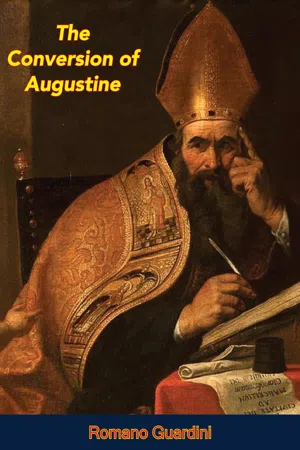
The Conversion of Augustine
About this book
Penned by Romano Guardini (1885-1968), one of the most profoundly insightful minds of the 20th century, this unique text…is a meditative unfolding of a defining moment in the history of Western civilization. A professor of religion and theology at the University of Munich, as well as a religious humanist, and an accomplished man of letters, Guardini wrote numerous influential works in several fields. This book is no exception to the Guardini rule: lucid explication of ideas and events central to the creation of Western culture. The merit of Guardini's beautiful book, writes Louis Dupre…consists in having restated Augustine's eternal insight in the light and darkness of contemporary existence. This title is, therefore, an unequaled aid for educators, students, and general readers wishing to understand the perennial issues embodied in the conversion from paganism to Christianity of the last Father of the Church.—Goodreads.
"Those who know and love the Confessions can expect to be amazed at how much more the personality and the conversion of this great religious genius will mean to them, seen through the eyes...of the author of this penetrating and beautiful study."—Virginia Kirkus
"For all libraries concerned with theology, philosophy, and the spiritual giants of our Christian era, this book is a rare find."—Library Journal
"Those who know and love the Confessions can expect to be amazed at how much more the personality and the conversion of this great religious genius will mean to them, seen through the eyes...of the author of this penetrating and beautiful study."—Virginia Kirkus
"For all libraries concerned with theology, philosophy, and the spiritual giants of our Christian era, this book is a rare find."—Library Journal
Tools to learn more effectively

Saving Books

Keyword Search

Annotating Text

Listen to it instead
Information
Topic
Theologie & ReligionSubtopic
ReligionThe Basis of Interpretation
I—Confession
AUGUSTINE ENTITLES his book Confessions. Definitions of the verb confiteri are these: to admit, to acknowledge formally, to proclaim, to praise God. The word signifies a stepping forth from the inmost reserve to the open, the public. Here, for religious reasons, the step is taken God-wards. A private life with its acts, just as it unfolded from attitude and intellectual struggle, is displayed—publicly, but also piously—before God, but so that men may hear.
What is the sense of such a confession? Augustine himself carefully weighs the question several times in the course of The Confessions, and in particular after the completion of the main account, namely, at the beginning of Book X, in which the new existence thus won is described. “For behold Thou lovest the truth, and he that does the truth comes to the light. I wish to do it in confession, in my heart before Thee, in my writing before many witnesses” (x. 1).
Then it continues: “And even if I would not confess to You, what could be hidden in me, O Lord, from You to whose eyes the deepest depth of man’s conscience lies bare? I should only be hiding You from myself, not myself from You” (x. 2).
God knows even without confession. He sees through a man’s inmost being, even when that man has no desire to be known, and resists. For God is Creator, and His knowing is the act by which He establishes the nature of His creature. God does not know because something is thus and so, but a thing is thus and so because God knows it. Through His creative knowing truth is true; through His will the creature has being and self-will. And God’s knowing is judicial. It is the act by which He measures His creature by the norm of the essential truth which He has established for it. His gaze judges, discards, and confirms. If this is so, confession is the act by which the creature places himself voluntarily in God’s truth. Now not only is it known by Him whose view is boundless, but it also desires to be known by Him. It allies itself with the all-perceiving power of God’s truth against its own shame and self-assertion.
The opposite of confession would be the will to close one’s heart. God can simply remain unknown, for all creatures the Impenetrable One. His knowledgeability of Himself is intrinsic to Himself; for the Father is revealed in His Son, who is the Father’s eternal, spoken Word, speaking and being spoken taking place in the boundless intimacy of love which is the Spirit, “nexus, osculum.” Outwardly, however, God is hidden and speaks only when it pleases Him to reveal Himself. A person can conceal his heart from other people. It is the better part of human relationships to practice, where wisdom so dictates, reserve toward others. But reserve toward God (in other words, refusal to confess) attempts the impossible; He is the All-penetrating One because He is the All-creating One. Such refusal is possible only as intention, intention that is already revolt.
Confession, then, is that act before God by which the created being voluntarily places himself into God’s knowing—into the knowing of the God who has created his essential nature out of nothing and who judges its reality. By this act he not only submits himself to divine appraisal, but he allies himself with it.
Viewed in context with Augustine’s teachings on man, this submerging of a human existence in divine truth is the supreme spiritual life, According to Augustine, the higher thing cannot be deduced from the lower; the lower must be understood from the higher. The possibilities inherent in a lower stage of a man’s life are liberated and fulfilled only when they are grasped by an overreaching higher. A man’s body can be understood really, essentially, only from his intellectual soul, for from the outset, the body is no mere biological reality, it is a reality determined by the mind; on the other hand, a man’s soul can be understood only from the true and the good, for the soul too is no simple reality, but one to be understood only in relation to its end. And in their turn, the true and the good are understandable only in the autonomous and holy reality of God. Thus for Augustine, the soul is not truly “spiritual” until it is drawn Godward in faith and the grace of the Holy Spirit. Human existence is formed “toward” God and “from” God. “Wherefore, as the soul is the flesh’s life, so is God the beatitude of man,” says the Civitas Dei (xix. 26). Ultimately, man is comprehensible only in God, because only in Him is his essence fulfilled. Hence, the real meaning of the confessio is the soul’s attempt to reach God in order to attain to fulness of being and self-realization.
At the same time, confession is directed also to men. It addresses God, but for the ears of men: candour with God becomes candour with men; the private act, public.
For this reason, admittedly, confession becomes questionable, and Augustine feels this. This questionable character is due partly to the ignoble motives of the hearer, to his curiosity and lust for sensation: “What therefore have I to do with men that they should hear my confessions, as if it were they who would cure all that is evil in me? Men are a race curious to know of other men’s lives, but slothful to correct their own. Why should they wish to hear from me what I am, when they do not wish to hear from You what they are themselves?” (x. 3) Only were the hearer himself to confess to the truth before God...only then would that understanding exist in which the words of his fellow-confessor could find their true place. Then there is that questionable aspect which arises from the doubt whether another can ever understand the outpourings of a man’s soul. “And when they hear me confessing of myself, how do they know whether I speak the truth, since no man knows the things of a man but the spirit of a man that is in him?” (x. 3) Not before God has taught men about themselves, thus placing them in the truth, are they enabled through Him to understand the words of a brother. “Whereas if they hear from You something about themselves, they cannot say: ‘The Lord is lying.’ For to hear from You about themselves is simply to know themselves. And who, knowing himself, can say: ‘It is false,’ unless himself is lying?” (x. 3)
Here is one of the great themes of Augustinian epistemology. A man and the words of his heart can be understood only by him who loves him. “But because charity believes all things—that is, all things spoken by those whom it binds to itself and makes one—I, O Lord, confess to You that men may hear, for though I cannot prove to them that my confession is true, yet these will believe me whose ears charity has opened to me” (x. 3). Naturally, this love must be defined more closely: it is the love “by which they are good,” not natural, demanding love, but that of the thirteenth chapter of Corinthians, that “loves all things,” in other words, love founded in divine revelation.
But why confess before men at all? “When the confessions of my past sins—which You have forgiven and covered up, giving me joy in You, changing my life by faith and Your sacrament—are read and heard, they stir up the heart. It no longer lies in the lethargy of despair and says ‘I cannot,’ but keeps wakeful in the love of Your mercy and the loveliness of Your grace, by which every weak man is made strong, since by it he is made conscious of his weakness” (x. 3). Man is man’s way to God. Augustine desires that his life bear witness to the possibility of reaching God. The reader is meant to understand this, to experience it himself, and bestir himself to action.
However, toward all men, himself included, he has one reservation: “To such then as You command me to serve will I show, not what I was, but what I now am, what I continue to be. But I do not judge myself. Thus therefore let me be heard” (x. 4). In the final analysis, then, Augustine places himself and his confession in the mystery of hope.
II—The Memory
THE CONFESSIONS on which the book so entitled is based, and which are its chief content, are exceedingly comprehensive: knowledge and acknowledgment of the confessor’s own acts, particularly those that are erring and blameworthy; insight into divine guidance; and praise of divine wisdom. Through confession a man becomes aware that everything he has is from God, and he acts upon that knowledge by putting himself and his life within God’s purview.
Confession springs from a review of the past, from the memory. Hence, it is proper that Book Ten, which was just quoted, should, after treating the essence of confession, turn to an examination of the essence of memory.
Augustine starts with the problem of how God may be comprehended; to this he replies: “Not by directing the senses to external things, but by spiritual experience.” With this he turns his attention to the inner world, beginning with a vivid description of the life of the memory; for the memory is the power with which a person summons his inner world for inspection, thus for the first time really possessing himself of it. “I shall mount beyond this power of my nature,” by which he means organic life and sense apperception still rising by degrees toward Him who made me. And so I come to the fields and vast palaces of memory, where are stored the innumerable images of material things brought to it by the senses. Further there is stored in the memory the thoughts we think, by adding to or taking from or otherwise modifying the things that sense has made contact with, and all other things that have been entrusted to and laid up in memory, save such as forgetfulness has swallowed in its grave. When I turn to memory, I ask it to bring forth what I want: and some things are produced immediately, some take longer as if they had to be brought out from some more secret place of storage; some pour out in a heap, and while we are actually wanting and looking for something quite different, they hurl themselves upon us in masses as though to say: “May it not be we that you want?” I brush them from the face of my memory with the hand of my heart, until at last the thing I want is brought to light as from some hidden place. Some things are produced just as they are required, easily and in right order; and things that come first give place to those that follow, and giving place are stored up again to be produced when I want them. This is what happens, when I say anything by heart (x. 8).
Augustine is referring to a “place” where the remembered may be found. At first glance this may seem unspiritual; but since it is this same Augustine who fought so passionately for recognition of the spirit’s incorporeity, it is clear that here there can only be question of a figure of speech. In themselves, such figures of speech are, of course, false; what counts is that they contribute to the knowledge in question. In this case the image of a spatial order is an apt device; one is reminded of depth-psychology, which in its attempt to grasp a person in all the multiplicity, tensions, and crises of his total existence, depicts him as a kind of architectural structure with precisely indicated “storeys.” Obviously the inner world is not really so divided; always the indivisible nature of the life-processes must also be taken into account. Nevertheless, the architectural concept remains the best way to impose upon the physically imperceptible an accessible form. In the same chapter Augustine himself insists that this “where,” this organized and comprehensive storeroom of experience, is not a real place (x. 8). Is not remembering precisely the retaining of corporeal things in an incorporeal manner? Furthermore, the whole concept is immediately related to that of sleep and to the “wakability” of memories, another indication of the spirituality of the act of remembering. Remembering is also the principle in virtue of which the receiving, storing, “awakening” of an experience proceeds, arranged according to place, time, similarity, cause, and so forth.
This concept creates a sense of great spaciousness within “the fields and vast palaces of memory.” Nothing is paltry, oppressive, or crude here; but rather, according to dimension, and the unfolding of different degrees of depth, height, breadth, and inwardness, the scene is variegated and full of tensions and potentialities: in brief, a stage for rich and significant happenings.
Then the concept of the memory is broadened still more. Now it no longer means only the storehouse of former experiences, but creative consciousness in general. Thus the spiritual life is rendered independent of reality’s immediate experience, since it can choose the material for its life and work from memory’s tremendous store. “All this I do inside me, in the huge court of my memory. In my memory are sky and earth and sea, ready at hand along with all the things that I have ever been able to perceive in them and have not forgotten” (x. 8).
Yes, in the memory too “I meet myself—I recall myself, what I have done, when and where and in what state of mind I was when I did it. In my memory are all the things I remember to have experienced myself or to have been told by others” (x. 8). Here the memory has become the organ of self knowledge, hence the basis of history.
Chapter Ten poses the problem as to how then “things themselves,” that is, the essence of things, “got into me.” Row did their meaning enter my consciousness? Through the senses? When these are asked, they reply: “No, we convey not the essence of things, but only their perceptible qualities.” Hence, knowledge of a thing’s essence must come from elsewhere.
Very well then, whence and how did they get into my memory? I do not know. For when I first learned them I was not trusting some other man’s mind, but recognized them in my own; and I saw them as true and committed them to my mind as if placing them where I could get at them again whenever I desired. Thus they must have been in my mind even before I learned them, though they were not in my memory. Then where were they, or how did it come that when I heard them spoken I recognized them and said: “It is so, it is true,” unless they were in my memory already, but so far back, thrust away as it were in such remote recesses, that unless they had been drawn forth by some other man’s teaching, I might perhaps never have managed to think of them at all? (x. 10)
Here we touch on epistemology’s basic problem: How is the essence—or aprioristic character—of a thing to be grasped? Augustine’s answer is already implied in his words “eternal images” and “Your unchangeable light.”
Understanding is concerned above all with the question of truth, with the question of what is essential and eternal. The senses transmit mere facts, which are as they happen to be, rather than as they should be according to their original image; they are facts which constantly change rather than facts which are essentially eternal. But genuine insight too exists: the upflare of an essence in its intrinsic necessity, of the value in its unshakable validity, of the eternal as constituted by true understanding. For Augustine, as for Plato, all this comes, not by way of the senses, but directly from the eternal ideas, of which the objects of experience and process are but images.
Without knowing it, while yet uninformed by any philosophical-theological awakening or particular mystical experience (See Book VII, Chapter X), the mind constantly refers itself to that realm of ideas which, ultimately, is none other than the living spirit of God. For God contemplates the One which is All: multiplicity in simplicity—Himself. He contemplates it and expresses what He contemplates in luminous clarity and holy beauty in the form born of heart and spirit, at once most powerful and most delicate—the Word. And since God is the absolute, all-creating One, His speech “begets”; His Word is alive and real. Thus God’s life assumes a personal form; He is the speaking God and the spoken Word: Father and Son. Augustine plunges into this mystery with all the power of his faith-enlivened mind, which is simultaneously the organ of his faith-enlivened heart, above all in his great work De Trinitate, in which he marries the heritage of Greek thought, namely, contemplation of the idea and of the Logos, with the tremendous powers of the Western world’s Christ-stirred heart, placing them, now one, in the service of Christian theology. Because the Father’s Word, the Logos, is the expression of all that must be expressed, of the very essence of God, it is also the expression of the essence of all possible finite things. For whatever can be, is, in that it reflects God. Thus the prototype of all things is to be found in the Logos, the Urwort.
Thither, unconsciously, man’s mind is drawn, first of all because it exists, hence, has its prototype there in the Logos. But a second reason lies in the fact that the mind is created to know. To know spiritually means to gra...
Table of contents
- Title page
- Table of Contents
- DEDICATION
- Acknowledgments
- Introduction
- The Basis of Interpretation
- The Way and The Decision
Frequently asked questions
Yes, you can cancel anytime from the Subscription tab in your account settings on the Perlego website. Your subscription will stay active until the end of your current billing period. Learn how to cancel your subscription
No, books cannot be downloaded as external files, such as PDFs, for use outside of Perlego. However, you can download books within the Perlego app for offline reading on mobile or tablet. Learn how to download books offline
Perlego offers two plans: Essential and Complete
- Essential is ideal for learners and professionals who enjoy exploring a wide range of subjects. Access the Essential Library with 800,000+ trusted titles and best-sellers across business, personal growth, and the humanities. Includes unlimited reading time and Standard Read Aloud voice.
- Complete: Perfect for advanced learners and researchers needing full, unrestricted access. Unlock 1.4M+ books across hundreds of subjects, including academic and specialized titles. The Complete Plan also includes advanced features like Premium Read Aloud and Research Assistant.
We are an online textbook subscription service, where you can get access to an entire online library for less than the price of a single book per month. With over 1 million books across 990+ topics, we’ve got you covered! Learn about our mission
Look out for the read-aloud symbol on your next book to see if you can listen to it. The read-aloud tool reads text aloud for you, highlighting the text as it is being read. You can pause it, speed it up and slow it down. Learn more about Read Aloud
Yes! You can use the Perlego app on both iOS and Android devices to read anytime, anywhere — even offline. Perfect for commutes or when you’re on the go.
Please note we cannot support devices running on iOS 13 and Android 7 or earlier. Learn more about using the app
Please note we cannot support devices running on iOS 13 and Android 7 or earlier. Learn more about using the app
Yes, you can access The Conversion of Augustine by Romano Guardini, Elinor Briefs in PDF and/or ePUB format, as well as other popular books in Theologie & Religion & Religion. We have over one million books available in our catalogue for you to explore.