- 380 pages
- English
- ePUB (mobile friendly)
- Available on iOS & Android
eBook - ePub
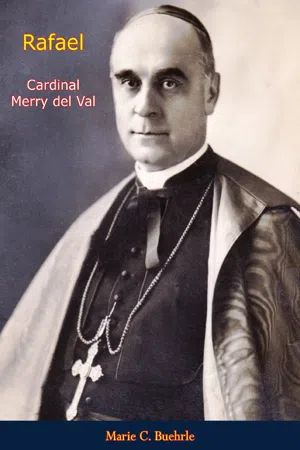
Rafael, Cardinal Merry del Val
About this book
"Give me souls, take away all else." This earnest appeal of Cardinal Merry del Val reveals the secret of his life, the story of his ambitions and joys. As man and prelate, few dignitaries of the Church during the early part of this century have left such an impression of culture, holiness, and statesmanship. Irish and Spanish by blood, English by birth and education, cosmopolitan by office, and Catholic in the deepest and truest sense of the word, his ideal was to be a priest in a poor parish in England but he was launched on a diplomatic career opposed to his tastes, his ideals, and his spiritual interests. In the course of his life he became a close friend of two great Popes, Leo XIII and Pius X, with whom he worked on famous reforms and on crucial modern problems. In the early years of his priesthood, Merry del Val organized a club for boys in Trastevere, a rough quarter in Rome, and even when he was Secretary of State under Pius X, he did not miss a day in a visit to this Association.—Print ed.
Trusted by 375,005 students
Access to over 1.5 million titles for a fair monthly price.
Study more efficiently using our study tools.
Information
Topic
Theology & ReligionSubtopic
Religion1
THE tall young Monsignor moved swiftly through the silent corridors of the Vatican, but paused a moment before he entered the Cappella Paolina. The stifling pressure of August was in the air, the suspense of a world hung over the Papal city, and in the square below, thousands of eyes were fixed upon a smokeless chimney. Although it was midday the chapel was dark except for the bright burning of the sanctuary lamp and the light of two candles on either side of the image of Our Lady of Good Counsel hanging high above the altar. Shadows were trembling over the crystal centre of the altar and around a motionless figure in red, kneeling before the Tabernacle at some distance from the communion rail.
The Monsignor’s light step scarcely brushed the stillness as he hurried up the aisle and knelt on the marble floor beside the Patriarch of Venice to whom he had never before spoken. Cardinal Sarto slowly lifted his head which had been buried in his hands while his elbows rested on one of the low wooden benches. Tears were streaming down his cheeks and a look of anguish was in his eyes as they met the calm, sympathetic glance of Monsignor Merry del Val.
Gently the young prelate repeated the message which, word for word, had burnt itself into his memory. With it he remembered the worried face of the Cardinal Dean, Oreglia di Santo Stefano, when, torn with anxiety, he had spoken to him after the first session of the morning.
“Ask Cardinal Sarto in my name,” he had said, “whether he persists in opposing his election and whether he wishes and authorizes me to make a final and public declaration to that effect before the assembled Conclave.”
Cardinal Sarto listened. The Monsignor’s eyes, warm with compassion, were fixed intently upon him. He scarcely breathed, awaiting the answer. It came; imploringly, but without hesitation: “Si, si, Monsignore. Tell the Cardinal to do me this kindness.” The look of Gethsemane was in his eyes. The Monsignor’s lips moved slowly as though they had strength merely to formulate a word dictated by another and drawn with difficulty from within:
“Coraggio!...Your Eminence, take courage. Our Lord will help you.” Cardinal Sarto looked deeply into the eyes of Monsignor Merry del Val.
“Grazie, grazie,” he repeated, then buried his face in his hands again and continued his wordless prayer.
Silently Monsignor Merry del Val withdrew; as silently as he had come, but with slower step. The picture on the wall at his right, Peter, head downward upon his cross, stood out with renewed significance as he retraced his way down the airless aisle. His first meeting with the Patriarch of Venice! He felt as though he had just left the presence of a saint.
*****
Some hours after Cardinal Sarto’s whispered words with Monsignor Merry del Val the urgently renewed appeal of many members of the Sacred College overcame his opposition. He loved God’s will better than his own. In a spirit of resignation and obedience he withdrew his great refusal. When on the following morning he was chosen by an overwhelming majority and asked whether he would accept the election, he replied with the words of Christ: “If this chalice cannot pass from me except I drink it, may the will of God be done!”
*****
The multitude in the square of St. Peter’s swayed uneasily towards the quiet Vatican on the morning of August 3rd, 1903. It was time for some sign of the outcome of the first voting of the day. Again thousands of eyes were riveted upon the smokeless chimney. Then a sudden cry! A slender thread, barely visible, spiralled into the upper air. From all sides a crescendo of shouts like an incoming tide broke in upon the windless day, while the wisp of smoke thickened into white billows rolling in rapid succession out into the sunlight. Driven by a single impulse all eyes turned towards the outside balcony of St. Peter’s. Then the throng grew still and waited.
Within the Vatican a white-haired Cardinal sat stricken and did not move from his place. The door of the Sistine Chapel opened and a tall young Monsignor, the Secretary of the Conclave, moved quietly to his side. Slowly, after some moments the Cardinal rose. The Secretary accompanied him to the Sistine sacristy, known as the room of tears, on the Gospel side of the altar. Silently, overcome by emotion, the newly elected Pontiff put on the Papal cassock.
Heavily the tense moments hung over the square of St. Peter’s; but like a sudden current a premonitory stir ran through the seething piazza when Cardinal Macchi appeared on the balcony proclaiming that the Church had a Pope, Cardinal Giuseppe Sarto, who had taken the name of Pius X. A generation had passed since such an announcement had been made, and a mighty roar of exultation, the first of its kind in more than a quarter of a century, beat upon the façade of St. Peter’s and against the silent Vatican where Monsignor Merry del Val was placing the white zucchetto upon the bowed head of Pius X.
*****
The heat of the day had abated ever so little when the bell of St. Peter’s sounded the final stroke of the evening Ave Maria, and one by one all the answering bells of Rome dropped into silence. The interval of stillness came like quiet breathing after the strain of prolonged exertion. The Cardinals, who lived so intimately together during this momentous Conclave, had separated and gone to their respective residences; but in the Sala Borgia Monsignor Merry del Val was still sitting at his desk using the concluding hours of that epoch-making day to finish the work that had so unexpectedly been thrust upon him.
It was almost over now. He was sorting papers and despatching the last urgent business before he would be free to return home to the Accademia Ecclesiastica. Pinturicchio’s magnificent murals had looked strangely down upon the twentieth-century desk, the electric lights, the telephone and the typewriter, upon a harassed secretary rattling his papers while the Catholic world was turning upon its poles. Behind it all towered the eternity of Rome. Within it, pulsed the wondrous identity between Peter in his tomb and Pius in the solitude of his Conclave cell. The labouring Monsignor felt those kindly eyes upon him as he worked towards the moment when his concluding duty as Secretary of the Conclave would take him into the presence of the Pope, to present for signature the letters announcing the election officially to sovereigns and heads of States.
The clock in the Court of St. Damasus struck half-past eight when Monsignor Merry del Val went up to the third floor of the Vatican, troubled at having to disturb the Holy Father after the long and trying day. He found him sitting at a table saying his breviary, still in the same room which he had occupied during the Conclave. Pius X looked up with a smile of welcome. The weariness dropped from his eyes and they lit rapidly with life and warmth. The young Monsignor knelt to kiss his hand.
“I am so sorry, Your Holiness, and beg you to pardon me for adding to your fatigue. I am well aware of how tired you must be, and should not have ventured to intrude except for the need of despatching these official letters without delay.”
“Ma si, si Monsignore, and are you perhaps not tired? I have seen how you have spent yourself during these days.”
To the Secretary, who felt that he had done only what others would have accomplished under similar circumstances, it seemed incredible that the Holy Father should so completely forget himself on such a day, as to think of the possible fatigue of a very young ecclesiastic rather than of his own exhaustion. Monsignor Merry del Val was destined to realize more and more that Pius X constantly thought of others and rarely, if ever, of himself.
“Show me, Monsignor, how I should sign,” the Holy Father asked as he took a slip of paper and wrote a sample of his first signature as Pope: Pius P.P.X. When the letters were finished Monsignor Merry del Val gathered them up and dropped to his knees. “May I beg the blessing of Your Holiness,” he asked, “before returning to my Accademia?” The Pope seemed startled and made a slight gesture of surprise. With his hand resting upon the Secretary’s shoulder, he said almost reproachfully: “Monsignore, do you want to abandon me?”
“No, Your Holiness,” Monsignor Merry del Val answered humbly; “but my work is done.”
“No, no, stay, stay. I have decided nothing yet. I don’t know what I shall do. For the present I have no one. Remain with me as Pro Secretary of State. Later we will see.”
The Pope’s voice was tender. It was that of the Vicar of Christ. Monsignor Merry del Val could not resist an appeal which seemed to come from Our Lord Himself. Deep down in his will however, the recurring struggle made itself felt. A shrinking from honours and high position dwelt at the very root of his being. Unfailingly his first impulse urged him to withdraw from notice; but the will of God, more urgent than any mere impulse, dominated him with a power stronger than that of his own strong will.
“Corraggio!” Gently the Holy Father whispered it, the word of destiny spoken within the hush of the Pauline Chapel. The young Prelate felt it in his soul, his own compassionate word come back to him, while the Pope’s hands lay upon his head in benediction.
“I shall expect you,” Pius X smiled with the words, “tomorrow morning.”
2
ON Good Friday of the year 1250, against the wall in the city of Saragossa in Spain, the story of Calvary had a sequel. In hatred of the religion of Christ and to reproduce His Passion, the ferocious Mossé Albaya with a group of his followers nailed an acolyte of the Cathedral, a child of seven, to a cross which they had painted upon the wall. He was the son of Sancho del Val, and a descendant of the Breton knight Laval, who in the preceding century had fought in the Spanish crusades against the Moors and later settled in Spain. The devotion to the little Saint obtained many graces, the most impressive of which was the conversion of the man who killed him. Today in the city of Saragossa a series of has reliefs and a side chapel in one of its churches commemorate San Dominguito, or little San Domingo, the martyr son of an ancestor of Rafael Merry del Val.
The name Merry also suggests a background of persecution, originating as it does, in seventeenth-century Ireland, where it was adopted for reasons of security by a family that traces its descent from the kingly O’Hoolichans of Hy-Main in Connaught. One branch of the family moved to Waterford, and in the latter half of the eighteenth century went to Spain and settled in Seville. The Merrys had always been almost as intensely Irish as they were Catholics, until Thomas Merry went to England and was educated at Ampleforth, while another member of the family served in the British navy.
Although this section of the Merrys was British, the succeeding generation became entirely Spanish; for it was Richard, the son of Thomas, who established himself in Seville, and Rafael, one of his sons, who married Donna Maria della Trinidad del Val, who belonged to a distinguished family of Aragon, which had originated in Saragossa. The name Merry y del Val was eventually legalized as simply Merry del Val. It was Rafael, a son of this marriage, who later went to London as Secretary to the Spanish Legation and became the father of Rafael, Cardinal Merry del Val.
“My second son,” Don Rafael wrote into his diary, “was born in London at eight minutes after ten o’clock, on the morning of October 1, 1865, at 33 Portman Square, Gloucester Place. He was baptized on the following day by Canon Hearn in the Spanish chapel, and was named Rafael, Mary, Joseph, Peter, Francis Borgia, Domingo del Val, Gerard of the Blessed Trinity.”
On his mother’s side the Cardinal’s ancestry is an equally interesting combination of nationalities. His maternal great-grandfather, Don Pedro Juan de Zulueta, first Count de Torre Diaz, belonged to an old Basque family and was a banker in Cadiz in 1823 when a French expeditionary force took possession of the city. Don Pedro Juan was not only Lord President of the Cortes, but an advanced liberal for his day. The political situation caused him to leave Spain and to settle in London, where, with his eldest son, Don Pedro José de Zulueta, he established the banking firm of Zulueta and Company.
Don Pedro José in his new environment in a non-Catholic country, misled by certain rationalistic influences and imagining that in England, not like in Spain, one could remain a good Christian without being a Catholic, joined the Church of England and married Sophia Wilcox, who belonged to a rigidly Evangelical family. Her father was a Scotsman; her mother was the daughter of the Dutch artist, Van der Gucht, a friend of Sir Joshua Reynolds. Despite his error Don Pedro José was a deeply religious man, and being a thinker, eventually felt impelled to investigate the doctrines of the Church into which he had been born. He became completely convinced, and decided to return to the Catholic Church despite his grief at the prospect of a difference in belief from his wife with whom he was deeply in love.
The Oxford Movement was at its height, and religious thinking filled the air. Don Pedro was determined not to influence his wife; but told her of his intention, that the children must therefore be instructed in the Catholic Faith, and requested that she be present at the instructions. She smiled reassuringly. “My dear,” she said, “I made up my mind to that a year ago; but I wanted to leave you free to think it out in your own way.”
This settled the question. Both husband and wife became devout Catholics. In the meantime they found a great friend in Cardinal Wiseman, who wrote some of his charming plays expressly for the children. The eldest daughter, Sophia Josephine, mother of the future Cardinal, inherited the fervour of her parents and brought up her four sons, Alfonso, Rafael, Pedro, Domingo, and her daughter Maria, in the same spirit.
Thus Brittany and Ireland, Scotland, Holland and Spain, contributed to the nationality of the Cardinal. But he and his mother were born in England, his early training was English, and many of those who knew him best agree that in tastes and outlook he was predominantly English. Belgium, however, also participated in his education, and it is from those who were at school with him, in the Jesuit College of St. Michael in Brussels, that we have many a picture of him in adolescent years. Finally Italy, where he spent most of his life, played a major part in fashioning him.
These multiple national influences, far from causing a complexity which is often a source of conflict within...
Table of contents
- Title page
- Table of Contents
- AUTHOR’S NOTE
- DEDICATION
- FOREWORD
- ACKNOWLEDGMENTS
- 1
- 2
- 3
- 4
- 5
- 6
- 7
- 8
- 9
- 10
- 11
- 12
- 13
- 14
- 15
- 17
- 18
- 19
- 20
- 21
- 22
- 23
- 24
- 25
- 26
- 27
- 28
- 29
- 30
- 31
- 32
- 34
- 35
- 36
- 37
- 38
- 39
- 40
- 41
- 42
- 43
- 44
- 45
- 46
- 47
- 48
- 49
- 50
- 51
- 52
- 53
- 54
- 55
- 56
- 57
- 58
- 59
- 60
- 61
- 62
- 63
- 64
- 65
- 66
- 67
- 68
Frequently asked questions
Yes, you can cancel anytime from the Subscription tab in your account settings on the Perlego website. Your subscription will stay active until the end of your current billing period. Learn how to cancel your subscription
No, books cannot be downloaded as external files, such as PDFs, for use outside of Perlego. However, you can download books within the Perlego app for offline reading on mobile or tablet. Learn how to download books offline
Perlego offers two plans: Essential and Complete
- Essential is ideal for learners and professionals who enjoy exploring a wide range of subjects. Access the Essential Library with 800,000+ trusted titles and best-sellers across business, personal growth, and the humanities. Includes unlimited reading time and Standard Read Aloud voice.
- Complete: Perfect for advanced learners and researchers needing full, unrestricted access. Unlock 1.5M+ books across hundreds of subjects, including academic and specialized titles. The Complete Plan also includes advanced features like Premium Read Aloud and Research Assistant.
We are an online textbook subscription service, where you can get access to an entire online library for less than the price of a single book per month. With over 1.5 million books across 990+ topics, we’ve got you covered! Learn about our mission
Look out for the read-aloud symbol on your next book to see if you can listen to it. The read-aloud tool reads text aloud for you, highlighting the text as it is being read. You can pause it, speed it up and slow it down. Learn more about Read Aloud
Yes! You can use the Perlego app on both iOS and Android devices to read anytime, anywhere — even offline. Perfect for commutes or when you’re on the go.
Please note we cannot support devices running on iOS 13 and Android 7 or earlier. Learn more about using the app
Please note we cannot support devices running on iOS 13 and Android 7 or earlier. Learn more about using the app
Yes, you can access Rafael, Cardinal Merry del Val by Marie C. Buehrle in PDF and/or ePUB format, as well as other popular books in Theology & Religion & Religion. We have over 1.5 million books available in our catalogue for you to explore.