This brilliant and engaging biography of Varina Davis tells of the early days of her marriage to Jefferson Davis, the controversial figure who would become president of the Confederacy. The story gives a detailed account of their life in Washington and Richmond, the years of war, and follows their journey during the weeks and months of escape and then—following Jefferson Davis' release from prison—exile.
"EVERY move the made was noticed and commented on. She was accused of being friendly to the North, of harboring spies in her home, of feasting when others starred, of pretentious ways, of nepotism, of not reading the books which she quoted so freely, of extravagant entertaining in hours of crisis, and of meddling in politics and military affairs. Some of the stories were true; many were not, but it is self-evident that she instinctively generated heat lightning around her."—First Lady of the South.
Includes numerous illustrations.
- 508 pages
- English
- ePUB (mobile friendly)
- Available on iOS & Android
eBook - ePub
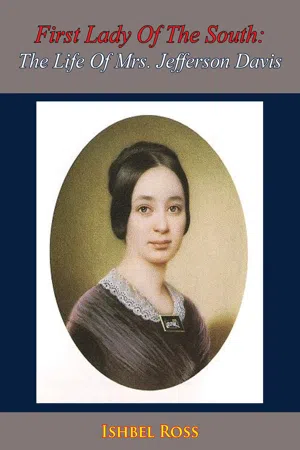
First Lady Of The South: The Life Of Mrs. Jefferson Davis
About this book
Information
Subtopic
19th Century HistoryIndex
HistoryPART ONE
1—A CHRISTMAS ENCOUNTER
VARINA ANNE HOWELL was seventeen when Jefferson Davis first crossed her path at the garden gate of his niece’s home in Mississippi. She had stopped off at Florida McCaleb’s house on her way to spend the Christmas holidays of 1843 at The Hurricane, the large plantation owned by Joseph Emory Davis, Jeff’s older brother and idol. Varina had come from her home in Natchez and had paused for a night at David McCaleb’s place, which was some miles distant from the family headquarters on lonely Palmyra Peninsula. Jeff was asked by his brother to deliver a note to Varina, telling her that his niece, Mary Jane Bradford, would arrive next day with horses to take her to The Hurricane.
It was only a brief encounter, a mild exchange of courtesies and a family chat, as he went on his way to a political caucus in Vicksburg. Varina was magnetized by the handsome planter with the soldierly bearing, although his stiff manner chilled her at first. They were widely different in age and experience. Davis had just taken his initial step along the political path that would lead to his ultimate destiny as first and only President of the Confederate States of America. Varina had recently completed her studies with a Whig tutor from New England.
Davis was eighteen years her senior, a widower who had isolated him-self on his plantation for eight years, dwelling with persistent melancholy on the memory of Zachary Taylor’s daughter who had died three months after their marriage in 1835. The legend of his love for Sarah Knox Taylor was to spread with his fame, casting a shadow at times over Varina’s possessive spirit. Yet this second romance, touched off at the McCalebs’, would flower eventually into one of the rarer idylls of American history.
Joseph may well have invited Varina to share his Christmas hospitality in the hope of diverting his younger brother from his morbid preoccupation with the past. The Howells and the head of the Davis clan were old friends, and Varina was already showing the kind of wit and intelligence that impressed the worldly Joseph, who had political aspirations for his brother and had stirred him into action for the Democratic party. She was better educated than the average girl of her generation, and even at seventeen displayed some of the strength and originality that were to distinguish her all through life, tempered at this time by a deferential manner and the soft accents of Mississippi.
Varina was of more than average height.{1} In her youth she was shapely and well proportioned, moving with grace and freedom. Her dark hair, glossy and thick, framed a long face, smooth in contour, firm in its planes. She had abandoned her dangling schoolgirl strands in favor of a more adult effect for the Christmas festivities. Her hair was sleekly groomed from a center part and fanned out in a high swirl on the crown of her head. Then and later Varina’s eyes were the feature that people remembered. They were uncommonly large, full, and dark, settled deep under heavy lids. Many who watched her commented on the way they could blaze with anger, shine with friendly interest, or flash with amusement. Her mouth was large and freely chiseled, suggesting petulance in her early years, and vigor in later life. She already had the sultry look that matched her powerful, driving nature. Varina was intense in all her emotions, and the years were to prove her a woman who could love and hate with equal vehemence. There were few points of similarity between her and the small dark beauty with spiraling ringlets who had been Jefferson Davis’s first wife, except that both were vivacious, sympathetic, and intelligent.
Because of the isolation in which he lived, Varina was scarcely conscious of the existence of Jefferson until this encounter, although Joseph Davis frequently visited their home, The Briers, outside Natchez. She had arrived in a state of high excitement after a trip up the Mississippi in the steamboat Magnolia which seemed a “floating palace of ease and luxury.” She was impressed with the cuisine and diverted by the exchange of wares at each landing—fresh fruits and plantation flowers for ice, new books, and luxury items ordered from New Orleans.
When Mary Jane joined her at the McCalebs’ with a groom and a carriage for her luggage the two girls galloped off in high spirits under a bright blue winter sky, their horses’ hoofs scattering the dry leaves that strewed the forested path to the Davis home. Although used to plantation ways, Varina was impressed with The Hurricane, which had taken its name from a cyclone in 1827 that had battered the property, eroded the peninsula, injured a Davis brother named Isaac, and killed one of his sons. There was strength, if not grace, in the massive building. Varina was conscious at once of its solid dimensions and the close spacing of the thick colonnades that ringed the house. It lacked the grace and unity of the Natchez mansions familiar to her, but she looked around her with keen interest as she entered the wide hall, noting the low ceilings in the main building, the narrow windows and massive walls.{2}
Christmas greens were looped against cream paneling. She was conscious of a blur of rose brocatelle and polished wood through the dim light of the drawing room and the “tea room” where the feminine members of the family gathered to embroider, read, and chat. Heavy walnut pieces and French period furniture mingled harmoniously in the various rooms. Lace and satin curtains blew at the windows. The prisms of glittering chandeliers stirred faintly in the breeze. Outdoors, a pergola led to an annex where the family dined en masse in a long paved room at a table set with fine crystal and silver. Varina was struck by the abundance of game, the gargantuan roasts, the exotic foods from the New Orleans markets. But upstairs in the annex she found her favorite spot—an arched music room and study where the young people “sang and played, acted charades, gave mock concerts, and improvised games, while the family portraits looked stolidly down upon our antics.”{3} The stern, handsome face of Samuel Davis, whose sons, Joseph and Jefferson, so closely resembled him, was of particular interest to Varina.
Doors paneled halfway with glass led to the grounds, which Joseph had cultivated to a high degree but which still vaguely suggested primitive forest land, although he adorned them with statuary, fountains, and arbors. Varina wandered happily in the huge rose garden and noted the pergolas and pathways; the imported trees and shrubs that blended with the native oaks and walnut trees; the China and tulip trees richly festooned with their own wild vines. Peach, fig, and apple trees covered eight acres of land. From the house the Mississippi could be glimpsed through wide clearings artfully contrived for vistas. A border of close-cut sward edged the open fields leading down to the river. Yet the plantation had a feeling of remoteness from civilization, in spite of all the modern conveniences that Joseph had introduced, and the sophisticated manner in which his household was managed. The Davis domain covered an area of more than five thousand acres on the peninsula, and land had been parceled out to various members of Joseph’s far-reaching clan. The McCalebs were a case in point. His niece Florida had married young David McCaleb, and he liked to see all of his relatives established in comfort. As long as he had money and land to give away, he shared them freely.
Joseph had given up his law practice in 1827, the year after Varina was born, to develop the uncultivated land he had acquired on Palmyra Peninsula, increasing his holdings gradually by buying out the small settlers who had already done some forest clearing. His brother Isaac helped him at first, but after a clash of wills the younger brother had moved to Canton. When Jeff, who was graduated from West Point in 1828, resigned from the army after seven years of frontier service in order to conciliate Zachary Taylor, who did not wish his daughter to marry a soldier, Joseph offered him eighteen hundred acres of uncleared land to cultivate, and slaves to work it. Although a novice at farming the young soldier gave it the same concentrated and technical interest that he applied to military tactics. He became invaluable to Joseph as he developed his own acres and ran The Hurricane for him while the elder Davis toured the spas in summer. Their land lay cupped in a bend of the Mississippi, with the river running almost all around it. Today the river encircles it completely. It was thirty miles below Vicksburg. Mail arrived several times a week at a landing three miles down the river. When passengers were headed for the larger Mississippi boats they were taken by skiff to the landing through thick underbrush.
Joseph had more visible warmth and geniality than his brother ever displayed, but he was an autocrat of the first order. He was a man of extraordinary force and energy, more than six feet tall, with a close resemblance to Jefferson—the same aquiline nose, the classically carved lips, the suggestion of a sensitive and ardent spirit. In his early years he looked more poet than planter, but by the time Varina met him he was becoming patriarchal, a sarcastic, dynamic man sustaining various family offshoots on his acres.
He had amassed his vast fortune from next to nothing, and he spent it according to prevailing plantation standards. He had blooded horses, fine equipages, and his cellar was stocked with well-chosen wines. He summered at the fashionable resorts and traveled in style with his own coaches and servants. Joseph was potent in regional politics and public affairs. He was a familiar figure at the cotton depot and slave market in Natchez, and he had helped to draw up the code of honor for the local duelists, of whom there were many. With little formal education he had become one of the best read men in the South. He fluently discussed politics, books, law, science, the legends of the Mississippi, and the history of New Orleans. He was thought to rule his plantation with a sense of equity, according to the standards of his day, but he was an autocrat in his home, except where his wife Eliza was concerned.{4} She was a pliant figure in his large hierarchy, gentle, quiet, sickly, humoring him in his whims and never raising her voice in protest over his complex family relationships. Cousins and nieces abounded at the family board. His brothers and his sisters were always warmly welcomed, and the hospitality of The Hurricane was notorious in the region.
Varina quietly took stock of the assorted family circle. She had been invited a year earlier for the Christmas festivities but was busy then with her studies, and her mother thought her still too young for gaiety away from home. Actually, Varina hungered for wider experience and was ready to meet it halfway. Most of her travels up to this time had been “autour de ma chambre,” she bleakly confessed, except for two terms spent at Madame D. Grelaud’s Female Seminary in Philadelphia. Her politics, her education, even her character, had been molded for the most part by her tutor, Judge George Winchester, a New England jurist from Salem who had settled in Natchez in the early 1820’s and was a true believer in Henry Clay.
Varina had just completed a stiff grounding in Latin and the English classics with the Judge. He was still so much a part of her life that her mother had asked him to escort her along the Mississippi as far as Diamond Head, where the McCalebs had their plantation. There he had left her to face the unknown. Joseph made her feel at home at once. As he strolled with her through his rose garden, he probed lightly for her political beliefs and found her ready to discuss them. Judge Winchester had accustomed her to debate and she was well informed on national politics. She read the National Intelligencer regularly and shared the prevailing distaste in her region for Martin Van Buren. Joseph noticed that she wore the Subtreasury cameo brooch that many Southern women affected by way of reproach. The symbol was a little bloodhound chained to a strongbox. Before leaving she took it off for Jefferson’s benefit, but it appears in a contemporary portrait of Varina taken shortly before her marriage.
To her delight there were books everywhere—in the study, in the office shared by the two brothers, in the small columned library on the grounds. Varina must have seemed a little pedantic to the worldly planter who kept her well entertained until his brother returned from Vicksburg, exhilarated by the success of his speech there. But her searching mind was to be a strong factor in her relationship with her husband. After his first wife’s death Jefferson Davis had read systematically and with purpose, and in the years to come each would feed this interest in the other. But for the time being he was conscious chiefly of her youth and freshness, her emotional warmth, her pride, and her keen response to her surroundings.
It was a family custom to read to Joseph in the evening. He followed the Congressional debates in this fashion, and kept abreast of the new books on politics and economics. Jefferson usually read to him until his eyes grew tired. Then the women of the household took turns. Varina picked up the thread with real enjoyment. Jeff noticed the ease with which she handled French idioms and Latin quotations, and her sharp awareness of what she read.
The days that followed were to be remembered always by the Jefferson Davises for their swift plunge into a deep and lasting love. Characteristically, Varina’s infatuation for the quiet thoughtful man so much older than herself was almost instantaneous. She had quickly dismissed her first doubts about him. His response was slower, but he listened attentively when Joseph remarked after an evening of reading, “She will take high rank in the world of femininity when she blossoms out and comes thoroughly to herself.” Then he added in a quick burst of admiration, “By Jove, she is as beautiful as Venus.”
Jefferson made no comment for several minutes. He was always more reserved than Joseph in his judgments. Did he perhaps feel some hidden drive on his brother’s part? It had always been Joseph’s habit to influence his younger brother, in politics, in plantation affairs, in family matters, in so far as Jeff could be swayed ...
Table of contents
- Title page
- TABLE OF CONTENTS
- ILLUSTRATIONS
- ACKNOWLEDGMENTS
- PART ONE
- PART TWO
- BIBLIOGRAPHY
Trusted by 375,005 students
Access to over 1.5 million titles for a fair monthly price.
Study more efficiently using our study tools.
Frequently asked questions
Yes, you can cancel anytime from the Subscription tab in your account settings on the Perlego website. Your subscription will stay active until the end of your current billing period. Learn how to cancel your subscription
No, books cannot be downloaded as external files, such as PDFs, for use outside of Perlego. However, you can download books within the Perlego app for offline reading on mobile or tablet. Learn how to download books offline
Perlego offers two plans: Essential and Complete
- Essential is ideal for learners and professionals who enjoy exploring a wide range of subjects. Access the Essential Library with 800,000+ trusted titles and best-sellers across business, personal growth, and the humanities. Includes unlimited reading time and Standard Read Aloud voice.
- Complete: Perfect for advanced learners and researchers needing full, unrestricted access. Unlock 1.5M+ books across hundreds of subjects, including academic and specialized titles. The Complete Plan also includes advanced features like Premium Read Aloud and Research Assistant.
We are an online textbook subscription service, where you can get access to an entire online library for less than the price of a single book per month. With over 1.5 million books across 990+ topics, we’ve got you covered! Learn about our mission
Look out for the read-aloud symbol on your next book to see if you can listen to it. The read-aloud tool reads text aloud for you, highlighting the text as it is being read. You can pause it, speed it up and slow it down. Learn more about Read Aloud
Yes! You can use the Perlego app on both iOS and Android devices to read anytime, anywhere — even offline. Perfect for commutes or when you’re on the go.
Please note we cannot support devices running on iOS 13 and Android 7 or earlier. Learn more about using the app
Please note we cannot support devices running on iOS 13 and Android 7 or earlier. Learn more about using the app
Yes, you can access First Lady Of The South: The Life Of Mrs. Jefferson Davis by Ishbel Ross in PDF and/or ePUB format, as well as other popular books in History & 19th Century History. We have over 1.5 million books available in our catalogue for you to explore.