Classic reflections on gospel wisdom from a modern martyr show the ongoing relevance of the gospel in an age of idolatrous power and capricious violence.
"Disturbing reminders...that pious formulas and clichés are not enough to combat evil."—Xavier Rynne, The New Yorker
"What is most characteristic about these writings...is their absolute honesty and the absolute sincerity of their passion for man....Some of the most powerful spiritual writing of recent times."—Walter Arnold, Commonwealth
"A searching commentary....These meditations of a priest ought to become the foci of those of every layman."—Eldon Talley, Cross Currents
"Must rank as one of the great human and spiritual documents of our time."—The Boston Pilot
- 152 pages
- English
- ePUB (mobile friendly)
- Available on iOS & Android
eBook - ePub
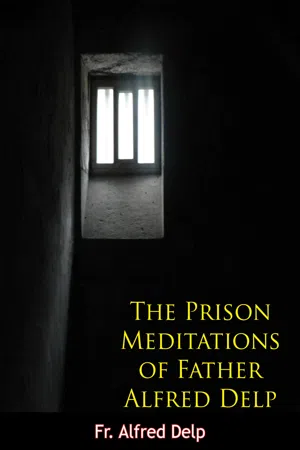
The Prison Meditations of Father Alfred Delp
About this book
Information
Topic
Theology & ReligionSubtopic
ReligionMEDITATIONS
I THE PEOPLE OF ADVENT
Advent is the time for rousing. Man is shaken to the very depths, so that he may wake up to the truth of himself. The primary condition for a fruitful and rewarding Advent is renunciation, surrender. Man must let go of all his mistaken dreams, his conceited poses and arrogant gestures, all the pretenses with which he hopes to deceive himself and others. If he fails to do this stark reality may take hold of him and rouse him forcibly in a way that will entail both anxiety and suffering.
The kind of awakening that literally shocks man’s whole being is part and parcel of the Advent idea. A deep emotional experience like this is necessary to kindle the inner light which confirms the blessing and the promise of the Lord. A shattering awakening; that is the necessary preliminary. Life only begins when the whole framework is shaken. There can be no proper preparation without this. It is precisely in the shock of rousing while he is still deep in the helpless, semiconscious state, in the pitiable weakness of that borderland between sleep and waking, that man finds the golden thread which binds earth to heaven and gives the benighted soul some inkling of the fullness it is capable of realizing and is called upon to realize.
We ought not to ignore Advent meditations such as these. We have to listen, to keep watch, to let our heart quicken under the impulse of the indwelling Spirit. Only in this quiescent state can the true blessing of Advent be experienced and then we shall also recognize it in other ways. Once awakened to an inner awareness we are constantly surprised by symbols bearing the Advent message, figures of tried and proved personalities that bring out in a most forceful way the inner meaning of the feast and emphasize its blessing.
I am thinking of three in particular—the man crying in the wilderness, the herald angel and our blessed Lady.
The man crying in the wilderness. We live in an age that has every right to consider itself no wilderness. But woe to any age in which the voice crying in the wilderness can no longer be heard because the noises of everyday life drown it—or restrictions forbid it—or it is lost in the hurry and turmoil of “progress”—or simply stifled by authority, misled by fear and cowardice. Then the destructive weeds will spread so suddenly and rapidly that the word “wilderness” will recur to men’s minds willy-nilly. I believe we are no strangers to this discovery.
Yet for all this, where are the voices that should ring out in protest and accusation? There should never be any lack of prophets like John the Baptist in the kaleidoscope of life at any period; brave men inspired by the dynamic compulsion of the mission to which they are dedicated, true witnesses following the lead of their hearts and endowed with clear vision and unerring judgment. Such men do not cry out for the sake of making a noise or the pleasure of hearing their own voices, or because they envy other men the good things which have not come their way on account of their singular attitude towards life. They are above envy and have a solace known only to those who have crossed both the inner and outer borders of existence. Such men proclaim the message of healing and salvation. They warn man of his chance, because they can already feel the ground heaving beneath their feet, feel the beams cracking and the great mountains shuddering inwardly and the stars swinging in space. They cry out to man, urging him to save himself by a change of heart before the coming of the catastrophes threatening to overwhelm him.
Oh God, surely enough people nowadays know what it means to clear away bomb dust and rubble of destruction, making the rough places smooth again. They will know it for many years to come with this labor weighing on them. Oh, may the arresting voices of the wilderness ring out warning mankind in good time that ruin and devastation actually spread from within. May the Advent figure of St. John the Baptist, the incorruptible herald and teacher in God’s name, be no longer a stranger in our own wilderness. Much depends on such symbolic figures in our lives. For how shall we hear if there are none to cry out, none whose voice can rise above the tumult of violence and destruction, the false clamor that deafens us to reality?
The herald angel. Never have I entered on Advent so vitally and intensely alert as I am now. When I pace my cell, up and down, three paces one way and three the other, my hands manacled, an unknown fate in front of me, then the tidings of our Lord’s coming to redeem the world and deliver it have quite a different and much more vivid meaning. And my mind keeps going back to the angel someone gave me as a present dining Advent two or three years ago. It bore the inscription: “Be of good cheer. The Lord is near.” A bomb destroyed it. The same bomb killed the donor and I often have the feeling that he is rendering me some heavenly aid. It would be impossible to endure the horror of these times—like the horror of life itself, could we only see it clearly enough—if there were not this other knowledge which constantly buoys us up and gives us strength: the knowledge of the promises that have been given and fulfilled. And the awareness of the angels of good tidings, uttering their blessed messages in the midst of all this trouble and sowing the seed of blessing where it will sprout in the middle of the night. The angels of Advent are not the bright jubilant beings who trumpet the tidings of fulfillment to a waiting world. Quiet and unseen they enter our shabby rooms and our hearts as they did of old. In the silence of night they pose God’s questions and proclaim the wonders of him with whom all things are possible.
Advent, even when things are going wrong, is a period from which a message can be drawn. May the time never come when men forget about the good tidings and promises, when, so immured within the four walls of their prison that their very eyes are dimmed, they see nothing but gray days through barred windows placed too high to see out of. May the time never come when mankind no longer hears the soft footsteps of the herald angel, or his cheering words that penetrate the soul. Should such a time come all will be lost. Then indeed we shall be living in bankruptcy and hope will die in our hearts. For the first thing man must do if he wants to raise himself out of this sterile life is to open his heart to the golden seed which God’s angels are waiting to sow in it. And one other thing; he must himself throughout these gray days go forth as a bringer of glad tidings. There is so much despair that cries out for comfort; there is so much faint courage that needs to be reinforced; there is so much perplexity that yearns for reasons and meanings. God’s messengers, who have themselves reaped the fruits of divine seeds sown even in the darkest hours, know how to wait for the fullness of harvest. Patience and faith are needed, not because we believe in the earth, or in our stars, or our temperament or our good disposition, but because we have received the message of God’s herald angel and have ourselves encountered him.
Our blessed Lady. She is the most comforting of all the Advent figures. The fact that the angel’s annunciation found a motherly heart ready to receive the Word, and that it grew beyond its earthly environment to the very heights of heaven, is the holiest of all Advent consolations. What use are all the lessons learned through our suffering and misery if no bridge can be thrown from our side to the other shore? What is the point of our revulsion from error and fear if it brings no enlightenment, does not penetrate the darkness and dispel it? What use is it shuddering at the world’s coldness, which all the time grows more intense, if we cannot discover the grace to conjure up visions of better conditions?
Authors of legends and fairy tales have always used mothers as a favorite theme for rousing the strongest human feelings. Often these authors use motherhood as the symbol of the earth’s fertility. They have even glamorized the hidden brood chambers of the eel in stream beds, identifying them with the mysterious upsurging of new life. Behind this symbolism lies a universal hunger and yearning, a premonition of the Advent-like expectation of our blessed Lady. That God should have condescended to become a human mother’s son; that one woman whose womb was sanctified as the holy temple and tabernacle of the living God should have been permitted to walk the earth—these wonders make up the sum total of the earth’s actual purpose and they are the fulfilment of all its expectations.
Our eyes rest on the veiled form of the blessed, expectant Mary, and so many different kinds of consolation radiate from her. How great a gift this was to be bestowed on the earth that it might bring forth such fruit. What a miracle that the world should have been permitted to present itself before God in the shape of this laden warmth, the trustful security of a mother’s heart.
On the gray horizon eventually fight will dawn. The foreground is very obtrusive; it asserts itself so firmly with its noise and bustle but it does not really amount to much. The things that really matter are farther off—there conditions are different. The woman has conceived a child, has carried it in her womb and has brought forth a son and thereby the world has passed under a new law. You see this is not just a sequence of historical events that stand out in isolation. It is a symbol of the new order of things that affects the whole of our life and every phase of our being.
Today we must have the courage to look on our Lady as a symbolic figure. At their core these times through which we are living also carry the blessing and the mystery of God. It is only a matter of waiting and of knowing how to wait until the hour has struck.
Advent in three holy and symbolic forms. It is not meant as a flight of fancy but as a message addressed to me and to you, reader, if ever these pages find you. Its purpose is not good prose but an exposition of truth which we must refer to again and again as a standard and a source of encouragement when the burden of these dreadful days becomes too heavy and confusing.
Let us pray for receptive and willing hearts that the warnings God sends us may penetrate our minds and help us to overcome the wilderness of this life. Let us have the courage to take the words of the Messenger to heart and not ignore them, lest those who are our executioners today may at some future time be our accusers for the suppression of truth.
And let us kneel and pray for clear vision, that we may recognize God’s messenger when he comes, and willing hearts to understand the words of warning. The world is greater than the burden it bears, and life is more than the sum-total of its gray days. The golden threads of reality are already shining through; if we look we can see them everywhere. Let us never forget this; we must be our own comforters. The man who promotes hope is himself a man of promise, of whom much may be expected.
And once again let us pray for faith in the maternal blessing of life as symbolised by our Lady of Nazareth. Life has to hold its own against ruthless and tyrannical forces, not only today but at all times. Let us have patience and wait in the spirit of Advent for that hour in which it shall please God to reveal himself anew. It may be in the very darkest hour—as the fruit and the mystery of these terrible times.
The air still vibrates with the noise of violence and destruction, of impudence and conceit, of weeping and despair. But silently the eternal values are gathering on the horizon. They are like the first pale rays of light as the promise of radiant fulfilment creeps upward accompanied by the first tentative notes of jubilation. It is not yet a full chorus but only an indication, a hint, far away. But it is drawing nearer. That is all for today; but for tomorrow the angels will joyfully proclaim the event and we shall be happy if we have believed and faithfully trusted in the Advent.
II THE SUNDAYS OF ADVENT
FIRST SUNDAY
Unless a man has been shocked to his depths at himself and the things he is capable of, as well as at the failings of humanity as a whole, he cannot possibly understand the full import of Advent.
If the whole message of the coming of God, of the day of salvation, of approaching redemption, is to seem more than a divinely inspired legend or a bit of poetic fiction two things must be accepted unreservedly.
First, that life is both powerless and futile in so far as by itself it has neither purpose nor fulfilment. It is powerless and futile within its own range of existence and also as a consequence of sin. To this must be added the rider that life clearly demands both purpose and fulfilment.
Secondly it must be recognized that it is God’s alliance with man, his being on our side, ranging himself with us, that corrects this state of meaningless futility. It is necessary to be conscious of God’s decision to enlarge the boundaries of his own supreme existence by condescending to share ours for the overcoming of sin.
It follows that life, fundamentally, is a continuous Advent; hunger and thirst and awareness of lack involve movement towards fulfilment. But this also means that in his progress towards fulfilment man is vulnerable; he is perpetually moving towards, and is capable of receiving, the ultimate revelation with all the pain inseparable from that achievement.
While time lasts there can be no end to it all and to try to bring the quest to an ultimate conclusion is one of the illusory temptations to which human nature is exposed. In fact hunger and thirst and wandering in the wilderness and perpetual rescue by a sort of lifeline are all part of the ordinary hazards of human existence.
God’s promises are given to meet and deal with all these contingencies—not merely to satisfy man’s arrogance and conceit. All we have to rely on is the fact that these promises have been given and that they will be kept. We are bound to depend on them—“the truth shall set you free.” That is the ultimate theme of life. All else is mere explanation, compromise, application, continuation, proof, practice. God help us to find ourselves and then to get away from ourselves, back to him. Any attempt to live by other principles is bound to fail—it is a living lie. This is the mistake we have made as a race and as a nation and are now paying for so bitterly. We have committed an unpardonable sin against our own being and the only way to correct it is through an existential reverse—back again to truth.
But this reverse, this return, must be made now. The threatening dangers of our sins. Recognizing the truth of existence and loosening the stranglehold of this error are not matters that can be postponed to suit our convenience. They call for immediate action because untruth is both dangerous and destructive. It has already rent our souls, destroyed our people, laid waste our land and our cities; it has already caused another generation to bleed to death.
None that wait on thee shall be confounded. We must recognize and acknowledge the hunger and thirst for satisfaction outside ourselves. After all it is not a case of waiting for something that may not happen. We have the comforting assurance of all those who wait knowing that the one they expect is already on the way.
If we are terrified by the dawning realization of our true condition, that terror is completely calmed by the certain knowledge that God is on the way and actually approaching. Our fate, no matter how much it may be entwined with the inescapable logic of circumstance, is still nothing more than the way to God, the way the Lord has chosen for the ultimate consummation of his purpose, for his permanent ends. Lift up your heads because your redemption is at hand.
Just as falsehood entered the world through the heart and destroyed it, so truth begins its healing work there.
Light the candles quietly, such candles as you possess, wherever you are. They are the appropriate symbol for all that must happen in Advent if we are to live.
SECOND SUNDAY: RISE AND STAND ON HIGH
The value or worthlessness of human life, its profundity or shallowness, depends very much on the conditions of our existence. Life ought to preserve its real stature and not dissipate itself in superficial interests or empty sterility. Western civilization is responsible for much misconception, foreshortening of views, distortion and so on both in public and personal life. We are the products of that faulty outlook. Distortion is a danger inherent in man’s nature to which we as a generation seem to have been more than ordinarily prone.
Moments of grace, both historical and personal, are invariably linked with an awakening and restoration of genuine order and truth. That, too, is part of the meaning of Advent. Not merely a promise, but conversion, change. Plato would have said preparation for the reception of truth. St. John more simply called it a change of heart. The prayers and the message of Advent shake a man out of his complacency and make him more vividly aware of all that is transmutable and dramatic in his life.
The first Sunday in Advent has the shock of awakening as its theme; it is concerned with underlining man’s helplessness (the g...
Table of contents
- Title page
- TABLE OF CONTENTS
- INTRODUCTION
- EXTRACTS FROM FATHER DELP’S DIARY
- MEDITATIONS
- THE TASKS IN FRONT OF US
- MAKING READY
- THE LAST STAGE
- REQUEST FROM THE PUBLISHER
Trusted by 375,005 students
Access to over 1.5 million titles for a fair monthly price.
Study more efficiently using our study tools.
Frequently asked questions
Yes, you can cancel anytime from the Subscription tab in your account settings on the Perlego website. Your subscription will stay active until the end of your current billing period. Learn how to cancel your subscription
No, books cannot be downloaded as external files, such as PDFs, for use outside of Perlego. However, you can download books within the Perlego app for offline reading on mobile or tablet. Learn how to download books offline
Perlego offers two plans: Essential and Complete
- Essential is ideal for learners and professionals who enjoy exploring a wide range of subjects. Access the Essential Library with 800,000+ trusted titles and best-sellers across business, personal growth, and the humanities. Includes unlimited reading time and Standard Read Aloud voice.
- Complete: Perfect for advanced learners and researchers needing full, unrestricted access. Unlock 1.5M+ books across hundreds of subjects, including academic and specialized titles. The Complete Plan also includes advanced features like Premium Read Aloud and Research Assistant.
We are an online textbook subscription service, where you can get access to an entire online library for less than the price of a single book per month. With over 1.5 million books across 990+ topics, we’ve got you covered! Learn about our mission
Look out for the read-aloud symbol on your next book to see if you can listen to it. The read-aloud tool reads text aloud for you, highlighting the text as it is being read. You can pause it, speed it up and slow it down. Learn more about Read Aloud
Yes! You can use the Perlego app on both iOS and Android devices to read anytime, anywhere — even offline. Perfect for commutes or when you’re on the go.
Please note we cannot support devices running on iOS 13 and Android 7 or earlier. Learn more about using the app
Please note we cannot support devices running on iOS 13 and Android 7 or earlier. Learn more about using the app
Yes, you can access The Prison Meditations of Father Alfred Delp by Fr. Alfred Delp in PDF and/or ePUB format, as well as other popular books in Theology & Religion & Religion. We have over 1.5 million books available in our catalogue for you to explore.