- 177 pages
- English
- ePUB (mobile friendly)
- Available on iOS & Android
eBook - ePub
About this book
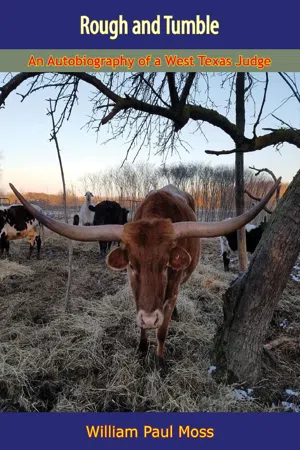
This is the autobiography of West Texas judge William Paul Moss, which was first published in 1954, and predominantly explores his youthful adventures on his ranches in Texas and New Mexico, where he loved to raise cattle and hunt. Judge Moss describes his life as having consisted of three parts: cattle, law, and oil. In describing his job as a judge, he portrays himself as a conscientious lawyer and judge and proclaims his love for his adopted city and state, observing that "the judge passes upon all questions of law, subject to the right of appeal to the appellate courts." His jurisdiction included both civil and criminal matters. Though not required by law he would appoint lawyers for those who could not afford them. Moss believed that a judge should try "to make his courthouse into a temple of justice" and he believed this involved keeping his mind "on the spirit of the law rather than its technicalities." He observed: "A country judge is, in many respects, like a country lawyer. He has to know a little bit about everything. There are times when he may not even know much about the law."
Information
Subtopic
Social Science BiographiesIndex
Social Sciences1
THEY say that if you see Naples in Italy, you can die. Not having seen that city, it is difficult for me to say whether it would cause me any death.
But there should be another unwritten law: that if you see Texas, you want to live. And if you’ve never seen Texas, then you needn’t go on living, for you don’t know what living is really like.
They were talking about Sam Houston and a place called the Alamo when I was introduced to the world. Texans didn’t know, then, that they were soon to be given a replacement. Well, they still talk about the Alamo, but they haven’t yet discovered the replacement. However, I’ve discovered just what Sam Houston was fighting for. Texas is like anything else. You come there hoping to take it in your stride. After a while you learn that Texas has taken you in its stride, and brother, where I come from, that’s a pretty big honor.
Ever since I can remember, I’ve been struggling. I was always going around with a chip on my shoulder, looking for someone with a bigger one to knock mine off. That spirit—to face great odds without fear—seems to have reached out, and the tail end of it is tied to the westernmost part of Texas. Perhaps that’s why I claim that if you see Texas you want to live...and although I may be a bit biased (since Texas, big and brawling, and myself have a lot in common) I reckon you’ll be agreeing with me before this is all over.
I remember that when I was a child they gave me a great big toy Easter egg for a birthday gift. You open up the biggest egg and inside find a smaller one. You keep on until you reach the last egg—and within its tiny enclosure you find a bit of gold. That, too, lived within me, and when I first explored Texas, it was like opening up the egg again. Only here the gold was mine, all around me.
If the chip were still on my shoulder I would say that I discovered Odessa; but for propriety, let’s say it discovered me. The streets aren’t paved with gold...they don’t need to be. When I first came to Ector County, in the extreme west of Texas, there wasn’t much of an Odessa. There wasn’t much of me, either, but with the years we’ve grown to love each other and, like anything else you love, it’s hard to be away from.
I don’t usually tell this to everybody. I’ve lived here so long on my ranch that people generally come to regard me as native-born. But North Carolina has that distinction. (And it is Western North Carolina, at that.)
The little farm that was my playroom was nothing pretentious. We raised mostly wheat, rye, and vegetables. There was cabbage because Grandpa Moss had a fondness for it which he tried to force on me, but my belligerent nature wouldn’t permit it. There were a few hogs, and after they were taken care of, I used to roam the limits of my little world. Grandpa has long since gone...so have a lot of other things. But if you go down near Tusquitee Valley and ask for Preacher Moss’s site (he was a part-time Baptist missionary), you can still see the Hiawassee River. It flows out of North Georgia through the county of Towns, winds its way through the Unaka Mountains, which separate North Carolina and Tennessee (Sam Houston’s birthplace), and flows on until it becomes a part of the Tennessee River.
We were located right smack cadab in the center of Tusquitee Valley. Grandpa helped build a road over the mountains to the east and grabbed himself about seven hundred acres of land. Somehow we lost a couple of acres during a transaction when the land was shared with his son, my father. But there were no regrets, since we had what they call first and second bottom land. The first bottom joined the creek on the south; the second, which was no more than a few acres, was on the tableland—a flat place overlooking the first bottom.
I always suspected Grandpa of pulling a fast one on me. He never failed to go searching for lost souls during the hottest summers or the coldest winters. Invariably some parishioner would rebuke him for venturing out in such weather and invite him to stay over for at least a week or two until it was again fit for him to go in the way of the Lord. And if it was winter while he was saving souls, he ignored the one he almost lost—the one he left behind to feed the hogs and milk the cows. If ever my shoulder chip was begging to be knocked off it was when the milk squirted in the pot while the cow flicked her tail in my face. I think now I understand that she suffered, too—the discomfort of icy fingers. If she could have understood the oaths that accompanied each predawn visit, she would have blushed; that is, if animals have a sense of decency.
But I loved Grandpa, for all his ways, and he did right by all his children. When he died and Papa took his place in the missionary field, Papa was alert enough to ease my burdens during the winters.
Papa married Mama rather late in life; but you must remember that in those days, eighteen for a girl was considered old-maidish, and many a father had turned twenty by the time his second child was born. You never saw two people who had so much in common. They loved their home, their family, their crops—but when it came to God, well, Mama was a Methodist and paid the Methodist preacher. Papa was a Baptist and paid the Baptist preacher. The Baptist church was just across the draw, east of where we lived, the Methodist, up the valley, perhaps a mile and a quarter east of the Baptist one. Naturally, each Sunday Mama went her way and Papa his. Whenever in a bad mood (which was rare) Mama would say: “Paulie, I guess when your father and I get to Heaven, he’ll go to one end and I’ll be at the other.”
But from what I know of Grandpa, he would probably have joined them together or kicked them both out.
Our pride and happiness couldn’t be equalled by any other family in that region or anywhere else in the country—that is, except Texas, where people are happier than any other place. You’ll soon find out why.
Now, my parents had just about everything there is to have in common. Both had ancestors who fought in the Revolutionary War and distant uncles who fell when the Confederacy did.
I can still hear Mama saying to Papa, on a churchgoing day, when he was trying to win her over to his side: “I guess your stubbornness must come from a Yankee. Are you sure one of your ancestors didn’t sneak out of battle to marry a Northerner?”
“Thunderation, woman!” Papa would fling down his black tie. “There wasn’t a Moss made to run away from anything! And a good Moss knows a bad wife when he sees one.”
That usually settled the argument because it was, in a way, a compliment meaning that Papa had agreed to a good choice in his marriage.
We did everything systematically. We raised a few mule colts every year. We took them south to the cotton fields beyond the mountains—sometimes far south of Atlanta, Georgia, where a good market was always open. It was a long walk, I admit, but I always reasoned that if the mule didn’t mind, why should I? And he was the one being sold. This was about the only length of reasoning my five-year-old mind would admit to. Otherwise I was as tough and rough as they came...wanting something but not being able to point it out. When we settled in Odessa some years later, the yearning ceased. There was nothing else I could want, anyway, when I let Texas take me.
Mama always used to say I had inherited Papa’s stubbornness. But she had a stubborn streak in her, too, and combined with that of Papa’s—you can see how it affected me.
Word used to spread throughout the house. “Mama’s mad,” Rosa, the first child and my only elder sister, used to warn me. That was a signal to be on our toes, and often Papa was grateful for the warning signals we kids used to spread.
Thaddeus Augustus Moss was a proud father. And Amanda Holden (Mama’s maiden name) also had a right to be proud. After Rosa was born, Augustus came into the world sickly and weak. There was no denying that he would die. Then I was born, to be followed by Leila, Samuel, Lenna, Henry, and John.
Every family has a favorite son or daughter. Usually it is either the first, who has priority over the others and naturally receives the best attention since he is something new; or it is the youngest. By the time John was born, the novelty had worn off and he received little, if any, attention. But I guess the grief and sorrow of losing Augustus was so deep that when I came they lavished all attentions upon me. Even Rosa did. So you can see that I was like two children in the house, receiving double of everything. But it didn’t spoil me. It made me more ambitious than ever.
And from the time they gave me that big Easter egg, I started to look for something...but couldn’t quite grasp what it was. The Golden City, as we call Odessa, was waiting for me, taunting and teasing me. But how was a child of sue supposed to know what his longing meant?
2
PEOPLE say that living in the 1800’s was not quite as hectic as it is today; that there was comparatively little to know about anything....You just planted your seeds, raised your livestock, tended to the house, went to church on Sunday (or two churches, as it was with Mama and Papa), and attended socials when they were held.
But to a little boy, learning is a difficult process. Especially when you’re being taught one thing and your mind is on something of a different nature. And for me life was very difficult, hectic—almost brutal.
School started out rather slowly at first. A small person, I received little attention except when called upon to recite. Then, like all little people, old and young, I felt every eye in the schoolroom upon me.
The one-room log schoolhouse was presided over by J. V. A. Moore. The school no longer exists. Mr. Moore does, and more so than ever. In some ways he understood that I was restless, being compelled to learn such useless things as ABC’s when my mind was on something else. But though he was firm and patient, without the threat of Mama’s spankings at the end of the day, I might never have made it.
Each morning, five days a week, I would trudge down a dirt path to the home of Minnie, a cousin. (Actually she wasn’t a cousin, but she was the daughter of a man named Patterson who had married one of my aunts. My aunt was his second wife, so out of due respect we called Minnie “cousin.”) From her home we would walk together until we crossed the Tusquitee Creek on a creaky footbridge in the usual slow manner of a child when what awaits him is not very pleasing.
The first day was not too bad. The usual Blueback Speller was given us, and I made out fairly well. Mr. Moore was patient, as I have pointed out, and my sharpness for learning increased when the Blueback was used by Mama—in a slightly different motion from that of holding it.
Like all mothers, she was impatient for her son to grow up to become the pride of the family. She fairly ran to me when she saw my red thatch in the distance, as I came along swinging a dinner pail in one hand and the Blueback in the other.
“Well, Paulie,” she would gasp excitedly, “what did you learn today? Did you like it?”
“Oh...lots of things. All about the Honeymaker, the Brokeback Man and the Snake—the Crooked Man. I learned all about it.” My bragging nature had asserted itself, but Mama, inclined toward doubt, pressed further.
“Oh? What is the Honeymaker? Tell me all about it.”
“Don’t know.”
“The Brokeback Man?” She was removing her smile.
“Well...”
“And the Crooked Man? The one you know all about?”
No answer.
If some of the other children had been around, I might have asked her: “Why ask me? Don’t you know?” But showing off is of little use unless there is somebody around to revel in the delight, too. So I kept my peace...luckily, as I was later to find out.
So you can see that the 1800’s, just before they bowed out to the 1900’s, were as confusing and difficult to me as was anything else after that.
We had few amusements in those days. At school, during recess, if the weather was right, we would go outdoors and play marbles. But it was not the way most boys play it today. We used to make a square and place a middle-sized marble at each of the four corners. A larger marble, the middleman, would go in the center. Then we would back away to a line and shoot a marble at the corner ones, with the middleman as the main target.
The climax came when the middle marble and the four corner ones were all knocked out. That would signify the end, and we would begin all over again. Being younger than the others, and rather smaller, I deemed it a privilege to play with the older ones—for them, that is; I think they understood. In any case they never hesitated to let me join in. I always tried to show off and take those around me into my confidence. It wouldn’t work today, but remember, this was the late 1800’s, when we had more time to think than we do now.
Sometimes a girl or two would suggest that we play outfield ball. Here a ball bat would be held firmly by a boy waiting for a ball to fly. If he struck it, the crowd made a mad scramble for it, and whoever caught it would be considered more important by the boys and sort of a hero by the girls. We had no television, no cowboy radio crooners, no jukeboxes to listen to; the nearest thing to a hot rod was an untamed mule. And here the fun would be to get him to start, rather than to stop, as in the case of a hot rod. But we had a way of enjoying ourselves through the use of pure imagination. Most kids today seriously lose out in this respect.
Mr. Moore, the teacher, was a pretty swell guy when you got right down to it. Stern and strict in many ways, he had his human side, too. When some of the older girls stood up to recite, he looked kinda pleasant at them, with a slight sparkle in his eye.
The Mosses on my father’s side felt happy that he attended their church. And I recall once seeing him pass a note to a young lady in the pew before him. Later I understood it was to ask if he might walk home with her. For a moment I thought it would be wonderful to tell all the others at school that their teacher and mine had found a wife in the church that my gr...
Table of contents
- Title page
- TABLE OF CONTENTS
- 1
- 2
- 3
- 4
- 5
- 6
- 7
- 8
- 9
- 10
- 11
- 12
- 13
- 14
- 15
- REQUEST FROM THE PUBLISHER
Trusted by 375,005 students
Access to over 1.5 million titles for a fair monthly price.
Study more efficiently using our study tools.
Frequently asked questions
Yes, you can cancel anytime from the Subscription tab in your account settings on the Perlego website. Your subscription will stay active until the end of your current billing period. Learn how to cancel your subscription
No, books cannot be downloaded as external files, such as PDFs, for use outside of Perlego. However, you can download books within the Perlego app for offline reading on mobile or tablet. Learn how to download books offline
Perlego offers two plans: Essential and Complete
- Essential is ideal for learners and professionals who enjoy exploring a wide range of subjects. Access the Essential Library with 800,000+ trusted titles and best-sellers across business, personal growth, and the humanities. Includes unlimited reading time and Standard Read Aloud voice.
- Complete: Perfect for advanced learners and researchers needing full, unrestricted access. Unlock 1.5M+ books across hundreds of subjects, including academic and specialized titles. The Complete Plan also includes advanced features like Premium Read Aloud and Research Assistant.
We are an online textbook subscription service, where you can get access to an entire online library for less than the price of a single book per month. With over 1.5 million books across 990+ topics, we’ve got you covered! Learn about our mission
Look out for the read-aloud symbol on your next book to see if you can listen to it. The read-aloud tool reads text aloud for you, highlighting the text as it is being read. You can pause it, speed it up and slow it down. Learn more about Read Aloud
Yes! You can use the Perlego app on both iOS and Android devices to read anytime, anywhere — even offline. Perfect for commutes or when you’re on the go.
Please note we cannot support devices running on iOS 13 and Android 7 or earlier. Learn more about using the app
Please note we cannot support devices running on iOS 13 and Android 7 or earlier. Learn more about using the app
Yes, you can access Rough and Tumble by William Paul Moss in PDF and/or ePUB format, as well as other popular books in Social Sciences & Social Science Biographies. We have over 1.5 million books available in our catalogue for you to explore.