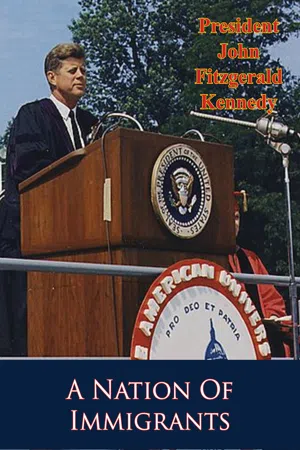
President John F. Kennedy's final book, A Nation of Immigrants, is a most worthy and relevant contribution to the contemporary debate on immigration reform.
Throughout his presidency, John F. Kennedy was passionate about the issue of immigration reform. He believed that America is a nation of people who value both tradition and the exploration of new frontiers, people who deserve the freedom to build better lives for themselves in their adopted homeland. This modern edition of his posthumously published, timeless work—offers the late president's inspiring suggestions for immigration policy and presents a chronology of the main events in the history of immigration in America.
As continued debates on immigration engulf the nation, this paean to the importance of immigrants to our nation's prominence and success is as timely as ever.-Print Ed.
"In this book, President Kennedy tells us what immigrants have done for America, and what America has done for its immigrants. It is one of the dramatic success stories of world history....It can stand as a testament to a cause President Kennedy cherished, and which we should carry on."—ROBERT F. KENNEDY
- 88 pages
- English
- ePUB (mobile friendly)
- Available on iOS & Android
eBook - ePub
A Nation Of Immigrants
About this book
Information
Topic
GeschichteCHAPTER 1—A NATION OF NATIONS
On May 11, 1831, Alexis de Tocqueville, a young French aristocrat, disembarked in the bustling harbor of New York City. He had crossed the ocean to try to understand the implications for European civilization of the new experiment in democracy on the far side of the Atlantic. In the next nine months, Tocqueville and his friend Gustave de Beaumont traveled the length and breadth of the eastern half of the continent—from Boston to Green Bay and from New Orleans to Quebec—in search of the essence of American life.
Tocqueville was fascinated by what he saw. He marveled at the energy of the people who were building the new nation. He admired many of the new political institutions and ideals. And he was impressed most of all by the spirit of equality that pervaded the life and customs of the people. Though he had reservations about some of the expressions of this spirit, he could discern its workings in every aspect of American society—in politics, business, personal relations, culture, thought. This commitment to equality was in striking contrast to the class-ridden society of Europe. Yet Tocqueville believed “the democratic revolution” to be irresistible.
“Balanced between the past and the future,” as he wrote of himself, “with no natural instinctive attraction toward either, I could without effort quietly contemplate each side of the question.” On his return to France, Tocqueville delivered his dispassionate and penetrating judgment of the American experiment in his great work Democracy in America. No one, before or since, has written about the United States with such insight. And, in discussing the successive waves of immigration from England, France, Spain and other European countries, Tocqueville identified a central factor in the American democratic faith:
“All these European colonies contained the elements, if not the development, of a complete democracy. Two causes led to this result. It may be said that on leaving the mother country the emigrants had, in general, no notion of superiority one over another. The happy and powerful do not go into exile, and there are no surer guarantees of equality among men than poverty and misfortune.”
To show the power of the equalitarian spirit in America, Tocqueville added: “It happened, however, on several occasions, that persons of rank were driven to America by political and religious quarrels. Laws were made to establish a gradation of ranks; but it was soon found that the soil of America was opposed to a territorial aristocracy.”
What Alexis de Tocqueville saw in America was a society of immigrants, each of whom had begun life anew, on an equal footing. This was the secret of America: a nation of people with the fresh memory of old traditions who dared to explore new frontiers, people eager to build lives for themselves in a spacious society that did not restrict their freedom of choice and action.
Since 1607, when the first English settlers reached the New World, over 42 million people have migrated to the United States. This represents the largest migration of people in all recorded history. It is two and a half times the total number of people now living in Arizona, Arkansas, Colorado, Delaware, Idaho, Kansas, Maine, Montana, Nevada, New Hampshire, New Mexico, North Dakota, Oregon, Rhode Island, South Dakota, Utah, Vermont and Wyoming.
Another way of indicating the importance of immigration to America is to point out that every American who ever lived, with the exception of one group, was either an immigrant himself or a descendant of immigrants.
The exception? Will Rogers, part Cherokee Indian, said that his ancestors were at the dock to meet the Mayflower. And some anthropologists believe that the Indians themselves were immigrants from another continent who displaced the original Americans—the aborigines.
In just over 350 years, a nation of nearly 200 million people has grown up, populated almost entirely by persons who either came from other lands or whose forefathers came from other lands. As President Franklin D. Roosevelt reminded a convention of the Daughters of the American Revolution, “Remember, remember always, that all of us, and you and I especially, are descended from immigrants and revolutionists.”
Any great social movement leaves its mark, and the massive migration of peoples to the New World was no exception to this rule. The interaction of disparate cultures, the vehemence of the ideals that led the immigrants here, the opportunity offered by a new life, all gave America a flavor and a character that make it as unmistakable and as remarkable to people today as it was to Alexis de Tocqueville in the early part of the nineteenth century. The contribution of immigrants can be seen in every aspect of our national life. We see it in religion, in politics, in business, in the arts, in education, even in athletics and in entertainment. There is no part of our nation that has not been touched by our immigrant background. Everywhere immigrants have enriched and strengthened the fabric of American life. As Walt Whitman said,
“These States are the amplest poem,
Here is not merely a nation but
a teeming Nation of nations.”
To know America, then, it is necessary to understand this peculiarly American social revolution. It is necessary to know why over 42 million people gave up their settled lives to start anew in a strange land. We must know how they met the new land and how it met them, and, most important, we must know what these things mean for our present and for our future.
CHAPTER 2—WHY THEY CAME
Little is more extraordinary than the decision to migrate, little more extraordinary than the accumulation of emotions and thoughts which finally leads a family to say farewell to a community where it has lived for centuries, to abandon old ties and familiar landmarks, and to sail across dark seas to a strange land. Today, when mass communications tell one part of the world all about another, it is relatively easy to understand how poverty or tyranny might compel people to exchange an old nation for a new one. But centuries ago migration was a leap into the unknown. It was an enormous intellectual and emotional commitment. The forces that moved our forebears to their great decision—the decision to leave their homes and begin an adventure filled with incalculable uncertainty, risk and hardship—must have been of overpowering proportions.
Oscar Handlin, in his book The Uprooted, describes the experience of the immigrants:
“The crossing immediately subjected the emigrant to a succession of shattering shocks and decisively conditioned the life of every man that survived it. This was the initial contact with life as it was to be. For many peasants it was the first time away from home, away from the safety of the circumscribed little villages in which they had passed all their years. Now they would learn to have dealings with people essentially different from themselves. Now they would collide with unaccustomed problems, learn to understand alien ways and alien languages, manage to survive in a grossly foreign environment.”
Initially, they had to save up money for passage. Then they had to say good-bye to cherished relatives and friends, whom they could expect never to see again. They started their journey by traveling from their villages to the ports of embarkation. Some walked; the luckier trundled their few possessions into carts which they sold before boarding ship. Some paused along the road to work in the fields in order to eat. Before they even reached the ports of embarkation, they were subject to illness, accidents, storm and snow, even to attacks by outlaws.
After arriving at the ports, they often had to wait days, weeks, sometimes months, while they bargained with captains or agents for passage. Meanwhile, they crowded into cheap lodging houses near the quays, sleeping on straw in small, dark rooms, sometimes as many as forty in a room twelve by fifteen feet.
Until the middle of the nineteenth century the immigrants traveled in sailing vessels. The average trip from Liverpool to New York took forty days; but any estimate of time was hazardous, for the ship was subject to winds, tides, primitive navigation, unskilled seamanship and the whim of the captain. A good size for the tiny craft of those days was three hundred tons, and each one was crowded with anywhere from four hundred to a thousand passengers.
For the immigrants, their shipboard world was the steerage, that confined space below deck, usually about seventy-five feet long and twenty-five feet wide. In many vessels no one over five and a half feet tall could stand upright. Here they lived their days and nights, receiving their daily ration of vinegar-flavored water and trying to eke out sustenance from whatever provisions they had brought along. When their food ran out, they were often at the mercy of extortionate captains.
They huddled in their hard, cramped bunks, freezing when the hatches were open, stifling when they were closed. The only light came from a dim, swaying lantern. Night and day were indistinguishable. But they were ever aware of the treacherous winds and waves, the scampering of rats and the splash of burials. Diseases—cholera, yellow fever, smallpox and dysentery—took their toll. One in ten failed to survive the crossing.
Eventually the journey came to an end. The travelers saw the coast of America with mixed feelings of relief, excitement, trepidation and anxiety. For now, uprooted from old patterns of life, they found themselves, in Handlin’s phrase, in a prolonged state of crisis—crisis in the sense that they were, and remained, unsettled.” They reached the new land exhausted by lack of rest, bad food, confinement and the strain of adjustment to new conditions. But they could not pause to recover their strength. They had no reserves of food or money; they had to keep moving until they found work. This meant new strains at a time when their capacity to cope with new problems had already been over-burdened.
There were probably as many reasons for coming to America as there were people who came. It was a highly individual decision. Yet it can be said that three large forces—religious persecution, political oppression and economic hardship—provided the chief motives for the mass migrations to our shores. They were responding, in their own way, to the pledge of the Declaration of Independence: the promise of life, liberty and the pursuit of happiness.”
The search for freedom of worship has brought people to America from the days of the Pilgrims to modem times. In our own day, for example, anti-Semitic and anti-Christian persecution in Hitler’s Germany and the Communist empire have driven people from their homes to seek refuge in America. Not all found what they sought immediately. The Puritans of the Massachusetts Bay Colony, who drove Roger Williams and Anne Hutchinson into the wilderness, showed as little tolerance for dissenting beliefs as the Anglicans of England had shown to them. Minority religious sects, from the Quakers and Shakers through the Catholics and Jews to the Mormons and Jehovah’s Witnesses, have at various times suffered both discrimination and hostility in the United States.
But the very diversity of religious belief has made for religious toler...
Table of contents
- Title page
- TABLE OF CONTENTS
- PICTURE CREDITS
- CHAPTER 1-A NATION OF NATIONS
- CHAPTER 2-WHY THEY CAME
- CHAPTER 3-WAVES OF IMMIGRATION-THE PRE-REVOLUTIONARY FORCES
- CHAPTER 4-WAVES OF IMMIGRATION-THE POST-REVOLUTIONARY FORCES
- CHAPTER-THE IMMIGRANT CONTRIBUTION
- CHAPTER 6-IMMIGRATION POLICY
- CHAPTER 7-WHERE WE STAND
Trusted by 375,005 students
Access to over 1.5 million titles for a fair monthly price.
Study more efficiently using our study tools.
Frequently asked questions
Yes, you can cancel anytime from the Subscription tab in your account settings on the Perlego website. Your subscription will stay active until the end of your current billing period. Learn how to cancel your subscription
No, books cannot be downloaded as external files, such as PDFs, for use outside of Perlego. However, you can download books within the Perlego app for offline reading on mobile or tablet. Learn how to download books offline
Perlego offers two plans: Essential and Complete
- Essential is ideal for learners and professionals who enjoy exploring a wide range of subjects. Access the Essential Library with 800,000+ trusted titles and best-sellers across business, personal growth, and the humanities. Includes unlimited reading time and Standard Read Aloud voice.
- Complete: Perfect for advanced learners and researchers needing full, unrestricted access. Unlock 1.5M+ books across hundreds of subjects, including academic and specialized titles. The Complete Plan also includes advanced features like Premium Read Aloud and Research Assistant.
We are an online textbook subscription service, where you can get access to an entire online library for less than the price of a single book per month. With over 1.5 million books across 990+ topics, we’ve got you covered! Learn about our mission
Look out for the read-aloud symbol on your next book to see if you can listen to it. The read-aloud tool reads text aloud for you, highlighting the text as it is being read. You can pause it, speed it up and slow it down. Learn more about Read Aloud
Yes! You can use the Perlego app on both iOS and Android devices to read anytime, anywhere — even offline. Perfect for commutes or when you’re on the go.
Please note we cannot support devices running on iOS 13 and Android 7 or earlier. Learn more about using the app
Please note we cannot support devices running on iOS 13 and Android 7 or earlier. Learn more about using the app
Yes, you can access A Nation Of Immigrants by President John F. Kennedy in PDF and/or ePUB format, as well as other popular books in Geschichte & Amerikanische Bürgerkriegsgeschichte. We have over 1.5 million books available in our catalogue for you to explore.